![]() Part One: Wearables for Healthcare
Part One: Wearables for Healthcare![]()
Chapter 1
Wearables and the IoT for Healthcare
Introduction
As an industry, healthcare is notoriously resistant to change, and in the realm of clinical information, this limitation is felt most acutely. Traditionally, enterprise information has been sequestered in silos, and distributed among a carefully controlled circle of stakeholders. This failure to leverage the power of shared information has had consequences that can be directly traced to excess cost and uneven quality. It’s been the Achilles heel of the industry - but today real foundational change is taking place in the application of healthcare information. It’s a vast, sweeping tide of innovation – medical product and clinical process innovation, finance and delivery model innovation, and stakeholder participation innovation – all based on information liquidity.
There are seminal moments in the evolution of healthcare – think the invention of the stethoscope, the discovery of penicillin, cracking the genetic code. We’re in such a moment today, and the organizing principle of this current wave is data driven, digital transformation. Through technology, healthcare information is becoming more granular, more liquid, more relevant, and is being employed with greater efficiency and effectiveness.
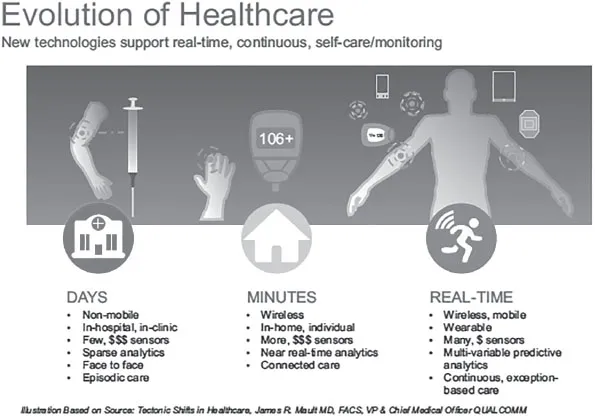
We’re entering the third wave of digital healthcare. The First wave, dating back to the mid 90’s, was about the Internet and connectivity. The Second, more recent wave of the 00’s has been dominated by mobility. And the Third wave, currently underway, is about personalizing healthcare. It’s about trends like the quantified self and the increasing awareness of the consumer that they are the stewards of their own health.
It’s also about software, mobile platforms and the power of data to not only intervene earlier but to intuit health issues before they occur. For providers, it’s about employing technology solutions to close the gaps in care delivery, about extracting greater value from data, and delivering real results against healthcare’s triple aim — improving the experience of care, improving the health of populations, and reducing per capita costs of health care.
Wearable and nearable technologies are integral to this third wave of digital medicine. Wearables – the Wristbands, monitors, and an ever widening assortment of purpose built wearable devices like the smart contact lens and the smart bra (no, not a misprint…), are recalibrating where and how healthcare occurs. They remove the complexities and inefficiencies of facility based care and replace traditional, hidebound delivery processes and venues with on-demand, self-directed diagnostics and personalized therapeutics. And nearables – small, wireless devices equipped with sensors that work as transmitters of data – are incubating healthcare’s Internet of Things.
Communicative biomedical sensors/biosensors and wearable integrated systems are major disruptors to traditional care. And at the cutting edge of these sensor technologies are implantables. These devices – often micro devices – are going to change our relationship with technology. With the introduction of implantables, we’re traversing a path from isolated content to connected experiences ranging from patient wellness to diagnosis, monitoring and adherence. Persistent, intuitive, and invisible, these devices are personal health coaches, diagnostic monitors and treatment managers. They mitigate the human element that is at the heart of noncompliance (which according to the CDC costs the U.S. $300 Billion annually), and they integrate with mobile devices and provider systems, delivering ever-granular insights into our daily health. They promote a collaborative provider-patient dialogue and preempt expensive, invasive treatments. Implantables are being developed to address a host of health conditions - Smart pills that monitor and wirelessly transmit biomedical data to providers and alerts patients to take their meds, a dime-sized chip that allows your doctor to continually monitor your vitals, a “bionic eye” that allows the blind to see, a cardioverter-defibrillator that treats sudden heart attacks, “hearables” - the list keeps growing. The promise of implantables is this: healthcare technology will become increasingly commoditized, connected, minimally invasive, and creates new treatments, changes behaviors, and introduces an immersive provider-patient relationship.
Collectively, wearables, nearables and implantables are sourcing a quantum leap forward in healthcare’s personalization and efficiency. New research indicates that digital health solutions will save the American healthcare system more than $100 billion over the next four years, and FDA-approved health solutions (33 in 2014, over 100 by 2018) are changing the patient-provider dynamic, raising consumer awareness, accountability, and engagement.
Wearables represent a huge proportion of that growth. According to an IDC report, consumers and businesses will buy nearly 112 million wearable computer devices by 2018, a 78.4% growth rate from 2014’s predicted sales of about 19 million units – and most of these gadgets fall in the realm of health-related devices. [ http://www.fool.com/investing/general/2014/07/09/who-stands-to-benefit-when-healthcarewearables-ar.aspx?source=iaasitlnk0000003]
But is this upsurge in wearable adoption really new? Many people have been living with pacemakers, cochlear implants, implanted biochips, and other medical devices for many years. What’s new is a consumer trend that allows healthy individuals to take personal responsibility for their health coupled with more powerful, cheaper devices. Wearable technologies provide new insights into the lives of their users. They activate consumer self-awareness, and promote “actionable” conversations with a care circle – providers, family and friends. And now wearable technologies are growing beyond personal wellness to become more clinically focused – for chronic disease monitoring and for data integration with enterprise systems.
There is also a subtle but influential human factor in play: the culture of healthcare delivery is changing as providers and patients become comfortable with personalized devices, with an electronic dialogue and with the efficiency and convenience of virtual medicine in an already stretched industry. But this cultural shift is not principally defined by access - wearables provide a foundation for “always on, all about me” stakeholder partnerships that promote accountable, preventive care. Collectively, these trends are reordering the structure of the providerpatient relationship and increasingly positioning the consumer as their primary health manager.
Movie 2: Has the IoT and wearables changed the way you do your work? by Eric Topol https://vimeo.com/156567446
Whether worn on the wrist, head, foot, or body as a garment, or inside the body, wearable devices are being designed in every conceivable form factor, with convenience and utility in mind. Using sensors to measure various aspects of a patient’s health, wearable devices now offer richer, actionable data that extend beyond body diagnostics – they now can educate, alert and anticipate health issues. But wearables are not strictly a product play – these technologies are increasingly being integrated within a larger catalogue of mobile and Cloud platforms; enterprise systems, clinical workflows and consumer health solutions. With guidance from NIST, FDA and others we’re seeing an increase in device integration with the EHR, PHR, office systems and patient portals. Its’ here that wearables meet the Internet of Things (“IoT”). Apps that capture and interpret data, integrated enterprise and cloud data repositories, and the networks of these devices form the underlayment of Healthcare’s IoT. Enterprise systems offer some but not enough information about a patient’s health indications, and certainly not persistently. This is where wearables and the IoT fill a huge gap in care. Wearable technologies offer a huge opportunity to deliver actionable insights at the point of care, to monitor and intervene in patient health issues in real time, to circumvent the lack of interoperability imbedded into vendor systems, to improve diagnostic accuracy and promote patient engagement. Via the IoT, data generated from wearables can be streamed seamlessly to provider and enterprise systems and the Cloud, to paint a more complete picture of the patient’s condition, and prompt intervention. The Cloud is a key component of the IoT: it introduces a common platform to store and retrieve information and to network devices and systems; it is endlessly scalable; and it reduces – greatly reduces the barriers to entry for smaller enterprises.
To date, the wearable space has been a largely retail market, fueled by fitness and health related devices. But that market dynamic is changing, as new products appear and new payers enter. Gartner predicts that by 2018 through 2020, 25% of fitness monitors will be sold through non-retail channels—including gyms, wellness providers, insurance companies, employers, and weight loss clinics—at subsidized or no cost. http://www.informationweek.com/healthcare/mobile-and-wireless/wearables-carve-new-path-tohealth-in-2015/d/d-id/1318279
But beyond the fitness crowd, there is a shift in healthcare spending underway, revealing some interesting demographic trends. Millennials are becoming health “hackers” and fueling wearable diversification due partly to their skepticism about traditional medicine and their bias towards wellness. Seniors are becoming more activated in managing their health issues, and find wearable devices comfortable, convenient, affordable and effective. The increasing sophistication of wearable devices – sensors, trackers, monitors, and now implantables, are drawing a widening customer base– including the chronically ill, the caregiver and the aging in place among others.
Payers are also entering the fray. A shift to value-based reimbursement and incentives are creating a fertile ground for adoption of new business models and clinical approaches incorporating wearable solutions. In the thrust towards value based care and risk based contracting models like the Provider Sponsored Plan, Payers are beginning to covver member costs for wearable technologies if they are deemed medically necessary. The payback? Patient accountability, patient engagement, and patient (member) satisfaction) – and lest we forget, huge cost savings. Doctors will uncover new methods for the diagnosis and treatment of their patients, which will likely impact doctors’ relationships with the insurance companies who can accommodate wearables as well.
FDA-approved devices have already started to disrupt the traditional provider-patient dynamic, introducing shared accountability, earlier intervention, and better outcomes. In 2014, web-enabled medical devices increased treatment adherence and behavior modifications, while simultaneously decreasing urgent episodic medical care and costs totaling $6 billion. We’ve just scratched the surface of industry potential for the IoT and wearables.
— Rick Krohn
![]()
Chapter 2
Types of Wearables
Movie 3: Types of Wearables by Aenor Sawyer
https://vimeo.com/156568010
Editor’s Note
Whether worn on the wrist, head, foot, or body as a garment, wearable devices are being designed in every conceivable form factor, with conve...