Whenever people talk about dyslexia, it’s important to know that some of the smartest people in the world, major owners of companies, are dyslexic. We just see things differently, so that’s an advantage. I just learn a different way; there’s nothing bad about it.
(Charlotte McKinney, American model and actress)
The potential to excel
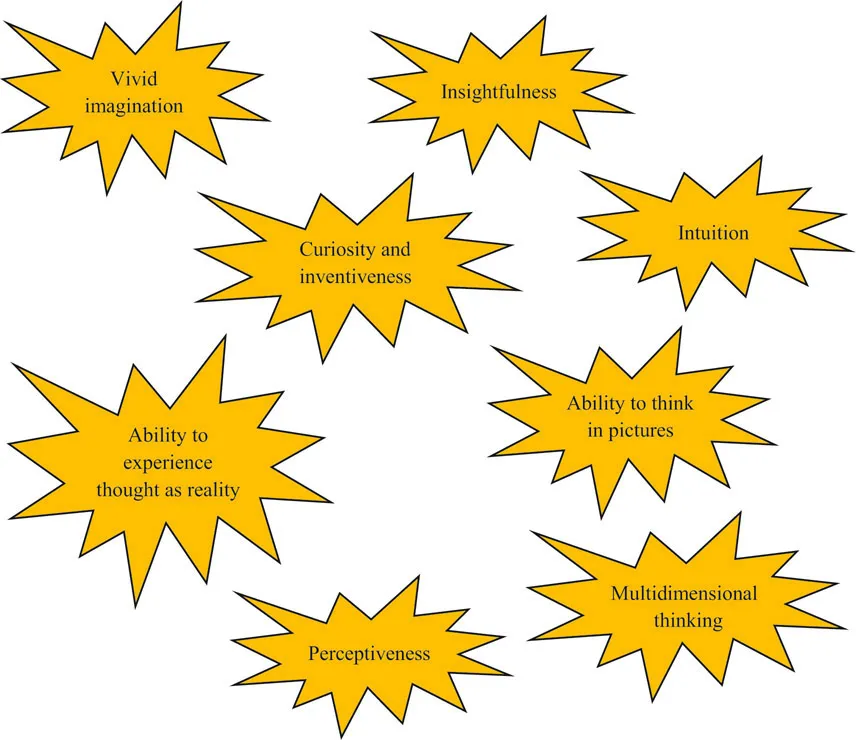
In the Foreword to the third edition of Ronald D. Davis’s famous book The Gift of Dyslexia (2010, p. xi), Linda Silverman highlights the ‘essential gifts of dyslexics’, these being:
As you have probably already noticed, however, the current pre-university education system (in the UK at least), with its focus on passing exams rather than learning, on hitting ‘Assessment Objectives’ and ‘Learning Outcomes’ rather than critical thinking and creativity, is simply not suited to the learning styles and ‘gifts’ of dyslexics. Indeed, you may well have had an enormous struggle to make it to university in the first place and feel as though your experience of education thus far has been stifling rather than enlightening. This is something that even Albert Einstein, himself a dyslexic, probably had in mind when he stated that ‘it is a miracle that curiosity survives formal education … Education is what remains after one has forgotten everything he learned in school’ (TheDyslexiaProject, 2017). Fortunately, university level study is rather different and gives you much more intellectual and creative space to spread your wings. Indeed, as Silverman points out, in today’s world student success (both within and beyond university), depends upon the
ability to see the big picture, to predict trends, to read customers, to think outside the box, to see patterns, to inspire collaboration among peers, to empathize, to synthesize information from a variety of sources, and to perceive possibilities from different perspectives. These are the natural talents of dyslexics.
(p. xi)
While these words are undoubtedly inspiring and hopeful, and have a profound relevance in a world which is seeing increasing amounts of complex and sometimes contradictory agendas, let us not get ahead of ourselves. A new battle awaits in the form of the higher intellectual demands associated with advanced study, whether this is as a first-year undergraduate, masters or doctoral student. Do not underestimate the challenges (which all students, not just those with dyslexia) face when ‘stepping up’ from ‘A’ levels, Access or International Baccalaureate to the first year of an undergraduate course. Indeed, you will need to ‘step up’ again as you transition from first year to second year, from second year to third year, from third year to masters, and from masters to doctorate. This may seem obvious, but in contrast to the non-dyslexic, this natural process of ‘stepping up’ also means that you need to develop increasingly sophisticated coping, learning and writing strategies so as to meet the higher demands placed on you as a result of your dyslexia (most notably in relation to difficulties associated with working memory, slower reading speeds and problems with sequencing and organising ideas). Unfortunately, nobody can wave a magic wand and make your dyslexia disappear. As such, what is required is the development and expansion of the coping strategies that have brought you this far to help you meet the new, advanced challenges. Remaining static, or relying on the coping strategies you have already developed are unlikely to work. Your dyslexia doesn’t mean that you cannot compete with your peers, or that the increasingly sophisticated coping strategies you need to develop mean that your progress will be slower or hindered in some way. Rather, the coping strategies proposed in this book harness and tap into your gifts as a visual and multidimensional thinker. By adopting them, you will not only cope at university but will thrive and excel.
Getting started – understanding the differences between writing at school/college and university
Studying and writing at university is very different from what you have probably encountered at school or college. While the International Baccalaureate does a better job of preparing students for university study, the traditional and currently more popular ‘A’ level or Access route is less helpful. Some of the key differences are as follows:
| ‘A’ level/Access | University |
| Taught, coached and mentored. | Emphasis is on independent learning. |
| Prescriptive (coursework titles are often chosen by the teacher or exam board, or if the student chooses it you are coached to create one which allows you to focus on meeting the exam boards’ very precise criteria). | Student increasingly autonomous and independent, minimal coaching/guidance. |
| Focused on fulfilling the exam boards’ very explicit criteria (‘Assessment Objectives’ – these are set in the UK by Office of Qualifications and Examinations Regulation (OFQUAL)). | Focused on articulating an argument that is engaged critically and creatively with the question. |
| Limited engagement with secondary reading. | Extensive, critical and evaluative engagement with secondary materials and theories. |
| Focused on exhibiting or achieving a specific aim or demonstrating a specific acquisition of knowledge rather than exhibiting wide ranging, critically perceptive knowledge of the discipline. | Critical evaluation, analysis and creativity/independent thinking. |
If you have studied for ‘A’ levels or an Access qualification, you’ll probably have already seen how these priorities are mapped onto the assessment criteria. Exam boards have to adhere to ‘Assessment Objectives’ defined by OFQUAL, and these are designed to provide teachers and examiners with a framework for assessing work in a fair, transparent and rigorous manner. These aims are entirely understandable, but what this often leads to is the student being taught how to ‘jump through hoops’ rather than gaining an in-depth knowledge of the subject. Indeed, as a former teacher of ‘A’ level English, I probably spent 80 per cent of my time teaching students how to meet ‘Assessment Objectives’ rather than teaching them about English. This results in rather formulaic, precise writing that is obsessed with hitting targets rather than exploring ideas. Let’s look at the following exemplar ‘A’ level literature essay that seeks to compare Shakespeare’s Hamlet with William Blake’s Songs of Innocence and Experience to see how this happens:
| Exemplar paragraph | Assessment objectives |
| One of the main themes around which the play pivots is Hamlet’s despair and alleged madness. In Act Three Scene One we find him uttering the now famous and thought-provoking line ‘To be, or not to be – that is the question;’ which initiates a bout of philosophical questioning concerning life and death. The definitive determiner ‘the’ emphasises the level of despair that Hamlet feels as it is ‘the question’; no other question matters. Moreover, ‘is’, the third person singular of ‘be’, reinforces the definitive determiner by preventing any possibility of modal questioning such as ‘might be the question’. Hamlet’s questions thus stand in sharp contrast to the rather more emotive, rhetorical questions Blake poses in relation to poverty, abuse and religion (such as ‘Is that trembling cry a song?’ in ‘Holy Thursday’ and in respect of child abuse, ‘are such things done on Albion’s shore?’ in ‘A Little Boy Lost’), although they clearly engage the reader in a similar form of self-examination as that encouraged by Hamlet and are perhaps intended to make the reader question not their life, but their conscience in relation to the ongoing suffering of children caught up in the exploitation of early industrial society. | AO1: Articulate informed, per sonal and creative responses to literary texts, using associated concepts and terminology, and coherent, accurate written expression
(Note – terminology is underlined)
AO2: Analyse ways in which meanings are shaped in literary texts
AO3: Demonstrate understanding of the significance and ... |