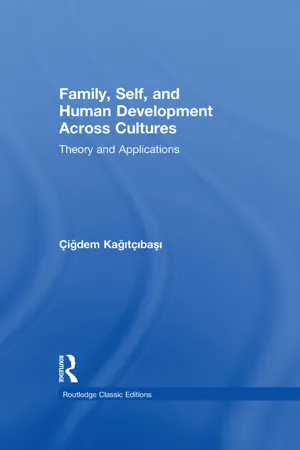
Çi?dem Ka??tç?ba??'s influential volume was a work of masterful scholarship and field-defining thought that challenged the existing assumptions in mainstream western psychology about the nature of individuals. During the past two decades since its publication, cultural and cross-cultural research and theory on the self, family, and human development have expanded greatly, developing fruitfully from the basic issues and paradigms Ka??tç?ba?? explored. This Classic Edition provides a critical assessment, consideration, and reflection of recent scholarship in this field. It brings this essential work up to date and appraises it in the light of current prevailing perspectives.
eBook - ePub
Family, Self, and Human Development Across Cultures
Theory and Applications
- 464 pages
- English
- ePUB (mobile friendly)
- Available on iOS & Android
eBook - ePub
About this book
Information
1
Introduction
ABOUT THIS VOLUME
What does this volume have to offer the reader? What is it about? It is about human development in family and cultural context. It is about the development of competence and the development of the self, two important spheres of human development. It is about patterns of similarities and differences in these spheres. It is also about systematic changes in family, self, and human competence in conjunction with social change and in particular with socioeconomic development. I first stress the variability that is notable in self and competence. However, I then look into commonality or lines of convergence that are apparent or that can be predicted, given the global changes in lifestyles that include common features, such as urbanization. Thus, this book attempts to provide an understanding into a number of complex and interrelated topics that are of importance to us all in our ever-changing global society. Additionally, it aims to shed light on these multifaceted human phenomena from a cultural and cross-cultural psychological perspective.
This book is about human development, self, and human relations within a cultural context. The development of human relations and the self is situated within the family and society. In my thinking, the links between the person, family and society are crucial for an understanding of global human psychology. On the other hand, this volume is also about the integration of theory and practice. Specifically, I make an attempt to find out whether a culturally sensitive conceptualization of individual–family–culture links has any relevance for applications and policies designed to promote human well-being.
So, there are two different types of linkages here that need some clarification from the beginning. The first one has to do with some of the intersections between the different levels of analysis—the individual (self), the group (family), and the larger context in which both exist (culture and society). The second one relates theory and application. It is a defining and possibly unique characteristic of this volume to pursue simultaneously both of these types of linkages that derive from different research traditions. Thus in this book, I attempt to integrate important topics not usually dealt with together, particularly theory and application.
To start with, I should also point out that this is a rather personal book. In several places throughout the volume, I make my views explicit; at times these are political outlooks. Thus, values come into the picture on some important issues, particularly regarding applied or policy-relevant matters. This “involved” stance is a distinguishing mark of the volume and is made clear in both the Preface and the Foreword to the First Edition. Indeed, the Preface and the Foreword constitute an essential part of the book in introducing it from my perspective and in providing an understanding into its main features; that is why they are retained in this second edition also.
Linking Self, Family, and Society
How do we link individual and society? This is an age-old goal of social philosophers and social scientists. From early on, recognition of the diversity of individual characteristics and interests brought forth the question, “How is social order possible?” (Allport, 1959). Many social theories have been devised to answer this question, but most important, the concept of culture has been construed to understand and make sense of the uniformity constructed out of diversity existing in human groups.
The links between individual and society have often been traced through middle-level contexts such as the family and child socialization. In this volume, I look into some aspects of family and family socialization within varying sociocultural contexts with a view to discovering their functional or causal links with human development. Thus, a contextual-developmental-functional approach is undertaken here that is also cultural and cross-cultural. It may be helpful at this point to briefly touch on these basic approaches that characterize my thinking in the field. They also constitute the defining features of this volume.
A Contextual Approach. The approach here is contextual in that the study of the person and human development automatically implicates the family as the context, and thus features the family explicitly in the conceptualization. Similarly, when the family is under focus, it is automatically situated in its sociocultural environment. This approach is very much in line with the original ecological orientation of Urie Bronfenbrenner (1979), with traces of the classical field theory of Kurt Lewin (1951), on the one hand, and with the later contextualist models, on the other (e.g., Featherman & Lerner, 1985; Hurrelmann, 1988; Lerner, 1998). Much thinking in cross-cultural psychology is also contextualistic, almost by definition, and the approach here is akin to the current theorizing in this field, particularly in dealing with human development (e.g. Berry, Poortinga, Seagall, & Dasen, 2002; Eckensberger, 1990; Gardiner & Kosmitzki, 2005; Greenfield & Cocking, 1994; Super & Harkness, 1994, 2002; Valsiner, 1989, 1994, 2000).
A Developmental Approach. The approach here is also developmental. This is because it is not enough to note or even to establish with some certainty differences across contexts. How these differences emerge is just as important for psychological inquiry. Increasingly the significance of a developmental approach is being recognized, and a developmental orientation is seen as inherently complementing a cross-cultural one (Bornstein & Bradley, 2003; Eckensberger, 1990; Jahoda, 1986; Keller & Greenfield, 2000; Rogoff & Morelli, 1989; R. B. Smith, Bond, & Kağıtçıbaşı, 2006; Valsiner, 1989). This is not to say that all cross-cultural work takes cognizance of developmental processes, but that the recognition of the need to do so is increasing. It is interesting to note in this context that in her invited address at the centennial convention of the American Psychological Association, Anne Anastasi (1992) pointed to the progress of cross-cultural psychology and life-span developmental psychology as the two most important developments of the last decades in psychology.
A Functional Approach. The present approach is functional because social and psychological adaptive mechanisms are invoked to explain why a particular type of development occurs, rather than another one. I should note, however, that the functional approach I use is not deterministic and allows for flexibility and feedback mechanisms. Adaptive mechanisms are used as clues to understand why self–family–culture linkages get established in particular ways, showing variability as well as similarity across cultures. In particular, the following basic questions figure importantly throughout the volume: Why does a certain type of human development occur in a particular family context, and why does that type of family occur in a particular type of socioeconomic–sociocultural context? Such questions address the adaptability of psychological processes and behaviors to (changing) environmental demands. The contextual, developmental, and functional approaches are elaborated where needed throughout the volume.
A Cultural and Cross-Cultural Approach. Finally, in forming the links among the self, family, and the larger sociocultural environment, I work from a cultural and cross-cultural perspective. A cultural approach is presupposed by contextualism, and a cross-cultural approach is required for the unambiguous interpretation of the observed cultural differences (Berry et al., 2002; Van de Vijver & Poortinga, 1990). To understand the functional relations among the society, the family, and the development of the self, the underlying dynamics need to be discovered. A cross-cultural comparative orientation provides the grounds for such an endeavor, as it supplies more variation than can be obtained in a single culture study (Berry et al., 2002; Rogoff, Gauvain, & Ellis, 1984; Segall, Dasen, Berry, & Poortinga, 1999). These basic approaches are elaborated further throughout the volume.
Linking Theory and Application
The second basic task I undertake in this volume is integrating theory and application. By application, I do not mean the individual-focused psychological practice that readily comes to mind, but rather the use of psychology in large-scale efforts to improve human well-being and to contribute to societal development. Psychologists’ contribution to development efforts focuses on its human aspects; therefore, any applied work would benefit from a knowledge of the cultural context in which human phenomena occur. Intervention attempts in the Majority World (see footnote 5 in the Preface to the First Edition) need to be especially sensitive to the human relations in the culture of relatedness (Kağıtçıbaşı, 1985a) prevalent in these societies. Thus, interventions may be expected to work better if they take into consideration and build upon the existing human connectedness, as reflected in closely knit family, kinship, and community ties, rather than counteracting them, for example, in building individualistic independence and competition.
The emphasis on applied research occupies a central place in my orientation to psychology (Kağıtçıbaşı, 1995, 2002b; see also the Preface to the First Edition). Theory that is not put to the test of application has limited utility, and applications not informed by theory tend to be haphazard and expensive “shots in the dark” that cannot be afforded, especially in the Majority World countries with limited resources. In other words, I believe that psychology need not choose between theory and scientific rigor on the one hand and relevance on the other; both are needed, and it is incumbent on the psychologist, especially on one who lives in the Majority World, to be involved in efforts to contribute to human well-being. Culturally sensitive and both “socially and scientifically responsible” (Drenth, 1991) psychological research can go a long way toward contributing to social development efforts (see the Preface to the First Edition).
In this book I present, in some detail, an applied research project that I have carried out with my colleagues in Istanbul, Turkey. I believe this study deserves attention for demonstrating both the integration of theory and practice on the one hand, and the potential of psychology for contributing to human development on the other. This is the Turkish Early Enrichment Project and its long-term follow-up studies that together spanned over a 22-year period. I attempt to bridge the gap between theory and application by using this applied research and program implementations deriving from it as a case in point. I also delve into applied issues in dealing with acculturation and immigration.
Finally, I give considerable attention to policy issues and policy relevance. This is a natural next step of a keen interest in the social applications of psychology. For psychological knowledge to contribute to large-scale applications, it should be policy relevant. In this book, the policy implications of the development of competence, early enrichment, and education, in particular, are examined.
A CULTURAL AND CROSS-CULTURAL PERSPECTIVE
The topics examined in this volume cover a wide scope and include extensive research and theory spanning the fields of cultural and cross-cultural psychology. I would like to give here a rather brief and general overview of the issues involved and examine the relevant concepts. My approach here is basically psychological, though I resort to anthropological and sociological conceptualizations, also, where appropriate.
The Culture Concept
Anthropologists have been studying culture from early on. It is often quoted that some 164 definitions of culture have been made (Kroeber & Kluckhohn, 1952). Obviously, there are different views about how best to conceptualize culture and what aspects to emphasize. Only recently, in 2005, there was a heated discussion in an online communication network of cross-cultural psychologists about how best to conceptualize culture. So the debate continues. There appears to be agreement, however, regarding its comprehensive nature. Thus, the following characterizations, and others, have been proposed: “traditional ideas and especially their attached values,” “the mass of learned behavior passing through generations,” “shared learned behavior and meanings that are socially transferred in life-activity settings,” “shared symbols and meanings,” “different experiences of groups that lead to predictable and significant differences in behavior,” “a ‘gestalt’ of ideas, practices, norms, and meanings that organize behavior as a system,” “a superordinate organizer with a pervasive influence on its constituent elements,” “a system, a set of interrelated and inextricably linked elements,” and “mental programming or software of the mind.”
Many psychologists tend to adopt Herskovits’s all-inclusive definition of culture as “the man-made part of the environment,” including both “physical culture” and “subjective culture” (subjective responses to what is human-made) (Triandis, 1980, p. 2). Various cultural conceptions have been elaborately discussed recently (e.g., Berry et al., 2002; Gardiner & Kosmitzki, 2005; Matsumoto, 2001b; Matsumoto & Juang, 2004; Segall et al., 1999).
Utilizing Culture in Psychological Research. The important point is situating the psychological phenomenon to be studied in its cultural context. This appears as “obvious” because we know that every human behavior is in response to some aspect of culture. Nevertheless, what appears to be obvious turns out to be less so when indeed an attempt is made to integrate culture into psychological analysis (Van de Vijver & Hutschemaekers, 1990).
First of all, the diffuse, all-inclusive nature of culture presents a problem in research. As a superordinate entity, it cannot serve as an explanation or an independent variable (Segall, 1983). Such explanations can turn into empty tautologies, such as “Chinese are this way because of their culture.” Thus, attempts have been made by psychologists to define culture in less molar and more molecular ways or to operationalize it (Poortinga, Van de Vijver, Joe, & Van de Koppel, 1987). In this more molecular conceptualization, culture is treated as a “set of conditions” (Segall, 1984), as quite different from culture as a system of meanings (Rohner, 1984). It has also been conceptualized as “shared constraints that limit the behavior repertoire available to members of a certain socio-cultural group” (Poortinga, 1992, p. 10).
Current experimental approaches, particularly in cross-cultural social psychology, “create” culture in the laboratory. This is done by priming certain cultural features, such as independence or interdependence, through experimental manipulations, and then the effects on behavior are examined (e.g. Gardner, Gabriel, & Lee, 1999; Kitayama, Markus, & Kurokawa, 2000; Kitayama, Markus, & Matsumoto, 1995; Kitayama, Markus, Matsumoto, & Norasakkunkit, 1997; A. Y. Lee, Aaker, & Gardner, 2000)....
Table of contents
- Cover
- Half Title
- Title Page
- Copyright Page
- Dedication
- Table of Contents
- Introduction to the Classic Edition
- Preface to the Second Edition
- Foreword
- Preface to the First Edition
- Chapter 1 Introduction
- Part I: Human Development, Family, and Culture
- Part II: Implications for Social Issues and Applications
- Glossary
- References
- Author Index
- Subject Index
Trusted by 375,005 students
Access to over 1.5 million titles for a fair monthly price.
Study more efficiently using our study tools.
Frequently asked questions
Yes, you can cancel anytime from the Subscription tab in your account settings on the Perlego website. Your subscription will stay active until the end of your current billing period. Learn how to cancel your subscription
No, books cannot be downloaded as external files, such as PDFs, for use outside of Perlego. However, you can download books within the Perlego app for offline reading on mobile or tablet. Learn how to download books offline
Perlego offers two plans: Essential and Complete
- Essential is ideal for learners and professionals who enjoy exploring a wide range of subjects. Access the Essential Library with 800,000+ trusted titles and best-sellers across business, personal growth, and the humanities. Includes unlimited reading time and Standard Read Aloud voice.
- Complete: Perfect for advanced learners and researchers needing full, unrestricted access. Unlock 1.5M+ books across hundreds of subjects, including academic and specialized titles. The Complete Plan also includes advanced features like Premium Read Aloud and Research Assistant.
We are an online textbook subscription service, where you can get access to an entire online library for less than the price of a single book per month. With over 1.5 million books across 990+ topics, we’ve got you covered! Learn about our mission
Look out for the read-aloud symbol on your next book to see if you can listen to it. The read-aloud tool reads text aloud for you, highlighting the text as it is being read. You can pause it, speed it up and slow it down. Learn more about Read Aloud
Yes! You can use the Perlego app on both iOS and Android devices to read anytime, anywhere — even offline. Perfect for commutes or when you’re on the go.
Please note we cannot support devices running on iOS 13 and Android 7 or earlier. Learn more about using the app
Please note we cannot support devices running on iOS 13 and Android 7 or earlier. Learn more about using the app
Yes, you can access Family, Self, and Human Development Across Cultures by Cigdem Kagitcibasi in PDF and/or ePUB format, as well as other popular books in Psychology & Developmental Psychology. We have over 1.5 million books available in our catalogue for you to explore.