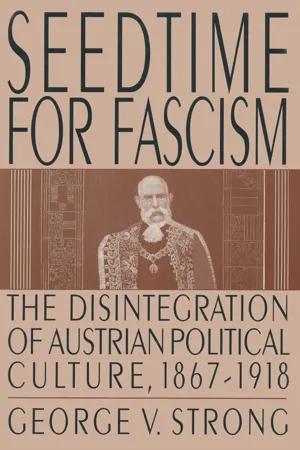
This study examines the political culture in Austria-Hungary in the latter half of the 19th century. It analyzes the centrifugal forces that arose from growing ethnic nationalism in the empire and that ultimately overpowered the centripetal forces which held the Austrian-Hungarian "state idea" together. The analysis is applied further to provide an historical explanation of analogous developments in post-1989 Europe.
Astudy of the political culture that took hold in Austria-Hungary after 1850 has relevance for Americans today in that the history of the Dual Monarchy may be viewed as a failed experiment by a state that attempted to sustain itself by reconstructing itself on the basis of its newly discovered cultural diversity. It needs no saying that today cultural diversity is an issue all Americans face. What this issue will bring to Americans cannot be foreseen. But old Austria, for her part, never found a formula whereby her diversity might be accommodated; granting its disparate parts civil recognition within a popular and liberal political framework brought about a fatal balkanization of the state as a whole, and so the state ultimately disintegrated into various combinations of its components under circumstances that robbed old Austria’s inhabitants of the fruits of her vibrant civilization.
There is yet another compelling reason why the workings of the Dual Monarchy during the era of Franz Joseph both fascinate and perplex historians. It would seem that almost every symptom of the societal ailments that bedeviled the European twentieth century (and indeed those who lived beyond Europe’s shores) was to be found enmeshed in the glitter and decadence of Austrian culture. On the political plane, one sees the rise of the prototype of modern mass political parties, fused along ideological lines and thereby creating a turgid and turbulent atmosphere founded on the politics of victimization and loud demands for the blood of scapegoats.1 One heard at the same time, often but not exclusively linked with this politicization of the masses, the sanguine rhetoric of prejudice on the basis of race and gender.2 One also heard voices calling for rough-hewn dictatorship as a solution to the seeming disintegration of things.3 It is not easy to overlook that the future führer of the Third Reich fabricated many of his preposterous views between the years 1907 and 1913 while walking the streets of Franz Joseph’s imperial city.4 Moreover, Benito Mussolini and both Lenin and Stalin knew Vienna before they made their dolorous appearances on Clio’s stage. It was in Vienna that Sigmund Freud destroyed the older assumptions of the fundamental perfectibility of human nature with his ideas of our primeval drives motivated by an insufficiently repressed subconscious; at least in the view of some, this rendered the belief in forgiveness and resurrection irrelevant to life, even relegating it to the dustbin as the superstition of an outworn past. Further, Vienna’s spheres of artistic creation, whether in drama, music, or art, witnessed challenges from experimental subgroups at least in part propelled by Freudian assumptions that, whatever their individual merits, generated immense antagonism and rippled through the many complex layers of Austrian society. And of course all this cacophony in the political, intellectual, and artistic spheres of activity was accompanied by social misery and individual degradation in both the agricultural and industrial sectors of Austrian life, generated by the impact of capital and technology as these destroyed the traditional ways of the old rooted communities. It would make a happy ending nonetheless if one could point to some signs of resolution out of these horrendous developments. But one cannot. The era of Franz Joseph ended in the most complete catastrophe: the outbreak of world war, in which young men once prized for being made in the image of God were transformed into common cannon fodder, and which led to the disintegration of the promises and potential not only of Austrian civilization but of Europe’s as well.5
These losses, it might be added, were an unintended result of the activities of a diverse mix of political reformers and dreamers, extending from Austrian socialists such as Otto Bauer and Karl Renner to the American president Wood-row Wilson. But then too, the glittering civilization lost in 1918 itself was the unintended result of self-interested state-building activity by a diverse group of adventurers operating prior to the eighteenth century in the lands that came to be a part of the Habsburg realm. Indeed, the end results of historical causality are most often unintended, because of the complexity of the impact of causality on events. But this is not to say that nothing can be learned from history. And so the outcome of Austria’s confrontation with her diversity should be a compelling reason why twenty-first-century Americans, being driven to embark on social experimentation of their own, might wish to read the history of Austria-Hungary.
Because of its unique evolution so as to include eleven different nations, the issue of multiculturalism in Austria-Hungary brings up the question of how a state might accommodate cultural nationalism. During the era of Emperor Franz Joseph I, this issue unfolded so as to underscore the inherent tension that inevitably exists not only between nations and the concept of modern parliamentary unitary states, but among nations themselves, living ad hoc under stately umbrellas created out of impersonal historical processes. But because Austria failed to contain the chauvinistic striving that was driving her nations toward cultural fulfillment, not only did this failure bring about the collapse of the state, but the historical processes involved played a primary role in the unleashing of the twentieth century’s two great catastrophes: the First and Second World Wars. It requires no retelling that the first of these cataclysms was sparked by the assassination of the Austrian-Hungarian heir to the throne in the Bosnian capital, Sarajevo, by the Serb nationalist Gavrilo Princip. Neither does it require retelling that World War II was unleashed in great part because of the latent violence that continued to live within and among those nations that had shared in old Austria, long after the old state had departed from the world stage.
The following chapters must be understood within the framework of not only the general values of the era but also Austria-Hungary’s stratagems as it played its role in the great power game and the impact of the prosperity emanating from the era of industry and capital on the experiences and perception of Franz Joseph’s people. It is our understanding of our experience within the parameters of society’s general values that generates perception. Perception thereby shapes general culture, including the political culture that drives politics.
The fabrication of the political culture of Austria-Hungary parallels the Dual Monarchy’s political history, while at the same time it drove that history. But it propelled it in symbiotic fashion; that is, while culture drives politics, the end result of political developments, in turn, gives color to political culture. Hence, the ambience of a given political culture must be comprehended within the framework of political history for the Dual Monarchy, especially its international dimension.
Austria-Hungary, which strictly speaking was constituted only in 1867, has its genesis in the events that destroyed the German Confederation founded at the Congress of Vienna in 1815. This destruction resulted from Prussian actions during the years 1862–1866, and especially those inspired by its prime minister, Otto von Bismarck, which brought about the creation of the North German Confederation. Indeed, it was this Prussian-inspired German civil war, the Seven Weeks’ War of 1866, that forced Austria to take her German territories (along with her rights as one of the confederation’s sovereign powers) out of Germany, thereby destroying the German Confederation. This action left the bulk of the remaining German territories under Prussia’s thumb, and hence fodder for the agenda set forth in the name of its Berlin resident dynasty, the House of Hohenzollern. It was out of the mostly Protestant territories among them that Prussian policy fashioned the North German Confederation, which stood until, in turn, it was replaced at the conclusion of the Franco-Prussian War in 1871 by the Protestant and Catholic German Second Reich.
In the meanwhile, the Austrian Empire, having been so proclaimed in 1806 under the press of defeat during the Napoleonic wars and sanctified in 1815 at the Congress of Vienna, underwent several permutations during the decades following 1815 in an unsuccessful search for her political equilibrium within the general European settlement to the wars of the French Revolution. It was the shattering of this elusive equilibrium that propelled the nineteen-year-old Franz Joseph to the throne in 1848, his elevation played out on December 2 in the somber and depressed ambience of Olmütz (today’s Olomouc), where the imperial family had taken refuge from the rebellious Viennese. As Franz Joseph was a mere stripling, his youthful but shy self-confidence matched only by his inexperience, the real mover of events was Franz Joseph’s first minister, Prince Felix Ludwig zu Schwarzenberg. The prince was unmoved by those liberal and popular aspirations that had been articulated in the politics of the revolutions of 1848. Moreover, Schwarzenberg was determined, if pragmatic, and comprehended completely what could be achieved through the ruthless use of political power. By 1850 the German Confederation with Austria at its center was back in place. Further, the return of the House of Habsburg to the tenets of absolutism had put an end to Austria’s previous flirtation with popular political institutions. If the prince had not died suddenly in 1852, there is no telling what he might have achieved for his sovereign. But as it was, while really unready for the exercise of power, the twenty-two-year-old monarch determined that he would rule in his mentor’s stead. And so the years 1852–1859 turned out to be ones of enervating political experimentation for Austria. For example, toward affairs abroad, Austrian neo-absolutism exhibited deplorable vacillation. The resultant loss of potential support from the Russian czar emboldened Prussian aspirations for hegemony in Germany; worse, the young Franz Joseph managed to enmesh Austria in a hopeless struggle in Italy against both the forces of nationalist Piedmont and the wily machinations of Louis Napoleon Bonaparte. The end result was Austria’s loss of the rich province of Lombardy and the general weakening thereby of her position in Mitteleuropa. It was these circumstances that forced the shelving of neo-absolutism and the advent, albeit at first very limited, of constitutional monarchy through the handing down of two imperial rescripts (patents) in October of 1860 and February of 1861. It was while the state structure was in the process of assimilating these changes, and in the face of Vienna’s insistence that Austria remain a unitary state (which angered her unhappy Magyar subjects in Hungary), that Otto von Bismarck drew Franz Joseph into what proved to be the disastrous Seven Weeks’ War during June and July of 1866.6 This humiliation at the hands of Berlin forced the government of Austria’s Emperor Franz Joseph I to face up to a long-simmering dispute between his government and his Magyar subjects concerning the House of Habsburg’s sovereign pretensions over the ancient Kingdom of Hungary. The end result of negotiations between Vienna and Budapest was the Ausgleich, a constitutional compromise between the emperor in Vienna and the Magyar leadership in Budapest that yielded that cumbersome stately device known as Austria-Hungary, generally referred to as the Dual Monarchy.7
The construction of the Dual Monarchy aimed at achieving several objectives that fundamentally were at odds with one another. It aimed to preserve the monarchical authority of the dynasty, the House of Habsburg-Lorraine, but framed that authority within a halfhearted liberal-style constitution and its consequent legal parameters. Nevertheless, it did permit a significant slice of Austria’s haute bourgeoisie resident in these lands to participate, if in a limited manner, in the dual state’s political decision-making processes. Further, this constitution was designed to buttress those traditional elements, their roots in the realm’s variegated feudal past, that had most often supported the monarchy down through the centuries in both halves of the realm; that is, the magnates in Hungary and the aristocrats and gentry in Austria. But at the same time, mostly by means of weighted voter qualification, it thereby willy-nilly brought into its political processes those activist elements whose self-image and confidence rested on the Dual Monarchy’s waxing industrial and capitalistic development. And although it divided the state so that there were two capitals and two ministries, it also sought to maintain the leverage of a single state, necessary if Austria-Hungary was to play a continuing great-power role in the international sphere. So the two halves were joined, not only through the powerful traditions surrounding the ruling Habsburg sovereign, but also on the basis of a joint ministry for finance, war, and foreign affairs and the possession of a common army in which German, albeit a kind of “pig German,” was the sole language of command. In addition, there was a third, perhaps incipient legislative body, the House of Delegates, that met to represent the views of the parliaments belonging to the two parts of the whole. The Ausgleich, in addition, required a negotiated tariff and general financial settlement for the operation of the Dual Monarchy, a vexatious provision requiring renegotiation once every ten years.8 Nevertheless, the divided realm was joined together by more than a personal union through the monarch and, at least in 1867, it was hoped that this incipient constitutional infrastructure would lead to more intricate development over the years that really would fuse Austria’s parts together into a workable whole. These hopes did not entirely succeed, although neither was this cooperation a complete failure, especially when consideration is given to the fact that the Ausgleich was attempting to join together in cooperation two quite different peoples with quite different political experiences and hence perspectives; added to this, the two nations together were to hold sway over the other nine, less articulate nations residing in Austria.
The weakness of the Ausgleich, and perhaps its fatal flaw, was that it provided that only Austria’s German and Magyar nations be the nations of state. That is, only the German and Magyar languages were to be the languages of civil discourse in their respective halves of the Dual Monarchy. It did not provide for the accommodation of the waxing chauvinistic instincts of the nine other nations residing in the dual state. This lack was not only because of the political ramifications of overweening Magyar (and to a lesser extent, German) chauvinism, but also simply because of the Vienna government’s blind eye toward the sensitivities of these other nations.9 At that time Europe in general was undergoing the growth and spread of nationalism, and it was this lack of accommodation that gave rise to the very fractious issue known as the nationality question.10
The Dual Monarchy added to the internal stresses and strains generated out of the Ausgleich because external political constellations drove it to continue Austria’s role as a great-power player in Europe. To be sure, the power game as played by Vienna was far less aggressive than that of Great Britain, France, Germany, or even the Russian Empire.11 This restraint, however, was less an expression of will than a reflection of Austria-Hungary’s inherent lack of cohesion (because of the nationality question). But even though Vienna’s game was defensive, in favor of the status quo, there were nevertheless sufficient difficulties in this stance to embroil the Dual Monarchy in the most dangerous of international political currents.12
Austria-Hungary was especially bedeviled by the ramifications of the loosening of the Ottoman Empire’s hold over her Balkan lands in the course of the nineteenth century. The collapse of Istanbul’s rule over these Slavic subjects, because it was accompanied on all sides by both the rhetoric and bloody deeds of chauvinism, gave an opening to the greatest of Europe’s Slav powers, the Russian Empire, to herald St. Petersburg as protector of her weaker Slavic sisters from their enemies. Thereby too an opening was presented where Russia might occupy the Balkans—if not directly, at least in the sense of spheres of influence. This development overflowed into Austria’s internal and external concerns due to the fact that many of her peoples were Slavic and not inured to the irredentist nationalist appeals generated by strife in the Balkans but packaged with the political interests of the self-appointed Russian standard bearer. These developments ultimately led both Vienna and Berlin to see that they had common interests vis-à-vis the Russian Empire; further, it caused the Dual Monarchy to swallow memories of the humiliation of Austrian arms by Prussia’s at Königgrätz, where Berlin had sealed her victory over the German Confederation during the Seven Weeks’ War in July of 1866. The result of this new modus vivendi between Berlin and Vienna was the famous 1879 Dual Alliance, whereby the German chancellor, Otto von Bismarck, sought to prop up Austria-Hungary in the face of Slavic resurgence with what was at bottom a kind of refabrication of the old German Confederation in the form of an Austrian-German axis. This cooperation continued to operate until the defeat and extinction of both powers in 1918 but, at least during the years between 1879 and 1903, in a way that gave Vienna to understand that sh...
Table of contents
Cover
Half Title
Title Page
Copyright Page
Dedication
Table of Contents
1. A Framework of Reference
2. Nation and State in Danubia: Centrifugal and Centripetal Forces in Austria-Hungary, 1867–1914
3. Kaiser as Political Icon
4. The Austrian Idea
5. Socialism, Nationalism, and National Socialism: Social Democracy’s Struggle with National Identity in Austria-Hungary
6. The Final Transformation: The Impact of Bourgeois Kunst and Kapital on the Austrian Idea
7. Into the Abyss: The First World War
8. Socialism: Between the Shoals of Nationalism and Internationalism
9. Interment
Bibliography
Index
About the Author
Trusted by 375,005 students
Access to over 1.5 million titles for a fair monthly price.
Study more efficiently using our study tools.
Frequently asked questions
Yes, you can cancel anytime from the Subscription tab in your account settings on the Perlego website. Your subscription will stay active until the end of your current billing period. Learn how to cancel your subscription
No, books cannot be downloaded as external files, such as PDFs, for use outside of Perlego. However, you can download books within the Perlego app for offline reading on mobile or tablet. Learn how to download books offline
Perlego offers two plans: Essential and Complete
Essential is ideal for learners and professionals who enjoy exploring a wide range of subjects. Access the Essential Library with 800,000+ trusted titles and best-sellers across business, personal growth, and the humanities. Includes unlimited reading time and Standard Read Aloud voice.
Complete: Perfect for advanced learners and researchers needing full, unrestricted access. Unlock 1.5M+ books across hundreds of subjects, including academic and specialized titles. The Complete Plan also includes advanced features like Premium Read Aloud and Research Assistant.
Both plans are available with monthly, semester, or annual billing cycles.
We are an online textbook subscription service, where you can get access to an entire online library for less than the price of a single book per month. With over 1.5 million books across 990+ topics, we’ve got you covered! Learn about our mission
Look out for the read-aloud symbol on your next book to see if you can listen to it. The read-aloud tool reads text aloud for you, highlighting the text as it is being read. You can pause it, speed it up and slow it down. Learn more about Read Aloud
Yes! You can use the Perlego app on both iOS and Android devices to read anytime, anywhere — even offline. Perfect for commutes or when you’re on the go. Please note we cannot support devices running on iOS 13 and Android 7 or earlier. Learn more about using the app
Yes, you can access Seedtime for Fascism by George V. Strong in PDF and/or ePUB format, as well as other popular books in History & European History. We have over 1.5 million books available in our catalogue for you to explore.