eBook - ePub
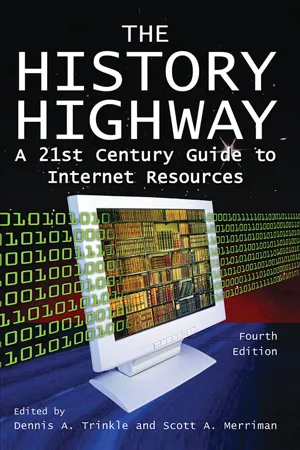
The History Highway
A 21st-century Guide to Internet Resources
- 704 pages
- English
- ePUB (mobile friendly)
- Available on iOS & Android
eBook - ePub
The History Highway
A 21st-century Guide to Internet Resources
About this book
Save yourself and your students hours of research time. Now extensively revised and expanded, "The History Highway" is widely recognized as the one essential tool for students, teachers and researchers seeking a reliable guide to history sites on the web. "The History Highway" offers the broadest, most current coverage of the astonishing amount of historical information available on the Internet: provides detailed, easy-to-use, and up-to-date information on more than 3000 web sites; covers U.S. and World history and all sub-fields; features ten new chapters, with coverage of futurism, environmental history, immigration history, and Mediterranean and Middle Eastern history; all sites have been thoroughly checked by specialists in the relevant field of history; the best sites in each field are clearly identified; hard cover and paperback editions include a CD of the entire contents with live links to sites; and e-book version with live links to sites is in preparation.
Part I
Getting Started
Chapter 1
The Basics
Dennis A. Trinkle
History of the Internet
Since this book is directed at those interested in history, it seems sensible to begin with a brief history of the Internet itself. The story of the Internet’s origins is as varied, complex, and fascinating as the information the Net contains. Ironically, the Net began as the polar opposite of the publicly accessible network it has become. It grew out of the Cold War hysteria surrounding the Soviet launch of Sputnik, the first artificial satellite, in 1957. Amid paranoia that the United States was losing the “science race,” President Dwight D. Eisenhower created the Advanced Research Projects Agency (ARPA) within the Department of Defense to establish an American lead in science and technology applicable to the military. After helping the United States develop and launch its own satellite by 1959, the ARPA scientists turned much of their attention to computer networking and communications. Their goal was to find a successful way of linking universities, defense contractors, and military command centers to foster research and interaction, but also to sustain vital communications in case of nuclear attack. The network project was formally launched in 1969 by ARPA under a grant that connected four major computers at universities in the southwestern United States—UCLA, Stanford, the University of California at Santa Barbara, and the University of Utah. The network went online in December 1969. The age of computer networks was born.
In the early 1970s, it became clear to the initial developers of the ARPANET that the system was already stretching past its Cold War origins. Nonmilitary research institutions were developing competing networks of communication, more and more users were going online, and new languages were being introduced that made communication difficult or impossible between networks. To resolve this problem, the Defense Advanced Project Agency (which had replaced ARPA) launched the Internetting Project in 1973. The aim was to create a uniform communications language (a protocol, as the rules governing a computer language are termed) that would allow the hundreds of networks being formed to communicate and function as a single meganetwork. In an amazing display of scientific prowess comparable to the Apollo program, this crucial step in the development of the information superhighway was accomplished in a single year when Robert Kahn and Vinton G. Cerf introduced the Transmission Control Protocol/Internet Protocol (TCP/IP). This protocol made possible the connection of all the various networks and computers then in existence and set the stage for the enormous expansion of the Internet.
Over the next decade, the Department of Defense realized the significance and potential of the Internet, and nonmilitary organizations were gradually allowed to link with the ARPANET. Commercial providers like CompuServe then began making the Internet accessible for those not connected to a university or research institution. The potential for profiting from the Internet fueled dramatic improvements in speed and ease of use.
The most significant step toward simplicity of use came with the introduction of the World Wide Web (Internet), which allows interactive graphics and audio to be accessed. The World Wide Web was the brainchild of Tim Berners-Lee of the European Laboratory for Particle Physics, who created a computer language called hypertext that made possible the interactive exchange of text and graphic images and allowed almost instantaneous connection (linking) to any item on the Internet. Berners-Lee was actually developing this revolutionary language as the Internet was expanding in the 1970s and 1980s, but it was only with the introduction of an easy-to-use Web browser (as the software for interacting with the Web is called) that the Web became widely accessible to the average person. That first browser—Mosaic—was made available to the public by the National Center for Supercomputing Applications at the University of Illinois, Urbana-Champaign, in 1991. Three years later, Mosiac’s creator, Marc Andreessen, introduced an even more sophisticated browser that allowed the interaction of sound, text, and images—Netscape Navigator. The next year Microsoft launched a browser of its own—Internet Explorer.
Today, there are many software options for exploring the Internet and access can be purchased through thousands of national and local service providers. A user need no longer be a military researcher or work at a university to “surf the Net.” There are now more than 100 million users logging onto the Internet from the United States alone. Tens of thousands of networks now are connected by TCP/IP, and the Internet forms a vast communication system that can legitimately be called an information superhighway.
Uses of the Internet
This section of Part I will explain the most useful features of the Internet for those interested in history. It will discuss sending and receiving e-mail, reading and posting messages to Usenet newsgroups and discussion lists, logg...
Table of contents
- Cover
- Half Title
- Title
- Copyright
- Dedication
- Contents
- Acknowledgments
- Introduction
- Part I. Getting Started
- Part II. Internet Sites for Historians
- Glossary
- About the Editors and Contributors
- Index
Trusted by 375,005 students
Access to over 1.5 million titles for a fair monthly price.
Study more efficiently using our study tools.
Frequently asked questions
Yes, you can cancel anytime from the Subscription tab in your account settings on the Perlego website. Your subscription will stay active until the end of your current billing period. Learn how to cancel your subscription
No, books cannot be downloaded as external files, such as PDFs, for use outside of Perlego. However, you can download books within the Perlego app for offline reading on mobile or tablet. Learn how to download books offline
Perlego offers two plans: Essential and Complete
- Essential is ideal for learners and professionals who enjoy exploring a wide range of subjects. Access the Essential Library with 800,000+ trusted titles and best-sellers across business, personal growth, and the humanities. Includes unlimited reading time and Standard Read Aloud voice.
- Complete: Perfect for advanced learners and researchers needing full, unrestricted access. Unlock 1.5M+ books across hundreds of subjects, including academic and specialized titles. The Complete Plan also includes advanced features like Premium Read Aloud and Research Assistant.
We are an online textbook subscription service, where you can get access to an entire online library for less than the price of a single book per month. With over 1.5 million books across 990+ topics, we’ve got you covered! Learn about our mission
Look out for the read-aloud symbol on your next book to see if you can listen to it. The read-aloud tool reads text aloud for you, highlighting the text as it is being read. You can pause it, speed it up and slow it down. Learn more about Read Aloud
Yes! You can use the Perlego app on both iOS and Android devices to read anytime, anywhere — even offline. Perfect for commutes or when you’re on the go.
Please note we cannot support devices running on iOS 13 and Android 7 or earlier. Learn more about using the app
Please note we cannot support devices running on iOS 13 and Android 7 or earlier. Learn more about using the app
Yes, you can access The History Highway by Dennis A. Trinkle,Dorothy Auchter,Scott A. Merriman,Todd E. Larson in PDF and/or ePUB format, as well as other popular books in History & Labour Economics. We have over 1.5 million books available in our catalogue for you to explore.