eBook - ePub
Air Cargo in Mainland China and Hong Kong
- 206 pages
- English
- ePUB (mobile friendly)
- Available on iOS & Android
eBook - ePub
Air Cargo in Mainland China and Hong Kong
About this book
Air traffic and the aviation industry have grown rapidly on the Chinese mainland in the two and a half decades since China's open door policy. Accession to the WTO will further stimulate trade and foreign direct investment (FDI), intensifying the demand for air cargo services. It will also open up the Chinese economy to foreign participation in the transportation and logistics sectors, making these sectors more competitive and efficient. This book provides a systematic and comprehensive study of China's air cargo industry as well as its policy evolution. It covers the sources and destinations of air cargo in mainland China and Hong Kong: whence it comes and where it goes to. The major hubs of the transportation network - Beijing, Shanghai, Hong Kong, and Guangzhou - are discussed one by one. The virtual aspects of the network at these hubs in terms of IT applications, preparedness, and needs are examined and compared. Though the subject matter of this book is air cargo, there is considerable coverage of the aviation industry and policy on the mainland and Hong Kong. Changes have been happening so fast there are few books and publications that cover them systematically and comprehensively. Readership includes business executives in airfreight companies, airports and airlines, logistics specialists, aviation university lecturers and students.
Information
Chapter 1
Introduction
This is a book about air cargo in mainland China and Hong Kong. Where does it come from? Where does it go to? How is it transferred between its source and destination? How well and efficiently is this done? What are the factors that lead to the decision of whether goods are transported by air rather than alternative means?
Three major events are currently driving changes in mainland's aviation and air cargo industry, prompting us to put together a book (partly based on our past reports and papers) to describe and analyze what is going on. These events are: (1) the restructuring of the aviation industry on the mainland; (2) the emergence of IT and global 'production fragmentation'; and (3) China's entry to the World Trade Organization (WTO).
Following the deregulation of its domestic aviation business in the 1980s, China has developed a highly fragmented airline industry with about three dozen carriers, some with only two or three planes. The resulting competition and overcapacity have brought financial losses to the industry and have contributed to a drop in productivity. Having awoken to this undesirable state of affairs, the Chinese central government has started to restructure the industry. One of its measures is to create three large airline consortia – consolidating the ten carriers under central government control – each with assets of about US$6 billion and fleets of more than 100 aircraft. The three consortia of Air China, China Eastern and China Southern will account for about 80% of flights inside China.
The emergence of globally integrated, just-in-time (JIT) production and distribution systems and the emergence of e-Commerce and e-Business over the last two decades have made air cargo in general, and air express in particular, the fastest-growth area in the cargo sector. Companies try to reduce inventories and cut down the time they take to move products to the market. Product life spans are also shortening in industries such as computers, pharmaceuticals and designer clothes. While some companies have turned to 'virtual warehousing' (keeping goods in transit as a substitute for holding goods in storage) a growing community of e-Commerce retailers have begun to rely on strategically located 'fulfillment centers' to enable speedy and economical delivery of goods bought on-line. It is expected that enterprises will widely adopt e-Business practices by integrating logistics functions into their business processes. Moreover, as a result of continuous declines in tariffs and other trade barriers, the international fragmentation of production, i.e., outsourcing various production blocks to countries that possess a comparative advantage in that productive activity, has become a dominant feature of globalization. This increases the demand for international service links in the form of transport services, and intensifies the search for a more efficient trade regime in international air cargo services.
As part of its WTO accession, China has made substantial market access commitments covering the industrial, services and agricultural sectors. For example, in the Sino-US agreement, China has committed to lowering import tariffs on industrial products from 17.0% to 9.4% by 2005. Import quotas will be eliminated within five years. For the first time, foreign companies will be given trading and distribution rights, phased in over three years after accession. In addition to industrial products, China has agreed to relax foreign investment restrictions on many important service industries, including distribution services, telecommunications, financial services, professional services and tourism. So the accession will on the one hand raise or maintain China's economic growth, which will naturally benefit China's air cargo industry, and on the other hand open more of the Chinese economy to foreign participation in transportation and logistics services, making these industry sectors more efficient and competitive.
The subject matter of this book is air cargo. It should therefore be no surprise that we will be covering aviation industry and policy in the mainland and Hong Kong. But the inordinate amount of space and discussion spent in the book on these two related topics may be somewhat unexpected; in the context of other countries this would generally only be background material and may even be taken for granted. There are three reasons for this emphasis. First, the air cargo industry has not come into its own in either jurisdiction. This is especially so in the mainland where the bulk of air cargo is still carried on passenger flights and where there are few airlines that specialize in the transport of air cargo. Second, as has already been mentioned, there are many changes afoot in both industry and policy as the mainland evolves from a centrally-planned economy to one with a greater role for free enterprises, and as the mainland develops from a low income country to a higher income level one; these two changes will shape the air cargo industry in the years to come. Finally, because these changes have been happening so fast there are few books and publications that cover them systematically and comprehensively. If not for the dearth of material and analysis on passenger flows and passenger services, our book could have been called 'Aviation and Air Cargo in Mainland China and Hong Kong'.
That Hong Kong is included with the mainland goes beyond the changeover of sovereignty (when Hong Kong was formally reunited with the mainland) as well as the background and institutional affiliations of the authors, all of whom having taught in Hong Kong's tertiary institutions at one point or another. Though governed since 1997 as a Special Administrative Region with its own distinct economic system, air traffic rights and aviation policy, Hong Kong is nonetheless an aviation hub of China. Arguably, it is the most important air cargo hub at present. In other words, though not part of mainland proper. Hong Kong's aviation industry and airport is as much a part of China's aviation industry and route network as Hong Kong itself is a part of China's trade and economic network.
Where a distinction needs to be made between the two places, as we have done above, we refer to China minus Hong Kong as the mainland. In contexts where there is no ambiguity, we use the terms China and mainland interchangeably. We should also mention Macau, which is the only other Special Administrative Region of China. Macau's airport is much less important and is treated only marginally in this book.
The book is organized as follows. Chapter 2 gives an overview of the aviation network and air cargo flows in the mainland and Hong Kong. Chapter 3 covers the aviation industry and policy on the mainland and describes the different reform efforts in the last two and a half decades. The four chapters that follow focus on each of the major aviation hubs: Beijing, Shanghai, Hong Kong and Guangzhou. In each of these, we present the basic statistics of each airport and analyze its cargo traffic. While Guangzhou is one of the three hubs in the mainland's domestic network, its role as an international gateway has been dwarfed by the proximity of Hong Kong. To further complicate the relationship between the two airports, there are three other international airports in the Pearl River Delta region – in Shenzhen, Zhuhai, and Macau. A discussion of these five airports is included in Chapter 7 as part of the discussion on Guangzhou as an aviation hub.
Chapters 8 and 9 cover IT. There are often two reasons why a shipper selects air transport as opposed to surface transportation (road, sea and rail). First, the speed of air transport, especially over long distances, is critical for goods subject to spoilage and goods requiring next-morning delivery (e.g., newspapers), and is a key competitive advantage for goods subject to just-in-time supply chain pressures, in particular computer-related products and fashion goods. Second, air transport is relatively more reliable when it comes to shipment loss or damage, which is an advantage for goods with a high ratio of value to size. Air cargo charges for these valuable and time-sensitive goods are usually small in comparison with the value of the items. So time and speed are inherent elements of air cargo. It is therefore only logical that IT is extensively used in the field. Chapter 8 covers IT applications in air cargo logistics in the mainland hubs and in Hong Kong. Chapter 9 follows up with an analysis of the IT readiness of these places. Even in Hong Kong, which is more advanced than the mainland hubs in terms of IT infrastructure, the timely exchange of information is still hampered by the incompatibility of standards and protocols used by different logistics agents. In Chapter 9, we advance a proposal for a fourth party e-Logistics platform to be considered at these aviation hubs.
Chapter 10 and 11 are the summing-up chapters. Chapter 10 starts out by looking at the liberalization effort directed at loosening the bilateral system of the Chicago Convention. We then go on to liberalization efforts on other fronts in the mainland's air cargo industry and obstacles to further developments. Chapter 11 provides a summary of the book as well as an update of the latest events at the time of going to print. It is a feature of the world around us that the time taken to write a book often tends to outdate it, something we have tried our best to correct in this final chapter.
Part I
Overview
Chapter 2
An Overview of Air Cargo Flows1
This chapter provides overall statistics on China's aviation, describes air cargo trends in China, identifies major air transport hubs and examines cargo movements between them. We also discuss some of the difficulties in comparing air cargo data between the mainland and Hong Kong.
2.1 Aviation Growth
Only limited statistics are available on the early years of China's aviation industry. For the period from 1950 to 1980, the major variables available – and only at 5-year intervals – are:
- passenger traffic;
- passenger-kilometres performed;
- freight traffic; and
- tonne-kilometres performed.
Consider a flight from airport A to airport B. The number of passengers on that flight is captured by the variable 'passenger traffic'. Multiply the number of passengers by the distance between the airports and we obtain 'passenger-kilometres performed'. Analogous reasoning applies to 'freight traffic' and 'tonne-kilometres performed'. Table 2.1 shows that though aviation growth was brisk in the 1950s, probably because the economy was recovering from the civil war, it stalled in the 1960s. Negative growth rates were recorded for air cargo in the first half of the 1960s and for passenger travel in the second half of the 1960s. Growth resumed for passenger traffic and, to a lesser extent, for cargo traffic in the 1970s. Passenger traffic and cargo traffic grew at similar rates from 1980 until 1995, when they started to diverge. Passenger traffic and passenger-kilometres performed grew especially fast in the first half of the 1990s, at a rate of about 25% per year, but have since slowed down to single digit growth. The slowdown has been much smaller for cargo, which was still showing double digit growth during the second half of the 1990s.
There are two measurement problems with the above data. First, though a variable such as passenger traffic is supposed to represent all passenger traffic in China, the statistical agencies actually include only the passenger traffic of domestic carriers. In other words, the passenger traffic of foreign carriers has been omitted. The other three variables all carry similar defects. Passenger and cargo throughput, the two remaining variables in Table 2.1, are measured, so to speak, at the ground level (e.g., at an airport) and do not carry the same deficiency. Second, the generally accepted definition of air cargo (or freight) refers to anything carried in an aircraft excepting mail or luggage carried under a passenger ticket and baggage check but including baggage moving under an air waybill or shipment record (IATA RP 1601 – Conditions of Carriage for Cargo).2 Until the early 1990s, the freight variables for China – freight traffic, tonne-kilometres performed, cargo throughput – all included air cargo, mail and luggage, and as a result are not comparable with international figures. We refer to cargo throughput that includes cargo, mail and luggage as cargo (plus) and the alternative that is consistent with international convention as cargo (only). Disaggregated data only started to be provided systematically from 1993 onwards.
Table 2.1 The mainland's aviation growth
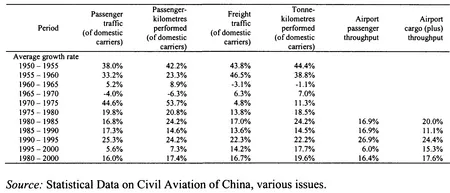
Airport statistics started to be available from 1980. Passenger throughput and cargo throughput as shown in Table 2.1 have registered similar growth rates to those of the four variables already discussed. Again, the passenger variable has shown a drastic drop since 1996 (though growth has remained positive). Probably for the first time, the freight variable has shown a significantly higher growth rate than the passenger variable. It should also be...
Table of contents
- Cover
- Half Title
- Title
- Copyright
- Contents
- List of Figures
- List of Tables
- List of Authors
- Preface
- Chapter 1 Introduction
- PART I OVERVIEW
- PART II MAJOR HUBS
- PART III INFORMATION TECHNOLOGY
- PART IV Prospect and Conclusion
- References
- Index
Trusted by 375,005 students
Access to over 1.5 million titles for a fair monthly price.
Study more efficiently using our study tools.
Frequently asked questions
Yes, you can cancel anytime from the Subscription tab in your account settings on the Perlego website. Your subscription will stay active until the end of your current billing period. Learn how to cancel your subscription
No, books cannot be downloaded as external files, such as PDFs, for use outside of Perlego. However, you can download books within the Perlego app for offline reading on mobile or tablet. Learn how to download books offline
Perlego offers two plans: Essential and Complete
- Essential is ideal for learners and professionals who enjoy exploring a wide range of subjects. Access the Essential Library with 800,000+ trusted titles and best-sellers across business, personal growth, and the humanities. Includes unlimited reading time and Standard Read Aloud voice.
- Complete: Perfect for advanced learners and researchers needing full, unrestricted access. Unlock 1.5M+ books across hundreds of subjects, including academic and specialized titles. The Complete Plan also includes advanced features like Premium Read Aloud and Research Assistant.
We are an online textbook subscription service, where you can get access to an entire online library for less than the price of a single book per month. With over 1.5 million books across 990+ topics, we’ve got you covered! Learn about our mission
Look out for the read-aloud symbol on your next book to see if you can listen to it. The read-aloud tool reads text aloud for you, highlighting the text as it is being read. You can pause it, speed it up and slow it down. Learn more about Read Aloud
Yes! You can use the Perlego app on both iOS and Android devices to read anytime, anywhere — even offline. Perfect for commutes or when you’re on the go.
Please note we cannot support devices running on iOS 13 and Android 7 or earlier. Learn more about using the app
Please note we cannot support devices running on iOS 13 and Android 7 or earlier. Learn more about using the app
Yes, you can access Air Cargo in Mainland China and Hong Kong by Anming Zhang,George W.L. Hui,Lawrence C. Leung,Waiman Cheung in PDF and/or ePUB format, as well as other popular books in Technology & Engineering & Business General. We have over 1.5 million books available in our catalogue for you to explore.