eBook - ePub
Vocational Training in General Dental Practice
The Handbook for Trainers
- 244 pages
- English
- ePUB (mobile friendly)
- Available on iOS & Android
eBook - ePub
About this book
Vocational training is the preferred method for developing practical and other workplace dental skills. It is mandatory for all UK dental graduates under the guidance of the Committee on Vocational Training (CVT). This book is for all dentists who have an interest in vocational training, and is particularly useful for trainers, VDPs and VT advisers/regional advisors. This is a unique and comprehensive guide to training in practice. All aspects of training and teaching methods are included and practical advice given on topics such as communication and presentation skills, finance, barriers to training and assessment. The book also covers the latest developments in clinical governance and legal matters. Clear, straightforward and free of jargon, it will enable dental practitioners to become competent educators with ease.
Information
CHAPTER 1
Trainer selection
General dental practitioners interested in becoming trainers must satisfy the Regional Trainer Selection Committee that they are eligible and suited for the role, and that their practice meets the minimum standards required of a training practice. Practitioners usually apply individually, but practitioners may also apply with a practice colleague and seek approval as joint trainers.
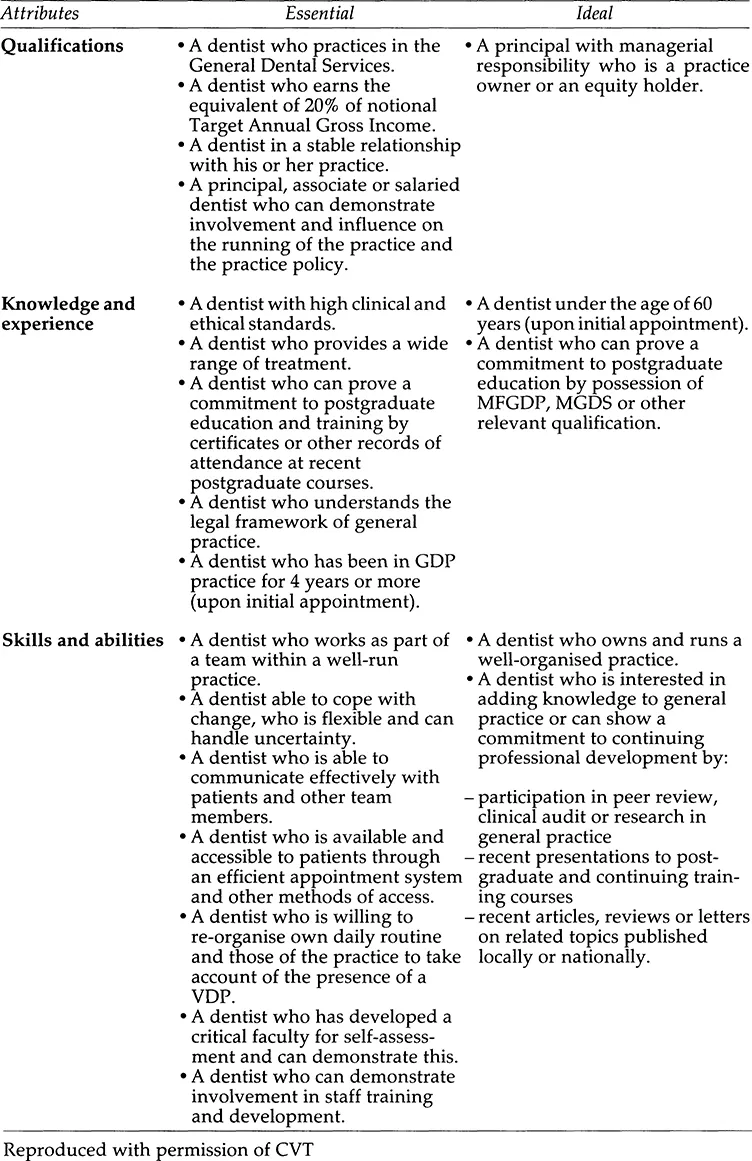
The Committee on Vocational Training (CVT) produces a person specification for trainers, which considers qualifications, knowledge and experience, and skills and abilities, and sets out essential and desirable criteria. These are summarised in Table 1.1.
The selection procedure comprises three parts:
- the completion of an application form
- a practice visit
- an interview before a trainer selection committee.
Formal application
Application forms are available from the regional postgraduate dental dean’s office and can be downloaded from the regional website. The forms do vary from region to region and may reflect regional preferences, but most seek to obtain very similar information from the applicants. Some trainers submit a CV with the form, but this is not a formal requirement. A copy of the practice visit form is available to applicants from the regional office or can be downloaded from the region’s website for manual completion or electronic transmission.
The design and content of application forms are under constant review to reflect topical issues, changes in health and safety legislation and good practice guidance.
Interviews are arranged after application forms have been received and carefully considered. Some regions prefer to short-list applicants first, but this practice has been used only when large numbers of applications have been received.
Table 1.1 Trainer person specification
In some regions, applicants may be requested to submit additional documentation with their form. Practice information leaflets, samples of staff contracts, the annual prescribing profile issued by the Dental Practice Board and evidence of compliance with a particular aspect of health and safety legislation are just some examples.
The practice visit
The practice visit is an important part of the selection procedure; its purpose is to assess the practice’s suitability for vocational training. Information is recorded on a form that includes sections on the facilities available for the VDP, details of services provided and not provided, staff arrangements, compliance with good practice guidelines and aspects of health and safety legislation. Most Deaneries now ask potential trainers to complete a self-assessment practice inspection document. A copy of the form is made available to members of the selection committee prior to or at the interview stage.
In the case of new trainers, the visit is normally undertaken by two people during the working day and at a time convenient to the practitioner. In the case of existing trainers, the visit may be undertaken by one person alone, usually the VT adviser. The visit lasts approximately 1 hour, and applicants are requested to set aside this time from their clinical schedule to accommodate the visiting team. Applicants can take advantage of this time to ask any questions they may have about any aspect of VT.
It should be noted that in some regions the practice visit takes place after the selection interview. If the applicant is deemed to be a potentially suitable trainer, a practice visit is then undertaken. It therefore follows that someone who is unsuccessful at interview will not be visited. This approach is the exception rather than the rule. It occurred in those regions that were heavily over-subscribed with trainer applications and where it was therefore impractical to undertake visits for each and every applicant, given that only 12 trainers (and some reserves) would be appointed on a competitive basis. The reason for this variation is a reflection on the emphasis placed by some regions on the different parts of the application process.
Practitioners are encouraged to prepare in advance for the visit and to have the various certificates and documents that must now comply with statutory legislation ready for inspection. If there are planned changes to the practice environment, for example refurbishment or redecoration, it is always prudent to have available a summary of the proposed changes to give the visitors a good idea of what changes are in the pipeline.
The visitors will follow the regional protocol on practice visits, which normally includes:
- the completion of a practice visit questionnaire
- a review of the workload of the practice by looking at the appointment book(s)
- an examination of a random selection of record cards and radiographs
- an appraisal of the office management systems
- meeting some of the practice staff
- assessing the practice library and other educational resources available.
This last point sometimes causes concern amongst new applicants. Practitioners are expected to maintain a reasonable selection of reference books and journals, including key reference books such as the Dental Practitioner Formulary/British National Formulary, copies of NHS Regulations. Access to other educational resources such as the Internet, CD-ROMs, and videotapes would also be looked upon favourably.
In some regions, the visitors may wish to take photographs or make a video recording of the practice. This is done with the applicant’s consent and total confidentiality of all records is assured.
In general terms, a practice would be considered suitable if it fulfilled certain criteria, namely that:
- the VDPs surgery is adequately equipped to permit the practice of four-handed dentistry
- sterilisation by autoclave is in routine use for items not damaged by the process
- handpieces are sterilised between patients and their supply is sufficient to permit this
- barrier protection, including gloves, masks and spectacles, is used during the treatment of patients
- correct methods of waste disposal are in place
- Ionising Radiation Regulations are observed
- the production of amalgam is by closed devices
- emergency drugs and oxygen are available
- there is evidence of compliance to good practice guidelines
- there is an out-of-hours service for the treatment of emergencies
- there is evidence of compliance with health and safety legislation
- there is adequate administrative and chairside support from a suitably experienced dental assistant.
If the practice fails to satisfy any particular requirement, the visitors will be pleased to advise on what needs to be done to remedy the situation. If, subsequently, evidence is available to confirm that shortcomings have been addressed, the application is not necessarily jeopardised and may proceed in the normal way. On occasions, and in the event of uncertainty or major changes, a follow-up visit may be recommended.
The interview
The regional trainer selection committee approves trainers and training practices. The selection committee normally includes the regional postgraduate dental dean, the regional/VT adviser, a general dental practitioner (GDP) who may be a Local Dental Committee (LDC) member, a General Dental Services Committee (GDSC) member and a representative from the FGDP.
The interview lasts approximately 30-45 minutes. The content and conduct of the interview may vary and applicants should be prepared to give their views on:
- reasons for wanting to be involved in VT
- postgraduate education activities
- items of particular interest on the application form
- previous experiences of VT
- personal strengths and weaknesses
- type of work carried out at the practice
- topics of current professional interest
- practice organisation and administration.
Notification of the outcome of the interview is by post once all the interviews have been completed. Successful applicants are approved for one year only and reappointments are made on a competitive basis. Successful applicants are ranked in order of merit, as determined by interview. This means that a particular applicant and practice may be suitable for training purposes, but may not necessarily be selected for that particular year if they fall outside the first 12 places. In this situation, many regions will appoint reserve trainers who can step in if someone has to withdraw from the scheme for any reason. Twelve trainers are normally appointed; in addition there may be as many as three reserves.
Trainers seeking reappointment in any year following their initial appointment will be required to submit a new application in the usual way.
CHAPTER 2
The trainer’s role and responsibilities
The trainer has a key role to play in the professional development of the VDP. This role, whilst not onerous, demands a continual commitment from both parties to ensure the satisfactory completion of the VT year. The responsibilities of trainers throughout the year are summarised below:
- employ a VDP in the practice under the terms of a nationally agreed contract
- prepare and conduct regular weekly tutorials for the VDP and be available to give guidance in both clinical and administrative matters by working in the same premises as the VDP for not less than three days per week
- provide the VDP with satisfactory facilities, support and relevant opportunities so that a wide range of NHS practice is experienced and, as far as is reasonably possible, the VDP is fully occupied
- assess and monitor the VDP’s progress and professional development, ensuring that the professional development portfolio is maintained and kept up to date, give feedback to the VDO and liaise with the VT adviser, as...
Table of contents
- Cover
- Title Page
- Copyright Page
- Table of Contents
- Forewords
- Preface
- About the author
- Acknowledgements
- Dedication Page
- 1 Trainer selection
- 2 The trainer’s role and responsibilities
- 3 Selecting your VDP
- 4 The early weeks
- 5 Adult learning
- 6 Teaching methods
- 7 Problem-based learning
- 8 Small group teaching
- 9 Presentation skills
- 10 Assessment
- 11 The study days
- 12 Trainers’ meetings
- 13 Communication skills
- 14 Financial aspects of VT
- 15 Barriers to training
- 16 Common concerns
- 17 Clinical governance
- 18 The end of the year
- 19 General professional training
- 20 Dento-legal aspects of VT
- References
- Appendix 1 VDP survey
- Appendix 2 www.first-practice.com
- Appendix 3 Framework for tutorial discussions
- Appendix 4 Reflections
- Index
Trusted by 375,005 students
Access to over 1.5 million titles for a fair monthly price.
Study more efficiently using our study tools.
Frequently asked questions
Yes, you can cancel anytime from the Subscription tab in your account settings on the Perlego website. Your subscription will stay active until the end of your current billing period. Learn how to cancel your subscription
No, books cannot be downloaded as external files, such as PDFs, for use outside of Perlego. However, you can download books within the Perlego app for offline reading on mobile or tablet. Learn how to download books offline
We are an online textbook subscription service, where you can get access to an entire online library for less than the price of a single book per month. With over 1.5 million books across 990+ topics, we’ve got you covered! Learn about our mission
Look out for the read-aloud symbol on your next book to see if you can listen to it. The read-aloud tool reads text aloud for you, highlighting the text as it is being read. You can pause it, speed it up and slow it down. Learn more about Read Aloud
Yes! You can use the Perlego app on both iOS and Android devices to read anytime, anywhere — even offline. Perfect for commutes or when you’re on the go.
Please note we cannot support devices running on iOS 13 and Android 7 or earlier. Learn more about using the app
Please note we cannot support devices running on iOS 13 and Android 7 or earlier. Learn more about using the app
Yes, you can access Vocational Training in General Dental Practice by Raj Rattan,Ian Waite in PDF and/or ePUB format, as well as other popular books in Medicina & Formación del profesorado. We have over 1.5 million books available in our catalogue for you to explore.