- 282 pages
- English
- ePUB (mobile friendly)
- Available on iOS & Android
eBook - ePub
About this book
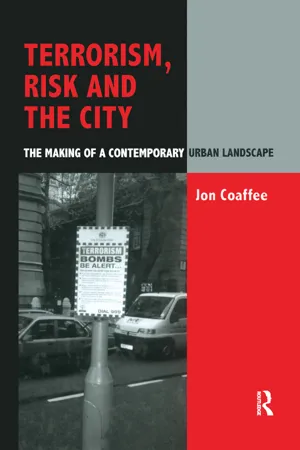
The development of defensive strategies encompassing the fortification and privatization of the city has attracted significant attention during recent years, and has become particularly relevant in the aftermath of September 11th. Dealing with issues of risk, security and the spatial restructuring of contemporary western cities, this book examines how the perceived risk of terrorist attack led to changes in the physical form and institutional infrastructure of the city of London during the 1990s when the city was a prime terrorist target. The book analyses how the various formal and informal strategies adopted in the City attempted to reduce both the physical and financial risk of terrorism. This was undertaken through a series of place-specific security initiatives and risk management policies which led to increased fortification, a substantial rise in terrorism insurance premiums, and, changing institutional relations at a variety of spatial scales. It also argues that the security measures deployed were developed not in terms of an anti-terrorist effort, but in relation to the unintended by-products of these approaches such as crime reduction and enhanced traffic management capabilities.
Information
PART I
TRANSFORMING CITIES IN THE AGE OF TERRORISM
Chapter 1
Introduction: Terrorism, Risk and the City
It has recently been argued by many commentators that since the 9/11 attacks on New York and Washington the fortification and militarisation of the city has proceeded at an unparalleled pace (Davis, 2001; Light, 2002; Swanstrom, 2002). This trend is set to continue as, ‘military doctrine and strategy will become more and more closely geared to the tactical and strategic protection of the political and economic key sites, zones and spaces of the global capitalist systems’ (Graham, 2001, p. 415).
However, it is important to note that the rise of military technology and strategy has always played a key role in the urbanisation process. Since the beginning of urban civilisation, defence against people or the natural elements has always been a factor influencing the structure and landscape of cities, becoming an ever-present preoccupation as the ruling powers sought to defend and secure their interests and create increased feelings of safety (Forbes, 1965; Postgate, 1992). As urbanisation proceeded so the defensive systems deployed by city authorities became increasingly sophisticated to cope with the improving strategies of intruders, in particular, through the construction of physical barriers in the form of gates, walls and ditches that were most widely used (Mumford, 1961; Dillon, 1994; Morris, 1994; Jordan et al, 1997). Such defensive structures, especially the city wall, also became associated with class distinction and the dual processes of inclusion and exclusion as the social élite lived within the defended citadel whilst the poor often lived in relative danger outside the city wall (Sjoberg, 1960; Pile et al, 1999).
In time the city wall became less important as a symbol of wealth, privilege and safety, as technological advances – most notably the invention of gunpowder – made such defences less effective (Keegan, 1993). Cities, however, continued to be characterised by defensive features as new walled and gated spaces developed, this time within the city boundaries, as danger was increasingly seen to originate from within, rather than outside, the urban area (Luymes, 1997; Atkins et al, 1998). As such by the mid nineteenth century many Western cities were characterised by secure residential estates amidst vast tracts of working class housing, which were seen as terra incognita (Newman, 1980; Jackson, 1992).
The Fortress City
Contemporary Western cities are no different from their predecessors in terms of making explicit attempts to use defence to structure the urban landscape. This situation is most pronounced in the United States where, since the 1960s, the relationship between defensive architecture and urban design has received widespread attention given rising crime rates and the declining state of high-rise residential dwellings (Jacobs, 1961; Boal, 1975; Gold, 1982; Newman, 1995). In particular, in the early 1970s the ideas of Crime Prevention through Environmental Design (Jeffery, 1971) and most notably Defensible Space (Newman, 1972) were popular approaches. Such approaches advocated ‘designing out crime’ through the addition or removal of physical features, which could control access, increase surveillance capabilities, and hence limit the opportunities for crime to occur in certain areas (Flaschsbart, 1969). Although the basis for this work was situated in an American context, during the 1970s and 1980s such approaches were extensively used by local authorities in the UK in existing housing schemes and in the design of new residential areas (Coleman, 1984, 1985; Dawson, 1984; Goodey and Gold, 1987).
In the 1990s further increases in violent crime, racial and cultural conflict, and material inequality within Western cities served increasingly to fragment the urban landscape creating ‘radically new and complex logics of segregation and displacement’ (McLaughlin and Muncie, 1999, p. 117). This scenario was most commonly brought about through the superimposition of an array of fortification and surveillance devices on to the cityscape. Increasingly, residential areas, commercial centres, retail spaces, entertainment districts, and public facilities were fortified and privatised as the result of the actions of urban authorities, private businesses and wealthier citizens (Christopherson, 1994; Dillon, 1994; Flusty, 1994; Fyfe, 1997; Oc and Tiesdell, 1997). As Davis (1995, p.356) argued from an American perspective, ‘we do indeed live in “fortress cities” brutally divided into “fortified cells” of affluence and “places of terror’“. More recently Lianos and Douglas (2000) articulated this idea through the concepts of ‘dangerization’ and suspicion where, they note, there is increasingly ‘a tendency to perceive and analyse the world through categories of menace’ (p.267) highlighting how the urban experience is seen through the differentiation of safe and unsafe areas:
We are caught in a dynamics that increasingly colonizes the life-world through safe, controlled spaces and defines all non-monitored territories, and those who are in them as dangerous. (p.270)
Through the 1990s the portrayal of the ‘fortress city’ was seen as one of the key characteristics of urban life and was, in large part, based on the experiences of Los Angeles, which assumed a theoretical primacy within urban studies per se, with a particular overemphasis on the militarisation of the urban landscape (Soja, 1989; Dear and Flusty, 1998; Dear, 1999). Of particular note was the work of Mike Davis on what he termed ‘Fortress LA’ (Davis, 1990, 1992, 1995, 1998). Davis depicted a city in which ‘defence of luxury has given birth to an arsenal of security systems and an obsession with the policing of social boundaries through architecture. This militarisation of city life is increasingly visible everywhere in the built environment of the 1990s’ (Davis, 1995, p.355). Such tendencies, although not to such extremes, can now be found in most urban areas, as recent studies in Brazil (Calderia, 1996; de Souza, 1996; Schiffer, 2002), Australia and New Zealand (Doekson, 1997), South Africa (Worden, 1994; Sutcliffe, 1996; Napier, 2000) and the UK (Widgery, 1991; Harvey, 1996; Fyfe, 1998) demonstrate.
An example within a British context can be shown by Graham’s (1995) work in Newcastle, which highlighted how a flagship office park planned for the run-down West End of the city could only attract occupiers ‘if security was seen as a priority and CCTV was given an important role’. He noted how the proposed site was to be developed next to some of the most deprived neighbourhoods in Britain and that businesses, despite the promise of grant and rent subsidy, would not initially locate in this area. He noted that ‘the solution was judged to be the “fortress approach” whereby the Business Park attracted clients on the basis of high security’ (ibid. pp. 10–11). Subsequently an array of fences, gates, and CCTV were added to the design of the proposed development. In addition the help of the local police force was sought to advise on where the placement of such fortifications would be most effective and how best use could be made of private security provision. As a result the business park, has suffered little crime and vandalism and has been able to obtain a large reduction in insurance premium, in contrast to the adjoining neighbourhoods, which are still plagued by high crime rates and dwindling property values.
Graham’s work highlights a number of key trends relating to the management, fortification and surveillance of urban space that drove the defence of selected areas of the city forward in the 1990s. His work showed that both occupiers and property developers are now assessing building security at the design phase where the militarisation of commercial buildings and their borders become ‘strongpoints of sale’ (Flusty, 1994; Dear and Flusty, 1999). Graham’s work also pointed to issues related to insurance reductions, the increasing influence of the police within the planning and building design process, the increasing role played by the private security industry and the juxtaposition within urban landscapes of controlled and regulated spaces and areas of disadvantage and poverty.
The trend towards increased urban fortification per se is related to enhanced perceptions of fear amongst urban dwellers (Blakely and Synder, 1999; Furedi, 2002; Swanstrom, 2002). Ellin (1997), for example, argued that ‘form follows fear’ in the contemporary city, with people in areas perceived to be at risk increasingly constructing defensive enclaves to protect themselves. In this sense the ability to pay for such fortifications is crucial. As Christopherson (1994, p.420) pointed out, ‘there is no doubt that the new fortress-like environments respond to some version of consumer preferences’. As a result, many have argued that contemporary city life has been fundamentally reorganised as certain sections of society seal themselves away from the rest of the city creating new types of ‘privatised’ public space, which do not provide the same degree of access to all members of society (Sorkin, 1995; Lees, 1998; Gottdiener, 2000).
Within the Western city the desire for secure urban environments is now seen as one of the defining characteristics of so-called postmodern urbanism (Ellin, 1997; Dear, 1999) or the design-led approach of new urbanism (Harvey, 1997; Fainstein, 2000). Oscar Newman who coined the term ‘defensible space’ in the 1970s as a solution to urban crime can now be seen as one of the most influential thinkers on urban design issues in the United States (Harvey, 1996). Indeed, Newman himself writing in 1995 suggested that defensible space ideas could be rejuvenated and used as a new physical planning tool for urban revitalisation. There is also clear evidence that Newman’s ideas continue to influence urban policy in the UK, which promotes neighbourhood renewal, social inclusion and a design-led urban renaissance. Increasingly, local authorities are now encouraged to form strategic partnerships with the police and local residents to reduce crime in their area with importance being placed on ‘policies and guidance for designing out crime’ (Urban Task Force, 1999, p. 127).
Such an emphasis on countering crime through changes in urban design have for many years, in certain cities, also been linked to reducing the risk of terrorist attack. This concern has become ever more pertinent since 9/11 with many commentators drawing attention to the potential impact of ‘new’ terrorist threats in relation to the design and functioning of cities (Marcuse, 2000a; Marcuse and Kempton, 2002; Mills, 2002; Warren, 2002).
The Terrorist Threat
In recent years it has not just been the perceived risks of crime and intrusion that have led urban authorities, in collaboration with the police and the private security industry, to construct defensive urban landscapes. Increasingly, the potential threat of urban terrorism in certain cities has necessitated attempts to ‘design out terrorism’ through the addition of advanced security design features which have to be constantly updated to keep pace with the ever-changing terrorist threat (Haynes, 1995; Hyett, 1996; Hoffman, 1998). Previous studies on the impact of terrorism on the functioning of cities highlighted that if an urban area is vulnerable, or perceived by the community to be at risk from terrorist attack, then a reduction occurs in business confidence and public unease ensues (Compton et al, 1980; Brown, 1985b; Jarman, 1993). This, in the worst-case scenario, leads to business relocation from the threatened area or, the reluctance of the public to visit certain parts of the city. For example Brown (1984) showed how Belfast city centre was adversely affected by the Provisional Irish Republican Army’s (Provisional IRA’s) bombing campaign of the 1970s and the early 1980s, and, how business establishments were in favour of high levels of security to ease public concerns over safety. This starkly illustrated that in certain contexts terrorism can serve to exacerbate the concern for safety, which is already a key concern for users of the city, and lead to increased fortification of the urban landscape (Rycus, 1991).
Since the 1960s, fuelled by the growth of the mass media, terrorism has been widespread and associated with attacks against military establishments, government buildings, VIPs, or concentrations of particular racial or cultural groups (Livingstone, 1994; see also Picard, 1994; Wilkinson, 1997). In the early 1990s the global tendency of such targeting shifted noticeably towards economic targets, with the aim of causing economic disruption, social unease and putting direct or indirect political pressure on the ruling powers (Hillier, 1994; Rogers, 1996). Such targeting commonly began to be concentrated against business districts, gas and electricity plants, telecommunication infrastructures and transport networks.
In the early 1990s important financial centres became prime targets of attack because of their vast array of new ‘designer’ office buildings, their increasingly cosmopolitan communities, the damaging effects of bombing on commercial activities and the significant media attention and publicity that could be obtained by the terrorists. Examples of such commercial targeting included bombs in the financial districts of New York and Bombay in 1993, and Tokyo, Madrid, Paris, Riyadh and Colombo in 1995. In a British context, the main terrorist threat during the early-mid 1990s came from the Provisional IRA, with their prime target being the City of London (also known as the ‘Square Mile’ or ‘the City’) due to its symbolic value as the traditional heart of British imperialism and its economic importance at the centre of the British and global financial system. This book is specifically concerned with the impact and reaction to two vehicle-bomb attacks the Provisional IRA carried out in the City in April 1992 and April 1993, the indirect effect on the City of two bombings in 1996 in the London Docklands and central Manchester, and the more recent worldwide attacks on or after 9/11.
During the late 1990s the threat of such economic terrorism received a good deal of attention from international leaders. For example, in June 1996 the US President Bill Clinton called on world leaders to work together to combat international terrorism. On a similar note the British Prime Minister of the time, John Major, cited the Provisional IRA bombings in London and Manchester in 1996 and the Tokyo subway poison gas attack in 1995 as examples of how terrorism affects security and freedom and stated that ‘it is a problem from which no one can hide and on which we must all co-operate. This is the security challenge of the 21st century’.1
In short, the threat of terrorist attack over the last decade has served to affect materially and symbolically the contemporary urban landscape in areas perceived to be at risk. Urban terrorism has created security threats to which municipal and national governments were forced to respond in order to alleviate the fears of their citizens and business community. As a result security measures similar to those used to ‘design out crime’ have been increasingly introduced, including physical barriers to restrict access, advanced surveillance techniques in the form of security cameras, and insurance regulations and blast protection, as well as innumerable indirect measures that operate through activating individual and community responses.
However, as w...
Table of contents
- Cover
- Half Title
- Title Page
- Copyrigh Page
- Table of Contents
- List of Figures
- List of Tables
- Preface
- Acknowledgements
- About the Author
- Part I: Transforming Cities in the Age of Terrorism
- Part II: The City of London’s Response
- Part III: Terrorism, Risk and the Future City
- Bibliography
- Index
Trusted by 375,005 students
Access to over 1.5 million titles for a fair monthly price.
Study more efficiently using our study tools.
Frequently asked questions
Yes, you can cancel anytime from the Subscription tab in your account settings on the Perlego website. Your subscription will stay active until the end of your current billing period. Learn how to cancel your subscription
No, books cannot be downloaded as external files, such as PDFs, for use outside of Perlego. However, you can download books within the Perlego app for offline reading on mobile or tablet. Learn how to download books offline
Perlego offers two plans: Essential and Complete
- Essential is ideal for learners and professionals who enjoy exploring a wide range of subjects. Access the Essential Library with 800,000+ trusted titles and best-sellers across business, personal growth, and the humanities. Includes unlimited reading time and Standard Read Aloud voice.
- Complete: Perfect for advanced learners and researchers needing full, unrestricted access. Unlock 1.5M+ books across hundreds of subjects, including academic and specialized titles. The Complete Plan also includes advanced features like Premium Read Aloud and Research Assistant.
We are an online textbook subscription service, where you can get access to an entire online library for less than the price of a single book per month. With over 1.5 million books across 990+ topics, we’ve got you covered! Learn about our mission
Look out for the read-aloud symbol on your next book to see if you can listen to it. The read-aloud tool reads text aloud for you, highlighting the text as it is being read. You can pause it, speed it up and slow it down. Learn more about Read Aloud
Yes! You can use the Perlego app on both iOS and Android devices to read anytime, anywhere — even offline. Perfect for commutes or when you’re on the go.
Please note we cannot support devices running on iOS 13 and Android 7 or earlier. Learn more about using the app
Please note we cannot support devices running on iOS 13 and Android 7 or earlier. Learn more about using the app
Yes, you can access Terrorism, Risk and the City by Jon Coaffee in PDF and/or ePUB format, as well as other popular books in Politics & International Relations & Urban Planning & Landscaping. We have over 1.5 million books available in our catalogue for you to explore.