Handbook of Laboratory Animal Anesthesia and Pain Management
eBook - ePub

Handbook of Laboratory Animal Anesthesia and Pain Management

Rodents

  1. 198 pages
  2. English
  3. ePUB (mobile friendly)
  4. Available on iOS & Android
eBook - ePub

Handbook of Laboratory Animal Anesthesia and Pain Management

Rodents

About this book

Rodents are the most commonly used species in biomedical research. Individuals conducting rodent research are often responsible to ensure that all areas of anesthesia and analgesia are performed humanely. Anesthetic agent selection, anesthetic monitoring, and postoperative pain assessment and management are essential to the institutional animal care and use program and contribute significantly to the 3Rs by reducing pain and/or distress and refining various procedures.

The Handbook of Laboratory Animal Anesthesia and Pain Management: Rodents is the first book to capture multiple advances in this important area that greatly impacts various experimental methodologies. Richly illustrated in full color, the book serves as a quick reference source for investigators, veterinarians, technicians, and other animal caretakers charged with the care and use of rodents in a research setting. The unique format of this book also makes it extremely valuable to IACUC members, institutional officials, and occupational health and safety professionals.

Key features:

  • Presents practical information in easily accessible 'bullet point' format
  • Covers anesthetic machine and related equipment, anesthetic management and monitoring, anesthesia and analgesia pharmacology, euthanasia, and record keeping
  • Written by well-recognized experts in the laboratory animal community
  • Provides extensive references to direct the reader to sources for further study of alternative techniques and their procedures
  • Concludes with a thorough chapter on Regulatory Management of Rodent Anesthesia which has global application

Frequently asked questions

Yes, you can cancel anytime from the Subscription tab in your account settings on the Perlego website. Your subscription will stay active until the end of your current billing period. Learn how to cancel your subscription.
No, books cannot be downloaded as external files, such as PDFs, for use outside of Perlego. However, you can download books within the Perlego app for offline reading on mobile or tablet. Learn more here.
Perlego offers two plans: Essential and Complete
  • Essential is ideal for learners and professionals who enjoy exploring a wide range of subjects. Access the Essential Library with 800,000+ trusted titles and best-sellers across business, personal growth, and the humanities. Includes unlimited reading time and Standard Read Aloud voice.
  • Complete: Perfect for advanced learners and researchers needing full, unrestricted access. Unlock 1.4M+ books across hundreds of subjects, including academic and specialized titles. The Complete Plan also includes advanced features like Premium Read Aloud and Research Assistant.
Both plans are available with monthly, semester, or annual billing cycles.
We are an online textbook subscription service, where you can get access to an entire online library for less than the price of a single book per month. With over 1 million books across 1000+ topics, we’ve got you covered! Learn more here.
Look out for the read-aloud symbol on your next book to see if you can listen to it. The read-aloud tool reads text aloud for you, highlighting the text as it is being read. You can pause it, speed it up and slow it down. Learn more here.
Yes! You can use the Perlego app on both iOS or Android devices to read anytime, anywhere — even offline. Perfect for commutes or when you’re on the go.
Please note we cannot support devices running on iOS 13 and Android 7 or earlier. Learn more about using the app.
Yes, you can access Handbook of Laboratory Animal Anesthesia and Pain Management by Cholawat Pacharinsak, Jennifer C. Smith, Cholawat Pacharinsak,Jennifer C. Smith in PDF and/or ePUB format, as well as other popular books in Medicine & Medical Theory, Practice & Reference. We have over one million books available in our catalogue for you to explore.

Information

1

terms and definitions

Travis Seymour

•  Acute pain: Pain associated with tissue damage that resolves once the tissue heals
•  Allodynia: Pain resulting from nonnoxious stimuli
•  Anesthesia: Loss of sensation to the whole or any part of the body
•  Chronic pain : Persistent pain that lasts significantly longer than the anticipated resolution time
•  General anesthesia: Unconsciousness due to drug-induced, reversible depression of the central nervous system
•  Hyperalgesia: Heightened pain intensity from noxious stimuli that normally cause pain
•  Neuroleptanalgesia: A combination of opioids and sedatives/tranquilizers that work synergistically; provides effective analgesia and sedation while decreasing the dosing requirements of both types of drugs
•  Neuropathic pain: Pain resulting from injury/damage of the peripheral or central nervous system
•  Nociception: Transmission of nociceptive information to higher CNS regions
•  Nociceptors : Receptors associated with mainly afferent neurons that detect noxious stimuli
•  Noxious stimuli: Stimuli causing tissue injury or damage (categorized as mechanical, thermal, chemical, or electrical stimuli)
•  Pain: An unpleasant sensation with an emotional component, usually associated with actual or potential tissue damage
•  Sedation: Depression of consciousness
•  Surgical anesthesia: The plane of anesthesia characterized by unconsciousness, muscle relaxation, and analgesia appropriate for a surgical procedure
•  Tranquilization: A behavioral change whereby the patient is relaxed yet cognizant of its surroundings

bibliography

Pacharinsak, C. and P. Sharp. 2013. Anesthesia in nonhuman primates. In Pocket Handbook of Nonhuman Primate Clinical Medicine, ed. A. Courtney, 1–32. Boca Raton, FL: CRC Press.
Tranquilli, W. J. and K. A. Grimm. 2015. Introduction: Use, definitions, history, concepts, classification, and considerations for anesthesia and analgesia. In Veterinary Anesthesia and Analgesia, the Fifth Edition of Lumb and Jones, eds K. A. Grimm, L. A. Lamont, W. J. Tranquilli, S. A. Greens, and S. A. Robertson. 5th edition, 23–85. Ames, IA: Wiley.

2

understanding anesthetic-related equipment

Daniel Pang

contents

2.1 carrier gas supply
2.1.1 Carrier Gas
2.1.2 Pipeline Oxygen
2.1.3 E Cylinders
2.1.4 Pressure Regulator
2.2 gas safety
2.3 the anesthetic machine
2.4 flowmeters
2.4.1 Safety
2.5 anesthetic vaporizers
2.6 O2 flush valve
2.7 carbon dioxide (CO2) absorber
2.8 breathing systems
2.8.1 Classification
2.8.1.1 Non-rebreathing systems
2.8.1.2 Rebreathing systems: Circle system
2.8.1.3 Open systems
2.9 reservoir bags
2.10 waste anesthetic gas
2.11 atmospheric pollution and occupational exposure
2.11.1 Atmospheric Pollution
2.11.2 Occupational Exposure
2.12 anesthesia machine check out procedure
2.12.1 High-Pressure System
2.12.2 Low-Pressure System
2.12.3 Breathing System
bibliography
Modern anesthetic equipment is reliable when regularly maintained and used appropriately. The provision of general anesthesia to laboratory species is often associated with additional constraints specific to the research setting, including animal positioning and access and drug and equipment restrictions. As a result, the associated anesthetic risk may be increased, emphasizing the role of the anesthetist in providing a successful outcome while safeguarding welfare.

2.1 carrier gas supply

2.1.1 Carrier Gas

The carrier gas, typically oxygen, is the gas used to carry an inhalational anesthetic agent to the animal. It may be supplied by connecting an anesthetic machine to a pipeline source or directly to a cylinder.

2.1.2 Pipeline Oxygen

Pipeline oxygen is common in larger units/clinics where it is more convenient to have large, less portable oxygen sources housed together in a secure, remote storage room, from which supplied gas is piped to a large number of suites. The form of oxygen source depends on workplace requirements, ranging from a bank of J cylinders to liquid oxygen containers (Figure 2.1a,b).
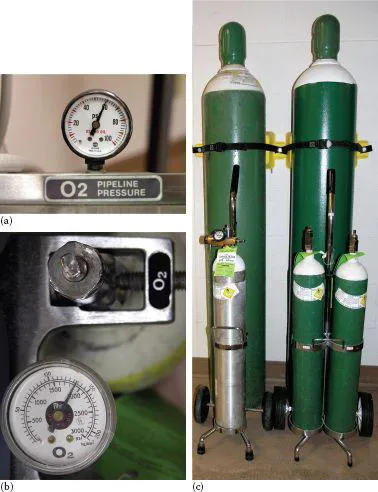
• Pipeline oxygen is transported at a pressure of approximately 50–60 psi (345–410 kPa) to the anesthetic machine (Figure 2.2a).
• The final pressure reduction occurs at the flowmeter (see below).
• Oxygen is stored at 1900 psi in both J and E cylinders (Figure 2.2b).
Image
Fig. 2.1 (a) Control unit for two banks of oxygen cylinders. Using dual banks allows for one bank to be replaced with full cylinders while providing a continuous supply of gas from the second bank. The switch from one bank to the other may be manual (as in this example) or automatically controlled. In either case, messages indicating a depletion in gas supply and switching of banks may be sent to a central unit in an area observed by personnel. (b) Liquid oxygen containers used to supply a large veterinary referral hospital.
J cylinders, containing approximately 6800 L of oxygen when full, are approximately 5 feet in height and may be used to supply pipeline oxygen or can be housed in a laboratory for local use (Figure 2.2c).

2.1.3 E Cylinders

E cylinders are fitted directly to anesthetic machines and contain approximately 660 L of oxygen when full. In the United States, oxygen cylinders are usually colored green, and in Canada, green with white shoulders.
Image
Fig. 2.2 (a) Pressure gauge showing an oxygen pipeline pressure of 59 psi at the point of connection to the anesthetic machine. (b) Pressure gauge showing an oxygen E cylinder pressure of 1900 psi, indicating a full cylinder (approximately 660 L). (c) Oxygen cylinders. Two J cylinders are in the background, with storage caps in place over valves. Notice color markings of green body with white shoulders. Both cylinders are secured to the wall with a strap and bracket. In the foreground are E cylinders stored in dollies. Notice the inconsistent color markings of the E cylinders: steel cylinders have green body with white shoulders, aluminum cylinder has silver body with white shoulders. Cylinder contents should be confirmed by reading the label (visible on E cylinders).
To calculate the volume of oxygen remaining in an E cylinder: 0.34 × cylinder pressure (psig); for example, for a half-full c...
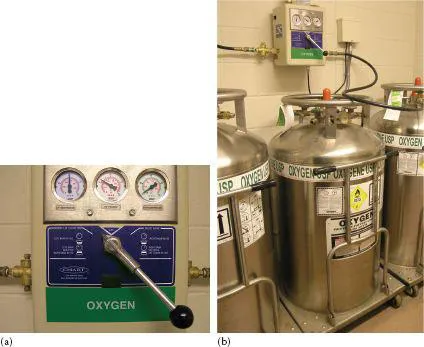
Table of contents

  1. Cover
  2. Half Title
  3. Series Page
  4. Title Page
  5. Copyright Page
  6. Dedication
  7. Table of Contents
  8. preface
  9. acknowledgments
  10. editors
  11. contributors
  12. 1 terms and definitions
  13. 2 understanding anesthetic-related equipment
  14. 3 anesthetic pharmacology and research-related anesthetic considerations
  15. 4 management of anesthesia
  16. 5 anesthesia monitoring
  17. 6 special techniques and species
  18. 7 pain management
  19. 8 euthanasia
  20. 9 regulatory management of rodent anesthesia
  21. index