eBook - ePub
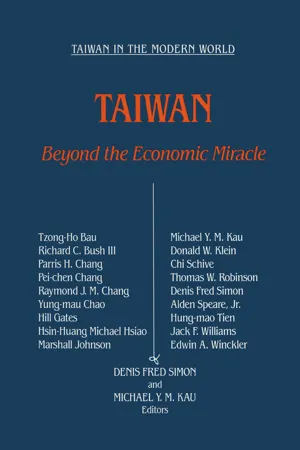
Taiwan: Beyond the Economic Miracle
Beyond the Economic Miracle
- 428 pages
- English
- ePUB (mobile friendly)
- Available on iOS & Android
eBook - ePub
Taiwan: Beyond the Economic Miracle
Beyond the Economic Miracle
About this book
This volume arises from a major conference on issues of importance to the future of Taiwan and the region. With contributions by scholars from Taiwan and the West, the book is divided into sections on: political reform and development on Taiwan, Taiwan's changing political economy, social and environmental issues on Taiwan, Taiwan external relations and the future of Taiwan-PRC relations. Among the many issues addressed within this framework are the evolution of democracy, local politics, Taiwan and the international division of labour, the labour movement, environmentalism, international commercial links and the role of the United States in Taiwan-PRC relations.
Information
Political Reform and Development on Taiwan
1
Taiwan's Evolution Toward Democracy: A Historical Perspective
Hung-mao Tien
Introduction
When World War II ended in 1945, the Kuomintang (KMT) regime on mainland China took control of Taiwan from the Japanese, who had ruled the island for fifty years. Four years later, as China's civil war came to an end, the defeated KMT forces retreated to Taiwan.
Then President Chiang Kai-shek and his followers initially thought Taiwan would be a temporary sanctuary, a military and political base for recovery of the mainland, which they had lost to the Chinese Communists. However, their defeat had shattered the morale of Chiang's followers, who still had to face the uncertain fate of the widely expected Communist military onslaught.
In June 1950, the outbreak of the Korean War forced the Truman administration to suddenly alter American policy regarding the security and future of the Taiwan Strait. On June 27, President Truman—previously uncommitted to Taiwan's defense—ordered the Seventh Fleet to patrol the island against any military action by the Chinese Communists. This change of U.S. policy not only saved Taiwan's inhabitants from the terror and destruction of war but also prevented the possible annihilation of the KMT forces by the Communists.
Beginning in late 1950, the United States provided Taiwan with an aid program that reached a total of U.S.$1.5 billion by 1965, the year it was finally terminated. American aid helped the KMT regime maintain its military strength and stabilize the shaky agrarian economy, which was experiencing terrible inflation. During 1950-52, the KMT also underwent a fundamental reorganization in order to invigorate the party machine from its state of paralysis on the mainland. An authoritarian political system, based on a one-party dictatorship, was transplanted to Taiwan. Although the KMT regime frequently resorted to oppression, its iron-fisted rule evidently provided Taiwan with three decades of political stability that enabled the government to launch a steady course of economic development. In the 1950s, the Taiwan authorities successfully undertook a land-reform program that equalized land distribution and prompted agricultural production. Once land reform was accomplished, the government switched to an industrial development plan that led to a prosperous export-intensive economy. By the end of 1989, Taiwan's two-way trade exceeded $118 billion, making the island nation's trade volume the thirteenth largest in the world. Its per capita gross national product (GNP) reached $7,509 in 1990, as compared with a mere $50 in 1952 (Free China Journal [FCJ], October 22, 1990, 73).
Taiwan's success in economic development has already received widespread attention; its evolution toward democracy, which dates from the 1970s, is only beginning to attract serious scholarly inquiry. In the past three years, the KMT regime has undertaken major steps to liberalize the society and to implement democratic reform. Martial law, declared over four decades ago, has been lifted. Opposition parties have been legalized. Some restrictions on demonstration, group activities, and publication of newspapers have been removed. The KMT government has also authorized the election of additional members to three parliamentary bodies, namely, the National Assembly, the Legislative Yuan, and the Control Yuan.
The current transition from authoritarianism to democracy makes Taiwan one of the few nations in the non-Western world undergoing such a political experiment. Not only is Taiwan one of a handful of nations with an entrenched one party dictatorship prior to legalizing opposition parties, but the KMT, as its ruling party, is hierarchically better organized than probably any non-Communist party in the world. It may be the only existing non-Communist party possessing all the organizational attributes of a powerful Leninist party. Its relations with both the state and society have also shown strong functional resemblance to the Leninist corporatist state.
The following analysis will begin with a brief account of the principal characteristics of the KMT regime, especially in the period prior to the current reform initiated during 1986-90. Subsequently, it will attempt to answer the following questions.
- What are the key aspects of Taiwan's political change in recent years?
- How do we explain the advent of democratic transition in Taiwan?
- What are the critical issues confronted by the KMT regime as it proceeds with democratic evolution and political liberalization?
Authoritarian Emergency Regime
Until recently, the forty-year-old KMT regime on Taiwan has been characterized essentially by the five major features that are outlined in the following discussion.
One-Party Dictatorship
While on the mainland, the KMT was reorganized in 1924 explicitly on the Leninist model, a democratic-centralist, elite, disciplined, and revolutionary party exercising leadership throughout the political system (Tien 1989a; 1989b, 105). Upon arrival on Taiwan, the party was again reorganized during 1950-52 along Leninist guidelines. Its power was highly centralized, with a hierarchy of party apparatus dispersed throughout the state structure and society, and its grass-roots organization, based on a complex network of cells, revealed its conspiratorial nature. The KMT professes the historical mission of political unification of China according to the Three Principles of the People, expounded initially by Dr. Sun Yat-sen, founder of the party.
During the reorganization period, the KMT reregistered members and purged those considered disloyal, suspected of enemy connections, or found guilty of corruption (Riggs 1952, 38). The party also recruited 170,000 civilian members; by 1954, about 210,000, or 35 percent, of the 600,000 military personnel were party members (Tien 1989a, 68). The percentage of civil servants who were party members was at least as high as that in the armed services. By 1968, party membership amounted to 6.89 percent of the population of 13.7 million (Jiang and Wu 1989, 20). The KMT, however, remained exclusionary: 60 percent of its members were reportedly politicians, civil servants, and military men, and 61 percent of the entire membership was composed of mainlanders (ibid.). The party's Central Standing Committee, Central Committee, and central headquarters were filled almost exclusively with mainlander elites of similar career background.
Despite its Leninist orientation, the KMT was never a monoparty. Local elections were held even during the 1950s and the 1960s. Nonparty candidates as well as candidates of two satellite parties—the Young China party (YCP) and the Democratic Socialist party (DSP)—were permitted to participate in the elections. Thus, Taiwan's one-party dictatorship was essentially hegemonic. In addition, the KMT, unlike any Leninist parties elsewhere, is committed ideologically to an eventual realization of constitutional democracy; it also accepts the principles of private ownership and market economy (Chou and Nathan 1987, 278). These structural features and this ideological orientation set the KMT apart from a typical Leninist party, despite similarities in organization and operational style.
Personal Rule and the Charisma of the Chiangs
Although the Taiwan government has been under the KMT's hegemony, the party's final authority rested in the hands of its two supreme leaders—Chiang Kai-shek (ruled 1949-75) and his son Chiang Ching-kuo (ruled 1975-87). Power held by other leaders was determined by the Chiangs' personal patronage. They appointed key officials in the party, the government, the military, and the security forces. Members of the KMT's Central Standing Committee and Central Committee were designated by the Chiangs before the slate was rubber-stamped by the Party Congress or, in the case of the Central Standing Committee, by the Central Committee. In the Central Standing Committee's weekly meeting, party leaders rarely engaged in policy deliberation; they merely listened to the Chiangs' personal instruction.
The extent to which either of the two Chiangs monopolized Taiwan's political and military power is seldom matched in other authoritarian systems throughout the world. Any attempts to formulate independent bases of power both within and outside the party were quickly put to an end. Chiang Kai-shek acquired his supreme power in Taiwan partly from his national leadership in the mainland before 1949. The mainlanders who followed him to Taiwan were largely his confidants and followers who shared with him the ultimate goal of recovering the mainland. Since the minority mainlanders felt the need to maintain cohesion in order to govern the indigenous population and to fend off the Communist infiltration, they looked upon Chiang Kai-shek as their "godfather," who protected their common interest while on the island.
Thus, for the mainlanders at least, Chiang Kai-shek acquired the status of a charismatic leader unmatched by any other KMT leaders. Throughout his life in Taiwan, he made certain that Chiang Ching-kuo—his eldest son—would succeed him. He made efforts to establish Chiang Ching-kuo's power bases in the armed forces, the security, the party, and the government. By the early 1970s, the younger Chiang had already risen to the second most powerful position in the regime's authority hierarchy, surpassed only by his father. In 1975, when Chiang Kai-shek passed away, Chiang Ching-kuo emerged as Taiwan's undisputed leader. Another era of charismatic rule had begun.
Corporatism
The structural configuration and functional relationship of the KMT, the state, and organized groups in the Republic of China's (ROC) political system are essentially corporatist. Not only do the party and the state form closely interlocking ties, but the party-state also serves as the principal arbitrator that directs the organization and activities of various civic groups. The KMT determines key personnel appointment of the government administration and the representative institutions. Major policies and laws are often initiated or approved prior to legislative action by the party center. The party also penetrates the state structure by establishing disciplined intragovernmental party branches that follow the party directives.
Organized civic groups are regarded as the party-state's transmission belts. Through legal restrictions and political controls, the party-state intervenes in the selection of leaders, activities, and even budgetary appropriation of strategic groups such as those for farmers, workers, business industrialists, youth, and professionals. The interests of these groups are often articulated within the party-state by means of concertation and intra-institutional representation. Consequently, group autonomy is held suspect as the party-state seeks to utilize civil groups for political mobilization and as auxiliary instruments for policy implementation. At times, organized groups also become part of the party-state's social control mechanism.
An Emergency Regime
The KMT also established in Taiwan an emergency regime. On May 10, 1948, as the civil war was nearing its end, the ROC government promulgated in the mainland the Provisional Amendments for the Period of Mobilization of the Suppression of Communist Rebellion, commonly known as the temporary provisions. These provisions, designated as supplements to the constitution, were subsequently extended to Taiwan. Moreover, President Chiang Kai-shek issued in January 1950 an emergency decree that applied the 1934 martial law to Taiwan. The authorities justified these two emergency measures on the grounds that China's civil war remained technically unfinished; Taiwan was to be treated as a combat area. The temporary provisions and the martial law literally turned the ROC on Taiwan into an emergency regime.
In brief, both measures suspended many important articles of the ROC Constitution (Hu 1985, 8-19). The temporary provisions extend virtually unlimited power to the ROC's president at the expense of the constitutional authorities of the Legislative Yuan and the Executive Yuan, or cabinet. The president not only serves unlimited terms but also has enormous power in the appointment of key government personnel. He is empowered to create extraconstitutional institutions, such as the National Security Council and the Garrison Command, to perform emergency functions. Moreover, the martial law severely restricted civil rights and liberties as protected by the constitution. Under the martial law decree, the military acquired extraordinary power over matters of civilian concern.
Permanent Members of the Representative Bodies
Following the promulgation of the ROC Constitution in 1947, elections of the three national representative bodies were immediately held on the mainland. By early 1990, 632 of the 2,961 national assemblymen, 144 of the 760 Legislative Yuan members, and 20 of the 180 Control Yuan members elected during 1947-48 were still alive in Taiwan.1 In light of the ongoing civil war on the mainland at that time, the nature of the voting that produced these "elected" persons is subject to question. Through a series of judicial interpretation and administrative manipulation, these 1947-48 cohorts have been able to hold on to their offices since their arrival in Taiwan more than four decades ago.
Perpetuating the terms of these "parliamentary representatives" serves at least two major political purposes for the regime. It enables the ROC government to self-proclaim its legitimacy as a regime that represents the mainland population. In addition, they provide rubber-stamp functions that legalize the election of the ROC president (by the National Assembly) and that facilitate passage of government bills. The fact that these permanent "representatives" are not held accountable to Taiwan's residents through periodic reelection seriously undermines the democratic nature of the regime.
The five major characteristics outlined above have presented serious obstacles to political democratization in Taiwan. Together they have brought about an entrenched authoritarian system that has long outlived its utility and popular tolerance.
Yet, there are reasons why such a system existed as long as it had before recent reform, despite rapidly changing internal social, economic, and political environments (Hu 1989, 8-9). Taiwan has faced a constant threat, actual or perceived, from the People's Republic of China, which has expressed the intent to amalgamate Taiwan, by force if necessary. This has provided the KMT ruling strata with a useful rationale for imposing military-type control as well as for maintaining the strongman rule of the Chiang family. In the face of a Taiwanese majority, the mainlander ruling elites have also been reluctant to share power with the natives lest the latter might undertake steps to deprive the former of their privileges and vested interests. The carnage of Taiwanese on February 28, 1947, by the KMT troops under General Chen Yi's command and the subsequent ill feeling expressed toward the mainlander KMT elites are constant reminders of the danger entailed in democratizing political power. After all, the Taiw...
Table of contents
- Cover Page
- Half Title page
- Title Page
- Copyright Page
- Contents
- Figures List
- Tables List
- Preface
- Introduction
- The Contributors
- Part I—Political Reform and Development on Taiwan
- Part II—Taiwan's Changing Political Economy
- Part III—Social and Environmental Issues on Taiwan
- Part IV—Taiwan's External Relations
- Part V—The Future of Taiwan–PRC Relations
- Index
Trusted by 375,005 students
Access to over 1.5 million titles for a fair monthly price.
Study more efficiently using our study tools.
Frequently asked questions
Yes, you can cancel anytime from the Subscription tab in your account settings on the Perlego website. Your subscription will stay active until the end of your current billing period. Learn how to cancel your subscription
No, books cannot be downloaded as external files, such as PDFs, for use outside of Perlego. However, you can download books within the Perlego app for offline reading on mobile or tablet. Learn how to download books offline
Perlego offers two plans: Essential and Complete
- Essential is ideal for learners and professionals who enjoy exploring a wide range of subjects. Access the Essential Library with 800,000+ trusted titles and best-sellers across business, personal growth, and the humanities. Includes unlimited reading time and Standard Read Aloud voice.
- Complete: Perfect for advanced learners and researchers needing full, unrestricted access. Unlock 1.5M+ books across hundreds of subjects, including academic and specialized titles. The Complete Plan also includes advanced features like Premium Read Aloud and Research Assistant.
We are an online textbook subscription service, where you can get access to an entire online library for less than the price of a single book per month. With over 1.5 million books across 990+ topics, we’ve got you covered! Learn about our mission
Look out for the read-aloud symbol on your next book to see if you can listen to it. The read-aloud tool reads text aloud for you, highlighting the text as it is being read. You can pause it, speed it up and slow it down. Learn more about Read Aloud
Yes! You can use the Perlego app on both iOS and Android devices to read anytime, anywhere — even offline. Perfect for commutes or when you’re on the go.
Please note we cannot support devices running on iOS 13 and Android 7 or earlier. Learn more about using the app
Please note we cannot support devices running on iOS 13 and Android 7 or earlier. Learn more about using the app
Yes, you can access Taiwan: Beyond the Economic Miracle by Michael Ying-Mao Kav,Denis Fred Simon in PDF and/or ePUB format, as well as other popular books in Politics & International Relations & Political Economy. We have over 1.5 million books available in our catalogue for you to explore.