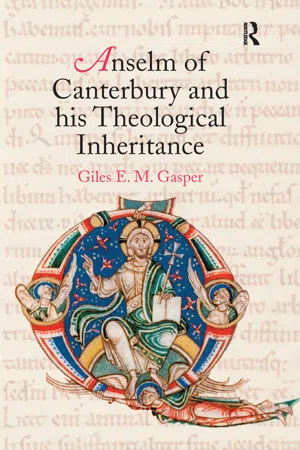
Anselm of Canterbury is one of the most famous of medieval Christian thinkers, who left a considerable political and intellectual inheritance of his own. This book reveals that the theological and intellectual inheritance available to Anselm was more dynamic, broader and deeper than is traditionally thought and Anselm was influenced by more than just the works of St Augustine. Giles Gasper focuses particularly on the part played by the translated works of the Greek Fathers. Demonstrating how widely the writings of the Fathers of the Church were available in western libraries, Gasper goes on to compare key aspects of doctrine in Anselm's thought with that of the notable Greek Fathers. Questioning the way in which Anselm and other authors have been described, this book moves away from well worn routes of interpretation and provides new perspectives on this most significant figure in the history of the church, the middle ages, and western thought.
- 224 pages
- English
- ePUB (mobile friendly)
- Available on iOS & Android
eBook - ePub
Anselm of Canterbury and his Theological Inheritance
About this book
Information
Chapter 1
Introduction
The student of Anselm is bound to be apprehensive when writing yet another commentary on his works. The sheer volume of material produced on the influence and persuasiveness of the ontological argument is enough to warrant caution to any potential pupil. Work on Anselm’s doctrine of the atonement is no less daunting since it too has yielded a prodigious amount of scholarship in the nine hundred years since its formulation. As for the amount of work that has been done on his monastic context, not to mention the political or social context, here too the reader discovers an embarrassment of riches. What reason, then, could anyone have for turning up what already appears to be well-tilled soil?
Perhaps the best way to answer this question, and to extend the metaphor, is to look at the whole landscape. It is indeed true that the fields of Anselm’s inquiry concerning the existence of God and the atonement have been well worked, but if we were to raise our eyes to the surrounding fields I would venture to argue that they have been left largely untouched. The advantage of this is that there is a richness in the terrain of these texts which has perennated due to the abeyance of activity surrounding them. The disadvantage is that without the wider landscape of Anselm’s thinking in view, we run the risk of failing to appreciate the tenor of his writing and the essence of his thinking. The attending consequences run the gamut from interpretations which are anachronistic to those which, while representing Anselm’s thought well, present an asymmetric view because of their lack of breadth.
Anselm’s theory of the atonement, for instance, might be slighted for not taking adequate account of the Trinity. His Proslogion is notoriously refuted on the basis of presuppositions deemed out of date and out-moded. As apparently legitimate as these sorts of criticisms may appear, one wonders to what degree those making such claims have tried to enter Anselm’s context and ask their questions in the light of an agenda that stretches over a lifetime. Should we, for example, understand the Cur Deus Homo as an occasional work or one whose fullness can best be appreciated when it is set beside the Monologion (Chapter 39 and following, in particular)? And is our understanding of the Trinity as it relates to the incarnation which expedited the atonement enhanced by our reading of the Proslogion wherein we discover not the mere existence of God, but the nature of the God in whom all things live and move and have their being?1
Clearly, the minutiae of Anselm’s arguments need to come under scrutiny but can we expect just adjudication apart from a comprehensive perscrutation? Gillian Evans’ echo of J. McIntyre’s lament of more than forty years ago is still true. There has been a proliferation of interest in Anselm’s doctrine of the atonement and the philosophy that lies behind the Proslogion ‘almost to the exclusion of his views on the Trinity, the attributes of God, the procession of the Holy Spirit, free will and predestination’.2 Granted, any given work in Anselm’s corpus has a certain autonomy, but is it not also the case that the more the reader is aware of his wider literary output, the better he or she will be at understanding and interpreting his thought?
As we shall see, the literary context in which Anselm was writing was so thoroughly infused with a particular model of reality and a way of interpreting sensible data in the light of revealed truth that we cannot afford to neglect it. This is, of course, not a popular position to espouse, as the range of articles and monographs that have been written on, for instance, the Proslogion testify. Occasionally, references are made to chapters fourteen and fifteen, and every now and again a few comments are made about the genre of prayer throughout the text, but, on the whole, the interest has been keenly focused on chapters two, three and four. Now it could be argued that that is where the emphasis rightly belongs since it is on the basis of the logic in those introductory chapters that the rest of the work seems to flow, but what if the reverse is true? What if the argument (or arguments, depending on who is doing the interpreting) in chapters two through four is not constituent for the rest of the work, but it is, in fact, the revelation outlined in chapter one and expanded in chapters five through twenty-six that provide the groundwork for the kind of argument forwarded in chapters two through four? In other words, is it possible that those who neglect to take the time to study the model of reality evident in the larger body of Anselm’s writings (as well as those of contemporary and earlier scholars) will ultimately supply unsuccessful expositions which not only distort a part, but also misrepresent the whole?
The answer to this question will be based on the merits of each source as it is introduced into the discussion, but on the whole it is true that our modern context has coloured our understanding of medieval concepts. It is, after all, characteristic of our mindset to prefer logical progression to proceed sequentially from one proposition to the next. The question is, did the medieval mind work in the same fashion? The best answer is probably yes and no. Yes, it is true that medieval theologians and philosophers3 framed their arguments in logical sequences of propositions; but no, this was not always the exclusive nor even the most desirable means of expressing an argument or idea.
What other way is there, then, of presenting an argument? One characteristically medieval way of communicating truth and expressing ideas is found in the repeated appeal to an undergirding aesthetic ideal. It is the presupposition of beauty and fittingness as displayed in the proportion and harmony between the creator and creation that, to the medieval mind, provides the only basis on which any proposition or series of propositions can be made. Consider, for instance, Boethius’ Consolation of Philosophy. In that work Boethius allows his mind to range over a number of perplexing problems associated with his unfortunate circumstances. He discusses the apparently hapless nature of fortune and fate and questions the extent of divine intervention and manipulation in human affairs. He addresses the problematical relationship between the foreknowledge of God and human freedom. His musings with Lady Philosophy are remarkably succinct yet detailed, but undergirding everything Boethius says is his continual appeal to order, goodness, beauty, symmetry and balance.
In his investigation into what constitutes false happiness, Boethius contrasts the eternal beauty and order of the ‘vault of heaven’ with the fleeting beauty of that found in humanity.4 The preceding arguments in favour of happiness as the world so often defines it all crumble before the immutable rule of order and beauty that transcends the mutable, fickle, transitory equivalent that we see within and around us. It is necessary, Boethius claims, that in order to make sense out of the multifaceted nature of reality, with all its complexities and conundrums, there must be something, indeed, someone, who holds it all together:
Nature’s fixed order could not proceed on its path and the various kinds of change could not exhibit motions so orderly in place, time, effect, distance from one another, and nature, unless there was one unmoving and stable power to regulate them. For this power, whatever it is, through which creation remains in existence and in motion, I use the word which all people use, namely God.5
A little further on, Boethius asserts that
… since we are right in thinking that God controls all things by the helm of goodness, and all things, as I have said, have a natural inclination towards the good, it can hardly be doubted, can it, that they are willingly governed and willingly obey the desires of him who controls them, as things that are in harmony and accord with their helmsman.6
Harmony and accord, order and beauty: these are the pillars on which Boethius built his philosophy for, ultimately, ‘a thing exists when it keeps its proper place and preserves its own nature. Anything which departs from this ceases to exist, because its existence depends on the preservation of its nature.’7 How does one exist? How, as Boethius asked earlier on, do we attain perfection? How do we achieve true happiness? Where can meaning be found in a chaotic world? These are the questions which, to Boethius’ way of thinking, cannot be answered by well-ordered and proven propositions. This is because in the medieval mind logic does not provide the basis upon which we order the world, but order, as guaranteed by the nature of God who created in his own image and sustains by his own power, is the necessary prerequisite for logic.
Inverting our thinking in this way is necessary if we are to grasp the purport of medieval theological writing. As Evans points out in her book on theology and philosophy in the Middle Ages, Boethius’ Consolation is representative of a pattern wherein the world is viewed as chaotic in its sin, and thus needs to be restored to order, balance and due proportion. That was what Boethius was trying to accomplish in his work; that is part of what Bede was doing when he wrote his History,8 and that is what Pseudo-Dionysius was doing when he wrote:
This – the One, the Good, the Beautiful – is in its uniqueness the Cause of the multitudes of the good and the beautiful. From it derives the existence of everything as beings, what they have in common and what differentiates them, their identicalness and differences, their similarities and dissimilarities, their sharing of opposites, the way in which their ingredients maintain identity, the providence of the higher ranks of beings, the interrelationship of those of the same rank, the return upward by those of lower status, the protecting and unchanged remaining and foundations of all things amid themselves. Hence, the interrelationship of all things in accordance with capacity. Hence, the harmony and the love which are formed between them but which do not obliterate identity. Hence, the innate togetherness of everything. Hence, too, the intermingling of everything, the persistence of things, the unceasing emergence of things. Hence, all rest and hence, the stirrings of mind and spirit and body. There is rest for everything and movement for everything, and these come from that which, transcending rest and movement, establishes each being according to an appropriate principle and gives each the movement suitable to it.9
Any goodness, beauty or order that we see around us is due to God’s sustaining presence, and any deviation, ugliness or disorder is due to sin, but can be remedied through a new creation effected by God. This, as we will see, is part of Anselm’s agenda in writing the Cur Deus Homo. He is not merely interested in outlining an objective view of the atonement, nor simply engaged in explaining the necessity for penal substitution or vicarious suffering. The overarching impression Anselm leaves on the reader of the Cur Deus Homo is that God is a God of order, harmony and beauty, and he must and will act in accordance with those aspects of his nature. Thus, the different words and expressions Anselm uses to describe fittingness, order or beauty become central to any study of that work.
Evans evinces her inclination in this direction in a footnote when she comments that the use of convenientia and decentia ‘occur often enough in the Cur Deus Homo for it to seem likely that “fittingness” was an important consideration in Anselm’s mind throughout the writing of the work’.10 She later expands on this when she claims that the arguments Anselm offers in the first few books of the Cur ...
Table of contents
- Cover
- Half Title
- Title Page
- Copyright Page
- Table of Contents
- Preface
- Acknowledgments
- 1 Introduction
- 2 The Beatific Vision: The Ecstasy of Thought and Prayer
- 3 Words: Neither Void nor Vain
- 4 Justifying the Ways of God to Men
- 5 In Dialogue with the Divine
- 6 ‘Nailed to the racking cross … So did I win a kingdom’
- 7 Conclusion
- Bibliography
- Index
Trusted by 375,005 students
Access to over 1.5 million titles for a fair monthly price.
Study more efficiently using our study tools.
Frequently asked questions
Yes, you can cancel anytime from the Subscription tab in your account settings on the Perlego website. Your subscription will stay active until the end of your current billing period. Learn how to cancel your subscription
No, books cannot be downloaded as external files, such as PDFs, for use outside of Perlego. However, you can download books within the Perlego app for offline reading on mobile or tablet. Learn how to download books offline
We are an online textbook subscription service, where you can get access to an entire online library for less than the price of a single book per month. With over 1.5 million books across 990+ topics, we’ve got you covered! Learn about our mission
Look out for the read-aloud symbol on your next book to see if you can listen to it. The read-aloud tool reads text aloud for you, highlighting the text as it is being read. You can pause it, speed it up and slow it down. Learn more about Read Aloud
Yes! You can use the Perlego app on both iOS and Android devices to read anytime, anywhere — even offline. Perfect for commutes or when you’re on the go.
Please note we cannot support devices running on iOS 13 and Android 7 or earlier. Learn more about using the app
Please note we cannot support devices running on iOS 13 and Android 7 or earlier. Learn more about using the app
Yes, you can access Anselm of Canterbury and his Theological Inheritance by Giles E.M. Gasper in PDF and/or ePUB format, as well as other popular books in Theology & Religion & Religion. We have over 1.5 million books available in our catalogue for you to explore.