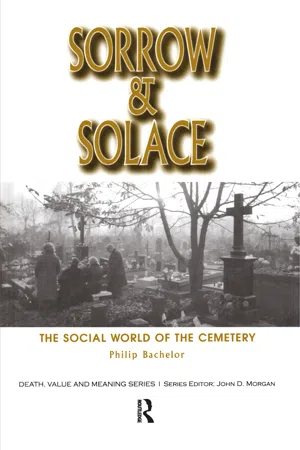
Sorrow and Solace focuses on the importance of cemeteries in the lives of everyday mourners, and ways in which our bereaved give meaning to and draw value from their commemorative activities. The death of someone dear to us is among the most momentous life event that we experience. In many societies, visiting the grave or memorial is a common behavioural response to bereavement. Memorial sites provide vital connections to our deceased loved ones with whom we wish to maintain ongoing social bonds, and cemeteries are crucial places of deep healing and growth. Millions of visits are made to cemeteries every day, but the extent of this activity and its value to those who mourn - the topics of this volume - have long remained largely unrecognised. Large urban memorial parks are hives of activity for recently bereaved persons, and are among the most visited places in Western communities. Some cemeteries, hosting millions of annual visits, are more popular than many major tourist attractions. Cemetery visitation is a high-participatory, value-laden, expressive activity, and a most significant observable behaviour of the recently bereaved. This work will be invaluable to those seeking a scholarly understanding of bereavement, mourning, and commemoration. Written principally for professionals with a tertiary educational interest in related fields, such as grief educators, nurses, palliative carers, and social workers, it is also an important resource for the further education of other carers and service providers, including psychologists, physicians, counsellors, clergy, funeral directors, cemetery administrators, and monumental masons. The book is also a significant contribution to the field of social anthropology.
- 198 pages
- English
- ePUB (mobile friendly)
- Available on iOS & Android
eBook - ePub
About this book
Information
Part C
In Part B, we reviewed major findings of the quantitative cemetery Visitation Study, identified the volume of cemetery visits, common visitation patterns, and general social and cultural significance of visitation.
Part C now presents key findings of the qualitative Bereavement Study, and identifies personal values of the cemetery to mourners within different social and cultural contexts. This part considers reasons for visitation and non-visitation, major activities and emotions of visitors, and what visitors feel about their frequency of visitation and its role in working through grief.
Chapter 8
Visitation Reasons
This chapter presents an account of self-reported common reasons why mourners actually visit cemeteries. The Bereavement Study revealed that there are three principal reasons and several less-significant reasons for visitation, as well as several reasons for not visiting [1]. The principle reasons for visiting are to fulfill a sense of obligation, to maintain a significant emotional bond, and to seek solace from the emotions of grief.
Of 27 informants in the Bereavement Study, four were non-visitors and 22 discussed their reasons for visiting and/or reasons for not visiting.
Obligation
Two-thirds of those interviewed in the Bereavement Study referred either directly or indirectly to a sense of obligation toward visiting the grave or memorial of a loved one. Such a perceived obligation may be felt to the decedent, the family, or to the visitor him/herself; or it may relate to the expectations of others. Other reasons for visiting that relate to a sense of obligation include a religious duty, some perceived duty of respect, and an inexplicable innate compulsion to visit.
The following verbatim comments illustrate typical sentiments expressed toward fulfilling a sense of obligation or duty, respectively to the decedent, the family, and to one’s self.
I’11 keep going; I promised my father I’d keep going for him.47-year-old, Australian daughter of no specific faith, bereaved 5 months
At first after she died, every time I drove past, I used to feel that I had to go, otherwise I was somehow letting the side down.62-year-old, Australian non-religious husband, bereaved 4½ years
I think it is perhaps a sense of duty that I feel to go there now. I feel it’s a duty to me, because—it’s a silly thought—if you don’t go, you feel that you’re forgetting the person.45-year-old, Australian non-religious female secret-lover, bereaved 3years
An obligation can also relate to fulfilling a perceived expectation of others, as expressed in the study by two non-religious husbands. One of these men expressed his feelings this way:
In the beginning, people expect you to go there. If I were really truthful, I’d probably have to say that most of the times I went were because people expected me to. To be honest, I felt a bit guilty if I hadn’t been when people thought I should have. Now I go when I want to go: when I feel like it, and not when other people think I should be going.51-year-old, Australian non-religious husband, bereaved 2 months
Several other mourners spoke of their religious duty to visit, including two Italian Catholic widows who both considered that their faith plays a significant role in the frequently of their visits.
The Catholic thing to do is go once a week. It is a religious obligation and a duty to [my husband] and to God.70-year-old, Italian Catholic wife, bereaved 3 years
Of course, that’s what you feel. That’s why you go into the cemetery, because if not that feeling, well what for do you go?66-year-old, Italian Catholic wife, bereaved 5 years
However, a somewhat less-traditional younger man revealed that not all Italian Catholic mourners feel the same obligation:
I don’t visit out of any religious obligation, purely out of a feeling that I should see Dad.40-year-old, Italian Catholic son, bereaved 3 years
Although neither Roman Catholicism nor Islam specifically encourages or discourages cemetery visitation, to some bereaved adherents of both faiths, some perception of a religious obligation to visit evidently does exist.
A special day for Muslims on Fridays. ... It is very important to be there, especially on Fridays. I come every Friday, and sometimes on Sundays or Saturdays.52-year-old, Turkish Muslim father, bereaved 14 months
As discussed in the previous chapter, Judaism requires appropriate cemetery visitation to be observed, including avoidance of the extremes of constant visitation and neglect. Graves are to be visited at proper times, including days of significance, but not holy days. Accordingly, a Jewish informant in the Bereavement Study advised that:
After a funeral, the immediate family is not permitted to go to the cemetery for thirty days or four weeks, so as a family, we all went four weeks later. After the thirty days, we have a special service.... Jewish law actually states that it is more important to go to the cemetery on important days like birthdays, memorial days, prior to high holidays and the anniversary of the death. It is not required to go daily, weekly or on a fortnightly basis and have a routine. Some people would actually condemn frequent visitation to the cemetery.37-year-old, Australian Jewish sister, bereaved 8 months
But no Protestant Christians in the study considered their cemetery visitation to be at all influenced by their faith.
A few mourners commented on a perceived duty of respect as a reason for visiting the cemetery.
I sort of felt that somehow it would be disrespectful, selfish, in bad taste, not to go in there. . . . There’s not a sense of visiting her, but there is a sense of duty done and respecting a memory: of ensuring that anybody else who goes there will see that the memory is respected and not neglected.62-year-old, Australian non-religious husband, bereaved 4½ years
Some people identified respect as a reason for paying secondary visits to other relatives, while they were in the cemetery primarily to visit a specific closer relative.
I sometimes do the rounds of the family, but that’s more out of respect than anything else, if I’ve got time.... I would’ve gone to visit my grandparents just purely through respect, but with my father, it’s a bit more. There is more emotion attached to the visit, because it’s my father.40-year-old, Italian Catholic son, bereaved 3 years
Compulsive visitation was identified among several mourners, most of whom were mothers.
I have to come and see him; I have to look after him. ... I have to do something. I can’t do anything for him at home, so I have to come and just talk to him. People might think I’m being silly. But quite frankly, I don’t care what people think. That’s my child there, and this is the last thing I can do for him.33-year-old, Australian Catholic mother, bereaved 2 years
But the reports of some others reveal that this behavior is not just limited to mothers.
I go every day, and it just helps me to sleep.66-year-old, Maltese Catholic husband, bereaved 4½ years
Within the study, compulsive visitation appeared more common shortly after the loss of a child or a spouse, but was also found to persist in cases of complicated mourning and chronic grief.
Emotional Bond
More than half of those in the Bereavement Study who visit a cemetery discussed issues pertaining to their maintenance of a significant emotional bond with the decedent. Talking to the decedent, maintaining the monument, and placing gifts were the most commonly expressed graveside activities undertaken by mourners toward maintaining emotional bonds.
I’m just his Mum. It’s my motherly instinct to look after him and to make sure everything’s well maintained and pretty, just as if he was at home, where I could look after him. That mother/child bond will always be there. I mean, I gave birth to him and I’ve got to do what I can for him—and for myself.33-year-old, Australian Catholic mother, bereaved 2 years
I come to the cemetery everyday purely because—well, [my wife] and me have been together for close to forty-eight years, so I just want to be with her for a few minutes—no other reasons.66-year-old, Maltese Catholic husband, bereaved 4½ years
It’s like the only place that I could identify in a physical sense with the last existence of hi...
Table of contents
- Cover
- Title Page
- Copyright Page
- Table of Contents
- Acknowledgements
- Introduction
- Part A
- Part B
- Part C
- Glossary
- Index
- About the Author
Trusted by 375,005 students
Access to over 1.5 million titles for a fair monthly price.
Study more efficiently using our study tools.
Frequently asked questions
Yes, you can cancel anytime from the Subscription tab in your account settings on the Perlego website. Your subscription will stay active until the end of your current billing period. Learn how to cancel your subscription
No, books cannot be downloaded as external files, such as PDFs, for use outside of Perlego. However, you can download books within the Perlego app for offline reading on mobile or tablet. Learn how to download books offline
Perlego offers two plans: Essential and Complete
- Essential is ideal for learners and professionals who enjoy exploring a wide range of subjects. Access the Essential Library with 800,000+ trusted titles and best-sellers across business, personal growth, and the humanities. Includes unlimited reading time and Standard Read Aloud voice.
- Complete: Perfect for advanced learners and researchers needing full, unrestricted access. Unlock 1.5M+ books across hundreds of subjects, including academic and specialized titles. The Complete Plan also includes advanced features like Premium Read Aloud and Research Assistant.
We are an online textbook subscription service, where you can get access to an entire online library for less than the price of a single book per month. With over 1.5 million books across 990+ topics, we’ve got you covered! Learn about our mission
Look out for the read-aloud symbol on your next book to see if you can listen to it. The read-aloud tool reads text aloud for you, highlighting the text as it is being read. You can pause it, speed it up and slow it down. Learn more about Read Aloud
Yes! You can use the Perlego app on both iOS and Android devices to read anytime, anywhere — even offline. Perfect for commutes or when you’re on the go.
Please note we cannot support devices running on iOS 13 and Android 7 or earlier. Learn more about using the app
Please note we cannot support devices running on iOS 13 and Android 7 or earlier. Learn more about using the app
Yes, you can access Sorrow and Solace by Philip Bachelor in PDF and/or ePUB format, as well as other popular books in Social Sciences & Emotions in Psychology. We have over 1.5 million books available in our catalogue for you to explore.