- 127 pages
- English
- ePUB (mobile friendly)
- Available on iOS & Android
eBook - ePub
About this book
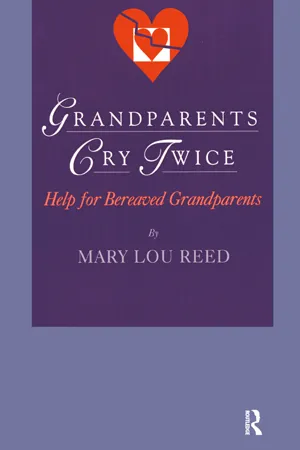
"Grandparents Cry Twice: Help for Bereaved Grandparents" is a book about grandparents' dual sorrow when a grandchild dies. They cry for their lost grandchild and they also cry for the terrible grief they see their own child having to bear. The author, Mary Lou Reed, writes of her experiences when her beloved grandson, Alex, died. Through her personal story she touches the universal in all grandparents' grief.
Information
Chapter 1
MY GRANDSON’S LIFE AND DEATH
The Soul that rises with us, our life’s Star,
Hath had elsewhere its setting,
And cometh from afar:
Not in entire forgetfulness,
And not in utter nakedness,
But trailing clouds of glory … [1, p. 348].
William Wordsworth
On a shelf above my computer I keep a photograph of my grandson Alexander holding his newborn sister, Stephanie, both enclosed in their mother Andrea’s arms. Alex looks directly out of that photo and seems to make eye contact with me. Most days I enjoy looking at that picture. Often my heart hurts. It is the last photograph I took of Alex before he died on Saturday, June 17, 1989. The next day was Father’s Day.
Born December 30, 1986, the second son of my second son, David, Alex appeared at birth, and for more than two years, to be a healthy baby with no evidence of his fatal genetic defect. His strawberry blonde hair and large blue eyes made him a poster boy in this grandma’s eyes. At birth, and throughout his too short life, I thought Alex to be perfect, the consummate example of Wordsworth’s suggestion that we come, “trailing clouds of glory.” If anyone doubts that statement, he has only to verify it with all the people I badgered with photos and anecdotes.
I had eagerly awaited Alex’s birth as he was to be the first new baby for our family in almost seven years. Starr, the daughter of my eldest son, had just turned eight. Curtis, David and Andrea’s first child, was six-and-a-half years old. I already felt blessed with two grandchildren as the Christmas holiday season approached in 1986. Since David and Andrea expected their new baby close to the first of the year, my husband, Frank, and I decided to travel to California to celebrate the holidays with them. Frank needed to return to work shortly after Christmas, but Alex’s maternal grandfather, Jim, and I remained to await the new baby’s birth.
Alex and his mother came home the first day of January 1987—an exciting way to celebrate the beginning of the New Year. We all enjoyed holding, talking, and singing to Alex, and sometimes just leaning over the crib to watch him sleep. Holding him and rocking in front of the fireplace while listening to Mozart remains one of my fondest memories of those first days of his life.
Curtis’ excited anticipation and then his enjoyment of his sibling became a source of mutual satisfaction for both boys and many photo opportunities for me. As Alex grew and developed, our enjoyment with him did not fade. He was a bright, amusing, and charming child. Our sense of delight in him came, not only due to our long wait for his arrival, but because of his sweet and beguiling personality. He also slept all night most nights, and as his father would say, “he wakes up happy.” On one of my visits I awoke to babbling baby sounds as Alex played in his crib (he would play with his crib toys for a long time in the mornings). I took him out of his crib to snuggle with me in my bed. Curtis joined us there, and the three of us made a lasting memory.
During Alex’s first year, his parents lived in an area close to a rugged canyon park. Curtis and I derived immense joy from the enchanting times with Alex out in his stroller, bouncing over the rough, leaf-strewn ground. Alex’s obvious thrill with the trips and his interest in the natural world made those trips special. Even as a small baby Alex seemed to see incredibly well and responded with excitement to all sorts of sights, especially birds and planes in the sky.
Alex loved the outdoors, also a favorite place of mine. The hummingbird exhibit at the San Diego Zoo enchanted both of us. He also visited our home when his family traveled to our home during the Christmas holidays of 1988. That trip gave me great pleasure and ultimately became the only time Alex visited our house. My memory of Alex being in our home remains important to me.
During his short life, Alex had the opportunity to experience a number of unusual places and events. For a child growing up in southern California, Alex had the rare adventure of seeing a snowstorm. The storm occurred during the period I stayed with him and Curtis (in February prior to his death in June) while their parents attended a business meeting. The boys and I often went to a local park to play when Curtis came home from school. One of those days we chased snowflakes. Alex ran about and squealed with happiness while trying to catch the elusive flakes, looking in surprise at the wet spot left when he did. The next morning we awoke to a winter wonderland of snow. Covering trees, bushes, and ground, the snow brought an expression of amazement and questioning to Alex’s big blue eyes.
One of my most poignant recollections of Alex comes from when he was about six months old. While I held him, his mother and I, both RNs, talked about some of our maternity ward experiences. I clearly remember commenting, “With all the things that can go wrong it is amazing how often babies are born perfect, like this one.” We had no suspicion of what would eventually happen to our perfect baby.
When baby Stephanie arrived on April 29, 1989, the family rejoiced. Alex would say, “My baby” as he hovered over her. Soon after I had returned home from being with his family for Stephanie’s birth, Alex became ill with cold/flu-like symptoms. One evening his parents called to tell us he had spiked a very high fever. We were all alarmed. I can still remember the stab of cold fear I felt in my heart.
Diagnosed originally as having an ear infection and placed on antibiotics, Alex improved somewhat—a pattern that would continue until the last day of his life. In this day of modern medicine and antibiotics, we were confident he would get well. The physician treating Alex assured his parents, “It’s just a virus.” When the high fever returned and he became sicker, he was diagnosed as having mononucleosis caused by the Epstein-Barr virus. Supportive-care only was prescribed, because, the doctor said, “a viral infection has to run its course.” Alex improved somewhat, then again got sicker. When examined on May 31, he was dehydrated; the doctor felt he needed to be hospitalized. Following Alex’s admittance to a local hospital, a routine blood examination revealed he had no white blood cells. He was transferred immediately to a hospital with a critical care unit.
Numerous tests were done the day following Alex’s admittance to Pediatric Intensive Care. Large amounts of antibiotics and whole blood were administered, since he had, for all intents, no immune system at that moment and had two streptococcus infections superimposed on the mononucleosis. Leukemia was considered. A bone marrow biopsy proved nega- tive. That good news, received three days after Alex’s admit- tance and on his parents’ wedding anniversary, seemed propitious; and our hopes rose.
Because some people develop a severe hepatitis as Alex did from mononucleosis, there is a small mortality rate, but Alex seemed well on his way to recovering after only four days in Intensive Care. He was moved to a ward bed, but his fever and diarrhea continued unabated, which was certainly enough to make anyone exhausted and irritable as he continued to be. When he did not improve after a week and then had some respiratory difficulties stemming from his enlarged liver and fluid in his abdomen, he was readmitted to Pediatric Intensive Care. Further tests were done, experts were consulted. We were all frightened.
At this time a suspicion of a genetic defect began to be discussed. Andrea had had a brother die about thirty years earlier at about the same age as Alex from an undiagnosed infection, despite antibiotics. Unable to reverse the effects of the Epstein-Barr infection, or to make a definitive diagnosis, Alex’s doctors considered the possibility Alex suffered from x-linked lymphoproliferative disease. Also known as Duncan’s syndrome, it is a disease with a 100 percent fatality rate for infants. (It would be a year after Alex died before a definitive diagnosis was made.) The genetic defect had made it impossible for Alex to develop any antibodies to the Epstein-Barr virus that overran his body.
During Alex’s hospitalization, we saw many children admitted and discharged from Pediatric Intensive Care. We were witnesses to the incredible, searing grief of parents whose child had died from drowning. We often became bystanders to the drama and the frenetic pace of a full Pediatric Intensive Care, and the seemingly near-miraculous recoveries of seriously-ill children. We had expected no less for Alex. It was not to be.
A little over two weeks after his admittance to the hospital, Alex had a seizure on Thursday morning and became unconscious. As his systems degenerated, the medical personnel worked valiantly to save his life. Unfortunate side effects of those efforts included swelling of his head, and the extreme imbalance in his blood chemistry caused bleeding. When I went to visit him on Friday evening, I found David reading a book to Alex and wiping blood from his nostrils. It is an image that will remain forever in my memory.
By Saturday evening, Alex’s body could no longer sustain his spirit. When all the heroics proved futile, the medical staff undid all the tubes and lines and lifted Alex into David’s arms to hold. Just as they did that, his weary little heart stopped. David sat and held him for quite some time and we each had an opportunity to touch, stroke, smell him, and tell him how much we loved him.
Alex had given us something very precious; contact with the love within us. When he died, however, I felt like I had been dropped into a pit of unspeakable emotions. How could Alex’s parents, brother Curtis, and baby Stephanie endure this terrible loss? How were we going to survive?
REFERENCE
1. W. Wordsworth, Ode: Intimations of Immortality from Recollections of Early Childhood, in A Treasury of the Familiar, Consolidated Book Publishers, Chicago, 1942.
Chapter 2
OUR FAMILY’S GRIEF
… And as he was dreaming, an angel song
Awakened our Little Blue
Oh, the years are many, the years are long,
But the little toy friends are true.
Aye, faithful to Little Boy Blue they stand,
Each in the same old place,
Awaiting the touch of a little hand,
And the smile of a little face.
And they wonder, as waiting these long years through,
In the dust of that little chair,
What has become of our Little Boy Blue
Since he kissed them and put them there [1, p. 603].
Eugene Field
How we longed to feel “the touch of a little hand” and see “the smile of a little face.” Stunned by the enormity of our loss, we not only “wondered” but wandered.
With great difficulty, we packed Alex’s clothes, blankets and toys, our belongings, and numerous other things accumulated during those two-and-a-half weeks David, Andrea, baby Stephanie and I lived in a hospital room to be near Alex. I drove one of their cars on that long trip to their home. Curtis rode with me, and I was glad to have him.
I have always felt emotionally close to my son’s family. When Curtis was born they had lived in the same city as us and Andrea’s parents. Several years after Curtis’ birth, Andrea’s mother died, and I became “mom” to both Andrea and David. When they moved to another state, I helped them move and then visited there often.
During my life I had been proud of my supporting capabilities as a wife, mother, grandmother, and nurse. Now, following Alex’s death, my own hurt felt terrifying. The help- lessness I felt watching my son and daughter-in-law’s anguish compounded my sense of inadequacy. My powerlessness to even mollify, much less alleviate, the pain from their incomprehensible loss heightened my sense of confusion. A long way from home, I felt isolated, bewildered, and overwhelmed.
Unable to soften my children’s suffering, all I could think to do was continue to be with them and attend to the necessary routines of life. With Andrea’s father with us, we had four adults and two children in the house, and my husband was on the way. Ordinary tasks such as unpacking, laundry, and food-preparation seemed essential.
“There is a reason women cook in the presence of death,” mystery writer Christine Andreae says, “why we bake hams and zucchini bread and cupcakes brightly dotted with M&Ms for the children. It not only grounds us in the deepest rhythms of life, it is also a discipline and, like any discipline, it can serve as a shield” [2, p. 45]. While I did not “bake hams and zucchini bread and cupcakes,” I kept busy doing routine chores. Laundry, cleaning up the house, answering phone calls, and taking care of Curtis and baby Stephanie helped to shield me from the horror of Alex’s death.
His death could not be denied constantly, however. One example of coming face-to-face with the reality of his death often involved caring for baby Stephanie. Andrea and I had sorted Alex’s baby clothes in preparation for her arrival. Often when we went to dress her, we wound find those clothes, and weep. Amidst our agony, however, baby Stephanie continued to be a constant source of love.
My emotions fluctuated those first hours and days after Alex’s death, between the joy and wonder of our newborn Stephanie and what felt like annihilating pain. When I wasn’t actively grieving for Alex, I ached for my children. Later I found a poem expressing those emotions:
The stars are not wanted now; put out every one,
Pack up the moon and dismantle the sun,
Put away the ocean and sweep up the woods;
For nothing now can ever come to any good [3, p. 141].
When I found David sobbing on Alex’s bed, the break in my heart opened wider. And then it broke some more when I watched David carry Alex’s tricycle up to his room. He had just learned to ride it while we awaited Stephanie’s arrival.
David’s action proved useful. Everywhere we found innumerable reminders of Alex—a toy, a book, a shoe, a coat, a cup, photos. We followed David’s example by picking up those articles and putting them in Alex’s room. We soon became aware of John Irving’s meaning:
When someone you love dies, and you’re not expecting it, you don’t lose (him) all at once; you ...
Table of contents
- Cover
- Title Page
- Copyright Page
- Prologue Letters for Curtis
- Table of Contents
- Introduction
- Chapter 1 My Grandson’s Life and Death
- Chapter 2 Our Family’s Grief
- Chapter 3 My Search for Help
- Chapter 4 The Grief Process
- Chapter 5 Helping Myself
- Chapter 6 Helping Our Grieving Child
- Chapter 7 Sibling Grief and Needs
- Chapter 8 In Memory: Memorials and Healing Rituals
- Chapter 9 How Others May Help/Hinder
- Chapter 10 Finding My Way
- Epilogue
- Appendix I Selected Poems
- Appendix II Resources
- Bibliography
- Index
Trusted by 375,005 students
Access to over 1.5 million titles for a fair monthly price.
Study more efficiently using our study tools.
Frequently asked questions
Yes, you can cancel anytime from the Subscription tab in your account settings on the Perlego website. Your subscription will stay active until the end of your current billing period. Learn how to cancel your subscription
No, books cannot be downloaded as external files, such as PDFs, for use outside of Perlego. However, you can download books within the Perlego app for offline reading on mobile or tablet. Learn how to download books offline
Perlego offers two plans: Essential and Complete
- Essential is ideal for learners and professionals who enjoy exploring a wide range of subjects. Access the Essential Library with 800,000+ trusted titles and best-sellers across business, personal growth, and the humanities. Includes unlimited reading time and Standard Read Aloud voice.
- Complete: Perfect for advanced learners and researchers needing full, unrestricted access. Unlock 1.5M+ books across hundreds of subjects, including academic and specialized titles. The Complete Plan also includes advanced features like Premium Read Aloud and Research Assistant.
We are an online textbook subscription service, where you can get access to an entire online library for less than the price of a single book per month. With over 1.5 million books across 990+ topics, we’ve got you covered! Learn about our mission
Look out for the read-aloud symbol on your next book to see if you can listen to it. The read-aloud tool reads text aloud for you, highlighting the text as it is being read. You can pause it, speed it up and slow it down. Learn more about Read Aloud
Yes! You can use the Perlego app on both iOS and Android devices to read anytime, anywhere — even offline. Perfect for commutes or when you’re on the go.
Please note we cannot support devices running on iOS 13 and Android 7 or earlier. Learn more about using the app
Please note we cannot support devices running on iOS 13 and Android 7 or earlier. Learn more about using the app
Yes, you can access Grandparents Cry Twice by Mary Lou Reed in PDF and/or ePUB format, as well as other popular books in Medicina & Salute mentale in psicologia. We have over 1.5 million books available in our catalogue for you to explore.