- 181 pages
- English
- ePUB (mobile friendly)
- Available on iOS & Android
eBook - ePub
About this book
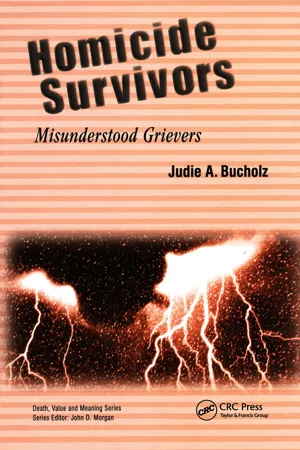
"Homicide Survivors: Misunderstood Grievers" is about families that have faced murder and how they have dealt with the trauma. It offers an interpretation of personal accounts of homicide survivors in order to understand the particular nature of homicide bereavement. The author herself a homicide survivor, Judie Bucholz offers a unique perspective and experiential base for examining the phenomenon of homicide bereavement. Her intent is to help the reader understand the homicide griever's situation both as one who grieves and one who grieves within a social context, as one who confronts horrific death at the personal level as well as at the social level.
Information
Part One
Our Stories
The following ten chapters contain real stories of homicide survivors. The names have been changed but the circumstances remain the same. The survivor's own words have been used to depict his or her experience. Some of the stories are slightly graphic and may cause some emotional discomfort. These stories are typical of what homicide survivors experience. More horrific stories are heard at national Parents of Murdered Children (POMC) conventions, at National Victims Week celebrations, or seen in various grief chat rooms on the World Wide Web. The following stories are real stories from homicide survivors that I interviewed.
Chapter One
Jack
Jack is a pleasant man who loves to talk. He is 54 years old, married with three children and four grandchildren. He lives just outside a small city in a neighboring state nearly an hour from where I live. When he found out I was interested in doing qualitative research on homicide survivors he readily agreed to be interviewed, in fact he specifically asked to be included in the study. Jack felt that by sharing his story he might "help someone else." We agreed to meet half way between his home and mine at a local truck stop. Jack wore a Parents of Murdered Children (POMC) baseball cap and brought newspaper articles and pictures with him. The newspaper articles were about his granddaughter's murder and the trial that followed. The pictures were of his granddaughter Lisa. Jack was a truck driver for 17 years but is currently disabled and unable to work due to medical problems related to stress. He spends most of his time helping other homicide survivors by attending court hearings, explaining the judicial system and what the survivors can expect to happen, and by writing letters to keep perpetrators in jail for the maximum sentence allowed.
Jack's daughter's boyfriend killed his two-year-ten-month-old granddaughter Lisa in 1994. The boyfriend was watching Lisa at home while Lisa's mother was working the afternoon shift. Lisa was not the boyfriend's daughter. During the evening, the boyfriend called Lisa's mother at work to tell her Lisa was choking on something.
"He [the boyfriend] never admitted to it, he denied it from the word go, but he admitted to being the only one alone with her when it happened. He was the only one alone there when it happened and he tried to say she was choking to death on something but the pathologist, in his report, said that her [Lisa's] main artery had been ripped from her heart and her liver split in two. You're not going to get that from choking on something. He [the boyfriend] tried to say it happened from her falling on a toy three days earlier. The pathologist said with those kinds of injuries, she [Lisa] bled to death in five seconds. I believe Lisa was kicked so hard in the stomach that her artery was ripped from her heart and her liver was spilt in two."
Jack believes Lisa was a victim of child abuse at the hand of his daughter's boyfriend.
"I didn't think about it until afterwards, but the signs of child abuse were there. One time Lisa had a bruise on her forehead and the boyfriend said 'she slipped getting into the bathtub.' It was a plastic bathtub but we didn't think much of it at the time. Lisa was very active and kids get bruised from time to time. It happens. Wednesday Lisa had bruises to her chest area that he said were from her falling on a Barney train. Saturday morning she was dead. Maybe if we had paid more attention to what was going on, Lisa would be alive today. You just don't think people hurt little children."
The boyfriend was working when he met Lisa's mother but quit when he moved in with her. Later Jack found out the relationship between Lisa's mother and the boyfriend was troubled from the beginning. Jack's daughter kept that from him so Jack would not worry.
Jack was very close to his granddaughter; although he had other grandchildren, Lisa was his favorite grandchild. She was his first grandchild and his only granddaughter at that time.
With a huge smile and sense of pride he said, "She was my little buddy."
Jack talked about how Lisa would help him tinker around the house, build the deck out back, and she always wanted to go for a ride with Grandpa.
"We were like two peas in a pod. When I went somewhere she went with me and she even liked the Cleveland Browns." Jack laughed when he mentioned the Cleveland Browns. It is unusual for a Pennsylvania resident to rally for the Cleveland Browns and not the Pittsburgh Steelers.
Jack was devastated by Lisa's death because not only did he have to deal with the loss of his granddaughter, he had to try to comfort his daughter with the death of her only child by someone she loved.
"The first six months there could not have been any more pain. We grieved for the loss of our granddaughter and for our daughter's loss too. We were hurting for her [daughter]. She lost her daughter and her boyfriend. She was in so much pain; it was a double loss for us. You're not supposed to outlive your kids let alone your grandkids."
The boyfriend was apprehended and charged with Lisa's murder.
"For three days he [boyfriend] let us believe she choked on something. He even acted sad up until the police came to arrest him."
Having never been to a murder trial before, Jack and his family were not prepared for what happened. They were not prepared for the attack on Jack's daughter's lifestyle and reputation.
"It's as if she were on trial, instead of the real killer. They tried to make it sound like she was some kind of prostitute or something.
"In our state [Pennsylvania] when you kill someone under the age of 12 you're supposed to be charged with first-degree murder. But this was the judge's first murder case as a judge and he was a defense attorney before that. He kept so much information from the jury and I think he confused the jury when he explained intent to kill. The jury came back with a charge of third degree murder.
"The boyfriend was given 10 to 20 years. Ten to 20 years is not enough for taking another person's life, especially a child's life."
Jack talked about how he believes that after the boyfriend does the 20 years in jail he will come after his daughter. He is very concerned for his daughter's safety.
"This is a kind of guy who holds a grudge. I think he'll try to kill my daughter when he gets out.
"Even after the sentencing, the boyfriend's sister threatened to cut my daughter's throat because her brother was found guilty."
Jack's anger over his granddaughter's death, the pain and insults to his family during the trial, and the lenient punishment of the perpetrator has forever changed Jack's life. Jack was determined to prevent others from experiencing the same sense of aloneness that he and his family did after Lisa's death. He joined a Parent's of Murdered Children (POMC) and Other Homicide Survivors support group and a year later started a POMC support group in his own community.
After Lisa's death, Jack describes his experience as, "At first I was in a daze. I'd walk around and wouldn't know what I was doing. I was confused. I couldn't even think straight. Nothing made any sense. You're in constant pain."
"For over a year I was at the cemetery every day. It was the only way I could cope, I just wanted to be with her.
"When I was driving a truck, I'd have to pull off to the side of the road because I was so upset when I thought about her. At a truck stop I'd find a waitress, even if she didn't wait on me, and tell her what happened. I just had to have someone to talk to, someone to listen. Later on just helping other people has helped me with my own grief."
Jack faithfully and consistently assisted other homicide survivors by attending murder trials and sitting with the surviving families in the courtroom.
"Some people say just having someone there helped them deal with their pain. Sitting through other people's trials brings back a lot of my own hurt and pain but I do not let that interfere with why I am there—to support them. I cry for other people too because I know what they went through. I know the pain."
Because he and his family were traumatized by the murder trail, Jack dedicated his life to helping others through their living hell. Jack traveled a tri-state area nearly every day to help other survivors. He made speeches, organized fund-raisers, and gave interviews, whatever he could do to raise public awareness and support for homicide survivors.
"My life has changed tremendously. Before I never thought about death. Now I think about it everyday. Life is not the same and it never will be. There are pictures of Lisa on the wall that will never change.
"At first I kind of blamed God. He could have stopped it. He could have struck him [boyfriend] down instead of Lisa. But I know that's not how the Lord works. He gives us all a choice and we have to pay for the choices we make."
Jack says homicide survivors need to talk about their experience, their feelings, their pain, and they need someone to just listen. He mentions that he sees a lot of families file for divorce after a murder because they do not communicate.
"One day I'd be smiling, laughing, and joking around. That doesn't mean I'm not hurting inside. The picture on the outside is different than what's on the inside. You're putting on a show because a lot of it is a show. I'm not going to say to make other people think you're feeling better but you want to be able to function with other people so you do what you think they want. A lot of people are afraid to talk about murder. It makes them uncomfortable. But married people have to talk to each other and explain that they are hurting inside although they might not be showing it. Otherwise the other person might think they don't care, that they aren't hurting any more.
"Some people don't want to open up and talk. They want to hold it in and I think that makes things worse. Their anger builds and they take it out on each other. Although you can't really know what a person is feeling, if you've gone through the same thing you have an idea of how they are feeling. You can somehow share their pain. You can help them realize what they are going through is normal for a homicide survivor."
Jack told me his health was failing and that he needed a heart transplant as a result of all stress of his granddaughter's murder. He said Lisa's death had "broken his heart" and that the stress of dealing with her death was just too much to cope with. When I met Jack he said he felt better than he had felt in a while but that he wanted to die, that he wanted to be with his granddaughter. Jack said he was tired and that he had done what he wanted to do by starting the POMC group in his area and now it was up to someone else to take over.
Although he was still on the waiting list for a heart, Jack felt he would not live long enough to see a transplant. His affairs were in order as much as he could get them in order [he was not eligible for life insurance because of his poor health] but he insisted he only wanted to die to be with his granddaughter. He was ready to die.
"If I died today I wouldn't care because I'd be with her. At least I hope I'd be with her. Hating him [boyfriend] so bad, I don't know if the Lord will forgive me. I don't hate him so much as I hate what he did."
Jack stated that the Victim Witness Coordinator and Police Department were very helpful during his granddaughter's murder trial. Both departments provided as much information to Jack and his family as legally permitted. The POMC support group was also helpful. Jack felt so strongly about the need for the support group that he started one in his own community.
Jack apparently had a heart attack and died while driving one afternoon. He died less than a year after I talked to him.
Notes
Path Through the Criminal Justice System
A murder case official enters the criminal justice system after a warrant is issued and a suspect is arrested or otherwise charged. Normally the first appearance a suspect makes before a court after an arrest is at arraignment where the suspect is advised of the nature of the charge(s) against him or her, legal representation is assured, and bail may be set. Most people who are thought to commit a crime are arrested in order to ensure that they will appear at trial. If a defendant can assure he or she will appear at all pre-trial hearings and the trial if released, he or she is entitled to reasonable bail or conditions of release. Bail may be in the form of cash or other property. If the defendant posts bail then fails to appear for any hearing, the cash or property is forfeited to the state or federal government and an arrest warrant is issued.
The case may be considered by a grand jury. The grand jury is a panel of citizens who hear and review the state's evidence against the accused person in a closed hearing. They determine what charges will be pursued and the charges may be different from those of the original arrest. The purpose of the grand jury is to determine if there is enough evidence to take the case to trial. Testimony is secret and usually does not become part of the public record.
There may be several pre-trial and other court hearings before the actual trial. One of these may be a suppression hearing in which the defense challenges part or all of the state's evidence. Usually the only testimony in a suppression hearing is by law enforcement personnel.
Another hearing that may occur is a competency hearing. This usually follows a psychiatric examination of the defendant and involves medical testimony to determine if the defendant is mentally competent to understand the nature of the charges.
There could also be a motion for discovery, which means the prosecution and defense share information such as physical evidence and witnesses. Real trials rarely have surprise witnesses.
Following the pre-trial hearings, the case is ready to go to trial. The defendant, however, may elect to enter a plea of guilty to a charge. This means there is no trial. A brief statement of facts is read into the court record as well as a summary of any consideration (deals) offered for the plea. Generally, a defendant may plead guilty or no contest. A no contest plea means that the defendant does not challenge the factual allegations but may not be willing to admit ...
Table of contents
- Cover
- Title
- Copyright
- Table of Contents
- Dedication
- Introduction
- PART ONE — OUR STORIES
- PART TWO — REACTIONS OF GRIEVING LOVED ONES
- PART THREE — SUMMARY AND SUGGESTIONS FOR COMFORT
- APPENDIX A 19th Century Letter
- APPENDIX C Legal Terms
- Bibliography of Additional Readings
- Index
Trusted by 375,005 students
Access to over 1.5 million titles for a fair monthly price.
Study more efficiently using our study tools.
Frequently asked questions
Yes, you can cancel anytime from the Subscription tab in your account settings on the Perlego website. Your subscription will stay active until the end of your current billing period. Learn how to cancel your subscription
No, books cannot be downloaded as external files, such as PDFs, for use outside of Perlego. However, you can download books within the Perlego app for offline reading on mobile or tablet. Learn how to download books offline
Perlego offers two plans: Essential and Complete
- Essential is ideal for learners and professionals who enjoy exploring a wide range of subjects. Access the Essential Library with 800,000+ trusted titles and best-sellers across business, personal growth, and the humanities. Includes unlimited reading time and Standard Read Aloud voice.
- Complete: Perfect for advanced learners and researchers needing full, unrestricted access. Unlock 1.5M+ books across hundreds of subjects, including academic and specialized titles. The Complete Plan also includes advanced features like Premium Read Aloud and Research Assistant.
We are an online textbook subscription service, where you can get access to an entire online library for less than the price of a single book per month. With over 1.5 million books across 990+ topics, we’ve got you covered! Learn about our mission
Look out for the read-aloud symbol on your next book to see if you can listen to it. The read-aloud tool reads text aloud for you, highlighting the text as it is being read. You can pause it, speed it up and slow it down. Learn more about Read Aloud
Yes! You can use the Perlego app on both iOS and Android devices to read anytime, anywhere — even offline. Perfect for commutes or when you’re on the go.
Please note we cannot support devices running on iOS 13 and Android 7 or earlier. Learn more about using the app
Please note we cannot support devices running on iOS 13 and Android 7 or earlier. Learn more about using the app
Yes, you can access Homicide Survivors by Judie Bucholz,Judie A Bucholz in PDF and/or ePUB format, as well as other popular books in Psychology & Mental Health in Psychology. We have over 1.5 million books available in our catalogue for you to explore.