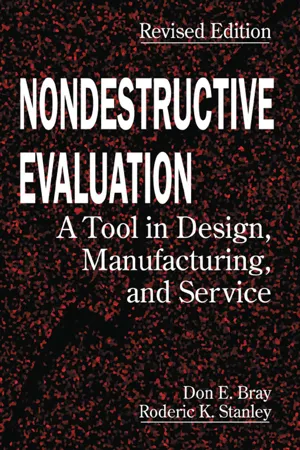
Nondestructive evaluation (NDE) inspection schemes are important in design, manufacturing, and maintenance. By correctly applying techniques of NDE, we can reduce machine and system failures and increase reliability of operating systems over an extended lifetime. Nondestructive Evaluation: A Tool in Design, Manufacturing, and Service introduces and discusses primary techniques used in the field, including ultrasonics, acoustic emission, magnetics, radiography, penetrants, and eddy currents. Examples of each of these techniques are included, demonstrating typical applications.
eBook - ePub
Nondestructive Evaluation
A Tool in Design, Manufacturing and Service
- 608 pages
- English
- ePUB (mobile friendly)
- Available on iOS & Android
eBook - ePub
Nondestructive Evaluation
A Tool in Design, Manufacturing and Service
About this book
Information
Part I
Probability, Design, and Management in Nondestructive Evaluation
CHAPTER 1
NDE IN DESIGN, MAINTENANCE AND SERVICE
1-1. INTRODUCTION
Since society first realized the fallibility of people and their machines, they have recognized a need to inspect these machines in order to prevent failures. A wide variety of test schemes exist, some destructive and some nondestructive. The practical benefits of nondestructive inspection are obvious, as long as the results are reliable and the inspection is cost-effective.
Three axioms, first proposed by Mordfin,1 suitably describe the relationship of nondestructive evaluation (NDE) and satisfactory service for components and systems. The axioms are:
1. All materials contain flaws.
2. Flaws in a material do not necessarily render it unfit for service.
3. The detectability of a flaw generally increases with size.
Load conditions, material properties, and flaw size will determine if a flaw is likely to affect the serviceability of the part. NDE, however, is essential in locating and sizing the flaw.
In general, NDE techniques can be characterized as active or passive, and surface, near surface or volumetric. The active techniques are those where energy in some form is introduced into or onto the specimen, and an observable change in the input energy is expected if an anomaly is present. Magnetics, eddy current, ultrasonics, and radiography fall into this category. Passive techniques, on the other hand, are those that monitor or observe the item in question in either the “as-is” state, under the influence of a typical load environment or a proof cycle, or with a visual enhancing liquid covering the surface. For passive techniques, the presence of a defect is determined by some response or reaction from the specimen being tested. Acoustic emission, noise analysis, penetrant, leak testing, visual examination, and some residual magnetic techniques are in this classification. Surface techniques are those where only surface defects can be detected. The penetrant methods are chief examples of surface only techniques. Electromagnetic methods, such as eddy current and magnetics, are usually limited to finding surface and near surface defects. While special enhancements in the processes can improve the inspectability at depths below the surface, there always are surface related limitations for these methods that separate them from the volumetric methods. Volumetric methods include ultrasonics, acoustic emission and radiography.
The reader will note the frequent use here and elsewhere of the terms nondestructive evaluation (NDE), nondestructive inspection (NDI), and nondestructive testing (NDT). Sometimes they are equal and interchangeable, while on other occasions they are not. While there are obvious inconsistencies in using only one term for all discussion in this text, the term NDE will be adopted since this generally represents the broadest range in the definitions.
1-2. BENEFITS OF NDE
The primary benefit of NDE must be economic through reduced failures, more efficient design, better performance, etc. For example, in mechanical design, a factor-of-safety typically is introduced in order to allow for a variety of uncertainties, such as unexpected load occurrences and material properties being out of specification. The results of these uncertainties have been well described in the literature dealing with fracture and material failure. One of the principal uncertainties is the performance of the components used in the construction of a mechanical system. Manufacturing irregularities, such as voids, inclusions, unfavorable stress patterns, and hardness, affect the performance of the final part. It is no longer satisfactory for the engineer to simply specify that the material shall be free of defects. The engineer must now specify the maximum allowable flaw size, based on fracture properties, and the least detectable flaw size for an inspection. The use of non-destructive evaluation in the quality control of manufactured parts, therefore, can provide the assurance that an item will perform as intended. With this, then, a lower factor-of-safety may be possible with a resulting overall saving in weight and cost of an item.
Nondestructive testing can also be beneficial in reducing the frequency of unscheduled maintenance which usually is more expensive than regularly scheduled maintenance. Often, NDE can be used to inspect questionable parts in-place on the equipment, thereby preventing an unscheduled and unnecessary shutdown if the part is in fact defect free. With assurance that there is no defect present, the equipment may continue operating without fear of failure.
Additionally, scheduled maintenance periods may be lengthened with the proper use of NDE. Knowing from an inspection that crucial parts are not approaching failure may allow the machine to operate safely for a longer period of time. Less frequent maintenance may be cost-effective provided that the cost of operation is not increased due to an unexpected failure.
Fluid or pressure losses through leakage can represent a significant cost for mechanical systems such as power plants, pressure vessels, piping systems, or transmission pipelines. The early detection of wall loss due to corrosion or erosion which will ultimately lead to leakage can prevent these losses. Also, leak detection devices often can detect these leaks before their volume becomes significant.
Considerable dedication is required in order to establish a nondestructive testing program that will yield sufficient confidence as to where a factor-of-safety or maintenance cycle can be changed. To do this requires positive communication and thorough understanding of th...
Table of contents
- Cover
- Half Title
- Title Page
- Copyright Page
- Table of Contents
- PART I Probability, Design, and Management in Nondestructive Evaluation
- PART II Ultrasonic Techniques in Nondestructive Evaluation
- PART III Acoustic Emission Techniques in Nondestructive Evaluation
- PART IV Magnetic Flux Leakage Techniques in Nondestructive Evaluation
- PART V Eddy Current Techniques in Nondestructive Evaluation
- PART VI Radiographic Techniques in Nondestructive Evaluation
- PART VII Penetrant Techniques in Nondestructive Evaluation
- Appendices
- Index
Trusted by 375,005 students
Access to over 1.5 million titles for a fair monthly price.
Study more efficiently using our study tools.
Frequently asked questions
Yes, you can cancel anytime from the Subscription tab in your account settings on the Perlego website. Your subscription will stay active until the end of your current billing period. Learn how to cancel your subscription
No, books cannot be downloaded as external files, such as PDFs, for use outside of Perlego. However, you can download books within the Perlego app for offline reading on mobile or tablet. Learn how to download books offline
Perlego offers two plans: Essential and Complete
- Essential is ideal for learners and professionals who enjoy exploring a wide range of subjects. Access the Essential Library with 800,000+ trusted titles and best-sellers across business, personal growth, and the humanities. Includes unlimited reading time and Standard Read Aloud voice.
- Complete: Perfect for advanced learners and researchers needing full, unrestricted access. Unlock 1.5M+ books across hundreds of subjects, including academic and specialized titles. The Complete Plan also includes advanced features like Premium Read Aloud and Research Assistant.
We are an online textbook subscription service, where you can get access to an entire online library for less than the price of a single book per month. With over 1.5 million books across 990+ topics, we’ve got you covered! Learn about our mission
Look out for the read-aloud symbol on your next book to see if you can listen to it. The read-aloud tool reads text aloud for you, highlighting the text as it is being read. You can pause it, speed it up and slow it down. Learn more about Read Aloud
Yes! You can use the Perlego app on both iOS and Android devices to read anytime, anywhere — even offline. Perfect for commutes or when you’re on the go.
Please note we cannot support devices running on iOS 13 and Android 7 or earlier. Learn more about using the app
Please note we cannot support devices running on iOS 13 and Android 7 or earlier. Learn more about using the app
Yes, you can access Nondestructive Evaluation by Don E. Bray,Roderick K. Stanley in PDF and/or ePUB format, as well as other popular books in Technology & Engineering & Industrial Engineering. We have over 1.5 million books available in our catalogue for you to explore.