![]()
Part I
EMERGING TECHNOLOGIES
![]()
Chapter 1
Technologies to Preserve Fresh-Cut Fruits and Vegetables
Sunil Pareek
Department of Agriculture and Environmental Sciences
National Institute of Food Technology Entrepreneurship and Management
Ministry of Food Processing Industries
Kundli, Haryana, India
Abstract
Abbreviations
1.1 Introduction
1.2 Mechanism of Enzymatic Browning in Fresh-Cut Fruits and Vegetables
1.3 Secondary Browning
1.4 Mechanism of Fresh-Cut Lettuce Discoloration
1.5 Mechanism of Fresh-Cut Carrot Discoloration
1.6 Technologies to Control Enzymatic Browning and Preserve Fresh-Cut Fruits and Vegetables
1.6.1 Antibrowning Agents
1.6.1.1 Acidulants
1.6.1.2 Reducing Agents
1.6.1.3 Chelating Agents
1.6.1.4 Combination Treatments
1.6.2 Emerging Physical Technologies
1.6.2.1 Modified Atmosphere Packaging
1.6.2.2 Ultraviolet Radiation
1.6.2.3 High-Pressure Processing
1.6.2.4 Ultrasound
1.6.2.5 Cold Plasma
1.6.2.6 Pulsed Light Treatments, Edible Coatings, and Active Packaging
1.7 Conclusions and Future Perspectives
References
Abstract
Fresh-cut fruits and vegetables are convenience foods. Today, consumers prefer ready-to-eat fruits and vegetables. These undergo a process of peeling, trimming, cutting, washing, disinfection, rinsing, packaging, storage, and distribution. During the course of preparation, fresh-cut products are injured and damaged and are thereby exposed to biochemical, physiological, and microbiological changes. Various problems are associated with these products and the most common is the change in color of the produce. Enzymatic browning is associated with cutting fruits and vegetables, resulting in their oxidation in the presence of polyphenol oxidase and phenylalanine ammonialyase. The physiology and biochemistry of color changes is the major goal of this chapter. This chapter emphasizes the technologies that are able to maintain the color in fresh-cut fruits and vegetables. Various chemicals, adjuvants, and physical treatments are also discussed.
Abbreviations
1-MCP | 1-Methyl cyclopropene |
4-HR | 4-Hexylresorcinol |
AA | Ascorbic acid |
CA | Citric acid |
ER | Endoplasmic reticulum |
FDA | Food and Drug Organization GRAS Generally recognized as safe |
GRAS | Generally recognized as safe |
HPP | High-pressure processing IFPA International Fresh-cut Produce Association |
IFPA | International Fresh-cut Produce Association |
LOX | Lipoxygenase MAP Modified atmosphere packaging MDA Malondialdehyde |
MAP | Modified atmosphere packaging |
MDA | Malondialdehyde |
PAL | Phenylalanine ammonialyase PAL-IF PAL-inactivating factor POD Peroxidase |
PAL-IF | PAL-inactivating factor |
POD | Peroxidase |
PPO | Polyphenol oxidase |
RH | Relative humidity SOD Superoxide dismutase |
SOD | Superoxide dismutase |
US | Ultrasound UV Ultraviolet |
UV | Ultraviolet |
1.1 Introduction
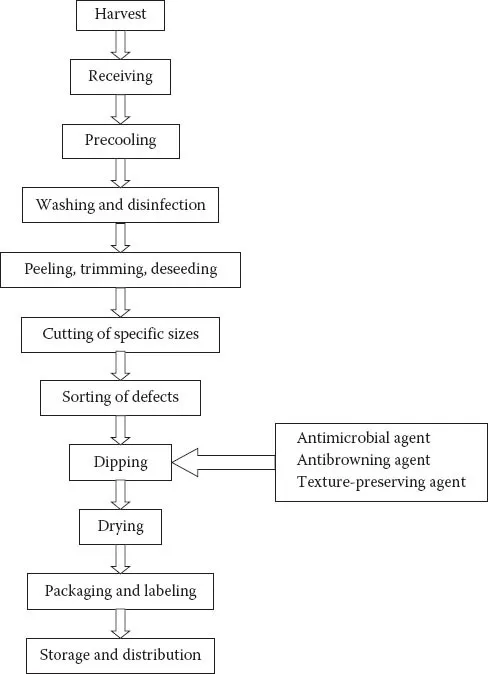
Minimally processed fresh fruits and vegetables are defined as any fruit and vegetable that has been subjected to different processing steps (e.g., peeling, trimming, cutting, washing, disinfection, rinsing, etc.) to obtain a fully edible product while providing convenience and functionality to consumers and ensuring food safety (Artes and Allende, 2014). The International Fresh-cut Produce Association (IFPA) defines fresh-cut products as a fruit or vegetable that has been trimmed and/or peeled and/or cut into 100% usable product, that is, bagged or prepackaged to offer consumers high nutrition, convenience, and flavor while maintaining its freshness (Figure 1.1).
In particular, fresh-cut fruits attract consumers because they are fresh, nutritious, low priced, and ready-to-eat. As a consequence, a wide assortment of minimally processed fruits has been developed to meet consumer’s need for “quick” and “convenient” products, and to benefit from a fruit’s healthy image (Ahvenainen, 1996). Minimal processing gives additional value to fresh-cut fruits in terms of convenience and time saving, although several hurdles are encountered due to the difficulty in preserving their freshness during prolonged periods. These products, in fact, are characterized by shorter shelf life than their whole counterparts, because of higher susceptibility to microbial spoilage, increased respiration rate, and ethylene production, which is stimulated by wounding of the tissue; in fact, the process operations (i.e., cutting, splicing, etc.) form lesions in the tissues that determine enzymatic browning, texture decay, rapid microbial growth, weight losses, and undesirable volatile production, thus highly reducing the shelf life.
Figure 1.1 Typical fresh-cut process flow chart for fruits, vegetables, and root crops.
Quality is a term which denotes a degree of excellence, a high standard or value. Kramer (1965) stated that: Quality of foods may be defined as the composite of those characteristics that differentiate individual units of a product, and have significance in determining the degree of acceptability of that unit to the user. Minimal processing of fresh fruits and vegetables, such as trimming, peeling, cutting, slicing and other physical actions, causes injury and damage to tissues, affecting physiological activities and subsequently quality (Watada et al., 1990). Some problems related to cell disruption are leakage of nutrients, enzymatic reactions, mold growth, lactic acid fermentation, loss of texture, development of off-flavors and off-odors, and appearance defects. All these factors limit the storage and market life of fresh-cut fruits and vegetables.
Currently, fresh-cut fruits and vegetables have tremendous market both in developed and developing countries. It is one of the fastest growing sectors in developing countries as well. Therefore, it attracts the researchers to develop eco-friendly technologies to maintain the quality and extend the shelf life of fresh-cut products. Many reviews on various aspects of fresh-cut fruits and vegetables, such as general aspects, enzymatic browning, microbiology, emerging technologies, etc., have been published (Table 1.1). In this chapter, a comprehensive picture on fresh-cut products problems, particularly enzymatic browning, its mechanism, and prevailing and emerging technologies, are discussed.
1.2 Mechanism of Enzymatic Browning in Fresh-Cut Fruits and Vegetables
Appearance and texture changes are two fundamental characters determining the acceptability of fresh-cut fruits and vegetables. Browning of cut surface is a problem with several products, such as apple (Toivonen, 2008b; Luo et al., 2011), eggplant (Barbagallo et al., 2012a; Mishra et al., 2013), kiwi (Antunes et al., 2010), lettuce (Bolin and Huxsoll, 1991), mango (De Souza et al., 2006; Siddiq et al., 2013), peach (Sapers and Miller, 1998), pear (Arias et al., 2009; Xiao et al., 2011), pomegranate arils (Gil et al., 1996; Lopez-Rubira et al., 2005; Maghoumi et al., 2012), potato (Cantos et al., 2002), rose apple (Supapvanich et al., 2012), and sweet peppers (Barbagallo et al., 2012b). The understanding of the processes leading to these changes is essential in developing better approaches to minimize them, and hence improving quality and shelf life for the consumer. One common issue regarding the biochemistry of appearance and textural changes has been, by and large, studied in whole plant or tissue systems. The consequences of the cutting operation and post-cutting processes in fresh-cut products have not been extensively studied (Toivonen and Brummell, 2008). It is estimated that over 50% losses in fruit occur as a result of enzymatic browning. It is one of the most important color reactions that affects horticultural commodities, leading not only to tissue discoloration but also to the development of off-flavors.
Table 1.1 Reviews Published on Various Aspects of Fresh-Cut Fruits and Vegetables
Scope of Review | Reference |
General aspects | Barmore (1987) Brackett (1987) Klein (1987) Rolle and Chism (1987) Shewfelt (1987) Soliva-Fortuny and Martín-Belloso (2003) Brecht et al. (2004) |
Physiology and handling | Huxsoll et al. (1989) King and Bolin (1989) Watada et al. (1990) Brecht (1995) Ahvenainen (1996) Saltveit (1997) |
Quality | Watada et al. (1996) Watada and Qi (1999) Rico et al. (2007) Ramos et al. (2013) Barrett et al. (2010) Oms-Oliu et al. (2010b) |
Coatings | Baldwin et al. (1995a) Baldwin et al. (1995b) Olivas and Barbosa-Cánovas (2005) Vargas et al. (2008) Rojas-Grau et al. (2009) Valencia-Chamorro et al. (2011) Dhall (2013) |
Enzymatic browning | Sapers (1993) Artes et al. (1998) Laurila et al. (1998) Salcini and Massantini (2005) Toivonen and Brummell (2008) |
Packaging | Myers (1989) Cameron et al. (1995) Rojas-Grau et al. (2009) |
Sanitation | Hurst (1995) Kim et al. (1999) Gomez-Lopez et al. (2007) Gomez-Lopez et al. (2008) Gomez-Lopez et al. (2009) Gil et al. (2009) Ölmez and Kretzschmar (2009) Oms-Oliu et al. (2010a) |
Microbiology | Garg et al. (1993) Francis et al. (1999) Nguyen-the and Carlin (1994) Parish et al. (2003) Olaimat and Holley (2012) |
Interaction of microbiology and MAP | Church and Parsons (1995) Zagory (1999) Farber et al. (2003) Caleb et al. (2013) |
Although the tissue, or cell structure, remains intact, the enzyme and phenolic compounds are separated and so do not react with one another. It is the breaking down of the cell structure caused by the bruising that initiates the oxidation reaction thus triggering the onset of browning. An enzyme called polyphenol oxidase (PPO) oxidizes the phenolic compounds that are found in the tissue of fruits. This oxidation causes the phenolic compounds to condense into brown spots. Therefore, the enzymatic browning in several fresh-cut fruits and veget...