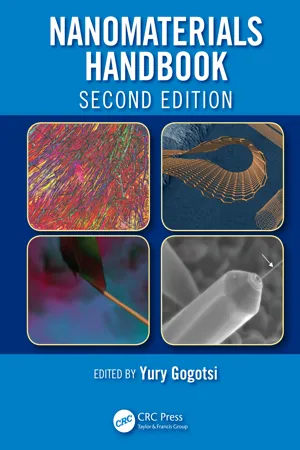
This title features 11 new chapters unique to this edition, including chapters on grain boundaries in graphene, 2D metal carbides and carbonitrides, mechanics of carbon nanotubes and nanomaterials, biomedical applications, oxidation and purification of carbon nanostructures, sintering of nanoceramics, hydrothermal processing, nanofibers, and nanomaterials safety. It offers a comprehensive approach with a focus on inorganic and carbon-based nanomaterials, including fundamentals, applications, synthesis, and characterization. This book also provides a unique angle from the nanomaterial point of view on application, synthesis, and characterization not found in any other nanomaterials book on the market.
- 712 pages
- English
- ePUB (mobile friendly)
- Available on iOS & Android
eBook - ePub
Nanomaterials Handbook
About this book
Information
1
Graphene
Synthesis, Properties, and Applications
Zongbin Zhao and Jieshan Qiu
Contents
1.1History and Development
1.2Synthesis of Graphene
1.2.1Mechanical and Ultrasonication Exfoliation
1.2.1.1Mechanical Exfoliation
1.2.1.2Ultrasonication Exfoliation
1.2.2Epitaxial Graphene from Silicon Carbide
1.2.3Chemical Vapor Deposition
1.2.4Chemically Derived Graphene
1.2.4.1Thermal Expansions
1.2.4.2Microwave Irradiation-Assisted Exfoliation
1.2.4.3Plasma-Assisted Exfoliation
1.2.4.4Photothermal Reduction
1.2.4.5Chemical Reduction of GO
1.2.4.6Green Reduction Agents
1.2.5Graphene Nanoribbons
1.2.5.1Direct CVD Method
1.2.5.2Nanocutting
1.2.5.3Unzipping of CNTs
1.2.5.4Total Organic Synthesis
1.3Structures and Physical Properties of Graphene
1.3.1Structures
1.3.1.1Ripples and Wrinkles in Graphene
1.3.1.2Structural Defects
1.3.1.3Edge States
1.3.2Properties
1.3.2.1Electronic Properties
1.3.2.2Optical Properties
1.3.2.3Mechanical Properties
1.3.2.4Thermal Properties
1.4Chemistry of Graphene
1.4.1Hydrogenation and Fluorination
1.4.2Covalent Functionalization
1.4.3Noncovalent Functionalization
1.4.3.1Noncovalent Functionalization with Aromatic Molecules
1.4.3.2Noncovalent Interaction with Polymers
1.4.3.3Biomolecule-Based Noncovalent Functionalization
1.5Applications of Graphene
1.5.1Energy Storage and Conversion
1.5.1.1Lithium Ion Batteries
1.5.1.2Supercapacitors
1.5.1.3Fuel Cells
1.5.1.4Solar Cells
1.5.2Sensors
1.5.3Field Effect Transistors
1.5.4Graphene–Polymer Composites
1.6Conclusions and Perspectives
Acknowledgments
References
1.1History and Development
Graphene, a two-dimensional (2D) and atomically thin crystal, consists of a single layer of carbon packed in a hexagonal lattice with a C–C distance of 0.142 nm.1 Although zero-dimensional (0D) fullerene (C60) and one-dimensional (1D) carbon nanotubes (CNTs) have been discovered since several decades, 2D materials graphene was discovered only recently. This discovery is attributed to Geim’s group from Manchester University; the famous ScotchTM tape work published in Science in 2004 was regarded as a landmark for 2D crystal.1 Since then, graphene has become one of the most exciting topics in fundamental research. The Nobel Prize in Physics for the year 2010 was awarded to Andre K. Geim and Konstantin S. Novoselov “who have made decisive contributions to the research of graphene.”2 However, pioneering work on graphene can be traced back to at least more than 60 years: P.R. Wallace predicted theoretically the unique electronic structure and the linear dispersion relation of graphene in 1947,3 J.W. McClure formulated the wave equation for excitations in 1956,4 and G.W. Semenoff, D.P. DiVincenzo, and E.J. Mele compared the equation with the Dirac equation in 1984.5,6 Along with the progress in the theory of graphene, great efforts have been made for growth and identification of graphene in the community of surface science.7,8 For example, John May grew and identified graphene on the surface of platinum as early as 1969,7 and Jack Blakely and coworkers systematically investigated the formation of carbon layer on metals (Ni, Pt, Pd, Co, and Fe) from chemical vapor deposition (CVD). The observation of sheet-like graphitic material during arc discharge can be dated back to the 1990s. In 1992, Ebbesen et al.9 reported that some sheet-like graphitic material was formed when they prepared multiwalled carbon nanotubes (MWCNTs) by helium arc discharge at low pressure. Because the yield of graphitic sheets was very low, and they always coexisted with other carbon allotropes, such as MWCNTs, it did not arouse much attention. In 1997, Y. Ando, X. Zhao, and coworkers observed petal-like graphite sheets, which were essentially stacked with graphene, deposited on the cathode surface by hydrogen arc discharge.10,11 The number of graphene layers is two or three for the thinnest cases based on the observation in HRTEM micrographs.10 In 2002, Wu et al. synthesize “carbon nanowalls,” a similar structure with petal-like graphite sheets, by a microwave plasma-enhanced chemical vapor deposition (PECVD) method.12 In fact, the sheet-like graphitic material, petal-like graphite sheets, and carbon nanowalls are all multiwalled graphene from the point of crystal structure.
Being the building block of graphite, graphene may not appear like a “new” material. Graphite is the most common and thermodynamically stable form of carbon. Its structure has been well-documented and consists of an ordered stacking of numerous graphene layers on top of each other. Each such layer is bonded by weak van der Waals force, which can be easily overcome, for example, by mechanical force as demonstrated by the excellent lubrication provided by graphite.13,14 However, for a long time, the belief that a freestanding atomically thin carbon sheet would be thermodynamically unstable had discouraged further efforts in the research of graphene significantly.
Preparing graphene consisting of a few layers is quite simple and is encountered on a daily level while using a simple pencil. However, the isolation, identification, and characterization of single-layer graphene are not a trivial task because depending on the synthesis method, the monolayers are only the minority phase which are accompanied by thick flakes.15 Geim’s group was the first to isolate single-layer g...
Table of contents
- Cover
- Half Title
- Title Page
- Copyright Page
- Dedication
- Contents
- Preface
- Acknowledgments
- Editor
- Contributors
- Chapter 1: Graphene: Synthesis, Properties, and Applications
- Chapter 2: Grain Boundaries in Graphene
- Chapter 3: Epitaxial Graphene and Carbon Nanotubes on Silicon Carbide
- Chapter 4: Two-Dimensional Transition-Metal Carbides and Carbonitrides
- Chapter 5: Cooperative Interaction, Crystallization, and Properties of Polymer–Carbon Nanotube Nanocomposites
- Chapter 6: Mechanics of Carbon Nanotubes and Nanomaterials
- Chapter 7: Biomedical Applications of Nanostructures: Carbon Nanotube Biosensors
- Chapter 8: Carbon Nanostructures in Biomedical Applications
- Chapter 9: Field Emission from Carbon Nanotubes
- Chapter 10: Carbon Nanotubes for Photoinduced Energy Conversion Applications
- Chapter 11: Fullerene C60 Architectures in Materials Science
- Chapter 12: Nanocrystalline Diamond
- Chapter 13: Combining Nanotechnology with Personalized and Precision Medicine: Nanodiamonds as Therapeutic and Imaging Agents
- Chapter 14: Carbon Onions
- Chapter 15: Carbide-Derived Carbons
- Chapter 16: Templated and Ordered Mesoporous Carbons
- Chapter 17: Oxidation and Purification of Carbon Nanostructures
- Chapter 18: Hydrothermal Process for Nano-Carbons and Carbonaceous Materials
- Chapter 19: Carbon Nanomaterials for Water Desalination by Capacitive Deionization
- Chapter 20: Sintering of Nano-Ceramics
- Chapter 21: Nanofiber Technology: Bridging the Gap between Nano and Macro World
- Chapter 22: The Safety of Nanomaterials on Molecular and Cellular Scale
- Index
Trusted by 375,005 students
Access to over 1.5 million titles for a fair monthly price.
Study more efficiently using our study tools.
Frequently asked questions
Yes, you can cancel anytime from the Subscription tab in your account settings on the Perlego website. Your subscription will stay active until the end of your current billing period. Learn how to cancel your subscription
No, books cannot be downloaded as external files, such as PDFs, for use outside of Perlego. However, you can download books within the Perlego app for offline reading on mobile or tablet. Learn how to download books offline
Perlego offers two plans: Essential and Complete
- Essential is ideal for learners and professionals who enjoy exploring a wide range of subjects. Access the Essential Library with 800,000+ trusted titles and best-sellers across business, personal growth, and the humanities. Includes unlimited reading time and Standard Read Aloud voice.
- Complete: Perfect for advanced learners and researchers needing full, unrestricted access. Unlock 1.5M+ books across hundreds of subjects, including academic and specialized titles. The Complete Plan also includes advanced features like Premium Read Aloud and Research Assistant.
We are an online textbook subscription service, where you can get access to an entire online library for less than the price of a single book per month. With over 1.5 million books across 990+ topics, we’ve got you covered! Learn about our mission
Look out for the read-aloud symbol on your next book to see if you can listen to it. The read-aloud tool reads text aloud for you, highlighting the text as it is being read. You can pause it, speed it up and slow it down. Learn more about Read Aloud
Yes! You can use the Perlego app on both iOS and Android devices to read anytime, anywhere — even offline. Perfect for commutes or when you’re on the go.
Please note we cannot support devices running on iOS 13 and Android 7 or earlier. Learn more about using the app
Please note we cannot support devices running on iOS 13 and Android 7 or earlier. Learn more about using the app
Yes, you can access Nanomaterials Handbook by Yury Gogotsi in PDF and/or ePUB format, as well as other popular books in Technology & Engineering & Biomedical Science. We have over 1.5 million books available in our catalogue for you to explore.