eBook - ePub
Loss and Grief Recovery
Help Caring for Children with Disabilities, Chronic, or Terminal Illness
- 192 pages
- English
- ePUB (mobile friendly)
- Available on iOS & Android
eBook - ePub
Loss and Grief Recovery
Help Caring for Children with Disabilities, Chronic, or Terminal Illness
About this book
The grief reaction is often similar for many diverse circumstances and situations. This book focuses heavily on caring for children with disabilities, chronic or terminal illness, dealing with the loss, and the recovery process.
Information
CHAPTER 1
Introduction: The Challenges of Our Numerous Losses
In each person’s life, much of joy and sorrow revolves around attachments or affectional relationships—making them, breaking them, preparing for them, and adjusting to their loss [1, p. 285].
I stared at the cold hospital gurney that held the body of my fourteen-year-old son. It was 1 A.M. and the doctor had just informed me, “Your son is dead.” I was numb and could hardly breathe. As a pediatric nurse I had seen dead children before, but now my own son. How could this be? I kissed him on the forehead and his familiar scent warmed my nostrils. “Is it him, is this really him, lying here motionless—DEAD?” I wanted to run away, hide, or scream out, “This cannot be happening!” My mind was frantically trying to find answers for so many questions, “How can I turn back the pages?” “How can I undo this horrible event?”
I left the room and found Dennis who had been at Cameron’s side all night and had watched helplessly as medical interventions failed to revive his son. We went outside where we held each other and I cried on his shoulder, asking, “Why?” “Why?” I wondered if I could really carry on. Would I have the strength to endure life without my beloved Cameron?
Life is a challenge! If you do not believe this, then it may be that you have not lived long enough! Circumstances, often beyond our control, happen to all who step upon this earth. Some of us may erroneously think adversity effects only those who make poor choices, do something wrong, or are not shrewd enough to prevent and avoid adverse situations. Although we can bring trials upon ourselves, the fact is, even when we are doing everything to the best of our ability, things can go wrong. Illness, disabilities, divorce, financial struggles, rebellious children, loss of home or job, abuse, unwed pregnancies, infertility, miscarriage, disappointments, and death are only a few of the trials that can bring deep feelings of pain, distress, and sorrow.
How do we cope with life’s challenges? Where can we turn for help? How do we find the happiness and joy in our life when so many things seem out of our control? Why did this happen to me? What is the purpose of our struggle with life? Why don’t our desires and wishes always come about? These are the kinds of questions we, and possibly you, have sought answers for.
This was not our first experience with loss and grief. We had experienced both unexpected losses and what society labels expected losses. We will share some of our losses as an introduction to ourselves and as an explanation of our current understanding; also a loss scale (Figure 1) can be helpful to see the cumulative effect of losses in one’s life.
LOSS OF PARENTS–SUICIDE
Dennis’s mother took her life with carbon monoxide fumes in her own garage. She had just turned fifty years old and left a crushed and bewildered husband to raise two teenage boys. We watched them struggle for years trying to pick up the pieces of their lives and find answers to the many complex and painful questions that seemed to elude them. (We discuss suicide more in Chapter 9.)
My own father died Christmas morning a few years later. He was sixty-one and we had traveled 700 miles to be with extended family and exchange gifts. He had gone to bed about midnight reminding us to, “Make sure Santa didn’t forget to fill the kids stockings!” Four hours later mother called us to their room because he was breathing strangely. My husband and I knew CPR (cardiopulmonary resuscitation) and we began it immediately. We were shortly joined by my brother who was a senior emergency medical resident, also visiting from out of town for Christmas. The paramedics soon arrived and transferred my father to a nearby hospital. Yet in spite of all this quick medical attention, his heart refused to take over on its own. It was a painful and confusing Christmas morning for all of us.
Because I had known for years Dad’s heart was bad, I thought I was somehow prepared for his death. I wasn’t! I had no idea it could hurt so much to lose a parent. I’ve realized since that we are seldom really prepared for the loss of any significant person in our life. I have come to understand that when you lose a parent, you lose part of your past. When you lose a spouse, you may feel as if you have lost the present. And when a child dies, you lose a large part of your future [2, p. 23; 3. n. 19].
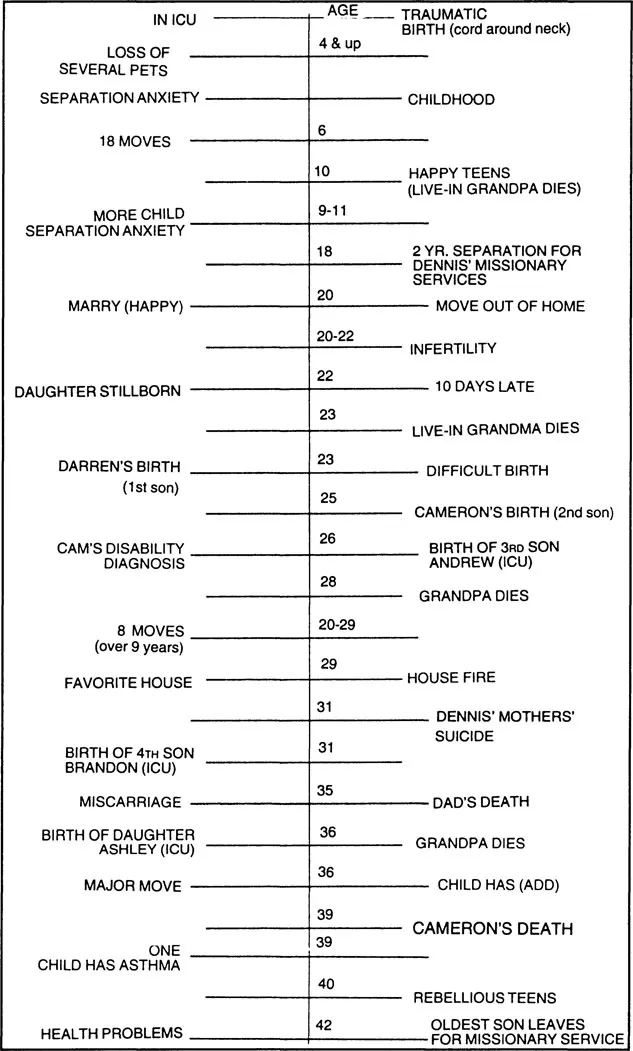
Figure 1. Loss Scale.
MISCARRIAGE, STILLBORN, AND INFANT LOSS
We discovered that an infant or child’s illness and death is one of the most painful and traumatic experiences a parent can have. We all expect and understand that parents usually die before their children. It is very hard for our minds to accept that our child has died first. It somehow seems against nature to experience this reversal. Society and nature have taught us to protect and provide for our children. We usually feel a great unconditional love for our children, that may not be felt in other relationships.
Our first child, a daughter, was stillborn. She was full term, weighing almost 7 lbs. Words cannot express how disappointed and heartbroken we were! We wanted to be parents more than anything else in the world! The doctors couldn’t tell us why she died. (We struggled with the unknown diagnosis which we will discuss in the next chapter.) We reached forward with all our faith and hope to carry on.
CHANGES
We have learned it is generally recommended that major changes not be made until one year after experiencing a significant loss. Some of our judgments made during grief stages may not be sound, or accurately represent what we really want in the long-run. We tried not to attempt to move too quickly while grieving. Even positive and desired change can cause additional stress and confusion.
After the death of our first daughter I went back to the pediatric unit as a charge nurse, and my husband enrolled in graduate school. It seemed like forever waiting to have another baby. I was depressed and discouraged. We did get a small puppy which gave me something to love and nurture during the long wait! I had always desired a large family, and wondered if my dream could still be realized.
INFERTILITY AND ADOPTION
I had fears about infertility because it had taken so long to become pregnant with our first child. After she died, the loss and prospects of having to start all over again seemed overwhelming. Time seemed to move very slowly, each month seemed like an eternity.
Infertility can also be a challenge and a loss. Some couples may spend large amounts of time and money trying to conceive. They may look around, like we did, and wonder why everyone else makes it look so easy. We wondered, “Why us?,” “What is wrong with us?,” “What did we do wrong?,” trying to find answers to questions that may or may not have solutions.
Some may choose adoption. While this brings joy and many lives are blessed by this process, remember even good changes can be stressful. Ambiguous feelings arise as the couple finally realize they will never have a child of their own making. Dennis has learned as an adoption worker that it takes time, work, and many adjustments after a couple receives a child.
A couple of years after the death of our daughter I was thrilled with the birth of a beautiful, healthy baby boy (Darren). Although I realized he could not take the place of our daughter, the joy I personally felt was beyond description. All of my dreams about motherhood were being fulfilled. I couldn’t help but hurt and wonder about those who would NEVER experience this kind of love and joy. How would they cope? How would they totally resolve and reconcile their grief? I now felt content, life looked good to me again! Little did I know that our future held more challenges including more infertility, miscarriage, illness, and death.
LOSS OF RELATIONSHIPS–DIVORCE
After any loss, relationships with others may become strained. These are called secondary losses. Men and women grieve differently. More arguments may occur and couples may reject each other. Many parents find the grief and stress of illness and death so intense that they cannot support one another. We were surprised by the high divorce statistics after parents experience the diagnosis of a serious illness or death of their child.
The fortunate ones might find that they can stay close, often becoming a source of strength and support to each other. We have discovered this is possible if you are willing to work at it. In Chapter 7 we will discuss some specific steps to help your relationships survive and grow in the face of adversity.
MOVING
Research has shown that not only changing jobs, but changing living locations is high on the list of life’s greatest stresses. Loss of identity and self-esteem may occur. It takes time and patience for many to adjust to a new situation or environment. Often children experience moving as a secondary loss following a death or divorce.
A year after the birth of our second baby my husband’s work took us miles away from family, friends, and familiar support. We were lonely and homesick. We discovered that a move can be a loss and require many adjustments. We experienced some of the grief cycle again as we learned to adapt to our new surroundings in what felt like a whole new culture!
CHRONIC OR TERMINAL ILLNESS
Not many parents plan to deliver a baby that is not normal and healthy. No parent ever dreams their child will be diagnosed with a terminal illness. Few, if any are prepared for the new challenges they must face.
A year after our move I delivered another 7 lb. baby boy (Cameron). Only this time as the months passed we noticed he didn’t progress developmentally as his older brother had. After several trips to our pediatrician, he suggested that a developmental screening be done. When Cameron was ten months old we received the official diagnosis of cerebral palsy. Although this was not classified as a terminal illness I knew the majority of these children do not make it to adulthood. I knew we were dealing with a chronic problem. I was shocked! Not us. I was a nurse, how had I missed noticing the signs? I remember closing all the drapes, taking the phone off the hook, and sobbing, “Why me?” I had already lost my first born, why another loss? Life was not fair! Life was too hard!
I learned that parents experience a variety of feelings when they discover their child is not “normal or healthy.” Once again we found ourselves experiencing the grief cycle. It is normal for some to refuse to accept the diagnosis, or not even hear it initially. Denial may come in many forms. Some parents blame doctors and other professionals. I remember telling a therapist that I knew Cam would walk because he was so determined! (However, he spent all of his 14 years in a wheel-chair.) I also assumed we would be one of the minority to see him grow into adulthood. Once again we reached and pulled for all the faith, hope, and strength we could find. Our parents, family, friends, and doctors lived many miles from us. Although they sent comfort and support through letters we had to find many new support systems to help us.
I was overwhelmed at how much I felt I needed to know about my child’s diagnosis. I went to the library for information on how to help him or some self-help book on helping our lives become more manageable. I couldn’t find much. I was determined then that when I learned what I needed to know, I would write this book in hopes of helping others not feel as lost as I did. (Unfortunately for 15 years I found I was too busy caring for Cameron and his siblings to do much writing.)
LOSS OF A CHILD
When the disabled, chronically, or terminally ill child dies, the pain continues for those left behind. Losing a loved one that was dependent on you can increase your grief reaction. The large amounts of invested time and energy can create irreplaceable relationships and may complicate your grief recovery. The loss of purpose and meaning may create enormous change in your life. We will discuss this in detail in Chapters 5 and 6.
Although Dennis and I were both professionals working with people who were experiencing loss, when we found ourselves enduring intense personal grief over and over, we realized we had only understood intellectually. Emotionally we were shocked at the enormous pain loss can bring. As time passed we were also surprised at the lengthy duration of our grief.
Now both of us have become more involved with grief issues. We speak on many related topics including adoption, abuse, infertility, stress, anxiety, depression, marriage, effective parenting, self-esteem, caring for disabilities, chronic, and terminal illnesses. Our primary focus and suggestions deal with loss and grief recovery.
We have experienced how loss and life’s challenges may affect people very differently. For example, we found it confusing that it seemed easier for me to cope and deal with my mother-in-law’s suicide than it was when we lost much of our home to fire! We have come to realize not only how complex life can be, but also how our own reactions to similar circumstances are very individualized. We’ve learned that many factors contribute to our views and our ability to recover from loss. The time, service, commitment, and emotional investment we give prior to a loss may intensify and prolong our grief reactions. I finally realized I had sacrificed and invested more emotionally to my home and family at the time of our fire than I had to the relationship with my mother-in-law who lived 700 miles away.
The pain of loss has taught us many things. We hope to share this knowledge and the comfort we discovered with others who are hurting and wondering if life really is worth living. We are not attempting to compare our pain to yours, because each person’s personality, life experience, and situation is unique to them. There are many circumstances, factors, and attitudes that shape our experiences, and it is usually not valuable to compare our challenges. Yet, it is by sharing our unique challenges that we bond, identify, and eventually help each other resolve pain. Come now, walk with us for awhile. We can hold each other’s hand, cry, and hopefully fi...
Table of contents
- Cover
- Title Page
- Copyright Page
- Dedication
- Table of Contents
- Prologue
- CHAPTER 1 Introduction: The Challenges of Our Numerous Losses
- CHAPTER 2 Our Struggle with the Diagnosis
- CHAPTER 3 Caring for Our Child at Home
- CHAPTER 4 Building Self-Esteem and Self-Worth
- CHAPTER 5 Recognizing and Managing Our Grief
- CHAPTER 6 Reconciliation of Our Loss: Adjusting, Accepting, and Healing
- CHAPTER 7 Our Relationships: Marriage, Friends, and Family (Other’s Reactions to Our Loss)
- CHAPTER 8 The Role of Spiritual Healing
- CHAPTER 9 Other Considerations
- APPENDIX Resources and Organizations
- About the Authors
- Index
Trusted by 375,005 students
Access to over 1.5 million titles for a fair monthly price.
Study more efficiently using our study tools.
Frequently asked questions
Yes, you can cancel anytime from the Subscription tab in your account settings on the Perlego website. Your subscription will stay active until the end of your current billing period. Learn how to cancel your subscription
No, books cannot be downloaded as external files, such as PDFs, for use outside of Perlego. However, you can download books within the Perlego app for offline reading on mobile or tablet. Learn how to download books offline
Perlego offers two plans: Essential and Complete
- Essential is ideal for learners and professionals who enjoy exploring a wide range of subjects. Access the Essential Library with 800,000+ trusted titles and best-sellers across business, personal growth, and the humanities. Includes unlimited reading time and Standard Read Aloud voice.
- Complete: Perfect for advanced learners and researchers needing full, unrestricted access. Unlock 1.5M+ books across hundreds of subjects, including academic and specialized titles. The Complete Plan also includes advanced features like Premium Read Aloud and Research Assistant.
We are an online textbook subscription service, where you can get access to an entire online library for less than the price of a single book per month. With over 1.5 million books across 990+ topics, we’ve got you covered! Learn about our mission
Look out for the read-aloud symbol on your next book to see if you can listen to it. The read-aloud tool reads text aloud for you, highlighting the text as it is being read. You can pause it, speed it up and slow it down. Learn more about Read Aloud
Yes! You can use the Perlego app on both iOS and Android devices to read anytime, anywhere — even offline. Perfect for commutes or when you’re on the go.
Please note we cannot support devices running on iOS 13 and Android 7 or earlier. Learn more about using the app
Please note we cannot support devices running on iOS 13 and Android 7 or earlier. Learn more about using the app
Yes, you can access Loss and Grief Recovery by Joyce Ashton,Dennis Ashton in PDF and/or ePUB format, as well as other popular books in Medicine & Mental Health in Psychology. We have over 1.5 million books available in our catalogue for you to explore.