- 184 pages
- English
- ePUB (mobile friendly)
- Available on iOS & Android
eBook - ePub
About this book
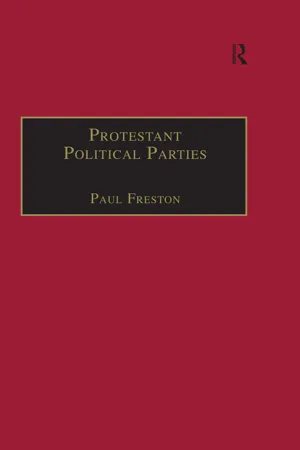
The recent global expansion of Protestant Christianity, and the increase in multiparty democracies, has led to the multiplication of Protestant political parties. One cannot talk of Protestant parties today without mentioning countries as diverse as Norway, Latvia, New Zealand, Indonesia, Zambia and Nicaragua. Whilst the well-established parties of the Netherlands and Scandinavia have long been studied, Paul Freston's groundbreaking book is the first global survey of this phenomenon. After looking at the traditional Protestant heartlands of Europe and the English-speaking world, Freston traces the spread of the Protestant party model to post-communist countries, the Pacific, the Muslim world, southern Africa and Latin America. He examines the circumstances favouring such parties, and the political projects they represent. The conclusion analyses the diversity of Protestant parties due to different interpretations of Christian politics and varied contexts. This unique book will interest specialists and non-specialists, across disciplines and in many parts of the world.
Information
Chapter 1
The European Heartland
The Netherlands
The logical place to begin our world survey is in the Netherlands. Besides having a plethora of small Protestant parties, it is home to the oldest and most successful one anywhere in the world, the ARP, which first came to power in 1888 and (having merged in 1980 with another Protestant party and a Catholic one to form the CDA) is in power at the time of writing.
The Protestant ARP first achieved power only four years after the first triumph of a Catholic party in any country (in Belgium). But the ARP was more ‘modern’, indeed perhaps the first ‘Christian Democratic’ party in the world, besides being the first modern party in the Netherlands. Why was the Netherlands able to play this pioneering role in regard to Protestant political parties?
One reason was its religious pluralism. Protestantism dominated but with a large Catholic minority. The virtual state church (Netherlands Reformed) became increasingly liberal during the nineteenth century and spawned dissenting movements by more orthodox Calvinists. When the national church and secular liberals attacked the denominational schools on which orthodox Calvinists and Catholics relied, the latter two groups were prepared to defend themselves politically via democratic political parties. In a situation in which no single group could enforce its will, the option of religious parties was embraced more easily, since it reflected both the desire for a specific representation of interests vis-à-vis a secular (or secularized) elite and recognition of the impossibility of imposing one’s will, of being merely a ‘party’ in the nation and not the whole.
Another factor was the type of popular Protestantism prevalent in late nineteenth-century Holland: a Calvinism undergoing a revival and revamping often labelled ‘neo-Calvinist’. It will become clear as we examine other countries that not all forms of Protestantism have been as likely to generate political parties. This has to do with inherent theological tendencies as well as with the implications of varying Church–state settlements. All things being equal, proudly independent churches are more likely to generate parties than are churches in a situation of dependence on the state; and churches with a Calvinist theology are more likely than those in the Lutheran tradition. As we shall see in the case of Norway, Lutheranism has been ‘notable for its historic weakness to generate political activism’ (Madeley, 1994, p.145) and for its doctrine of the ‘two realms’ which has emphasized the autonomy of the state and politics. Calvinism, in contrast, has a ‘drive to unify all aspects of culture under religious categories’ (Martin, 1978, p.207). Significantly the plethora of religious parties in Dutch history are all the product of Calvinism and Catholicism, the two forms of Christianity most associated with both the elaboration of overarching worldviews and the defence of ecclesiastical autonomy.
A third facilitating factor in the development of Protestant parties in Dutch politics was the country’s relatively late industrialization. When neo-Calvinists and Catholics entered politics in the 1870s and 1880s, they did not yet have to compete with the highly organized and powerful political movements typical of more industrialized European countries at the time. They were able to stake their political claims and build a range of supporting social organizations before the field had been pre-empted. And their leaders were thus given time to develop theoretical and (to some extent) practical answers to the ‘social question’ which allowed their parties to survive in the twentieth century.
Also important for Dutch primacy in the development of Protestant parties were the organizational and ideological labours of one of the most extraordinary religiopolitical leaders of modern times, Abraham Kuyper. Kuyper defended a vigorous neo-Calvinism with a wide-ranging political philosophy, allowing the development of a broad party programme which was also supportive of the nonconfessional state and democratic pluralism. This programmatic basis was achieved before large-scale extension of the suffrage in the 1880s and in time to benefit from it. An intellectual of considerable stature and immense energy, Kuyper was also a leader in both the ecclesiastical and political spheres, making him an almost unique figure in the modern West. As a leader in both Church and party, Bruce considers him the only modern figure comparable with Northern Ireland’s Ian Paisley (Bruce, 1989, p.1); but Paisley has achieved neither Kuyper’s intellectual stature nor his breadth of institutional innovation.
As a pastor in the national (semi-official) Hervormde church with theologically liberal inclinations, Kuyper was transformed into a passionate defender of Calvinist orthodoxy by his first parish experience. From the late 1860s, he became the intellectual and organizational leader which the largely lower-middle-class orthodox community needed. His party militancy was just one aspect of a many-sided social movement for the emancipation of the kleine luyden (‘little people’), the shopkeepers, artisans, clerks and small farmers who were the social backbone of Calvinism. ‘His praise of faith and instinct, of traditional communities and decentralised society, reflected the values of the lower-middle level of the countryside and smaller cities where Calvinism thrived’ (Bratt, 1984, p.28).
Kuyper was a prolific writer, both in the two newspapers (a political daily and a religious weekly) which he founded and edited and in his theological tomes. De Standaard was founded in 1872 as the first mass-circulation daily in the Netherlands, and acted as the mouthpiece of the emerging mass Calvinist movement. In 1880, Kuyper was instrumental in the founding of the Free University of Amsterdam, intended to train an intellectual elite for the movement. A third plank in the institutional construction of orthodox Calvinism was the ecclesiastical breakaway which Kuyper helped to lead in 1886, by which a sizeable chunk of the national Hervormde Kerk separated to form the theologically more orthodox Gereformeerde Kerken.
Kuyper knew that, to stir the orthodox from their isolation, both new organizations and a new awareness were needed. The latter was provided in his newspaper editorials, theological books and party programme. It was based on (philosophically idealist) ‘principial thinking’, an ‘architechtonic critique’ of modern worldviews and their political outworkings from a Calvinist standpoint. He united previous strands of nineteenth-century Dutch history: the pietistic secessionism with its orthodox theology, and the more aristocratic evangelical Reveil movement with its conservative critique of the French Revolution based on an appeal to romantic nationalism and ‘natural’ social development. Kuyper unified elements of these to create an institutionalized mass movement with an all-embracing philosophy and a politically democratic and less conservative bent.
The latter of these preceding movements, the Reveil, had spawned an incipient political movement around Groen van Prinsterer’s small ‘Anti-Revolutionary Voters’ Clubs’, which until 1871 were allied with the Conservatives. Van Prinsterer had developed a critique of the principles of the French Revolution which combined aristocratic reaction, Dutch nationalism and Calvinism. Interpreting the French Revolution as essentially rooted in an Enlightenment rejection of Christian revelation, he styled his critique ‘anti-revolutionary’ and ‘Christian–historical’. Kuyper, from the early 1870s, gave this movement more energetic leadership, a mass appeal and a different cultural vision. ‘From 1870 to 1920, it … wrote much of [the Netherlands’] political and cultural agenda, and in the end reshaped some of its fundamental structures’ (ibid., p.14).
As a church intellectual creating a political movement in a pluralistic environment, Kuyper’s attitudes towards the ‘unbelieving world’ were, as Bratt observes, contradictory. On the one hand (and especially in the early stages), he emphasized what he called the ‘antithesis’ (of redeemed and unredeemed humanity), which was the ideological basis for the need to create separate Calvinist organizations in every field of life (university, schools, newspapers, party, unions, hospitals, welfare agencies and so on). His appeal to the ‘antithesis’ reached its peak in his early career, precisely the phase of institutional formation, and declined later on when he was involved in the practicalities of sharing power with Catholics and governing a country which also included secular liberals and socialists. Emphasis then shifted to ‘common grace’, that grace of God which does not save the sinner but enables virtue and knowledge to flower and a semblance of justice to be desired even in the absence of true religion in individuals’ hearts. ‘Common grace’, a key Kuyperian theological concept, thus authorized political alliances beyond the frontiers of orthodox Protestantism (ibid., pp.18–19).
Kuyper was a member of the lower house of parliament from 1874 to 1877 (resigning for health reasons) and again from 1894 to 1905. In the latter four years of that term he was prime minister; and from 1913 until just before his death in 1920 he was a member of the (indirectly elected) upper house. Having founded the ARP as Holland’s first modern political party in 1879, he was party leader for 40 years, during 12 of which the party held the prime ministership. But after his own term as head of government at the beginning of the century, he was resented within the party for his authoritarian charismatic leadership. Following a familiar pattern with charismatic leaders in many organizations, the qualities that had enabled him to build the party and achieve power within a generation came to be perceived as liabilities as the demands of the moment shifted. Impatience with programmatic detail made him a less than ideal prime minister, even without the challenge of an attempted general strike led by the railway workers. Much of his educational and social platform was only implemented by subsequent religious administrations.
At a more fundamental level, Kuyper’s political philosophy can be critiqued for its ‘naïveté about the means of overcoming entrenched power’, attributed by Bratt to his suspicion of the state, which prevented him from translating his fierce denunciations of savage capitalism into practical proposals (ibid., pp.28–9). On the other hand, his praise of civil society seemed at times to forget what the Calvinist emphasis on human depravity would lead one to expect (and which has been remembered in the post-1989 flurry of debate on civil society): that segments of civil society can often be very uncivil and can attempt to capture the state for their own anti-democratic ends. And finally, Kuyperian ‘principial’ worldview thinking has shown the weakness common to all such philosophies: the belief that history is explicable as the development of ruling ideas, underestimating the material determinants of social and political life; and the underlying illusion that, ‘if only people professed correct principles, poverty, disorder and oppression would cease’ (ibid., p.26).
Bratt divides the history of the ARP into stages typical of many social movements. The first of these is ‘cultural disorientation’ and refers to the 1870s. A handful of Anti-Revolutionary MPs existed (including Kuyper himself after 1874), now independent from the Conservatives but only loosely organized. The movement had a daily newspaper but needed a catalyst, a unifying issue. This came in the form of the school-strijd, a protest against the Liberal government’s attempt in 1878 to secularize elementary education and effectively make church schools inviable (and weaken religious dissent in general). The ensuing petition campaign (modelled on the British Anti-Corn Law League) mobilized the Calvinist constituency and created the communications network for all the subsequent neo-Calvinist institutions (ibid., p.232). On this basis, Kuyper organized the ARP as a real party, with a National Convention and a weighty party programme written by himself (demands included a system of proportional representation and an extension of the suffrage, on the basis not of adult male franchise but of ‘heads of household’ franchise, reflecting an emphasis on the family as the basis of society). The name ‘Anti-Revolutionary’, inherited from Groen van Prinsterer, reflects opposition to the secularist principles of the French Revolution, especially the idea of ‘popular sovereignty’ (interpreted as in opposition to ‘divine sovereignty’) and the idea that the public sphere could be religiously neutral (that is, that religion was merely a particular sphere of life which could and should be excluded from public affairs).
The events of the late 1870s also initiated a process of cooperation between Calvinists and Catholics, at first in defence of their respective schools but later on broader issues. Dutch Protestant trends, while more advanced in some respects, are not dissimilar to Catholic tendencies in many parts of Western Europe at the time. As Fogarty (1957) says, before about 1880 the organized Christian voice in politics had been generally traditionalist and reactionary; afterwards it gradually becomes a critique from within, more accepting of democracy and ‘modernity’. Within Holland, this capacity of the ARP to find ready allies amongst the Catholics was fundamental for its subsequent evolution (the comparison with the Scandinavian Protestant parties, bereft of possible Catholic allies, is stark).
The schools question was given a broader ideological basis by Kuyper through the doctrine of ‘sphere sovereignty’, a Calvinist approximation to the later Catholic political doctrine of ‘subsidiarity’. ‘Sphere sovereignty’ values ‘organic’ communities as an alternative to liberal individualism on the one hand and socialist collectivism on the other. Seeing people not as lonely ‘individuals’ but as multiply related ‘persons’ participating in diverse sectors or spheres of society (politics, the economy, the arts, science, the family, the law and so on), society is thus seen as a ‘community of communities’, and the state’s job is to do justice to the distinct spheres in their interrelationships, helping each to flourish without being oppressed either by other spheres or by the state itself. Although there is no logical connection between what came to be known as ‘pillarization’ and ‘sphere sovereignty’, this concept, together with that of the ‘antithesis’ and of religion as having to do with all of life, gave ideological undergirding to the neo-Calvinist drive to emancipation from liberal dominance by constructing a range of institutions within which their members could live from the cradle to the grave. In Bratt’s stages of the neo-Calvinist social movement, this is referred to as ‘revitalisation’, corresponding largely to the institution building of the 1880s.
The end-result of this was what the Dutch call verzuiling, usually rendered in English as ‘pillarization’. The institution building of the Calvinists and Catholics transformed Dutch society so that it became vertically stratified or ‘pillarized’ (with a ‘secular’ pillar added on). The latter was undoubtedly a reaction to the failure of Dutch liberalism to hold on to the state; but whether pillarization was initially viewed by the religious movements as a permament pluralist solution or as a temporary stage on the way towards capturing the state is debatable. Was the pluralist model of several integrated subcultures in which the elites of each practise a politics of accommodation by negotiating over the walls of their ghettos (a ‘consociational democracy’ as Lijphart called it) always meant to be the outcome, or was it an adjustment to the ultimate failure to remake the country in their own image? The latter may have been the case with those who broke with the ARP in the 1890s to form the Christian Historical Union (CHU); and perhaps for some of the grassroots of the ARP itself. It was probably not Kuyper’s own project, nor that of the Catholics who were resigned to being a minority in the country.
The religious parties’ chance came with the 1887 reform of the suffrage, which more than trebled the electorate. Sensing their moment, the ARP and the Catholics formed what Kuyper styled the ‘Unio Mystica’, an agreement to coordinate candidacies in the 1888 elections. The result was a majority in the lower house and the formation of a coalition government under the premiership of the ARP’s Baron Aeneas Mackay. This first term in power lasted until 1891 and saw the introduction of modest subsidies for church-run elementary schools. But there were internal party tensions (Kuyper was party leader but not in parliament or government), and the religious parties were defeated in the 1891 elections (the ARP declining from 28 to 20 seats).
The 1890s are characterized by Bratt as the phase of ‘adaptation’ of the neo-Calvinist social movement. Power had been briefly achieved and lost and had been less than glorious, and new momentum was needed. Ideologically the emphasis was now on ‘common grace’ and cooperation, and less on the ‘antithesis’ of the redeemed and unredeemed. In any case, the redeemed were split, not all having supported Kuyper’s defence of an alliance with the Catholics and suffrage extension. The latter, together with the rise of socialist tendencies in the country, had also given a new salience to the ‘social question’ and it was to this that Kuyper now turned.
Late 1891 saw the first Christian Social Congress of the Netherlands, sponsored by a Christian workingmen’s association and the ARP. In Fogarty’s judgement, the Congress produced a statement of Christian social principles and policy worthy of the year that also saw the first great Catholic ‘social’ encyclical, Rerum Novarum (Fogarty, 1957, p.301). In fact, apart from internal factors in this heightened concern for the ‘social question’, the Catholic example may also have played a part: Kuyper (1991, p.84) acknowledges that ‘the Roman Catholics are far ahead of us in their study of the social problem’.
In his opening address, Kuyper set the tone.1 It sets out from the usual Kuyperian double emphasis: that religion is the totality of what humans do, all of life is ‘religious’, but not all of life is ecclesiastical. A differentiated social order is accepted, but with the desire for Christian-inspired reform of the whole of life. ‘The church was organised not only to seek the eternal welfare of its followers, but also to remove social injustices’. Indeed, ‘Christ (just as his prophets before him and his apostles after him) invariably took sides against those who were powerful and living in luxury, and for the suffering and oppressed.’
This taking of sides is not to be done through the support of revolutionary movements (‘we are to submit to every constituted authority’), but it does require the (presumably peaceful) defence of a ‘different arrangement of the social order’. ‘If you … think that social evil can be exorcised through an increase in piety, or through … more generous charity, then you may believe that we face a religious question or … a philanthropic question, but you will not recognise the social question [which requires] an architechtonic critique of human society.’
No advocate of a classless society, Kuyper sounds traditionalist in his lament that ‘the balance between classes has been lost’. For him, the class conflict of the late nineteenth century is not the inevitable result of capitalist industrialism, but of capitalism with French Revolutionary ideas. The Revolution ‘constructed an artificial authority based on individual free will’, demolishing all social organization and proclaiming ‘the mercantile gospel of laissez faire’. ‘If personal faith and the moral life of society had not been so defiantly undermined by the French Revolution, the class struggle would never have taken on such formidable proportions.’ Against the Revolution’s denial of human co...
Table of contents
- Cover
- Dedication
- Title
- Copyright
- Contents
- Acknowledgments
- List of Abbreviations
- Introduction: Protestant Political Parties in Global Perspective
- 1 The European Heartland
- 2 Scandinavia and the Baltic
- 3 The English-speaking World
- 4 Asia and the Pacific
- 5 Africa
- 6 Latin America (I)
- 7 Latin America (II)
- Conclusion
- Bibliography
- Index
Trusted by 375,005 students
Access to over 1.5 million titles for a fair monthly price.
Study more efficiently using our study tools.
Frequently asked questions
Yes, you can cancel anytime from the Subscription tab in your account settings on the Perlego website. Your subscription will stay active until the end of your current billing period. Learn how to cancel your subscription
No, books cannot be downloaded as external files, such as PDFs, for use outside of Perlego. However, you can download books within the Perlego app for offline reading on mobile or tablet. Learn how to download books offline
Perlego offers two plans: Essential and Complete
- Essential is ideal for learners and professionals who enjoy exploring a wide range of subjects. Access the Essential Library with 800,000+ trusted titles and best-sellers across business, personal growth, and the humanities. Includes unlimited reading time and Standard Read Aloud voice.
- Complete: Perfect for advanced learners and researchers needing full, unrestricted access. Unlock 1.5M+ books across hundreds of subjects, including academic and specialized titles. The Complete Plan also includes advanced features like Premium Read Aloud and Research Assistant.
We are an online textbook subscription service, where you can get access to an entire online library for less than the price of a single book per month. With over 1.5 million books across 990+ topics, we’ve got you covered! Learn about our mission
Look out for the read-aloud symbol on your next book to see if you can listen to it. The read-aloud tool reads text aloud for you, highlighting the text as it is being read. You can pause it, speed it up and slow it down. Learn more about Read Aloud
Yes! You can use the Perlego app on both iOS and Android devices to read anytime, anywhere — even offline. Perfect for commutes or when you’re on the go.
Please note we cannot support devices running on iOS 13 and Android 7 or earlier. Learn more about using the app
Please note we cannot support devices running on iOS 13 and Android 7 or earlier. Learn more about using the app
Yes, you can access Protestant Political Parties by Paul Freston in PDF and/or ePUB format, as well as other popular books in Politics & International Relations & Religion. We have over 1.5 million books available in our catalogue for you to explore.