eBook - ePub
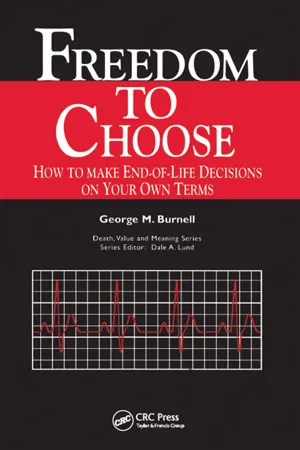
Freedom to Choose
How to Make End-of-life Decisions on Your Own Terms
- 168 pages
- English
- ePUB (mobile friendly)
- Available on iOS & Android
eBook - ePub
Freedom to Choose
How to Make End-of-life Decisions on Your Own Terms
About this book
"Freedom of Information in a Post 9-11 World" is, to date, the first international scholarly examination of the impact of the terrorist attack on the United States in terms of how it may alter academic and corporate research, as well as the sharing of information generated by that research, by international colleagues in technological fields. The collection of essays brings together a widely varied panel of communications experts from different backgrounds and cultures to focus their expertise on the ramifications of this world-changing event. Drawing upon the related but separate disciplines of law, interpersonal communication, semiotics, rhetoric, management, information sciences, and education, the collection adds new insight to the potential future challenges high-tech professionals and academics will face in a global community that now seems much less communal than it did prior to September 11, 2001.In "Freedom to Choose: How to Make End-of-Life Decisions on Your Own Terms", young persons, baby boomers, and "senior citizens" alike will find the information they need to make intelligent, informed, and well-planned decisions about end-of-life care, and to clearly state their wishes based on personal, cultural, religious, and family values. In direct and simple language, Dr. Burnell describes how to prepare for a smooth transition to end-of-life care and what to do to prevent family conflicts, overcome death fears and anxiety, and achieve peace of mind for our loved ones and ourselves.The book gives practical advice on how to make decisions about end-of-life care and how to prepare a living will and durable power of attorney for health care. Dr. Burnell provides guidelines at the end of each chapter on what to consider before preparing these important documents: how to preserve one's rights as a patient; how to choose the right doctor; the best place to be when critically ill; the laws governing advance directives; and the best alternatives for end-of-life care, such as good pain control and assisted dying (where this is legal). "Freedom to Choose" provides a user-friendly approach to facing these difficult decisions. It includes extensive lists of resources and organizations, and a glossary necessary for understanding the issues at hand. As this book makes clear, preparing an advance directive and knowing all the available options at the end of life are the most important steps for achieving peace of mind.The primary audience is anyone, young or old, who needs to prepare a set of advance directives: healthy people, for themselves or their loved ones who are seriously ill or on life support, and people with a terminal illness. The secondary audience is health professionals who deal with people in end-of-life care or with decision-makers on end-of-life issues: primary care physicians; nurses; geriatricians; psychiatrists; hospice doctors, nurses, and volunteer staff; caregivers for the seriously ill; oncologists; interns and residents; counselors; family therapists; psychologists; social workers who work with the dying and bereaved; attorneys; thanatologists; estate planning advisors; senior citizen center staff; college teachers in death and dying courses; professionals taking courses in psychology, gerontology, thanatology, nursing, and social work.
Information
CHAPTER 1
What Happened to Terri Schiavo?
Of all the cases dealing with end-of-life care, none has generated more emotions and media frenzy than the case of Theresa Schiavo. Terri Schiavo was 27 years old when her heart stopped beating; she died but was resuscitated, though not completely. From then on, everything that could go wrong did go wrong. Terri’s sad story eventually went public when the family could not agree on how to manage the end of her life and sought help from the courts and public opinion. The following case history was reconstructed from various sources on the Internet.
Hundreds of newspaper and magazine articles covered the medical, ethical, legal, and political aspects of her case, yet little was written about the events that may have led to her heart problem. Some experts thought it was a heart attack; others speculated that Terri’s past history significantly contributed to an understanding of the tragedy.
Theresa Marie Schindler was born on December 3, 1963, in Huntington Valley, a suburb of Philadelphia. Her parents, Robert and Mary Schindler, were well off; her father was a dealer in industrial supplies, and her mother was a full-time wife and mother. Being devout Catholics, they had named their first child after Saint Teresa of Avila, the Spanish mystic who, believing that the Carmelites were too moderate, founded a more restrictive order.
As a child and later as a teenager, Terri had gained more weight than she would have liked. She reached a maximum weight of 250 pounds; not surprisingly, her social life consisted of going to the mall, buying presents for her little brother, Bobby, and going to the movies.
She went to a Catholic grade school and a Catholic high school. During high school her main extracurricular activity consisted of being a library aide [1].
After graduating from high school, she went on a Nutrisystem diet and lost over 100 pounds in a few months. Her eating and drinking habits included eating lots of salad, eating a large omelet on weekends, and drinking large amounts of iced tea. She never admitted taking diet pills, binging, purging, or consuming laxatives, although women who usually do this never talk about it to anyone. She never volunteered to her family that she had an eating disorder; young women typically hide their eating problem from friends and family as well.
She enrolled in a two-year community college in Bucks County and while attending a psychology class she met her first love, Michael Schiavo. Two years later, at the age of twenty-one, she married him; he was only eight months her senior. After a short honeymoon at Disney World, they moved in with her parents in Huntington Valley. When her parents moved to Florida, Terri and Michael moved into a condominium in St. Petersburg, where Terri got a clerical job at the Prudential Insurance Company and Michael worked at local restaurants. Still concerned about her weight, Terri continued to diet and drank several quarts of iced tea a day [1, p. 5].
On the evening of February 24, 1990, Michael came home from his restaurant job to find Terri already in bed. He too went to bed and awoke at 5 A.M. (on February 25th) when he heard his wife fall to the floor in the hallway.
Allegedly, he called Bob Schindler, Sr., who advised him to call 911. Bob Sr. also alerted Bobby Schindler, Terri’s brother, who was living in the same apartment complex.
Before the paramedics arrived, both her husband and her brother noted that she was lying prone, breathing, or at least making “gurgling noises.” By the time the emergency crew arrived she was lying supine in the hallway, with no respiration and her cardiac rhythm in ventricular fibrillation. She went into full cardiac arrest; was intubated within the first five minutes; was given a dextrose solution, injections of epinephrine, lidocaine, Narcan, and dopamine; and seven attempts at defibrillation were made. After several electric shocks, the heart started beating again and a normal rhythm was restored.
Her pulse returned but her blood pressure was not recorded until almost an hour after resuscitation was begun. She had received over 30 minutes of CPR, and after her admission to the hospital at around 6:46 A.M., her blood was drawn, and a low potassium level was found. Although many blood tests were done for a toxicology screen, no test was done for a caffeine level—which has been known to cause cardiac arrhythmias, as is a low level of potassium. Authorities discounted that, because the night before Terri had spent the evening at her parents’ house, having a rather large meal.
Terri remained a patient at Humana Northside Hospital in St. Petersburg for the next three months, apparently in a comatose state. When she emerged from the coma, she was in an unresponsive state—which was to last for the next fifteen years [1, p. 7].
Despite enormous press coverage of the family’s discord over discontinuing life support measures, little was reported about the possibility that Terri suffered from an eating disorder, clinically known as bulimia nervosa, commonly called bulimia.
This condition is so disguised by those who suffer from it that even friends never suspect that anything is wrong. People affected by this disease, mostly young women, tend to overeat, referred to as binging, and soon thereafter vomit, referred to as purging. The alternating cycle of binging and purging becomes extremely dangerous because of all the chemical imbalances that result in the body’s organs. The heart, for example, requires a balance of electrolytes, such as potassium and sodium, in order to maintain a normal function; vomiting can upset that balance. When potassium levels drop too low, the imbalance can lead to a cardiac arrhythmia or a heart attack. In Terri’s case, after she was resuscitated by the emergency crew, her brain had been deprived of oxygen long enough to produce catastrophic brain damage.
Later, Michael Schiavo sued the health care providers who treated Terri for having missed the diagnosis of bulimia and who failed to refer her to the proper specialist. Several witnesses at the trial, including outside experts in psychiatry and gynecology, speculated that an eating disorder was the most likely cause of her low potassium level and subsequently the underlying cause of her heart problem and resulting brain damage. However, other physicians at the trial felt that other causes could have contributed, such as artifact as well as excessive thirst and water intake.
In the end, the jury concluded that had she received the appropriate treatment, the tragedy could have been prevented.
But there is more to the story. Terri may have been the victim of medical negligence, but she was also the victim of a society that tells young women, at every opportunity, that their physical appearance and their looks are all-important. That condition, described as “lookism,” was well documented and discussed in a book by Dr. Mary Pipher, which deals with the pressure placed on young women to look good at any cost [2]. Like so many young women with bulimia, Terri was desperately and obsessively trying to be thinner, and in the progression of events, she fell victim to her own search for a new self. By the same token, her parents—like so many parents today—were seemingly unaware of her condition.
After her cardiac arrest, medical experts repeatedly reviewed the events that led to this medical tragedy. The consensual opinion was that the extreme deficiency of potassium, brought on by the eating disorder, led to the heart problem and subsequent poor oxygenation of the brain. The latter resulted in the loss of all higher brain function. CAT scans of her brain showed severe atrophy of her cerebral hemispheres, and her EEG showed flat waves, all indicating that there was no brain function.
Her neurological examination indicated that she was in a persistent vegetative state, which included periods of wakefulness alternating with sleep; some reflex responses to light and noise; some basic gag and swallowing reflexes; but no signs of emotion, willful activity, or cognition. All experts agreed that Terri was not suffering, since the usual definition of suffering requires conscious awareness, not present without cortical function [3].
Subsequently, Terri’s body was kept alive by artificial nutrition and hydration administered through a feeding tube.
In the years that followed, the public and the family were confused when they watched apparent alertness and movements in edited videotapes of Terri Schiavo. The facial movements, thought to be meaningful by the Schindlers, were interpreted as smiles and became the focus of considerable controversy and disagreements among the family and even the press reports.
The problem was that Terri Schiavo had not left any written advance directives, thus leaving her closest family members to interpret what her wishes and values would have been in these medical circumstances if she could have spoken for herself. This is known as the principle of “substitutive judgment,” around which most families try to interpret and guess at the patient’s views and values. Other families, however, who cannot agree on what the patient’s wishes would have been, meet head on with a crisis, which is often aggravated by long-standing family dynamics and conflicts.
This is how Michael Schiavo and the Schindlers met on a collision course: Under Florida law, Michael Schiavo, as Terri’s spouse, was made her legal guardian. He tried traditional and experimental therapies for three years, which produced no signs of improvement. Terri continued to be tube-fed to keep her body alive, and Michael Schiavo, believing that she could be kept alive indefinitely in this condition and recalling that she had made statements like “I don’t want to be kept alive on a machine” accepted the diagnosis of “irreversible persistent vegetative state” and was ready to proceed with executing her wishes.
The Schindlers, however, did not accept the diagnosis of persistent vegetative state and, despite the negative results of therapy, persisted in believing that her condition would improve.
Although the relationship between Michael and the Schindlers had been cordial and warm, it began to break down in 1993 around the time that the malpractice suit was settled. The suit—based on the doctors’ failure to diagnose and treat Terri’s bulimia—resulted in a settlement between the parties, awarding $750,000 for Terri and $300,000 for Michael.
A year later, Michael attempted to refuse treatment for an infection that Terri had developed. That is when the Schindlers took legal action to insist on treatment. From that time on, the conflict between the husband and the parents intensified: Michael was being attacked for his financial greed and questionable loyalty to his wife (he was living with another woman with whom he eventually had two children.) The family dissension was unlike the case of Nancy Cruzan who, also in a persistent vegetative state, got approval from the court to remove the feeding tube, following a consensual request by both parents.
This led the Florida trial-court judge to conduct evidentiary hearings on Terri Schiavo’s condition, including evaluations by four neurologists, one radiologist, and Terri’s physician.
The two neurologists selected by Michael Schiavo, a court-appointed “neutral” neurologist, and Terri’s doctor all agreed that Terri’s condition met all the criteria for the diagnosis of persistent vegetative state. The two neurologists and the radiologist chosen by Terri’s parents thought that her condition might improve with experimental therapies such as hyperbaric oxygen and vasodilators, but had no objective data to support their assertions.
Terri’s case then continued in the legal arena. The trial-court judge ruled that the diagnosis of a persistent vegetative state met the legal standard of “clear and convincing” evidence. The decision was later reviewed and upheld by the Florida Second District Court of Appeal. Subsequent appeals to the Florida Supreme Court and the U.S. Supreme Court were denied.
Terri’s story then spread to the political arena. Senate Majority Leader Dr. Bill Frist, a physician himself, said on the basis of viewing a home video—not a clinical examination—that Terri Schiavo was not in a persistent vegetative state. (This of course is an unethical extension of a physician’s prerogative since Senator Frist is not a neurologist and had never personally examined Terri.)
House Majority Leader Tom Delay and other politicians reaffirmed this publicly. Even President Bush got involved, leaving his vacation to return to Washington, where he made the statement, “Where there are serious questions and substantial doubts in our society, our laws, and our courts should have a presumption in favor of life.” He then signed a bill quickly passed by the Senate and the House—applying only to Terri Schiavo—that allowed a federal judge to review a case that had previously been a state issue [4]. This was unprecedented in United States history.
The Terri Schiavo case further inflamed the causes of various community groups, such as religious fundamentalists and groups for the disabled, and the press continued to publish inflammatory articles on both sides of the issue.
Right to Life groups claimed that the removal of the feeding tube ordered by the court was equivalent to an act of killing. Others raised questions about Terri’s time of collapse fifteen years ago, implying that the husband might be covering up murderous intentions because of the discrepancy between the time of her fall, the 911 phone call, and the arrival of the emergency crew. They also raised the suspicion that there might have been physical abuse by the husband.
These allegations and press reports prompted Jeb Bush, the governor of Florida, to ask the Mr. Bemie McCabe, the prosecutor of Pinellas and Pasco counties, to further investigate the matter, focusing on the time span between Terri’s collapse and the length of time before Michael Schiavo called 911.
In a report dated June 30, 2005, Mr. McCabe indicated that there was no evidence of criminal activity surrounding Terri Schiavo’s collapse 15 years ago [5].
Finally, the autopsy done by Dr. Jon Thogmartin, the Florida Medical Examiner, showed that Terri had massive and irreversible brain damage and was blind. The autopsy did not find any evidence of strangulation, physical abuse, or drug overdose. The irreversible brain damage was so severe that no amount of therapy could have regenerated the massive loss of brain tissue [6].
In a thorough review of her past medical records, the medical examiner acknowledged that she had a low potassium level, but that in itself might not prove that she had an eating disorder, although of all the possibl...
Table of contents
- Cover
- Title Page
- Copyright Page
- Dedication
- Table of Contents
- Foreword
- Introduction
- CHAPTER 1 What Happened to Terri Schiavo?
- CHAPTER 2 Making the Most Important Decision in Your Life
- CHAPTER 3 Knowing Your Rights as a Patient
- CHAPTER 4 Choosing End-of-Life Care at Home or in the Hospital
- CHAPTER 5 Evaluating Risks versus Benefits of Treatment: Avoiding Fatuous Therapy
- CHAPTER 6 Advance Directives: What Are They?
- CHAPTER 7 Take the Time to Plan
- CHAPTER 8 Current Laws You Need to Know for End-of-Life Planning
- CHAPTER 9 Selecting the Best End-of-Life Care
- CHAPTER 10 Choosing Caregivers
- CHAPTER 11 Anatomy of Two Good Deaths
- CHAPTER 12 Achieving Peace of Mind
- CHAPTER 13 Frequently Asked Questions
- RESOURCES Useful Web Sites and Addresses of Organizations
- APPENDIX
- Annotated Bibliography
- Glossary
- Index
Trusted by 375,005 students
Access to over 1.5 million titles for a fair monthly price.
Study more efficiently using our study tools.
Frequently asked questions
Yes, you can cancel anytime from the Subscription tab in your account settings on the Perlego website. Your subscription will stay active until the end of your current billing period. Learn how to cancel your subscription
No, books cannot be downloaded as external files, such as PDFs, for use outside of Perlego. However, you can download books within the Perlego app for offline reading on mobile or tablet. Learn how to download books offline
Perlego offers two plans: Essential and Complete
- Essential is ideal for learners and professionals who enjoy exploring a wide range of subjects. Access the Essential Library with 800,000+ trusted titles and best-sellers across business, personal growth, and the humanities. Includes unlimited reading time and Standard Read Aloud voice.
- Complete: Perfect for advanced learners and researchers needing full, unrestricted access. Unlock 1.5M+ books across hundreds of subjects, including academic and specialized titles. The Complete Plan also includes advanced features like Premium Read Aloud and Research Assistant.
We are an online textbook subscription service, where you can get access to an entire online library for less than the price of a single book per month. With over 1.5 million books across 990+ topics, we’ve got you covered! Learn about our mission
Look out for the read-aloud symbol on your next book to see if you can listen to it. The read-aloud tool reads text aloud for you, highlighting the text as it is being read. You can pause it, speed it up and slow it down. Learn more about Read Aloud
Yes! You can use the Perlego app on both iOS and Android devices to read anytime, anywhere — even offline. Perfect for commutes or when you’re on the go.
Please note we cannot support devices running on iOS 13 and Android 7 or earlier. Learn more about using the app
Please note we cannot support devices running on iOS 13 and Android 7 or earlier. Learn more about using the app
Yes, you can access Freedom to Choose by Burnell Burnell,Dale Lund,Burnell M. Burnell,Dale A. Lund in PDF and/or ePUB format, as well as other popular books in Medicine & Medical Law. We have over 1.5 million books available in our catalogue for you to explore.