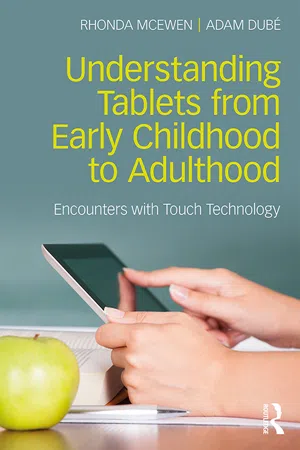
Understanding Tablets from Early Childhood to Adulthood offers an alternative to dominant and populist narratives that young people are intuitively able to successfully use tablet devices. Adopting a research-driven approach, the book contests the ideology that touch-technologies are easier to understand, and identifies the factors that contribute to communicative encounters between users and tablets. Communication theory and cognitive psychology concepts and methods are employed to offer an epistemological exploration of user-tablet interaction with a focus on the use of these technologies in educational settings.
eBook - ePub
Understanding Tablets from Early Childhood to Adulthood
Encounters with Touch Technology
- 96 pages
- English
- ePUB (mobile friendly)
- Available on iOS & Android
eBook - ePub
Understanding Tablets from Early Childhood to Adulthood
Encounters with Touch Technology
About this book
Information
1
Studying Tablets
“One Ring,” the central plot element in Tolkien’s famous trilogy The Lord of the Rings, is a simple and seemingly commonplace artifact, fascinating in its potential for infinite power. As a symbolic literary device, we are drawn to confer mystery, complexity and desirability on this object so that, as readers, we too can believe that there is, “One Ring to rule them all.”
In these first decades of the 21st century, the tablet may be considered the “One Device to rule them all” – with similar claims of ubiquity, mystery and attraction, and the added claim of simplicity. While the rise of electronic and digital technologies of the 1990s and early 2000s offered consumers innovations in audio, video, storage, portability and reach – epitomized by the Internet – no single technology has captured the imagination of consumers to the degree of the tablet. Babies in strollers watch their favourite red Muppet, seniors play brain-games, kindergartners encounter formal learning for the first time and their teachers prepare lesson plans, concert-going teens share photos, ministers write sermons, business consultants deliver presentations, athletes track their performances, musicians edit songs, immigrants interview for jobs, preteens upload short movies and journalists make documentaries – all on a common device for the first time. Tablets have become this “One Device.”
The rapid rate at which tablets have become ubiquitous is a consequence of this broad appeal, crossing generational and market segments. Tablets are showing faster adoption rates than their older, smaller cousins, smartphones. Two years after tablets debuted internationally, they achieved a six percent penetration rate – it took smartphones four years to do the same.1
Gartner, an information technology research company, estimates that global tablet sales rose 24 percent between 2013 and 2014 and 25 percent between 2014 and 2015.2
While the focus of this book is on the tablet, the issues we discuss can be applied to touchscreen devices more broadly to include smartwatches, e-book readers, touchscreen computers, hybrid tablet-laptops and, especially, smartphones. Hardware designers are creating form factors for smartphones with larger screens and tablets with smaller surfaces, resulting in a trend in device convergence that has brought the phablet (smartphone-tablets) to the market.3
Smartphones and tablets account for a majority of the touchscreen market; so, if we combine the numbers for tablet and smartphone adoption globally, one in every seven people in the world has access to a tablet or smartphone. From a functionality perspective, tablets and smartphones offer their users similar experiences because they both use touchscreens for inputting information. Yet, owing to their historical linage, smartphones retain a core function of voice telephony while tablets have focused on data from the start. Given that both smartphones and tablets are touch devices, and given that the projected adoption of tablet devices is unprecedented, and given that the declining use of smartphones for telephony brings them in line with tablets functionally, our focus and ideas on tablets can be applied to other touch devices.
The rapid adoption of tablets is accompanied by a dominant social rhetoric that these devices are intuitive and can be used successfully by everyone for almost any occasion. So simple in design, they don’t even come with a user manual; there’s just a button or two and all you need is a finger. But is this true? Are tablets naturally intuitive and users universally successful at using them? Are tablet devices somehow innately attuned to the ways human beings process information, or, in the wave of excitement that tablets are riding, are we missing something more? Asking and answering these questions has become even more important as we witness the optimism with which tablets are being adopted in educational environments. “Tablet versus textbooks” is a topic of discussion and debate in North America, Europe and Australia, with the rest of the world weighing in and watching the results of the deployment of tablets in schools in the western world.4
The online polling site Debate.org boasts 250,000 members worldwide and asked this question in a poll: “Should kids use iPads for textbooks in school?”5
Sixty-seven percent of participants chose “yes” as their response. While the statistical reliability of the poll can be questioned, the comments and discussion around the poll are fascinating. “When kids use iPads they will learn how to do better work and be smarter … just use your common sense and know that using iPads will be more efficient,” one response stated. Another reads, “I am going into my sophomore year. I do not learn anything from my textbooks when I read out of them. When I get home, I read about it online and I remember it. Kids aren’t able to recite paragraphs from textbooks, but when they read it in a text message, or on a social media site, they remember the entire thing word for word … once I received my iPad this past Christmas, my grades actually improved.”
Claims that tablets improve learning and that they are more efficient in facilitating learning, and that people have better memory associations when engaged with the device, underpin a growing and positive association in public perception between tablets and education. Those opposed to this line of thinking often make the argument about the cost of acquiring and replacing devices, express concerns about controlling Internet access for younger users for privacy reasons and worry that the entertainment aspect of tablets will distract students from learning. However, even among those opposed to using tablets in schools, it is rarely argued that tablets may not support learning outcomes. The relationship between tablets and how users make inferences from the information received – that is, the role that the tablet itself plays in the process through which users understand content – remains unknown and unproven.
The goal of this book is to identify and critically examine the factors that influence success and failure when we use tablets. What are the interaction characteristics of both users and tablets that result in positive learning outcomes and increase the likelihood that learning takes place? This form of inquiry can support evidence-based dialogue among users, application developers, educators, parents, interface designers and others collectively interested in improving the usefulness of touch devices, and in particular tablets as educational technologies. In the field of education, the idea of using our hands to engage in the physical manipulation of objects in order to better understand concepts is not new. From the use of blocks for counting to the creation of models in 3D printing, tangible interaction with materials has mediated our processing of both simple and complex ideas for a very long time.
The tablet and other touch devices can be added to this legacy of using our hands to learn – traditionally called “hands-on learning” – where we find utility in engaging the sense of touch to gather information and gain a better understanding about a given topic. By directly interacting with digital content and by witnessing the cause and effect brought about by our interaction with tablets, we appear to make digital content manifest in a tangible way, and perhaps this contributes to our belief that tablets are learning tools. But research is needed to investigate these beliefs.
We can look to users and the academic fields most closely associated with information and communication technologies (ICTs) to see what others have discovered about the effectiveness of tablets thus far. As we will see, each field of study has approached this in different ways with varying levels of focus on the user and the device.
Communications Scholars Studying Tablets
Communications studies involves inquiry into the complex processes involved in human expression and examines the relationships among users (and non-users), media, social practices and values. Communications scholars are interested in how people make sense of ICTs. They challenge us to think critically of the social consequences of media use and adoption. Scholars and practitioners, often at the forefront of investigating new media, can be more – or less – successful at tempering enthusiasm for the potential of technologies and can consider the effects these technologies may have on society from a broader perspective. The analysis of tablets has followed this tension.
The launch of the Apple iPad on April 3, 2010, gave the general public access to the first mass-produced touchscreen tablet with a 9.7-inch smooth glass surface.6 Almost immediately communications scholars saw the utility in these devices for people requiring assistive or augmentative communication (AAC) support, an extension of the work done with Apple’s earlier iPod devices.7 Compared to available devices built specifically for AAC support at the time, tablets were much cheaper, and the addition of applications, better known as “apps”, made tablets multipurpose and more versatile than other AAC devices. The nonverbal communication and augmentative communications scholars and practitioners conducted many studies comparing tablets to non-digital AAC devices.8 These contributions provided a basis for making changes in special education classrooms. Tablets could provide another medium for teachers to present content and for students to engage with and create content. However, many of these studies explored the use of tablets as a supplement to existing communications tools only, and did not get into details on whether learning was taking place and to what extent.
Some researchers have criticized these studies for being technologically deterministic – that is, for showcasing the view that the tablet is driving change in users without considering the interaction between the tablet and the user as a more balanced and co-constitutive encounter.9 While there are a few articles adding tablets to the digital divide debate, there is little from a critical communications perspective from the academic community. Very little theorizing on the contribution of tablets to the area of communications studies exists to date and most of the literature is of a practical nature, heavily focused on how hardware and software drive the user experience.
Information Scholars Studying Tablets
Library and information studies (LIS) scholars also have an interest in tablets. This field is interested in the management of digital data in many different ways, including the analysis of access, search, organization, evaluation and preservation of information across multiple formats and media. The LIS research community saw early opportunities – and threats – for classic paper book collections when tablets were first introduced, followed by e-book readers. Studies on the benefits and costs of using tablets for search, reference and for borrowing content were among the first in the field of information studies.10 Many of these studies focus on the use of tablets as another hardware-software tool in the same way that computers are used in libraries for searching and accessing collections. Some work on digital preservation of collections utilizing tablets has been done.11 Tablets have also been considered in explorations in digital literacy with critical assessments on the effect of tablets on reading styles and on storytelling as a practice.12 However, articles or books applying or developing information theory in relation to tablets have yet to emerge.
HCI and the “I” (Individual) in iPad
At the announcement of the iPad, Apple cofounder and CEO Steve Jobs went to great lengths to forward the idea that tablet computer use was intimate – going so far as to create a living room on the presentation stage just so he could sit in a chair with the device resting against a crossed leg. This scene catalyzed the notion that tablets are more dependent on the individual user and more natural than desktop or laptop computers. The role the individual plays in tablet computer use is also of central interest to researchers, with a considerable focus on how the individual and their experience is shaped by the technology.
Researchers in the field of human computer interaction (HCI) produced many early articles on the human interface guidelines to support the standardization or establishment of best practices for designers of tablets.13 The largest contribution from HCI is in the area of human factors and known as the study of ergonomics. Human factors regarding tablets consider the effects and efficacy of particular design choices of various tablet makers, including weight, screen brightness, the angle and position of the hands when using the device, and the optimal and non-optimal distance of the average users’ eyes from the screen.14 While there have been a few studies on tablets and interface design, there are no studies yet on the role that tablet interfaces play in the way users understand content. The focus so far has been on the device itself.
Educators Studying Tablets
The potential for the tablet as an education tool was apparent from the beginning. Before the iPad, Windows-based tablets and other proprietary tablets were created for, and marketed specifically to, the education sector.15 Since the creation of the Apple app store and Google Play store, educational applications have dominated the marketplace, with more than 80 percent of educational apps advertised as being designed for children. Interestingly, in one review of the Apple app store, only 14 percent of apps surveyed specifically mentioned school usage in their descriptions, whereas a majority mentioned “early learning.”16
Developers readily create educational applications for children, but seem hesitant to make claims regarding the suitability of the applications for formal instruction (which raises the question whether they are indeed effective learning tools). A likely reason for this reluctance is that the developers lack the skillset and infrastructure to conduct reliable user testing. Instead, educators and researchers have been scrambling to test the educational claims made by application marketers and hardware manufacturers.
Much of the current research is focused on two goals: comparing the learning outc...
Table of contents
- Cover
- Half Title
- Title Page
- Copyright Page
- Table of Contents
- Preface
- Acknowledgements
- 1. Studying Tablets
- 2. Proposing a Model of User-Tablet Communication
- 3. How Tablet Technology Influences User-Tablet Communication rab women writers 1980–2010
- 4. How the Mind Influences User-Tablet Communication
- 5. Tablets as a Form of Screen Learning
- 6. Tablets as a Form of “Hands-On” Learning
- 7. User–Tablet Communication – A Complete Model
- Index
Trusted by 375,005 students
Access to over 1.5 million titles for a fair monthly price.
Study more efficiently using our study tools.
Frequently asked questions
Yes, you can cancel anytime from the Subscription tab in your account settings on the Perlego website. Your subscription will stay active until the end of your current billing period. Learn how to cancel your subscription
No, books cannot be downloaded as external files, such as PDFs, for use outside of Perlego. However, you can download books within the Perlego app for offline reading on mobile or tablet. Learn how to download books offline
Perlego offers two plans: Essential and Complete
- Essential is ideal for learners and professionals who enjoy exploring a wide range of subjects. Access the Essential Library with 800,000+ trusted titles and best-sellers across business, personal growth, and the humanities. Includes unlimited reading time and Standard Read Aloud voice.
- Complete: Perfect for advanced learners and researchers needing full, unrestricted access. Unlock 1.5M+ books across hundreds of subjects, including academic and specialized titles. The Complete Plan also includes advanced features like Premium Read Aloud and Research Assistant.
We are an online textbook subscription service, where you can get access to an entire online library for less than the price of a single book per month. With over 1.5 million books across 990+ topics, we’ve got you covered! Learn about our mission
Look out for the read-aloud symbol on your next book to see if you can listen to it. The read-aloud tool reads text aloud for you, highlighting the text as it is being read. You can pause it, speed it up and slow it down. Learn more about Read Aloud
Yes! You can use the Perlego app on both iOS and Android devices to read anytime, anywhere — even offline. Perfect for commutes or when you’re on the go.
Please note we cannot support devices running on iOS 13 and Android 7 or earlier. Learn more about using the app
Please note we cannot support devices running on iOS 13 and Android 7 or earlier. Learn more about using the app
Yes, you can access Understanding Tablets from Early Childhood to Adulthood by Rhonda McEwen,Adam Dubé in PDF and/or ePUB format, as well as other popular books in Education & Education General. We have over 1.5 million books available in our catalogue for you to explore.