The College Classroom Assessment Compendium provides new and seasoned instructors with comprehensive strategies, perspectives, and solutions for the daily challenges and issues involved in student assessment. Composed of cross-referenced, research-based entries organized for effective and immediate access, this book provides systematic explanations of assessment policies and practices, including guidelines for classroom implementation. Situated beyond the techniques covered in most instructor training and preparation, these practical entries draw from a variety of disciplines and offer an invaluable reference for college instructors interested in developing coherent, reliable classroom assessment climates.
eBook - ePub
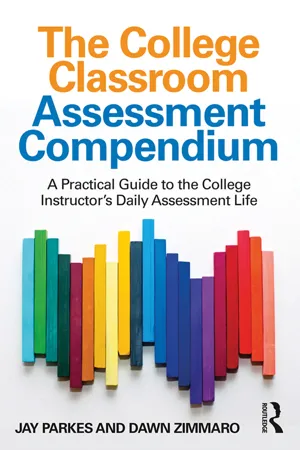
The College Classroom Assessment Compendium
A Practical Guide to the College Instructor’s Daily Assessment Life
- 242 pages
- English
- ePUB (mobile friendly)
- Available on iOS & Android
eBook - ePub
The College Classroom Assessment Compendium
A Practical Guide to the College Instructor’s Daily Assessment Life
About this book
Information
1
Introduction
Who Has Time for This?!?!?
As a 21st-century college instructor, you know what a crush teaching can be! You face a maze of issues: technology, diverse students, helicopter parents, outcomes assessment, shrinking budgets, rapidly changing fields, etc. Assessing your own students in your own classes is definitely part of that mix. It is most likely a part of your job, though, on which you haven’t had systematic education or training. Perhaps you’ve been to a workshop on using clickers in your classroom, or you’ve read a book about e-portfolios. But we’d wager you’ve not had sustained, integrated study regarding student assessment.
That’s a lot to take on. You spend a large percentage of your teaching time with assessment-related tasks and issues: writing exams, grading papers, talking with students about their work during office hours, filing course grades. A study of K–12 teachers in the 1980s found that they spent a quarter to a third of their time in assessment-related activities (Stiggins & Conklin, 1992). That was educational epochs ago; we suspect that in their reality and yours those numbers are still valid, or now a little low! Spending that much of your teaching time working on all of those activities and issues without a coherent philosophy and sense of purpose is very grueling.
There are plenty of issues you encounter, too: ever-changing course management systems; new educational technologies to support in-class, blended, and online teaching approaches; changing policies and procedures from upper administration; and disgruntled students, intrusive parents, well-meaning colleagues, department chairs, etc. These are issues and people which we can perceive as challenging to our decisions as an instructor. We seem constantly to need either to make a decision or to explain a decision to someone.
You paradoxically need just-in-time information, in an easily accessible and digestible format, that will guide you in what to do, yet you also require a comprehensive approach to addressing assessment issues in your daily life. For these reasons, we’ve decided to write a compendium of college classroom assessment.
We are deliberately structuring this book into short, encyclopedia-like entries so that it serves as an off-the-shelf reference for you. Compendium, according to the Oxford English Dictionary, means “giving the sense and substance, within smaller compass” or “an embodiment in miniature.” We’ve tried to do that for you. Are you writing your syllabus for the next term and are wondering what to do about attendance∗? Did you just make an appointment with a student who wants to know “what else I can do” to better her grade (see extra credit∗)? Was the average on your last exam lower than you and your students were expecting (see low test scores∗)? We offer this volume as some assistance in those situations.
We have constructed this compendium, though, fully acknowledging that assessment policies and practices are driven by your own philosophies (see assessment philosophy∗), which are often as determinative of what you choose to do as any “best practice” recommendation. You need to have, and this compendium has, an underlying framework of philosophy, evidence, and best practice recommendations. Compendium, also from the OED, derives from the Latin compendere, which means “to weigh together.” Each of the entries in this volume cannot be taken in isolation. You might consult an entry to solve a time-sensitive issue, but we hope that, once the immediate crisis is over, you’ll take additional time to consider how that issue fits into larger ones.
How to Use This Book
First and foremost, we intend this compendium as a resource for just-in-time learning. As you’re preparing a syllabus, as you read a student’s e-mail asking about her grade, after you’ve had a conversation with a colleague about, say, groupwork∗, you can pull this off your shelf and, in a few minutes, have some details and perspectives about that issue. That’s why we’ve broken it into brief, topical entries which are organized alphabetically.
If you can’t find exactly what you’re looking for immediately, there are several other ways you can look up topics. There is a traditional index at the end of the book. Furthermore, most entries include a “see also” list of other related entries in this book. So if you’ve found an entry but it isn’t exactly what you’re looking for, glance down at the “see also” list.
Second, we’ve designed the book deliberately to aid more systematic learning on your part, too. Every entry includes references which we’ve used to prepare the entry, resources on the topic which would provide you with more in-depth discussions related to that topic, and a “see also” list of other related entries in this book. Another technique we’ve adopted is that we will boldface and asterisk any term in the text which has its own entry in this book. So when you’re done reading the entry on extra credit∗, you may decide that you also need to consult the entry for assessment plan∗, or what to say when a grade feeding frenzy ∗ occurs. You can use the book in Choose Your Own Adventure® style, moving from entry to entry.
Create Your Personal Classroom Assessment Mosaic
Third, you do not actually tackle your assessment issues in isolation. Your own teaching philosophy, your own professional and personal values, and the policy and practice environment in which you work affect many of these decisions and practices. So we invite you here to work on integrating your assessment policies and practices into an explicit framework. Create your own Personal Classroom Assessment Mosaic.
There are lots of ways to do this. Writing about assessment in your statement of teaching philosophy is definitely one option. Assessment of students is routinely considered a portion of what one should address in a statement of teaching philosophy (Schönwetter, Sokal, Friesen, & Taylor, 2002). We would upend the traditional logic, however, which tends to suggest that you write about your values, beliefs, and philosophy first and then write about how that plays out in your instruction. We actually suggest that you think about what you do with assessment first because assessment is usually your values, beliefs, and philosophy enacted.
When Jay teaches classroom assessment to K–12 teachers, one of their assignments is to write a Personal Grading Plan (Frisbie & Waltman, 1992). Frisbie and Waltman propose questions like, “What should failure mean in your course?,” “What does an A+ signify?,” and “Should borderline grade cases∗ be reviewed?” The Frisbie and Waltman article is thought-provoking and may prove a useful starting point. We include these and other questions in the assessment philosophy∗ entry.
In conversations with instructors about their course design, Dawn advises them to first develop an assessment plan∗ that not only outlines the number of assessments but defines how they will be used (see formative and summative assessments∗) and to which learning objectives they will align (see align assessments to learning objectives∗). This process helps you explicitly define the alignment between your assessment, learning objectives, and instructional activities that ultimately reflect your overall assessment philosophy∗ as an instructor.
When should you do this? Perhaps you’ll start on Spring Break, or when you are next required to submit your teaching philosophy for your formal faculty review, or during the summer when you have some time to read, think, and study. But start soon. Do something now. Regardless of the method(s) you choose to think through and capture your assessment philosophy, beliefs, and values, do take some time to do this. Perhaps you could even get started by writing in the margins of this book. Feel free to make marginal notes like, “Yes!” or “Are you crazy!?!?!?!” next to what you find in this book. But then have some system for articulating to yourself, and then to your students and other constituents, why you think so.
We refer to this as a mosaic because any assessment decision has subcomponents to it. In a mosaic, if you’re standing back far enough, you can’t actually see those small tiles individually, you see only the whole picture. But if you examine a mosaic closely enough, you can differentiate those subcomponents. The same thing is true of your assessment practices. What decision you make regarding a flawed multiple-choice item on a test (see drop a question∗) draws on your positions on values like fairness ∗, equity ∗, and beneficence ∗; on your philosophy regarding student motivation and learner-centeredness; on your knowledge of educational measurement principles; and on best practice guidelines for multiple-choice use and, perhaps, a research base on those issues.
For some of those issues, like fairness, there are different, reasonable positions and thus actions which different instructors may adhere to. For some of those issues, like educational measurement principles, there are best practice, sense-of-the-field, consensuses on better or worse choices. And for some of those issues, there is a right answer, or at least a research-derived conclusion to the question. You owe it to yourself, to your students, and to your institution to know which of those kinds of foundations on which you’re building your assessment practice.
As we wrote these entries in this book, we also drew on this mosaic approach. So for some entries, like attendance∗, we will make a recommendation for your practice and tell you why that’s our recommendation. For other entries, like compensatory and conjunctive grading∗, the options rely a bit more on philosophical stance. There, we will provide best practice suggestions for the different options.
Let’s Go!
Now that you have some sense of how this book is organized and how we anticipate you will use it, let’s go! Use it the way it serves you best as you tackle the challenges that come with assessing student learning each day.
References
Frisbie, D. A., & Waltman, K. K. (1992). Developing a personal grading plan. Educational Measurement: Issues and Practice, 11 (3), 35–42.
Schönwetter, D. J., Sokal, L., Friesen, M., & Taylor, K. L. (2002). Teaching philosophies reconsidered: A conceptual model for the development and evaluation of teaching philosophy statements. International Journal for Academic Development, 7 (1), 83–97.
Stiggins, R. J., & Conklin, N. (1992). In teachers’ hands: Investigating the practice of classroom assessment. Albany, NY: SUNY Press.
2
Align Assessments to Learning Objectives
What Is a Learning Objective?
A learning objective describes the knowledge, skills, abilities, and behaviors you want students to gain from an activity, unit of instruction, or course. Well-written learning objectives are:
- Centered on students, rather than instructors (Students will be able to…).
- Focused on the specific learning that results from an activity.
- Worded in clear, concise, and concrete language about learning.
- Focused on learning that can be measured and assessed.
Here is an example of a well-written learning objective: Given a diagram of an animal cell, students will be able to identify the various parts of the cell.
Why Should I Align My Assessments to Learning Objectives?
Developing assessments aligned to learning objectives ensures that you are giving students the opportunity to practice and meet the learning objective. Every assessment should be created with a specific learning objective in mind, and learning objectives can vary in learning level.
How Do I Align My Assessments to Learning Objectives?
Most learning objectives, regardless of th...
Table of contents
- Cover
- Title
- Copyright
- Dedication
- Contents
- List of Illustrations
- 1 Introduction
- 2 Align Assessments to Learning Objectives
- 3 Assessment Philosophy
- 4 Assessment Plan
- 5 Attendance
- 6 Beneficence
- 7 Borderline Grade Cases
- 8 Cheat Sheets or Crib Sheets
- 9 Cheating and Plagiarism
- 10 Collaborative Testing
- 11 Compensatory and Conjunctive Grading
- 12 Contract Grading and Learning Contracts
- 13 Criterion-Referenced Grading Approaches
- 14 Design Assessments First
- 15 Drop a Question
- 16 Drop the Lowest Grade
- 17 Effort
- 18 Equity
- 19 Evaluation Anxiety
- 20 Extra Credit
- 21 Fairness
- 22 Feedback
- 23 Feedback Timing
- 24 FERPA (Family Educational Rights and Privacy Act)
- 25 Formative and Summative Assessments
- 26 Gatekeeping
- 27 Grade Explanation
- 28 Grade Feeding Frenzy
- 29 Grade Inflation
- 30 Groupwork
- 31 Humor
- 32 Incomplete Grades
- 33 Late Work
- 34 Learning-Oriented Assessment
- 35 Low Test Scores
- 36 Make-Up Exams
- 37 Mastery Opportunities
- 38 Missing Assignments
- 39 Non-Cognitive Factors
- 40 Norm-Referenced Grading Approaches
- 41 Not Everything That Matters Must Be Graded
- 42 Online Assessment and Authentication
- 43 Online Discussions
- 44 Online Test Security
- 45 Open-Book Exams
- 46 Our Policy on Policies
- 47 Participation
- 48 Peer Assessment
- 49 Personal Disclosures
- 50 Pop Quizzes
- 51 Prior Knowledge
- 52 Quizzing Frequency
- 53 Rubrics
- 54 Scoring Essay Tests, Papers, or Assignments
- 55 Selected- and Constructed-Response Questions
- 56 Self-Assessment
- 57 Student Choice
- 58 Take-Home Exams
- 59 Test Security
- 60 Zero Grades
- Resources
- References
- Index
Trusted by 375,005 students
Access to over 1.5 million titles for a fair monthly price.
Study more efficiently using our study tools.
Frequently asked questions
Yes, you can cancel anytime from the Subscription tab in your account settings on the Perlego website. Your subscription will stay active until the end of your current billing period. Learn how to cancel your subscription
No, books cannot be downloaded as external files, such as PDFs, for use outside of Perlego. However, you can download books within the Perlego app for offline reading on mobile or tablet. Learn how to download books offline
Perlego offers two plans: Essential and Complete
- Essential is ideal for learners and professionals who enjoy exploring a wide range of subjects. Access the Essential Library with 800,000+ trusted titles and best-sellers across business, personal growth, and the humanities. Includes unlimited reading time and Standard Read Aloud voice.
- Complete: Perfect for advanced learners and researchers needing full, unrestricted access. Unlock 1.5M+ books across hundreds of subjects, including academic and specialized titles. The Complete Plan also includes advanced features like Premium Read Aloud and Research Assistant.
We are an online textbook subscription service, where you can get access to an entire online library for less than the price of a single book per month. With over 1.5 million books across 990+ topics, we’ve got you covered! Learn about our mission
Look out for the read-aloud symbol on your next book to see if you can listen to it. The read-aloud tool reads text aloud for you, highlighting the text as it is being read. You can pause it, speed it up and slow it down. Learn more about Read Aloud
Yes! You can use the Perlego app on both iOS and Android devices to read anytime, anywhere — even offline. Perfect for commutes or when you’re on the go.
Please note we cannot support devices running on iOS 13 and Android 7 or earlier. Learn more about using the app
Please note we cannot support devices running on iOS 13 and Android 7 or earlier. Learn more about using the app
Yes, you can access The College Classroom Assessment Compendium by Jay Parkes,Dawn Zimmaro in PDF and/or ePUB format, as well as other popular books in Education & Education General. We have over 1.5 million books available in our catalogue for you to explore.