eBook - ePub
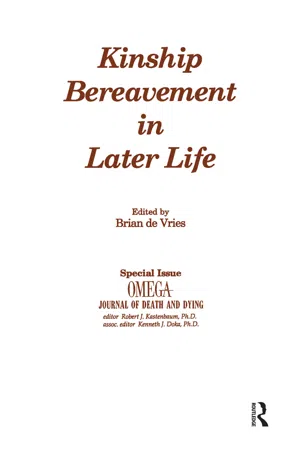
Kinship Bereavement in Later Life
A Special Issue of "Omega - Journal of Death and Dying"
- 162 pages
- English
- ePUB (mobile friendly)
- Available on iOS & Android
eBook - ePub
Kinship Bereavement in Later Life
A Special Issue of "Omega - Journal of Death and Dying"
About this book
This collection of articles is an outgrowth of the Death, Dying, Bereavement and Widowhood Interest Group of the Gerontological Society of America and comprises empirical accounts of several distinct family losses: the death of a spouse, sibling, parent, child, and grandchild. These articles represent normative and non-normative losses; the juxtaposition of short-term and long- term bereavement reactions; cross-sectional and longitudinal comparisons; sociological, psychological, and psycholinguistic research paradigms; national and regional level data; and qualitative and quantitative analytic strategies. The articles and their approaches are as diverse and varied as are the experiences they describe, yet each contributes something of value to the more singular and superordinate goal of understanding kinship bereavement in the later years.
Information
THE ADULT CHILD’S ACCEPTANCE OF PARENT DEATH*
ANNE R BOWER PH.D.
Polisher Research Institute, Philadelphia Geriatric Center, Pennsylvania
ABSTRACT
In the grief and bereavement literature, the discussion of acceptance often regards it as an end-point of the process and utilizes a definition that is linked to duration and intensity of grief. The study of parent death is no exception. Adult children are rarely asked whether or why they have or have not accepted the death of an elderly parent, or even what acceptance means to them. The extent to which such studies accurately report on the experience of parent death acceptance is questionable. Using ethnographic and linguistic techniques, this study approaches acceptance through a qualitative examination of adult children’s verbatim responses to direct inquiries about their acceptance of an elderly parent’s death. Findings indicate that while the majority of adult children readily assert acceptance of their parent’s death, these assertions are contingent upon important beliefs and values relating to the death, the power of feelings, and the strength of memory. Further, and most important, acceptance appears to be a phenomenon adult children feel compelled to explain.
ACCEPTANCE IN THE BEREAVEMENT LITERATURE
The importance of acceptance in current conceptualizations of the course of grief is indisputable. The bereavement literature discusses acceptance in a variety of ways, treating it as a necessary and important part of grief. Yet, perhaps the most striking feature of the literature’s treatment of acceptance is that the researcher’s voice predominates. Apart from the occasional case note, single-sentence verbatim quote, or single word “descriptors” to give the “flavor” of respondents’ comments, the clearest voice we hear in the literature is that of the researcher or clinician. The voices of the bereaved speaking about their own acceptance of a loved one’s death are markedly absent.
A review of the literature suggests that the role assigned to acceptance in bereavement theory is more likely to reflect the researchers’ theoretical views and personal intuitions about what acceptance is or ought to be rather than reflecting an inquiry into acceptance or their subjects’ perceptions of acceptance. For example, acceptance is widely discussed as a desirable outcome to grief and, as such, is typically situated in the broad context of grief’s course, often as the last in a sequence of grief-related “tasks” or “work” [1-14]. Acceptance is linked explicitly to other experiential states attributed to grieving, such as recognition [3], recovery [15], resignation [16], or used interchangeably with resolution [17], but is rarely accompanied by discussion about the reasons for such conceptual alignments. Acceptance is differentiated according to type, again with little explication, emotional and cognitive acceptance [2, 8, 18] or conscious and unconscious acceptance [8]. Other research isolates acceptance in respondents’ agreement or disagreement with statements about the timeliness or fairness of the parent’s death [9, 18] or about satisfying and unsatisfying aspects of the parent/child tie [10, 16]. Given the centrality of bereaved people to our research, and given the important role of acceptance in our understanding of bereavement, acceptance deserves an examination that is more closely attentive to the voices of the bereaved rather than to the researcher’s voice.
Consequently, the purpose of this discussion is to examine acceptance of an elderly, widowed parent’s death from adult children’s point of view and in their own words. By asking recently bereaved sons or daughters what they have to say about their own experience of acceptance, and then listening closely to both what they say and how they say it, I contend that we can better understand what constitutes acceptance and how it is experienced. In the discussion to follow, we will approach acceptance by identifying four key features of the discourse. One of these is that acceptance is a heavily explained phenomenon. The content of participants’ explanation for their acceptance and non-acceptance will be explored. We will then consider how the overall structure and specific language of acceptance talk relates explanatory content to participants’ affirmations and denials of acceptance. Finally, we will consider the explaining nature of acceptance talk as a structural characteristic of the experience rather than as an artifact of the interview context.
The present study takes its inspiration from recent research in cultural anthropology which argues that the experience of emotion, such as grief, is culturally constructed [19-22] and analytically accessible through discourse [23, 24]. This perspective contends that grief is conveyed through verbal modalities, such as oratory, wailing, poetry or ordinary talk, and cannot be separated from their verbal expression. Further, verbal expression cannot be separated from the context of its occurrence [25, 26]. Following this perspective, this discussion will regard acceptance of parent death as one aspect of the “lived experience” of grief [27]. As such, the nature of the experience of acceptance should be accessible through examination of talk about it. Acceptance talk will be examined through ethnographic analysis of its content and application of sociolinguistic analytic techniques to its specific language and structure. The result will be a realistic close-up picture of acceptance that assists in further understanding and defining this important aspect of grief.
THE DATA
The Sample
The sample of fifty respondents used in this analysis is drawn from a larger ongoing study of 240 participants aimed at understanding the adult child’s perspective on the death of an elderly parent. The specific aim of the parent death study is to understand the death as both a loss and as a life course transition for the adult child, specifically the affect of parent death on the adult child’s perceptions of self, personal continuity, and well-being. The effect of care giving circumstances on children’s understanding of the meaning of their parents’ death is also an important focus of the study, as is the role of gender in affecting perspective on parent death.
An in-depth, semi-structured ethnographic interview was conducted with each of the 240 participants. Interviews ranged between two to four hours in length, and were audiotape-recorded with the respondents’ permission. The interviews were conducted six to eight months after parent’s death; long enough after the death for the respondent to have begun to make sense of the experience, yet close enough to it to constitute a recent bereavement. The deceased parent was a widowed mother or father, sixty-five years or older.
In this study of acceptance, a total of fifty respondents is represented: twenty-seven daughters and twenty-three sons. Three age categories are represented: forty to forty-nine years (n = 18); fifty to fifty-nine years (n = 19) and sixty to sixty-five years (n = 13), and three caregiving categories: heavy caregiving (n = 14); nursing home (n = 18) and light or no caregiving (n = 18). While the sex, age, and caregiving status of the respondent will not figure in this analysis, the interaction of these variables with adult sons’ and daughters’ reaction is addressed in Moss et al.’s article, “The Role of Gender in Middle-Age Children’s Responses to Parent Death,” in this volume.
Description of the Data
The data for this discussion are participants’ tape-recorded responses to the open-ended question about acceptance:
Some [sons/daughters] say they have accepted their [mother’ s/father’s] death and others say they have not fully accepted the death. How was it for you?
The introduction of this topic is deeply embedded in the discussion of the respondent’s emotional reaction to his or her parent’s death, which initiates and occupies the first hour or more of the interview. The acceptance question is situated in a sequence of topics that moves from the opening request for the respondent to tell the story of the parent’s death to the daughter’s or son’s initial reaction to the death, the importance or meaning of being with the parent at the moment of death, subsequent reactions to the death; prior thoughts about the parent’s death and concerns about what reaction she or he might have to the death, the need for and value of controlling emotion surrounding the death, the daughter’s or son’s acceptance of the death and finally to a comparison of parent’s death to other significant deaths over the years.
Participants’ responses to this question were transcribed verbatim, in full. This included all of the respondent’s talk in response to the question and on any additional topics stimulated by the acceptance talk. Interviewer comments and reactions were also transcribed verbatim, in full. Non-verbal components of the response, such as tears, laughter, coughs, sighs, or pauses, were also noted in the transcription as potentially important sources of information about the respondent’s understanding of or reaction to the issue or acceptance. Kinesic behavior can also be laden with meaning in some situations. Consequently, behavior such as tapping the edge of a spoon on the side of a cup for emphasis as one son did, or jumping up from the table in mid-statement to adjust the airconditioning level as another daughter did, were also noted in the transcriptions. The response to the acceptance question was regarded as completed when the respondent fell silent or otherwise indicated by word or other conversational behavior that her or his turn at talk on this topic had concluded. The interviewer then asked the next question.
The following examples illustrate the variety of response to the acceptance question, and the type of verbatim transcript used in this study. In each case, the question is asked as indicated above. The interviewer’s comments are in parentheses. At the close of each quotation, the speaker’s age is indicated, followed by an abbreviation of the parent/child dyad: DA/MO refers to daughter/mother, SO/FA to son/father, DA/FA refers to daughter/father, and SO/MO to son/mother.
Accepted it, yes. Because I know it was God’s will. Had it not been His will, she would be here now. She may be a vegetable. I would probably be more tired now than when I was running back and forth to the hospital. But it was God’s will that she should leave us. So, I have accepted it. Yes, I miss her, but that’s to be expected. But, I accept God’s will. (65, DA/MO)
I accepted—[pauses, tapping spoon against side of coffee mug]—my father’s death because I know everybody has to die, OK? And as I—and I said it previously, I could accept it a lot easier considering his age, and the fact that he was here with us. He wasn’t alone, you know what I mean? And you just—you just can’t ignore the eventuality. (45, SO/FA)
Yeah. Yeah. Yeah. Yeah. You know—I mean—I’m not looking forward to him walking through that door! No. But, I have. I have because, like I said, it’s a natural thing, OK? And this is it. (45, SO/FA)
Well-it-uh—sure, I accepted it because I know he’s dead. Hehhehehheh, OK? Uhm—. (Sure.) I—like I said, I still dream of him. And most of [my] dreams are of him comin’ back, OK? And-uh-like me, I’m like: “No! Don’t come back!” Yeah, I did accept it, because he isn’t here, and I-I know he can’t be here, but I can talk to him all the time. (43, DA/FA)
Oh, I’m over the death, if that’s what you mean. There’s no cost in going back over it, or anything like that. I’m over it. Death happens. It happened. (63, SO/MO)
I’ve accepted it. [Tearful, blowing nose] When I say that I accept it, I know that he is gone, but not gone, because [sobs] he’ll always be [voice breaks] in my heart. (Mhhhmmm.) But I know he’s at peace. And he’s not suffering anymore. And that makes me feel better because I loved him too much to see him suffer. I didn’t want him to be here suffering, you know. [Sobs, takes a deep breath, blows nose.] (61, DA/FA)
Oh, I’ve accepted it. Absolutely. (58, SO/MO)
These examples communicate something of the complex and ambiguous content and feeling in the response to the acceptance question. Let us turn now to a discussion of the content, structure, and language of acceptance.
KEY FEATURES OF ACCEPTANCE DISCOURSE
Four striking characteristics define respondents’ discussion of acceptance. First, response to the acceptance query was swift; second, the proportion of affirmative responses was high; third, acceptance was not easily described by respondents; but, fourth, acceptance was readily and extensively explained.
Swiftness of the Response
Respondents did not hesitate in the...
Table of contents
- Cover
- Title Page
- Copyright Page
- Contents
- Introduction: Kinship Bereavement in Later Life
- Case Histories of Traumatic Grief
- Sibling Bereavement in Late Life
- The Role Of Gender In Middle-Age Children’S Responses To Parent Death
- The Adult Child’S Acceptance Of Parent Death
- Long-Term Psychological And Somatic Consequences Of Later Life Parental Bereavement
- Grandparents’ Reactions to the Death of a Grandchild: An Exploratory Factor Analytic Study
- Kinship Bereavement in Later Life: Understanding Variations in Cause, Course, and Consequence
Trusted by 375,005 students
Access to over 1.5 million titles for a fair monthly price.
Study more efficiently using our study tools.
Frequently asked questions
Yes, you can cancel anytime from the Subscription tab in your account settings on the Perlego website. Your subscription will stay active until the end of your current billing period. Learn how to cancel your subscription
No, books cannot be downloaded as external files, such as PDFs, for use outside of Perlego. However, you can download books within the Perlego app for offline reading on mobile or tablet. Learn how to download books offline
We are an online textbook subscription service, where you can get access to an entire online library for less than the price of a single book per month. With over 1.5 million books across 990+ topics, we’ve got you covered! Learn about our mission
Look out for the read-aloud symbol on your next book to see if you can listen to it. The read-aloud tool reads text aloud for you, highlighting the text as it is being read. You can pause it, speed it up and slow it down. Learn more about Read Aloud
Yes! You can use the Perlego app on both iOS and Android devices to read anytime, anywhere — even offline. Perfect for commutes or when you’re on the go.
Please note we cannot support devices running on iOS 13 and Android 7 or earlier. Learn more about using the app
Please note we cannot support devices running on iOS 13 and Android 7 or earlier. Learn more about using the app
Yes, you can access Kinship Bereavement in Later Life by Brian de Vries in PDF and/or ePUB format, as well as other popular books in Scienze sociali & Salute mentale in psicologia. We have over 1.5 million books available in our catalogue for you to explore.