eBook - ePub
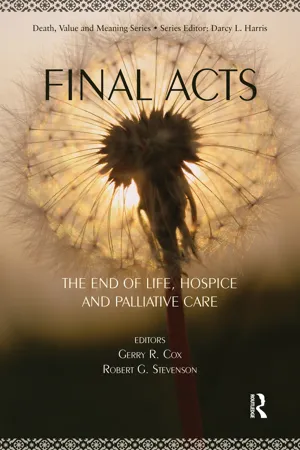
Final Acts
The End of Life: Hospice and Palliative Care
- 258 pages
- English
- ePUB (mobile friendly)
- Available on iOS & Android
eBook - ePub
Final Acts
The End of Life: Hospice and Palliative Care
About this book
The editors undertook this project to promote the International Conference on Death, Grief, and Bereavement in La Crosse, Wisconsin, USA. Throughout its history, the conference has attracted internationally known speakers. This book illustrates the quality of their presentations.
Information
SECTION 1
Professional Applications in End-of-Life Care
CHAPTER 1
Existential Empathy: Caregiver Understanding of Patients' Religious Beliefs at the End-of-Life*
Joseph M. Currier, Miyoung Yoon Hammer, and Robert A. Neimeyer
The appreciation of [illness] meanings is bound within a relationship: it belongs to the sick person’s spouse, child, friend, or caregiver, or to the patient himself. For this reason it is usually as much hedged in with ambiguities as are those relationships themselves. But in the long, oscillating course of chronic disorder, the sick, their relatives, and those who treat them become aware that the meanings communicated by illness can amplify or dampen symptoms, exaggerate or lessen disability, impede or facilitate treatment.
—Arthur Kleinman (1988, pp. 8–9)
Religion has long provided a framework on which dying individuals and their loved ones construct meanings of illness and death (Park, 2005). In the above excerpt from Illness Narratives (1988), Kleinman highlights the importance of a systemic understanding in this regard—that the effects of irreversible health conditions can reverberate beyond the patient and touch those who are in direct relationship with him or her. Ironically, however, research on the impact of death and bereavement rarely adopts a systemic perspective, instead concentrating nearly exclusively on the adjustment of individuals without regard to relational or family factors (Hooghe & Neimeyer, 2012). Yet, particularly for persons at the end-of-life (EOL) who are increasingly dependent on their caregivers for the provision of basic needs, the meaning of their condition could be embedded in these relationships and reciprocally contribute to death anxiety and other existential concerns. Given the centrality of religion for many aging persons (Idler et al., 2003), mutual appreciation of the perceived role of religious faith in the dying person’s life might affect his or her quality adjustment at the EOL. Focusing on a sample of hospice patients and their caregivers, this study explored whether such mutuality in the patient-caregiver relationship predicts patients’ self-esteem and attitudes toward death.
There is evidence that having a reliable social support network in times of suffering generally carries positive health implications. Theoretically, a supportive caregiver relationship at the EOL can help the dying person maintain a sense of self-esteem, which along with companionship and instrumental aid, can buffer distress associated with facing one’s death. However, caregivers do not always possess the resources to cope with the patient’s illness and may hold opposing views regarding the dying process and religious (or secular) meanings of life and death. The term “support paradox” has been used to capture the burden that patients sometimes feel for a distressed caregiver who is unable to care for them due to negativity and potential opposition (Chan, Epstein, Reese, & Chan, 2009). In these instances, dissonance in the caregiving relationship about the patient’s core beliefs can cause relational strain and emotional distress (Schumacher, Stewart, & Archbold, 2007; Skerrett, 2003). In contrast to many EOL contexts, when loved ones experience deep connection and healing (Sulmasy, 2002), such strains might eventuate in extreme isolation and guilt, thereby interfering with the patient’s capacity to face death with a sense of integrity and acceptance.
Considering specific factors that might bear on patient adjustment at the EOL, the potential benefits of religion have been well documented (for review, see Koenig, McCullough, & Larson, 2001). For instance, studying a sample of over 800 older adults who were admitted to a general medical service, Koenig and colleagues (Koenig, George, & Titus, 2004; Koenig, George, Titus, & Meador, 2004) found that patients indicating greater spirituality had better social support, cognitive function, cooperation with medical staff, and less depression and need for long-term care across a 2-year span. In one of the few other studies with an EOL sample conducted to date, Ita (1995) found that hospice patients who reported greater spirituality had less death anxiety than those who rated themselves as being less spiritual. Results of a recent study by Neimeyer, Currier, Coleman, Tomer, and Samuel (2011) from the current dataset similarly demonstrated that religiousness figured prominently in quality of life at the EOL. When controlling for a number of clinically relevant EOL factors (e.g., social support, past- and future-related regret), the degree to which hospice patients reported an internalized sense of religiousness was uniquely related to greater acceptance and less avoidance of death (Neimeyer et al., 2011).
These findings suggest that for individuals at the EOL, a sense of religiousness can aid in the adjustment process by evoking comforting emotions, offering strength, facilitating meaning making and acceptance of the illness, and reducing feelings of self-blame. Although many friends and loved ones can come and go across the life span, religious support—derived from a church or other religious community—might also provide a stable support network at the EOL (Ita, 1995). In addition to providing an interpretive framework for possible existential concerns in the face of irreversible illness (Park, 2005), dying persons and their families could be assured of help from like-minded individuals who will not abandon them in their time of need. Notwithstanding these possibilities, the lack of a reliable link between religion and death anxiety in the broader literature makes it clear that the former does not always positively influence attitudes toward dying. In addition, other research by Pargament and colleagues (2000) on negative religious coping has clarified ways in which religion may actually exacerbate death fears in some cases (e.g., by contributing to guilt and fear of punishment versus the hope of forgiveness).
From a systemic perspective, an integral aspect of religion at the EOL may entail the degree to which the religious orientation of the patient is empathically understood by his or her family caregiver. Generally, mutuality refers to the consonance, shared values, and affective intimacy that can exist in a relationship. As one may anticipate, research has documented that higher levels of mutuality between patients and their family caregivers frequently serve as a protective factor against depression and other negative outcomes (Ball et al., 2010; Schumacher, Stewart, & Archbold, 2007; Skerrett, 2003; Stricks, 1998). However, in some patient-caregiver relationships, the dyad may not share the same values but nevertheless be knowledgeable and mindful of one another’s basic convictions and meaning systems. In such cases, the caregiver could still engender a sense of existential empathy in the relationship by respecting and honoring the patient’s beliefs and values. In contrast, there could be dyads characterized by dissonance in which the caregiver is unable to appreciate the perceived role of religion in the patient’s life. At worst, such empathic failure could subtly or unsubtly undermine the patient’s attempt to draw on his or her beliefs during a vulnerable period or risk imposing religious convictions of the family caregiver that the patient does not share.
The present study attempts to address the possible role of caregiver empathic accuracy regarding the role of religion for the patient at the EOL. Extending prior work with this sample (Neimeyer et al., 2011), we hypothesized that hospice patients with high intrinsic religiousness (via both self and caregiver report) would indicate more adaptive attitudes toward death and greater self-esteem. However, when accounting for effects of demographic features (gender and ethnicity), religious affiliation, and a number of clinical factors at the EOL (social support, type of caregiver relationship, patient risk factors, caregiver risk factors), we hypothesized that high caregiver convergence in understanding patients’ religious attitudes also would be associated with better EOL outcomes for the patients in the sample.
Method
Participants
Analyses were based on data from 108 patients receiving hospice care and their family caregivers. This dataset represents a subset of a larger sample of patients recruited to examine factors associated with psychosocial/spiritual adjustment at the EOL (Neimeyer et al., 2011). Participants selected for the present study included those who had a caregiver available to participate in an interview about their loved one’s adjustment in the dying process. In contrast, the previous report concentrated exclusively on patient data.
Following institutional review and approval of the project, eligible participants were contacted about the study via telephone or in person by a clinical social worker on staff at a large hospice service located in the southern United States. Consenting patient-caregiver dyads were enrolled if the patient was at least 18 years of age, had a prognosis of at least 3 weeks but not more than 6 months to live, and both the patient and the caregiver had the cognitive ability and language skills to communicate in an interview and respond to objective assessment measures. Separate interviews were arranged with both the patient and primary caregiver in the patient’s home. In an effort to reduce burden, only individual items were used from existing measures to assess study constructs rather than relying on the longer total scales.
In keeping with the predominantly bi-ethnic composition of the geographical region where the study was conducted, 69% of the patients were Caucasian and 28% were African American. The sample ranged in age from 39 to 99 years (M = 76.12, SD = 11.57) and had an almost equal proportion of men (45%) and women (55%). Just over half of the patients were married (56%) at the time of the study, with widowed (21%), never married (12%), and divorced (11%) individuals represented as well. The majority of the patients described themselves as Protestant in their religious involvement (73%), while smaller subsets affiliated with the Roman Catholic faith (7%) or professed no religious affiliation (21%). Caregivers’ relationships to patients included spouses (40%), daughters (33%), sons (8%), siblings and other familial relatives (10%), personal friends (6%), and other types of nonfamily relationships (3%).
Measures
Intrinsic religiousness of the patients was assessed via two reporting methods based on Genia’s (1993) revision of the Religious Orientation Scale. First, the patient rated him- or herself on the question, “My religious beliefs are what really lie behind my whole approach to life” on a 7-point scale (Strong Disagree = 1, Strongly Agree = 7). Second, in a separate interview without the patient present, the caregiver reported his or her perception of the patient’s religiousness on the same scale for an adapted version of the question, “My loved one’s religious beliefs are what really lie behind his or her whole approach to life.”
The Death Attitude Profile-Revised (DAP-R; Wong, Reker, & Gesser, 1994) was used to assess the patients’ attitudes toward death. Consistent with a contemporary emphasis on the multidimensionality of death attitudes (Neimeyer, Moser, & Wittkowski, 2003), the DAP-R consists of several subscales, including Fear of Death (e.g., “The prospect of my own death arouses anxiety in me”) and Death Avoidance (e.g., “Whenever the thought of death enters my mind, I try to push it away”). Other subscales assess positive attitudes toward death, including Approach Acceptance (e.g., “I look forward to a reunion with my loved ones when I die”) and Escape Acceptance (e.g., “I view death as a relief from earthly suffering”). Psychometric properties of the DAP-R have been shown to be favorable, with test-retest reliabilities in the range of .61 to .95 over a 1-month period and correlations with other assessments of death attitudes (Wong et al., 1994). Responses were scored on a 7-point scale for the patients (Strongly Disagree = 1, Strongly Agree = 7). Internal consistencies for the four subscales of the DAP-R ranged from .82 to .94 among the patients in the present sample.
Self-esteem of the patients was assessed with selected items from Rosenberg’s Self-Esteem Scale (RSE; Rosenberg, 1965). The RSE is a widely used and well-established self-report instrument using a Likert-type scale. Items incorporated for this study included, “On the whole, I am satisfied with myself,” “I feel that I have a number of good qualities,” and “I feel that I am a person of worth.” Internal consistency for RSE items was .93 in this sample.
So as to provide a fuller picture of the patient and caregiver, additional information was gathered from the patient’s medical record. These measures included 16-item assessments of risk factors for both the caregiver (e.g., presence of physical/mental disability, substance abuse, conflicted relationship with patient, job demands, financial difficulties) and hospice patient (e.g., presence of family discord, caregiver competence, questionable spiritual issues, poor symptom control, other dependents in the home). In addition, this study included 5-item m...
Table of contents
- Cover
- Title
- Copyright
- Dedication
- Contents
- Foreword
- Preface
- Acknowledgments
- SECTION 1 Professional Applications in End-of-Life Care
- SECTION 2 Facing End-of-Life and Its Care
- SECTION 3 Cultural Considerations
- Contributors
- Index
Trusted by 375,005 students
Access to over 1.5 million titles for a fair monthly price.
Study more efficiently using our study tools.
Frequently asked questions
Yes, you can cancel anytime from the Subscription tab in your account settings on the Perlego website. Your subscription will stay active until the end of your current billing period. Learn how to cancel your subscription
No, books cannot be downloaded as external files, such as PDFs, for use outside of Perlego. However, you can download books within the Perlego app for offline reading on mobile or tablet. Learn how to download books offline
Perlego offers two plans: Essential and Complete
- Essential is ideal for learners and professionals who enjoy exploring a wide range of subjects. Access the Essential Library with 800,000+ trusted titles and best-sellers across business, personal growth, and the humanities. Includes unlimited reading time and Standard Read Aloud voice.
- Complete: Perfect for advanced learners and researchers needing full, unrestricted access. Unlock 1.5M+ books across hundreds of subjects, including academic and specialized titles. The Complete Plan also includes advanced features like Premium Read Aloud and Research Assistant.
We are an online textbook subscription service, where you can get access to an entire online library for less than the price of a single book per month. With over 1.5 million books across 990+ topics, we’ve got you covered! Learn about our mission
Look out for the read-aloud symbol on your next book to see if you can listen to it. The read-aloud tool reads text aloud for you, highlighting the text as it is being read. You can pause it, speed it up and slow it down. Learn more about Read Aloud
Yes! You can use the Perlego app on both iOS and Android devices to read anytime, anywhere — even offline. Perfect for commutes or when you’re on the go.
Please note we cannot support devices running on iOS 13 and Android 7 or earlier. Learn more about using the app
Please note we cannot support devices running on iOS 13 and Android 7 or earlier. Learn more about using the app
Yes, you can access Final Acts by Gerry Cox,Robert Stevenson,Gerry R. Cox,Robert G. Stevenson in PDF and/or ePUB format, as well as other popular books in Medicina & Sanità, amministrazione e assistenza pubblica. We have over 1.5 million books available in our catalogue for you to explore.