The textbook covers the background theory of various effects discussed from first principles, as clearly as possible, to introduce students to the main ideas of quantum physics and to teach the basic mathematical methods and techniques used in the fields of advanced quantum physics, atomic physics, laser physics, nanotechnology, quantum chemistry, and theoretical mathematics. Many of the predictions of quantum physics appear to be contrary to our intuitive perceptions, and the student will learn how it comes about that microscopic objects (particles) behave in unusual ways that are called quantum effects, what we mean by quantum, and where this idea came from. The textbook is supplemented with Problems and Solutions in Quantum Physics, which contains a wide range of tutorial problems from simple confidence builders to fairly challenging problems that provide adequate understanding of the basic concepts of quantum physics.
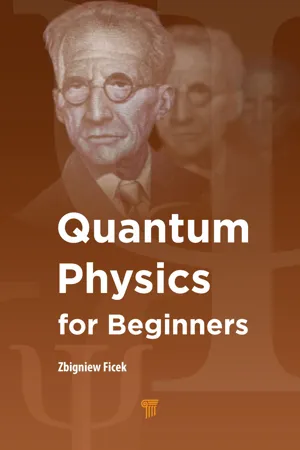
- 340 pages
- English
- ePUB (mobile friendly)
- Available on iOS & Android
eBook - ePub
Quantum Physics for Beginners
About this book
Information
Topic
Physical SciencesSubtopic
BiologyChapter 1
Radiation (Light) is a Wave
To anyone who is motivated by anything beyond the most narrowly practical, it is worthwhile to understand Maxwell’s equations simply for the good of his soul.
—J. R. Pierce
It is well known from classical optics that the most commonly observed phenomena with light (optical radiation) are polarization, interference, and diffraction. These phenomena are characteristic of waves, and some sort of wave theory is required for their explanation. Maxwell, in 1860, formulated the wave theory of light. He predicted the existence of electromagnetic waves that propagate with a speed, calculated from the laws of electricity and magnetism, similar to the measured speed of light. The prediction of electromagnetic waves and the subsequent successful use of Maxwell’s theory in explaining the interference and diffraction phenomena made the theory to be recognized as the fundamental wave theory of radiation.
We begin our journey through the fundamentals of quantum physics with an elementary, but quantitative, classical theory of the radiative field. We first briefly outline the electromagnetic theory of radiation, and describe how the electromagnetic radiation may be understood as a wave that can be represented by a set of harmonic oscillators. This is followed by a description of the Hamiltonian of the electromagnetic field, which determines the energy of the electromagnetic wave. In particular, we will be interested in how the energy of the electromagnetic wave depends on the parameters characteristic of the wave: amplitude and frequency. In our analysis, we assume that the readers are familiar with vector algebra and with the basi...
Table of contents
- Cover
- Half Title
- Title Page
- Copyright Page
- Table of Contents
- Preface
- Note to the Reader
- Suggested Readings
- 1 Radiation (Light) is a Wave
- 2 Difficulties of the Wave Theory of Radiation
- 3 Blackbody Radiation
- 4 Planck’s Quantum Hypothesis: Birth of Quantum Theory
- 5 Bohr Model
- 6 Duality of Light and Matter
- 7 Non-Relativistic Schrödinger Equation
- 8 Applications of Schrödinger Equation: Potential (Quantum) Wells
- 9 Multidimensional Quantum Wells
- 10 Linear Operators and Their Algebra
- 11 Dirac Bra-Ket Notation
- 12 Matrix Representations
- 13 Spin Operators and Pauli Matrices
- 14 Quantum Dynamics and Pictures
- 15 Quantum Harmonic Oscillator
- 16 Quantum Theory of Hydrogen Atom
- 17 Quantum Theory of Two Coupled Particles
- 18 Time-Independent Perturbation Theory
- 19 Time-Dependent Perturbation Theory
- 20 Relativistic Schrödinger Equation
- 21 Systems of Identical Particles
- Final Remark
- Appendix A: Derivation of the Boltzmann distribution function Pn
- Appendix B: Useful Mathematical Formulae
- Appendix C: Physical Constants and Conversion Factors
- Index
Trusted by 375,005 students
Access to over 1.5 million titles for a fair monthly price.
Study more efficiently using our study tools.
Frequently asked questions
Yes, you can cancel anytime from the Subscription tab in your account settings on the Perlego website. Your subscription will stay active until the end of your current billing period. Learn how to cancel your subscription
No, books cannot be downloaded as external files, such as PDFs, for use outside of Perlego. However, you can download books within the Perlego app for offline reading on mobile or tablet. Learn how to download books offline
Perlego offers two plans: Essential and Complete
- Essential is ideal for learners and professionals who enjoy exploring a wide range of subjects. Access the Essential Library with 800,000+ trusted titles and best-sellers across business, personal growth, and the humanities. Includes unlimited reading time and Standard Read Aloud voice.
- Complete: Perfect for advanced learners and researchers needing full, unrestricted access. Unlock 1.5M+ books across hundreds of subjects, including academic and specialized titles. The Complete Plan also includes advanced features like Premium Read Aloud and Research Assistant.
We are an online textbook subscription service, where you can get access to an entire online library for less than the price of a single book per month. With over 1.5 million books across 990+ topics, we’ve got you covered! Learn about our mission
Look out for the read-aloud symbol on your next book to see if you can listen to it. The read-aloud tool reads text aloud for you, highlighting the text as it is being read. You can pause it, speed it up and slow it down. Learn more about Read Aloud
Yes! You can use the Perlego app on both iOS and Android devices to read anytime, anywhere — even offline. Perfect for commutes or when you’re on the go.
Please note we cannot support devices running on iOS 13 and Android 7 or earlier. Learn more about using the app
Please note we cannot support devices running on iOS 13 and Android 7 or earlier. Learn more about using the app
Yes, you can access Quantum Physics for Beginners by Zbigniew Ficek in PDF and/or ePUB format, as well as other popular books in Physical Sciences & Biology. We have over 1.5 million books available in our catalogue for you to explore.