While many students, parents, educators, and organizations who hire their graduates hold US universities in high regard, the cost of higher education has risen much faster than the rate of inflation. High costs, in turn, have severely limited access to higher education for large portions of the US population or caused graduates and those who fall short of graduation to face substantial student loan debt. This book examines the root causes of these underlying problems and offers a comprehensive, easy-to-understand, high-impact solution. The book identifies actions that improve higher education outcomes including lower tuition costs, better access for student from low and middle income homes, faster throughput, fewer dropouts, and better job opportunities for graduates. It links a real and implementable solution to the underlying problems and their root causes. Upon finishing this book, readers should understand why the performance of higher education needs to improve and have solid ideas about how to fix it. The book focuses on public universities, but the ideas discussed are also applicable to private for-profit and not-for-profit universities. The writing style is simple and direct.
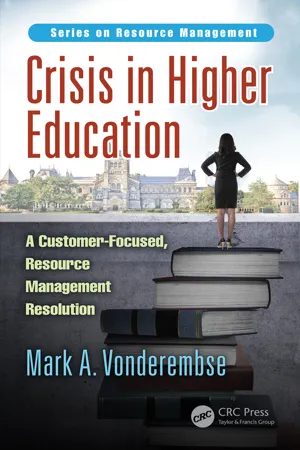
eBook - ePub
Crisis in Higher Education
A Customer-Focused, Resource Management Resolution
- 372 pages
- English
- ePUB (mobile friendly)
- Available on iOS & Android
eBook - ePub
About this book
Information
1
The Higher Education Conundrum
For thousands of years, the world evolved from a place where success/survival was determined by physical strengths, running speed, and hand–eye coordination to a place where intellectual ability, knowledge, and creativity are key success factors. Admittedly, strength, speed, and coordination are still essential for professional athletes and a few other professions, but this group is a very small portion of the population in the developed world.
Manufacturing jobs, which are considered manual labor, are a declining portion of the U.S. labor market. In 2013, manufacturing employment was only 12 million workers or less than 9% of the U.S. workforce.1 In addition, many manufacturing jobs are held by supervisors, engineers, and managers who engage in intellectual work such as scheduling, designing, and planning. Even the mundane, repetitive jobs on an assembly line often have automation and power assistance to cope with the physical dimensions of work. Plus, assembly line workers are expected to identify and solve problems related to workplace safety, equipment reliability, process improvement, and maintenance. This may not require education beyond high school, but it does require thought, knowledge, and creativity.
As the United States and other countries continue the march toward jobs that require intellectual work, the need for more and better education becomes obvious. A hundred years ago, graduating from the eighth grade was celebrated as high school graduations are celebrated today. At that time, an elementary school teacher often had only a high school diploma. In 1940, only 25% of the population aged 25 years and older had completed high school and only 5% of adults held a bachelor’s degree or higher.2 World War II began a big push for higher education by emphasizing the importance of innovation and technology as well as high-output, efficient manufacturing systems. The United States entered the war with weapons, especially airplanes, that were inferior to its enemies in both capabilities and quantity. In a short time, it dramatically improved both, becoming the “arsenal of democracy.”
In 1944, a grateful nation passed the Servicemen’s Readjustment Act better known as the G.I. Bill, which provided a series of benefits to World War II veterans, including cash payments for tuition and living expenses to attend institutions of higher learning. By 1956, roughly 2.2 million veterans used this benefit,3, 4 which is still in place today. In 1964, the leading edge of the baby boomers graduated from high school and sought college degrees in record numbers. In 1965, President Lyndon Johnson signed the Higher Education Act that provided massive federal support for students through tuition grants, guaranteed student loans, and work-study funds.5 As a result, institutions of higher learning benefited from decades of growth—enrolling just over 2 million in the early 1950s, 13 million in 1987, and more than 21 million in 2010.6, 7 By 2015, 33% of the U.S. adult population held a bachelor’s degree or higher.2
This background information is important because it provides a context for understanding higher education. During this time, it was common for institutions, especially public colleges and universities supported by state and local tuition subsidies, to double in size and double again in response to:
- Pent-up demand from nearly 16 years of the Great Depression and World War II
- Recognition that higher education is needed to advance science, technology, and business
- Veterans taking advantage of the G.I. Bill
- Baby boomers seeing the value of higher education and demanding it
- Low out-of-pocket costs for tuition, as a result of federal, state, and local subsidies.
During this rapid growth phase, the concern of higher education leaders tended not to be about planning, cost control, and workforce productivity, on which for-profit manufacturing and services firms focused intently. These resource management concepts took a backseat to concerns about meeting what appeared to be an insatiable demand for quality programs. Faced with these circumstances, most organization would have acted similarly. If customer after customer bought a Tahiti vacation and did not ask the price, why would the travel agent be concerned about keeping costs low? Higher education was heavily subsidized, so out-of-pocket costs were low.
There were other factors that reinforced this “meet demand for higher education” mindset. Many higher education leaders were and are today faculty members with PhDs in subjects like history, medicine, and science, so their inherent interest was investigating problems and providing a quality education with small classes. In addition, investing in higher education was an easy choice for politicians because they could boast to their constituents about educational opportunities for their children, plus it was thought to be a driver of jobs and economic growth. Furthermore, recent high school graduates had little experience in buying goods and services, and their parents often had no experience with higher education, so students and their families did not push back as cost increased. In combination, these factors help to explain why the cost of higher education grew much faster than the rate of inflation.
In the global economy, the country with the best educated population should have the best innovation, most entrepreneurs, strongest economy, and highest standard of living. Combining brainpower with a supportive environment for transforming ideas into useful and innovative goods and services creates a winning economy. The United States accomplishes this in two ways. As technology increases in complexity, and new products require innovative design capabilities and production processes, and organizations become larger and require sophisticated management, higher education responds with comprehensive, in-depth programs of study to meet these needs. In a knowledge-based economy, higher education plays a key role in building wealth for society as it provides the educated actors who participate in the value creation process. This process transforms inputs, including labor, materials, energy, and capital, into outputs—goods and services—that are worth more to society than the costs of these inputs. In the not-for-profit arena, higher education delivers a high-quality workforce for organizations involved in healthcare, education, and public service.
Second, building a highly educated and motivated workforce is facilitated by an immigration policy that
- Encourages scientist, engineers, and highly trained professionals from other countries to immigrate to the United States in order to meet this growing demand.
- Draws high-quality students from other countries to U.S. graduate programs and eventually entice them to work in the United States and become U.S. citizens and permanent residents.
- Offers pathways to success for immigrants who come to this country legally searching for a better life for themselves and their families. The first generation may not be well educated, but they work hard and encourage and support their children to succeed. These children are highly motivated to make a better life for themselves and their children.
1.1 Understanding Higher Education
Institutions of higher learning are often seen as a set of buildings made of brick and stone where people go to earn a degree. In fact, these institutions are by design collections of faculty scholars who have as their mission the creation and dissemination of knowledge. To accomplish this, they engage in the following:
- Research and innovation: Faculty participates in discovering and developing new thoughts, ideas, and processes across a wide variety of topics from basic science, to sociology, to economics and business. It might involve advances in medica...
Table of contents
- Title Page
- Copyright Page
- Dedication
- Table of Contents
- Acknowledgments
- Author
- About the Book
- Chapter 1 The Higher Education Conundrum
- Chapter 2 Underlying Problem: Higher Education Costs Are Out of Control
- Chapter 3 Underlying Problems: Quality, Access, Graduation Rate, Completion Time, and Jobs
- Chapter 4 Understanding the Root Causes
- Chapter 5 A Customer-Focused, Resource Management Perspective
- Chapter 6 Changing Attitudes and Expectations of Students, Parents, Family Members, and Friends
- Chapter 7 Becoming Student-Centered: The Right Way
- Chapter 8 Building Bridges to Potential Employers
- Chapter 9 Government's Role in Higher Education
- Chapter 10 Redesigning Curriculum and Pedagogy
- Chapter 11 Reforming Administration and Management
- Chapter 12 Reshaping Faculty's Role
- Chapter 13 Creating High-Technology Learning Materials
- Chapter 14 Revamping Relationships among High Schools, Community and Technical Colleges, and Universities
- Chapter 15 Framing and Implementing a Practical Solution
- Appendix A: Compilation of the Recommendations
- Appendix B: Summary, Impacts of the Elements of the Solution on the Underlying Problems
- Index
Trusted by 375,005 students
Access to over 1.5 million titles for a fair monthly price.
Study more efficiently using our study tools.
Frequently asked questions
Yes, you can cancel anytime from the Subscription tab in your account settings on the Perlego website. Your subscription will stay active until the end of your current billing period. Learn how to cancel your subscription
No, books cannot be downloaded as external files, such as PDFs, for use outside of Perlego. However, you can download books within the Perlego app for offline reading on mobile or tablet. Learn how to download books offline
We are an online textbook subscription service, where you can get access to an entire online library for less than the price of a single book per month. With over 1.5 million books across 990+ topics, we’ve got you covered! Learn about our mission
Look out for the read-aloud symbol on your next book to see if you can listen to it. The read-aloud tool reads text aloud for you, highlighting the text as it is being read. You can pause it, speed it up and slow it down. Learn more about Read Aloud
Yes! You can use the Perlego app on both iOS and Android devices to read anytime, anywhere — even offline. Perfect for commutes or when you’re on the go.
Please note we cannot support devices running on iOS 13 and Android 7 or earlier. Learn more about using the app
Please note we cannot support devices running on iOS 13 and Android 7 or earlier. Learn more about using the app
Yes, you can access Crisis in Higher Education by Mark A. Vonderembse in PDF and/or ePUB format, as well as other popular books in Education & Business General. We have over 1.5 million books available in our catalogue for you to explore.