- 232 pages
- English
- ePUB (mobile friendly)
- Available on iOS & Android
eBook - ePub
About this book
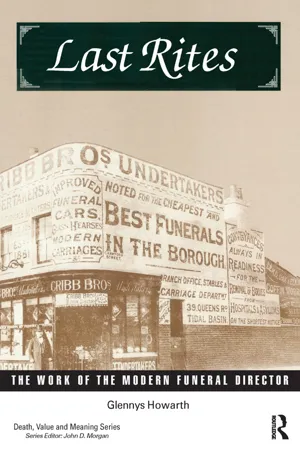
First Published in 2017. This book examines death rituals and the social significance of undertaking in western society and presents an ethnographic account of funeral directing in an area of east London which, for the purposes of anonymity. It is concerned with undertakers' perceptions and organization of death rituals.
Information
CHAPTER 1
Modern Death Rituals and the Undertaker
Almost every society transforms the disposal of human remains into a cultural ritual. These rituals, and the agencies and individuals dedicated to their maintenance, vary in complexity according to the place death commands within the social value system. In this chapter a variety of explanations are of Tered for the existence of modern death rituals. Those most commonly suggested revolve around social and individual needs to deal with loss, a desire to demonstrate some measure of control over mortality, and fear of the dead and of death itself. A combination of these led Michael Kearl to conclude that without funeral rituals,
… bereaved individuals may be unable to function in their roles if overwhelmed by grief, incapacitated by fear, or unable to develop new relationships to replace the old [1, p. 481].
Let us consider each of the forces for ritual in turn.
SOCIAL AND INDIVIDUAL LOSS
The nineteenth-century anthropologist, E. B. Tylor, argued that thinking about mortality was a manifestation of nascent culture [2]. Our consciousness of the inevitability of death and the creation of sophisticated ways of dealing with it distinguish us from animals and from our former animal-like existence. Robert Hertz, a disciple of Durkheim, extended this analysis: people and animals die in an instant but because people are highly social beings, funeral rituals are created to enable others to adapt to the death of the social creature [3].
Participants in funeral rituals, however, often rationalize these rites by viewing them as being of benefit to the dead. In this respect we might consider the tendency to take great care of the way the corpse is dressed and coffined. This is conventionally explained by bereaved people as a desire to do one’s best for the deceased—to “give them a good send-off.” In pre-Reformation Europe and in some contemporary cultures such as rural Greece [4], funeral ceremonies may be observed as a means of assisting the soul on its long journey to the afterlife. In this context the pioneering work of Hertz discusses the practice of secondary-burial [3]. These rites are adopted as the means by which the soul is eventually released from the body after death. Similar customs are employed in the Neapolitan region of modern Italy where the inhabitants perceive exhumation,
… as final proof that a soul has arrived safely in purgatory. This means that mourning can end. As the living resume normal life, so the soul starts its time in purgatory. In other words, the actions of the bereaved and the fate of the corpse and soul are synchronous and interdependent [5, p. 9].
Societies practicing secondary burials today tend to be small scale or rural communities and this accords with assertions made by Durkheim [6] and Hertz [3], and more recently by Blauner [7]. They argue that the key to understanding death rituals is contained in the distinction between simple and advanced societies. In simple communities, death has a profoundly disruptive effect on everyday life and is therefore accorded prominence in cultural behavior. As a society becomes more highly structured, death has less impact on the community as individuals perform a variety of social roles. Institutions and agencies evolve, such as experts in deathwork, to offset the more inconvenient aspects of mortality, thereby reducing the amount of time and commitment devoted by individuals to the loss of a family or community member.
On an individual level, it is often suggested that obsequies are employed as a means of consoling the living. Whether the rituals are seen as a method of coping with sorrow [8] or, alternatively, as a means of exorcising guilt [9], the periods and practices of mourning are, according to this explanation, primarily designed to help the bereaved to personally adjust to loss. Some studies concentrate on this aspect of funeral rituals, most notably Parkes [10]. This interpretation parallels that concerning the “emergence of civilization” as they both view the necessity for after-death observances as stemming from a social need to reconcile the loss of a community member.
CONTROLLING DEATH
A further explanation for the creation and nature of post-mortem ritual is connected with a need to exert some form of control over mortality. The Grim Reaper’s arbitrary choice of victim has long been a problem with which individuals and societies have struggled. Death is the unknown quantity—not only are we unaware of what, if anything, lies beyond the grave, but moreover, we cannot with any certainty even predict the “where,” “when,” and “how” of its coming. The fact that life may be extinguished without warning and with no consideration for the victim’s situation, fills the human heart with fear. It is for this reason that people have been at pains to exercise dominion over the chance nature of death.
Philipe Ariès, in his colossal history of western attitudes to death since pre-Christian times, believed that there was once a golden age of death when people were somehow alerted to its imminent arrival; felt little physical revulsion or alarm toward the act of dying or the subsequent corruption of the body; and had no fear of the terrifying possibility of the eternal night [11]. If such a disposition did exist, then it was in Christendom when people relied on God’s mortal agent, the established church, to guide them through life and into immortality; the overarching purpose of death rituals was to demonstrate control over the condition itself. In previous era, and in other cultures, religion or other supernatural forms were invoked to influence the nature, frequency, and victims of death. In the contemporary western world the declining role of Christianity in providing a framework for (or means of making sense of) mortality appears to be directly proportional to the increasing influence of science. People have always desired control over death. Historically this was pursued through religious belief. In modern societies, science and technology have largely replaced faith as a means of influencing mortality—perhaps with the underlying promise of eternal life. Like the quest for the Holy Grail, which was itself essentially a desire for immortality, its elusiveness merely serves to fire the determination of those in pursuit.
FEAR OF THE DEAD AND OF DEATH ITSELF
Psychologists and social observers frequently stress fear of the dead, and of death itself, as the primary motive for the introduction of death rituals [12–16]. Puckle explains all such rituals as originating from a universal fear of the return of the dead [12]. According to this analysis, people accept a responsibility to care for, respect, and honor their dead because they fear that their deceased relatives might otherwise return to haunt them. In arguing his case, Puckle, an early twentieth-century social commentator, traces the origins of many superstitious and idiosyncratic conventions. One interesting example he cites is the wearing of black mourning dress, sometimes known as “weeds.” In medieval times, black was thought to render the wearer invisible to the dead and thus protected them from any unwelcome advances.
In some societies it may not be the souls of the dead that people fear so much as the physically and symbolically contaminating properties of the corpse. Such fear of pollution is discussed by Watson in his work on the management of death in Cantonese society [17], In the communities he studied, the cadaver was perceived as a source of impurity. Death contamination, the Cantonese believed, was carried both through physical contact with the body and also through contiguity to the corpse or merely from inhaling the “killing airs.” That is, simply being in the vicinity of the body could have dire consequences as the defiling effect was carried in the very air breathed. It was important, therefore, to minimize the risk of contamination and this compelled the employment of professional corpse handlers to wash, lay-out, and coffin the body. As a consequence of their work with the dead, these undertakers were excluded from residence within the village boundary.
In some respects the modern response to death resembles Cantonese death rites. In western societies, since the nineteenth century, a physical and symbolic separation has occurred which has divided the living from the dead and has encouraged the development of rituals which privatize dying, death, and grief. It was in the nineteenth century that the link between disease and hygiene was first established. Once uncovered it was not long before the proximity of the graveyard to the abodes of the living was cited as a source of pestilence: for example, one source of cholera was traced to water supplies drawn from local churchyards. Similarly, symptoms of ill health and, occasionally, sudden death among gravediggers were identified as stemming from malevolent bacteria associated with putrescence. In modern societies, dying people have become separated from the healthy and this has created an illusion of distance from death. The typical place for dying is in the hospital, and more recently the hospice, not the home among the living; the place for disposing of human remains is no longer the local churchyard but the cemetery or crematorium, usually located at a distance from residential areas. When mourning, few individuals wear black even at the funeral and people are expected to “pick up the threads” and “get on with life” within a few days. This privatization of death, typically occurring in an institutional setting, and of sorrow, restricted to the immediate family, has been described as an unhealthy aspect of modern living [18–20].
The link between death and disease (see Chapter 5 for a full discussion), combined with the modern proclivity to classify and separate, has contributed to a perception of the corpse as polluting and a reliance on undertakers to deal with its ritual purification. Yet as Douglas suggests in her discussion of dirt, fear of contamination is not purely physical but is primarily symbolic [21]. In a society which emphasizes the need for order, for everything to be in its right place, a fear of being defiled by the corpse is not necessarily a physical sense of revulsion for the body of the deceased but rather a cultural abhorrence of
matter out of place…. In short, our pollution behaviour is the reaction which condemns any object or idea likely to confuse or contradict cherished classifications [21, pp. 35–36].
The dead no longer belong among the living and the proper location for the corpse is not in the home but in the funeral parlor or mortuary.
Like the Cantonese, the effects of the need for separation are felt by those who work with the dead. The repercussions for funeral directors of the symbolic contamination with death are two-fold. First, undertakers are stigmatized by the omnipresence of death in their work. This, as I demonstrate in Chapter 4, encourages deathworkers to adopt a variety of strategies to combat detrimental images of the funeral industry and, on a more personal level, which allow individuals to “pass as normal” members of society. Second, and perhaps an unintended consequence of the first effect, this symbolic fear of death, coupled with the fear of physical contamination by disease and decay resultant from putrefaction, enables funeral directors to practice their trade with relatively little outside interference. Modern funeral directors acquire control over the funeral service via their custody of the corpse. Care of the body of the deceased is delegated to them primarily in societies where the fear of physical and symbolic pollution is high.
Bereaved people might also suffer a symbolic contamination with death and some report feeling shunned socially. This symbolic defilement could be responsible for what one person has described as the identification of bereaved people as “diseased”; a state which can lead to avoidance behavior.
… I felt totally alone with my grief. I felt as if I had some kind of disease. I imagined that people could see just by looking at me that I had this illness, that everyone was trying to keep their distance. So I kept my distance too, or at least tried to hide my disfigurement [22].
A further basis for such avoidance may stem from the loss of codes for public expressions of sympathy and this has left friends and neighbors embarrassed and bereft of social skills for communication with the bereaved.
It is this last explanation that has led to mounting criticism of the professionalization of dying and death and to calls for reform [23–26]. Modern “deathways” are being described as isolating and inappropriate and there are now increasing demands for individuals and families to exert greater control over dying and for more meaningful funeral rituals.1 The growth of the hospice movement and the proliferation of funeral reform groups are symptomatic of this rejection of late twentieth-century approaches to dying and death.
These relatively recent trends toward reform might appear to contradict the thesis (set out above) of the dead body as polluting. It should be remembered, however, that the corpse is not primarily perceived as physically defiling but is symbolically contaminating when it is located in the wrong place. If the separation between life and death is an artificial one, reuniting the two, an apparent aim for many of the reform groups, will negate the social perception of the dead body as out of place in the home. If this should occur, the role of professionals or experts in the care of the dying and the dead will be open to further scrutiny and will be either transformed or ...
Table of contents
- Cover
- Title Page
- Copyright Page
- Dedication
- Acknowledgments
- Table of Contents
- Introduction
- Chapter 1 Modern Death Rituals and the Undertaker
- Chapter 2 The Business of Funeral Directing
- Chapter 3 Funeral Directing in Easton
- Chapter 4 Becoming an Undertaker
- Chapter 5 The Contaminated Corpse
- Chapter 6 Making Arrangements
- Chapter 7 Humanizing the Body
- Chapter 8 The Funeral Ceremony
- Conclusion: The Undertaker: Past, Present, and Future
- Bibliography
- Index
Trusted by 375,005 students
Access to over 1.5 million titles for a fair monthly price.
Study more efficiently using our study tools.
Frequently asked questions
Yes, you can cancel anytime from the Subscription tab in your account settings on the Perlego website. Your subscription will stay active until the end of your current billing period. Learn how to cancel your subscription
No, books cannot be downloaded as external files, such as PDFs, for use outside of Perlego. However, you can download books within the Perlego app for offline reading on mobile or tablet. Learn how to download books offline
Perlego offers two plans: Essential and Complete
- Essential is ideal for learners and professionals who enjoy exploring a wide range of subjects. Access the Essential Library with 800,000+ trusted titles and best-sellers across business, personal growth, and the humanities. Includes unlimited reading time and Standard Read Aloud voice.
- Complete: Perfect for advanced learners and researchers needing full, unrestricted access. Unlock 1.5M+ books across hundreds of subjects, including academic and specialized titles. The Complete Plan also includes advanced features like Premium Read Aloud and Research Assistant.
We are an online textbook subscription service, where you can get access to an entire online library for less than the price of a single book per month. With over 1.5 million books across 990+ topics, we’ve got you covered! Learn about our mission
Look out for the read-aloud symbol on your next book to see if you can listen to it. The read-aloud tool reads text aloud for you, highlighting the text as it is being read. You can pause it, speed it up and slow it down. Learn more about Read Aloud
Yes! You can use the Perlego app on both iOS and Android devices to read anytime, anywhere — even offline. Perfect for commutes or when you’re on the go.
Please note we cannot support devices running on iOS 13 and Android 7 or earlier. Learn more about using the app
Please note we cannot support devices running on iOS 13 and Android 7 or earlier. Learn more about using the app
Yes, you can access Last Rites by Glennys Howarth in PDF and/or ePUB format, as well as other popular books in Social Sciences & Mental Health in Psychology. We have over 1.5 million books available in our catalogue for you to explore.