- 184 pages
- English
- ePUB (mobile friendly)
- Available on iOS & Android
eBook - ePub
About this book
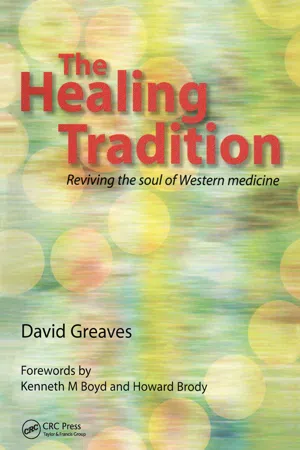
The Healing Tradition argues that Western medicine is fundamentally flawed because it fails to provide a healing environment for both individuals and society, and indicates potential ways to correct this through an integration model of medical humanities. All health professionals and those with an interest in medical humanities will find this book valuable reading.
Information
CHAPTER 1
Sudden infant deaths: models of health and illness
Abstract
The assumptions underlying the traditional biomedical model of health and illness, and criticisms of it, are described. An examination of the historical development of ideas concerning cot (crib) deaths shows how early explanations, which were congruent with this model, came to be discredited. Because subsequent explanations have also been considered unsatisfactory, cot deaths have come to be regarded as medically problematic. The relationship of models of health and illness to cot deaths has therefore been exposed to an unusual degree of scrutiny.
Two possible contending models, social epidemiological and socioeconomic, are identified, and their status vis-à-vis the biomedical model is considered. The choice as to which of these models is applied to cot deaths is shown to be not only of theoretical interest but also to have ethical implications for healthcare policy and medical practice.
Introduction
Raphael states that in his view ‘the main purpose of philosophy as practised in the Western tradition, is the critical evaluation of assumptions and arguments’.1 In recent years attention has been drawn to the failures of Western medicine to be critically aware of the underlying assumptions and concepts from which it derives both its logical structure and its legitimacy.2
In this chapter some of the general assumptions and arguments concerning models of health and illness will be reviewed. Cot (crib) deaths3 will then be looked at as a specific topic in order to examine how models of health and illness can be used in determining both the nature of the deaths and the appropriate medical response in attempting to deal with them. Cot deaths have been selected because they have proved persistently resistant to established modes of medical explanation. Many hypotheses have been proposed and some have gained acceptance for a while, but all have been rejected as unsatisfactory. The very nature of the deaths has proved problematic and they therefore provide a challenge to medical assumptions, which has produced more explicit argument and comment in the medical literature than is usual.
From the demonstration that alternative models can be adopted in dealing with cot death, it follows that certain claims are involved in deciding which to choose, even if they are not recognised. The ethical implications of such claims will therefore be explored and their importance shown in relation to practice.
The traditional biomedical model
Wright and Treacher4 have argued that there are four main assumptions that have traditionally characterised Western medicine.
1 The nature of medicine and medical knowledge poses no difficulties which require debate or argument. Medicine is what doctors and their ancillary workers do and it is taken for granted that medical knowledge is simply transmitted through professional teaching and literature.
2 Modern medical knowledge is distinctive because of two particular features:
• it is built on the findings of modern science
• it is effective.
3 The disease entity is a key conceptual component. Diseases are natural objects which exist prior to, and independently of, their isolation or designation by doctors.
Social factors - whether much attention is given to them or not - are self-evidently distinct from medicine. Society and medical knowledge are regarded as independent and autonomous zones, by their very nature.
Mishler5 also identifies four assumptions which he relates to the traditional biomedical model, which he sees similarly as defining the framework of modern medicine:
1 the definition of disease as deviation from normal biological functioning
2 the doctrine of specific aetiology
3 the conception of generic diseases, that is, the universality of a disease taxonomy
4 the scientific neutrality of medicine.
The first three of these are more detailed characteristics of the disease as a discrete entity identified in Wright and Treacher’s third assumption. The fourth of Mishler’s assumptions, the scientific neutrality of medicine, relates to Wright and Treacher’s first assumption, and is the position which underpins all the other assumptions, without which they have no credibility.
A combination of these two sets of assumptions provides the basis for the traditional biomedical or clinical pathological model. What, though, is wrong with it, and what are the arguments against continuing with it unchanged?
The first difficulty is that the traditional model is treated as the representation or picture of reality, rather than being understood as a representation. This idea is comparatively recent. Historically there have been two polarised conceptions of health and illness, the first concentrating on diseases as entities with specific causes, the second focusing on the sick individual and the inter-relationship between personal characteristics and aspects of the environment. The Hippocratic writings as represented in, for example, On Airs, Waters, Places,6 the medieval notion of humoral pathology and the nineteenth-century theory of miasmata, all relate to the second of these concepts. It has only been since the late nineteenth century that the first has gained such pre-eminence. To settle for it as the only correct and rational pathway implies that medicine is embarked on an inevitable course of scientific progress that cannot be denied. It is merely a question of uncovering nature. But this positivist view of science has long been challenged by historians and philosophers of science, e.g. Kuhn,7 engaged in the study of physics, chemistry and biology, the very disciplines which medicine lays claim to, as forming the basis of its scientific approach. The fact that scientists are not agreed amongst themselves about the nature of scientific knowledge would seem good reason for doctors also to develop a more sceptical attitude to the foundations of medicine.
One of the features of positivist science is its claim to be value free, and by adopting it medicine purports to be sustained by an internal rationale which is independent of any set of general values. This allows doctors to assert that medical theory and practice are not open to challenge from religious, legal, ethical or other perspectives. It is therefore impossible to encompass insights from a range of different disciplines. So, for example, anthropological theories which postulate that science and medicine can be understood as systems of symbols which societies use to make sense of their existence in the world, e.g. the theories of Mary Douglas8 and Susan Sontag,9 are simply discounted.
So far these arguments against the traditional biomedical model have been largely theoretical, but the practical results of adherence to the model have also been called into question in recent years. These doubts have been expressed both from within medicine itself, e.g. by Muir Gray10 and McKeown,11 and from a variety of sources outside medicine, e.g. Powles,12 Doyal and Pennell,13 and Illich.14 Whilst the arguments from within medicine do not necessarily imply a direct attack on the traditional scientific approach and may even be used to call for a greater adherence to it, those from outside claim that medicine has been positively damaged by its application (Illich) and that present medical problems will prove resistant to it and are therefore misguided (Powles).
A further argument against the model is the way in which it has structured the power relationship between doctors and patients, giving doctors an unwarranted degree of professional autonomy. According to Jewson,15 the historical process by which this imbalance in power relationship came about took place over the period 1770–1870. Waddington16 describes how in the Paris hospitals of the Napoleonic era, the medical focus was directed away from the whole person to particular anatomical organs and pathological lesions. As this process spread to medicine as a whole, the effect was to limit the power of the patient in defining his needs and in being involved in determining his own treatment and care. By the end of the nineteenth century the medical profession had achieved a legitimacy which united it and so freed it from the direct competition of other healthcare workers, who were diminished to the status of fringe practitioners and whose claim could no longer be assessed on an equal footing with that of doctors. Medicine had also acquired the right to regulate its own teaching and conduct, and by implication the manner in which it would work with patients. It is this protected insularity which Freidson describes as the critical flaw:
It develops and maintains in the profession a self-deceiving view of the objectivity and reliability of its knowledge and of the virtues of its members. Furthermore, it encourages the profession to see itself as the sole possessor of knowledge and virtue, to be somewhat suspicious of the technical and moral capacity of other occupations, and to be at best partronizing and at worst contemptuous of its clientele. Protecting the profession from the demands of interaction on a free and equal basis with those in the world outside, its autonomy leads the profession to so distinguish its own virtues from those outside as to be unable to perceive the need for, let alone undertake, the self-regulation it promises.17
These are a number of arguments against the traditional biomedical model. Once they are conceded, the model no longer has an absolute status and it is possible to think in terms of competing models of health and illness. Such models introduce social factors. The problem then raised is whether social facts are a function of attitudes, expectations and rules in a way radically unlike natural facts, and so whether any alternative model of health and illness is congruent with the traditional model. Set in its wider context the question touches on whether the social sciences can be dealt with simply as an extension of natural science or whether they should be viewed in an entirely different manner.18 These issues will be explored further by considering how possible alternative models might be conceived through an examination of the historical development of ideas relating to cot deaths.
Cot deaths
The task is to explore the way in which certain deaths in the first year of life have been conceived historically and identified as a particular problem. This involves unravelling the details and framework of the explanations which have been investigated as possible solutions.
During the nineteenth century, death in the first year of life was a common event. It occurred at a rate of approximately 150/1000 live births and had probably remained much the same over the previous centuries. What did change was the perception of how death came about. Foucault19 describes how the notion of clinical death gained acceptance in the early years of the nineteenth century. This implied that death was necessarily accompanied by disease and was no longer to be regarded as natural or inevitable. Illich takes up this theme in describing how ‘The general force of nature that had been celebrated as “death” turned into a host of specific causations of clinical demise’.20
Such ideas were a precondition to the development of a universal classification of death by cause, which became established in Britain in 1837 following the Registration Act of 1834. This allowed the statistical compilation of mortality rates by cause and in later years the designation of the Infant Mortality Rate (IMR) as an index of public health. So by the end of the nineteenth century the certification of deaths had become an important task, and it meant that doctors were increasingly expected to produce a specific explanation for every death and ideally this should be definable in pathological as well as clinical terms.
The notion of deaths as sudden and unexpected took on a new meaning under these new circumstances, because if death had to have a clinical explanation then it should also be preceded by manifestations of disease. New rules had been established which allowed the possibility of sudden and unexpected death as a residual group which was ‘abnormal’ and therefore problematic by definition.
Early explanations
Overlaying
Both before and during the nineteenth century it was common for infants to sleep with parents or siblings, so that when death occurred in bed with no obvious evidence of illness, mechanical suffocation from overlaying or smothering provided a ready explanation. One of the earliest reports to challenge this explanation and to imply the existence of a problem came in a letter to the Lancet in 1834:
I have lately been called upon to examine two children, who without having been previously indisposed, were found dead in bed .... In these cases one naturally asks - what was the cause of death? The similarity of the post-mortem appearances would lead one to suppose that the cause must in each case have been the same.
In the first case I was strongly disposed to think, in spite of the evidence of the mother, that the child must have been destroyed by overlaying it; but after the occurrence of the last case, where, from all the testimony that could be obtained it se...
Table of contents
- Cover
- Title Page
- Copyright Page
- Contents
- Foreword
- Foreword
- Preface
- Acknowledgements
- Introduction
- 1 Sudden infant deaths
- 2 What are heart attacks? Rethinking some aspects of medical knowledge
- 3 Conceptions of persons and dementia
- 4 The tradition of the healer
- 5 The enduring appeal of the Victorian family doctor
- 6 Changing priorities in residential medical and social services
- 7 Contrasting perspectives of inequalities in health and in medical care
- 8 The creation of partial patients
- 9 The nature and role of medical humanities
- 10 Biomedical, humoral and alternative systems of medicine
- 11 Reflections on a new medical cosmology
- Index
Trusted by 375,005 students
Access to over 1.5 million titles for a fair monthly price.
Study more efficiently using our study tools.
Frequently asked questions
Yes, you can cancel anytime from the Subscription tab in your account settings on the Perlego website. Your subscription will stay active until the end of your current billing period. Learn how to cancel your subscription
No, books cannot be downloaded as external files, such as PDFs, for use outside of Perlego. However, you can download books within the Perlego app for offline reading on mobile or tablet. Learn how to download books offline
Perlego offers two plans: Essential and Complete
- Essential is ideal for learners and professionals who enjoy exploring a wide range of subjects. Access the Essential Library with 800,000+ trusted titles and best-sellers across business, personal growth, and the humanities. Includes unlimited reading time and Standard Read Aloud voice.
- Complete: Perfect for advanced learners and researchers needing full, unrestricted access. Unlock 1.5M+ books across hundreds of subjects, including academic and specialized titles. The Complete Plan also includes advanced features like Premium Read Aloud and Research Assistant.
We are an online textbook subscription service, where you can get access to an entire online library for less than the price of a single book per month. With over 1.5 million books across 990+ topics, we’ve got you covered! Learn about our mission
Look out for the read-aloud symbol on your next book to see if you can listen to it. The read-aloud tool reads text aloud for you, highlighting the text as it is being read. You can pause it, speed it up and slow it down. Learn more about Read Aloud
Yes! You can use the Perlego app on both iOS and Android devices to read anytime, anywhere — even offline. Perfect for commutes or when you’re on the go.
Please note we cannot support devices running on iOS 13 and Android 7 or earlier. Learn more about using the app
Please note we cannot support devices running on iOS 13 and Android 7 or earlier. Learn more about using the app
Yes, you can access The Healing Tradition by David Greaves in PDF and/or ePUB format, as well as other popular books in Medicine & Clinical Medicine. We have over 1.5 million books available in our catalogue for you to explore.