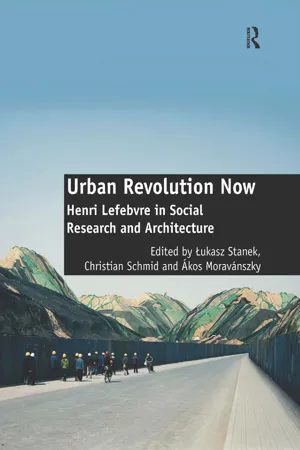
eBook - ePub
Urban Revolution Now
Henri Lefebvre in Social Research and Architecture
- 368 pages
- English
- ePUB (mobile friendly)
- Available on iOS & Android
eBook - ePub
Urban Revolution Now
Henri Lefebvre in Social Research and Architecture
About this book
When Henri Lefebvre published The Urban Revolution in 1970, he sketched a research itinerary on the emerging tendency towards planetary urbanization. Today, when this tendency has become reality, Lefebvre's ideas on everyday life, production of space, rhythmanalysis and the right to the city are indispensable for the understanding of urbanization processes at every scale of social practice. This volume is the first to develop Lefebvre's concepts in social research and architecture by focusing on urban conjunctures in Barcelona, Belgrade, Berlin, Budapest, Copenhagen, Dhaka, Hong Kong, London, New Orleans, Nowa Huta, Paris, Toronto, São Paulo, Sarajevo, as well as in Mexico and Switzerland. With contributions by historians and theorists of architecture and urbanism, geographers, sociologists, political and cultural scientists, Urban Revolution Now reveals the multiplicity of processes of urbanization and the variety of their patterns and actors around the globe.
Information
Part I
On Complete Urbanization
1
The Trouble with Henri: Urban Research and the Theory of the Production of Space
Christian Schmid
Translated by Christopher Findlay
Translated by Christopher Findlay
Henri Lefebvre's theory of the production of (urban) space, which he developed over a short period from the mid-1960s to the mid-1970s, is today widely quoted and the subject of intense debates. Just two decades ago, this theory was regarded as almost inaccessible, extremely difficult to apply and was consequently rarely used for empirical research. Since then, it has experienced widespread reception and application, both in the field of urban studies as well as in architecture and urban design.
This process of appropriation and application of Lefebvre's theory has not been untroubled. Time and again, all sorts of confusions and problems have arisen. While these initially concerned mainly questions of interpretation and theoretical construction, more recent discussions have primarily focused on the question of how this theory can be successfully introduced into empirical analysis. Engaging with Lefebvre's theory is indeed a remarkable experience: as in one of Hitchcock's funniest movies, where the corpse of poor Harry suddenly disappears and then reappears in the most unexpected places, this theory creates all kinds of unforeseen trouble.1As soon as it seems that one problem is solved, another appears.
The following text sheds light on some of these problems and identifies possible paths towards creative applications of the theory of the production of space. It begins with the current state of reception, explains the fundamental structure of this theory, lays out Lefebvre's epistemological strategy, and analyses his understanding of the relationship between theory and empirical research. These points are then illustrated with examples of concrete research on the urbanization of Switzerland, on planetary urbanization and on the urban development of Havana.
On the Third Wave of Lefebvre Interpretation
In the past few years, the debate on the theory of the production of space has entered a new phase. While mainly reductionist and one-sided interpretations were dominant in the 1970s and 1980s, especially in the English- and French-speaking debates, a new and more open appropriation of this theory has asserted itself in recent years (see Kipfer et al. 2008, Kipfer et al. 2012).
In that first phase, Lefebvre's texts on urbanization and on space had an ambivalent reception: in France during the early 1970s, Lefebvre was pushed to the margins of intellectual life, mainly by the strong influence of Manuel Castell's vehement critique of his broad and far-reaching conception of the urban revolution (Castells 1977 [1972]).2 This critique also influenced Lefebvre's reception in the English-speaking world, where his work was almost absent from the debates of new urban sociology, radical geography or urban political economy-an important exception being David Harvey, who was especially inspired by Lefebvre's rigorous analysis of the relationship between urbanization and the dynamics of capital accumulation (see notably Harvey 1973 and 1982).3 However, both theorists finally pursued very different projects: while Harvey developed a relatively restricted theory of the political economy of space, Lefebvre had the much broader vision of a comprehensive theory of the production of space. But this project did not arouse much interest for quite some time.
This situation changed fundamentally in the 1990s, when, under the influence of the spatial and the cultural turn, the theory of the production of space was 'rediscovered' and finally received with great interest and even enthusiasm (for example, Soja 1989,1996, Gregory 1994, Dear 2000). Accordingly, this second phase of Lefebvre reception was strongly influenced by postmodern and poststructuralist thought, which also manifested often a reductionist tendency in presenting Lefebvre as a precursor of postmodernism and in trying to narrow his complex and dynamic theory of the production of space to a kind of a spatial ontology (see especially Soja 1989). However, it is very difficult to reconcile a postmodernist or poststructuralist approach with Lefebvre's decidedly historical, materialist and dialectical epistemology (cf. Kipfer et al. 2008, Schmid 2008).
For a few years now, a new and different form of access to Lefebvre's work can be observed, which we may consider as the third wave of Lefebvre interpretation (cf. Schmid 2005, Kipfer et al. 2008). It is marked first of all by the fact that it relates in a fundamentally different way to Lefebvre's heterodox and open-ended materialism than earlier interpretations. It no longer tries to demarcate its position from Lefebvre's epistemology, or conversely to functionalize his work for a specific theoretical approach, but rather to have an independent and open debate on his thinking.
Second, an informed and intense discussion of the epistemological and historical context of his theory was initiated, together with careful analysis of a wide range of aspects of his complex work.4 This development was much favoured by the translation of some of his most important texts into English,5 which made many aspects of his theory accessible to a broader audience – the lack of translations had long posed almost insurmountable obstacles to the English-language interpretation of his work. Thus, in recent years, it has been possible to clarify many open questions that had caused considerable confusion, especially concerning the construction of his theory. Furthermore, after the dominant Lefebvre interpretation had long focused mainly on the question of space, topics such as urbanization and the urban, the state and everyday life found a new or renewed interest.
Third, this reception is characterized by curiosity and an open-minded approach to Lefebvre's work. An increasing number of texts take Lefebvre's theory as a point of departure, place it in a contemporary context, and thus make it fruitful for further reflections and analysis. Among these are efforts to combine Lefebvre's with other approaches and thus to open up new perspectives.
Fourth, there has been an increasing number of empirical applications. More and more studies are being published that not only cite Lefebvre's work – such citations having become almost routine in certain fields of research – but integrate his theory into the very heart of the investigation itself. The present book is evidence of the breadth and creativity of these efforts.
In this way, the third wave of Lefebvre interpretation has brought about an important expansion of our horizon: it is rooted in an undogmatic reading, uses Lefebvre's work as a point of departure for further reflection, and is at the same time more precise and more open than previous phases of reception.
A General Historical–Materialist Theory of Society
Discussion of Lefebvre's work has acquired a new quality in recent years. Key elements of his theory that had long been sources of considerable confusion have been clarified, and the main lines of his thinking can be laid open today. The reconstruction of his theory requires a twofold analysis: first of all, a historical reading that reconstructs the sequence of questions and fields arising in his work and that reveals how they have unfolded in the course of historical development. Second, it requires a synchronic reading that is capable of identifying the overall structure of Lefebvre's theory and of positioning the various aspects in a general theoretical framework.
The Historical Production of Social Realities and Theoretical Concepts
A fundamental aspect of understanding Lefebvre's thinking arises from the fact that he always developed and advanced his theoretical concepts through a thorough engagement with the social reality of his times. Thus a range of new questions came to the fore in the course of his intellectual trajectory. His point of departure was a critical engagement with the philosophical debates of the 1920s and also with the avant-garde and artistic movements of his time – Dada and Surrealism, and later the Situationists. He had not only helped to introduce Hegel and the early works of Marx into the French debate, but continuously developed his own heterodox materialism through critical engagement with phenomenology, existentialism and structuralism. In this regard, the 'German Dialectic' based on the works of Hegel, Marx and Nietzsche played a crucial role, and would become a formative constant in his work. From those quite diverse sources he developed his very specific approach of a heterodox, revolutionary, materialist and dialectical thinking.
This epistemological basis had an immediate effect on his theoretical and empirical analyses, in which a key topic gained prominence even before the Second World War: 'everyday life'. This problematic, which was a very unusual subject for scientific research at the time, marked the consequent application of his strong critique of contemporary philosophical thought, his related claim to wrest philosophy away from pure contemplation, to make it practical and thus also to bring it down to earth – hence his attempts to grasp social reality through concrete investigations. Interestingly, Lefebvre began his empirical work in the countryside, in the Pyrenees, and soon extended it to an analysis of social reality in postwar France.6 The topic of everyday life remained a recurring theme of his work until the end of his life. He returned to it again and again and illuminated it from various angles. It is also reflected in his philosophical work, which in the 1960s dealt with questions of metaphilosophy, modernization and modernity, and – even before the linguistic turn in social sciences – with language theory.7
In the course of Lefebvre's explorations of everyday life, a new phenomenon gradually emerged, indicating a fundamental historic transformation: urbanization. Once more based on his investigations in the Pyrenees, where Lefebvre had observed and analysed the construction of a new town, this new phenomenon gained prominence and soon became a dominant subject of his work.8 The urban question also proved to be a key aspect of the emerging social protest that culminated in the revolts of the late 1960s and particularly in the events of May 1968 in Paris that marked a decisive experience for Lefebvre.9 His theoretical and practical explorations of the urban phenomenon led him to the identification of two decisive and interrelated aspects: on the one hand, he analysed the process of urbanization and placed it in the context of industrialization and modernization. On the other, he studied the conditions of the emergence of a (possible, virtual) urban society as a concrete Utopia. He finally found and developed the central term signifying the epistemological shift from urbanization to urban society: difference.10
Soon after these pioneering works, which marked the beginning of critical urban studies in social science, Lefebvre dedicated himself to a further related question that initially won but little attention, yet was later considered his most important contribution by many scholars: the question of space and its social production.11 This work, which is as comprehensive as it is challenging and difficult to access, anticipated not only the spatial turn, but in some respects also the cultural turn in social science, thus providing the decisive point of reference for postmodern and poststructuralist interpretations. It is also in this work that Lefebvre fully developed and employed his three-dimensional dialectic.
Just two years later, Lefebvre's intellectual trajectory once more took an unexpected turn when, at the very beginning of globalization, he provided a comprehensive discussion of the questions of the state and of mondialisation, before he returned to the question of everyday life and expanded it with an analysis of rhythms.12
In this impressive sequence of topics and research fields, a determining aspect of Lefebvre's overall œuvre becomes visible: it follows the process of historic development, explores new aspects of social reality and identifies a whole range of new processes. This implies, for any appropriation and application of Lefebvre's thinking, conceptualizing social reality as well as the production of theory as a historical process, analytically and empirically following the course of social dynamics and, therefore, consistently advancing his concepts.
A General Theory of Society in Space and Time
The apparently loose sequence of topics and questions emerging through the course of Lefebvre's intellectual trajectory is thus not the incidental result of a cruise through the Zeitgeist, but the findings of a careful study of the unfolding of social reality that can be embedded in an overall historical and theoretical context. A systematic reading reveals that Lefebvre's theoretical construction displays great rigour and coherence on the one hand, but also offers a flexible framework that facilitates the continuous adoption of new developments and allows them to be integrated into the theory. Accordingly, the second, systematic reading reveals a very different depiction of Lefebvre's theoretical concepts. Here, three core analytical categories may be distinguished: levels, dimensions and fields.13
The category of 'space-time levels' of social reality refers to the social context of the production of space. Here, Lefebvre identifies first of all a general level or distant order; second, a private level or near order; and third, an intermediate and mediating level, the genuine level of the urban (cf. also Goonewardena 2005). Within this category, the four central topics that dominate Lefebvre's later work can be related to each other and placed in a general scheme: 'everyday life', the 'urban', the 'state' and 'space'. In this framework, 'space' is to be understood as the comprehensive category, while the other categories refer to specific space-time levels of space. One might also say that what is referenced here is the spatial component of social life, and thus also the patterns of spatial development at their various scales.
The category of 'space-time dimensions' in social reality refers to the fundamental aspects of any social practice: the perceived, the conceived, and the lived (le perÇu, le conÇu, lévecu). Lefebvre superimposes upon these three phenomenological terms three corresponding terms derived from linguistics and semiotics: spatial practice, th...
Table of contents
- Cover
- Half Title
- Title
- Copyright
- Contents
- List of Figures
- About the Contributors
- Introduction: Theory, Not Method – Thinking with Lefebvre
- PART I ON COMPLETE URBANIZATION
- PART II CONTRADICTIONS OF ABSTRACT SPACE
- PART III EVERYDAY ARCHITECTURES
- PART IV URBAN SOCIETY AND ITS PROJECTS
- Index
Trusted by 375,005 students
Access to over 1.5 million titles for a fair monthly price.
Study more efficiently using our study tools.
Frequently asked questions
Yes, you can cancel anytime from the Subscription tab in your account settings on the Perlego website. Your subscription will stay active until the end of your current billing period. Learn how to cancel your subscription
No, books cannot be downloaded as external files, such as PDFs, for use outside of Perlego. However, you can download books within the Perlego app for offline reading on mobile or tablet. Learn how to download books offline
Perlego offers two plans: Essential and Complete
- Essential is ideal for learners and professionals who enjoy exploring a wide range of subjects. Access the Essential Library with 800,000+ trusted titles and best-sellers across business, personal growth, and the humanities. Includes unlimited reading time and Standard Read Aloud voice.
- Complete: Perfect for advanced learners and researchers needing full, unrestricted access. Unlock 1.5M+ books across hundreds of subjects, including academic and specialized titles. The Complete Plan also includes advanced features like Premium Read Aloud and Research Assistant.
We are an online textbook subscription service, where you can get access to an entire online library for less than the price of a single book per month. With over 1.5 million books across 990+ topics, we’ve got you covered! Learn about our mission
Look out for the read-aloud symbol on your next book to see if you can listen to it. The read-aloud tool reads text aloud for you, highlighting the text as it is being read. You can pause it, speed it up and slow it down. Learn more about Read Aloud
Yes! You can use the Perlego app on both iOS and Android devices to read anytime, anywhere — even offline. Perfect for commutes or when you’re on the go.
Please note we cannot support devices running on iOS 13 and Android 7 or earlier. Learn more about using the app
Please note we cannot support devices running on iOS 13 and Android 7 or earlier. Learn more about using the app
Yes, you can access Urban Revolution Now by Christian Schmid, Lukasz Stanek in PDF and/or ePUB format, as well as other popular books in Architecture & Architecture générale. We have over 1.5 million books available in our catalogue for you to explore.