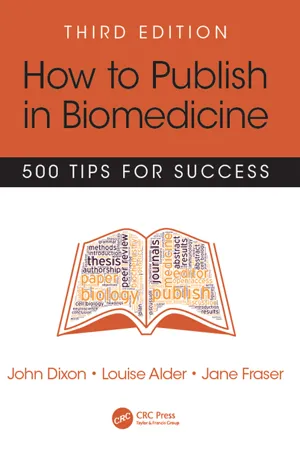
Getting published is crucial for success in biomedicine. Whether you are a beginner or an experienced writer, you will find this book has fresh, practical tips on everyday issues. Based on the authors' successful training courses and extensive experience of healthcare communications, this book will answer your questions and help you to avoid the most frequent problems and pitfalls. The book is designed to be very practical, and to be used when you are actually writing. It does not need to be read straight through from beginning to end before you get started. Instead, just dip into any chapter and you will find a range of tips relevant to the material you are working on right now.
eBook - ePub
How to Publish in Biomedicine
500 Tips for Success, Third Edition
- 224 pages
- English
- ePUB (mobile friendly)
- Available on iOS & Android
eBook - ePub
How to Publish in Biomedicine
500 Tips for Success, Third Edition
About this book
Information
PART I
The publishing process in science
CHAPTER 1
What do you want to write?
If you want to publish something in a biomedical journal or magazine, you will need to decide on the right format for what you have to say. This section defines some of the commonest types of publication, to help you decide into which category your publication fits.
Use these definitions in conjunction with the advice on choosing a journal in Chapter 5. The important thing is to choose the right format for the information you wish to convey, and to send your paper to a journal or magazine that accepts that format.

Full-length original research papers are the main category of paper included in any peer-reviewed journal. Think, however, about whether your paper might have a better chance of publication as a shorter communication (see below). Chapters 9–20 and 29 give more advice on how to prepare an original research paper.
Many journals publish shorter communications than full-length papers. Some communications are specifically for comment on recent publications in that journal, and some provide a route to publish new research. Journals refer to these with various terminology such as: ‘letters to the editor’, ‘research letters’, ‘short communications’, ‘brief communications’, ‘comments’, ‘technical comments’, ‘correspondence’, ‘perspectives’, ‘analysis’ and ‘opinion’. These shorter communications vary in focus and audience, and whether they are by invitation only or ‘open’ for submission or proposal from prospective authors. If ‘open’ (and do check each journal’s criteria), such articles provide alternative opportunities for publishing original research or communicating ideas, albeit with a strict limit on the number of words or pages allowed (Chapter 5).
When describing original research in a shorter communication, you will be restricted in the number of references and graphics you can include. In a ‘letter to the editor’ you can usually include a couple of references, but no figures or tables. Note that if you publish results of your own research in something such as a letter to the editor, you will not be able to publish the same study again as a full paper. Bear in mind also that relatively few letters to the editor are indexed in PubMed (the database of biomedical research at the US National Library of Medicine), so although your publication will be citable as a research publication, it will be less likely to be identified and read than a full paper.
You may wish to comment on a study recently published in the journal, and amplify the comment with a few lines reporting your own findings, e.g. ‘In their recent paper (Elderly Issues. 2016;36:2–7), Smith and Brown reported that gerontazole is an effective treatment for Portillo’s disease in elderly patients. In our own pilot study in six women aged 95 years or older, we found that …’
Shorter communications can simply convey your opinion or state some relevant facts on any topical issue. For a young scientist, having such a publication in a top journal can be a useful career boost. The chief criterion for acceptance of this kind of communication is that it should be of interest to the journal’s readers. Make sure that, in commenting on someone else’s research or practice, you do not inadvertently say anything that could be construed as libellous – keep it as impersonal as possible. Make it clear in your communication that you give your permission to publish (some letters sent to the editor are written for the eyes of the editor only).
Only some journals accept case reports – descriptions of one or more patients or a family that illustrate some novel clinical problem or its solution. Be sure that your case history is really as interesting as you think it is – it will have to tell a story that has not been told before. Case reports are most likely to be published if they describe:
• a previously unknown disease or syndrome (it still happens occasionally)
• a diagnostic challenge or problematic differential diagnosis and how the problem was solved
• a previously unsuspected causal association between two diseases
• a new and unexpected variation in the usual pattern of a disease
• a hitherto unreported adverse drug reaction or interaction.
Frequently, considerable time is spent developing, optimising and validating a new method while undertaking research, for instance during a PhD programme. Often, such research remains unpublished because no ‘results’ or new discoveries materialise. However, there are increasing numbers of ‘methods’ journals in which such research is ideally suited for publication: another publishing opportunity.
Only some journals accept review articles. They are often commissioned by the editor, so a review article submitted with no prior notice may be courting rejection. However, editors of journals that publish review articles are always open to new ideas, so contact them first to see if your suggested topic is welcome. For more about review articles, see Chapter 21.
Look closely, and you will see that ‘editorials’ and similar articles are not always written by the editor of the journal, but also by invited contributors, well-known and well-respected in their field. You are unlikely to get an editorial accepted if it is submitted speculatively. However, if you have something really important to say, it is worth approaching the editor to see if they would consider inviting you to write an editorial.
You may find that not everything you want to say fits into the categories described above. A few journals include informal articles alongside peer-reviewed research papers. These ‘news and views’ articles do not carry the academic kudos of a peer-reviewed paper, but they can still help attract attention to you and your institution. They can also be fun to write. For example, you might want to write about something ‘newsy’ like ‘How our geriatric unit cut antibiotic costs’ or ‘The Global Congress of Gastroenterology 2016: a surgeon’s view’. You might also want to write something more personal, or even humorous – ‘Medicine at 30 000 feet’.
Opportunities for informal writing may also be available in magazines and newsletters for your fellow professionals or the general public. For example, you might have a suitable idea for the New Scientist, Scientific American or Trends in Pharmaceutical Sciences. If you are unsure whether the...
Table of contents
- Cover
- Half Title
- Title Page
- Copyright Page
- Table of Contents
- Foreword to the first edition
- About the authors
- About this book
- Acknowledgements
- Part I The publishing process in science
- Part II Writing the core sections of a scientific research paper
- Part III Writing other scientific material
- Part IV Fundamentals of scientific writing
- Part V Practicalities of scientific writing
- Appendix 1: Manuscript checklist
- Appendix 2: Submission checklist
- Index
Trusted by 375,005 students
Access to over 1.5 million titles for a fair monthly price.
Study more efficiently using our study tools.
Frequently asked questions
Yes, you can cancel anytime from the Subscription tab in your account settings on the Perlego website. Your subscription will stay active until the end of your current billing period. Learn how to cancel your subscription
No, books cannot be downloaded as external files, such as PDFs, for use outside of Perlego. However, you can download books within the Perlego app for offline reading on mobile or tablet. Learn how to download books offline
Perlego offers two plans: Essential and Complete
- Essential is ideal for learners and professionals who enjoy exploring a wide range of subjects. Access the Essential Library with 800,000+ trusted titles and best-sellers across business, personal growth, and the humanities. Includes unlimited reading time and Standard Read Aloud voice.
- Complete: Perfect for advanced learners and researchers needing full, unrestricted access. Unlock 1.5M+ books across hundreds of subjects, including academic and specialized titles. The Complete Plan also includes advanced features like Premium Read Aloud and Research Assistant.
We are an online textbook subscription service, where you can get access to an entire online library for less than the price of a single book per month. With over 1.5 million books across 990+ topics, we’ve got you covered! Learn about our mission
Look out for the read-aloud symbol on your next book to see if you can listen to it. The read-aloud tool reads text aloud for you, highlighting the text as it is being read. You can pause it, speed it up and slow it down. Learn more about Read Aloud
Yes! You can use the Perlego app on both iOS and Android devices to read anytime, anywhere — even offline. Perfect for commutes or when you’re on the go.
Please note we cannot support devices running on iOS 13 and Android 7 or earlier. Learn more about using the app
Please note we cannot support devices running on iOS 13 and Android 7 or earlier. Learn more about using the app
Yes, you can access How to Publish in Biomedicine by John Dixon,Louise Alder,Jane Fraser in PDF and/or ePUB format, as well as other popular books in Medicine & Authorship. We have over 1.5 million books available in our catalogue for you to explore.