Not since the great military suicide epidemic of the American Civil War have we seen so many of our heroes, our soldiers and veterans, die by suicide. Why? War is violence. There is intent to cause death, or serious injury, or threat to the physical and psychological integrity of others. War stress is unforgiving. Suicide is an all too frequent response. Today, one member of the military dies by suicide every day. This is a new epidemic. This book addresses some tough questions: What do we know about suicides in the military? Are rates high? Or low? Is military suicide the same or different in the United States and Canada? Is military culture relevant? Do we know the causes, patterns, and associations? Is suicide among the armed forces similar to or different from suicide among civilians? Can it be altruistic? Through individual case studies and general/population approaches, we attempt to understand the cost of military service. It is especially through the personal stories of the great Civil War hero General Emory Upton, Admiral of the Navy Mike Boorda, and Hospital Corpsman Chris Purcell that we find answers. We learn there is a relative lack of understanding about military suicides, mainly due to the very complexity of suicide. The nature of suicide is not monolithic--it is multi-determined. Military service, we find, is a risk factor for suicide and suicidal behavior. Military veterans are twice as likely as civilians to die by suicide. Posttraumatic stress disorder (PTSD) and traumatic brain Injury (TBI) are especially noted to be huge risk factors, but so are other physical and psychological injuries. Sadly, the aftershocks of war include not only suicides but also incarceration, motor vehicle accidents, homicides, homicide(s)-suicides, and many more faces of violence. And there are many more, uncounted, wounded and dead. The families of traumatized soldiers and veterans, too, are indirect victims of their traumatic experience and, for some, their suicides; there is secondary traumatization. Yet, as this book shows, we must not forget that despite the unbearable pain of war, soldiers, veterans, and their military families, including children, are typically resilient. They can survive! Without question, our vulnerable heroes and veterans are at risk for suicide. But there is secrecy surrounding this, which may well be the biggest barrier. The government, the Department of Defense, the military, veterans groups, survivors, health providers, and other stakeholders need to develop and support more research, more programs, and more care for suicidal and disabled armed services personnel, veterans, and survivors. This war stress needs to stop.
eBook - ePub
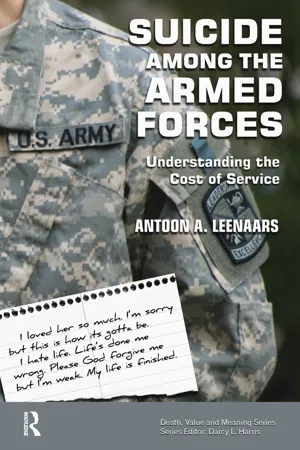
Suicide Among the Armed Forces
Understanding the Cost of Service
- 366 pages
- English
- ePUB (mobile friendly)
- Available on iOS & Android
eBook - ePub
About this book
Information
PART ONE
Introduction
There should be discernable stages in our development of understanding suicide among armed forces. There is a natural progression from conceptualization, to understanding, and then to application and practice. The three chapters in this section reflect some basic conceptualizations on the military and suicide.
Following the WHO’s recommendation to understand violence (war-related deaths, suicide, and homicide), I take an ecological perspective: individual, relationship, community, and society factors. It is a systems view. In the first chapter, I examine the military, beyond the individual level, and I explicate the collective military (“green”) culture. I answer the specific question on the relation of war and suicide through a unique study on the rates and associations of war and suicide during and after the Yugoslavian War. In the second chapter, I look at and answer, “What is suicide?” Suicide is a multidimensional event. I offer a way to psychologically understand suicide by detailing the most worldwide tested theory of suicide. It answers the question, How can we best understand the soldier’s suicide?
The psychological autopsy (PA) has been the gold standard for investigations of suicide; in fact, the PA began in the military after WWII. This is the work of my mentor, Edwin Shneidman. I explicate, in the final chapter in this section, using Captain Edwin Shneidman’s own words, what a PA is.
CHAPTER 1
The Military and Suicide
The day soldiers stop bringing you their problems is the day you have stopped leading them. They have either lost confidence that you can help them or concluded that you do not care. Either case is a failure of leadership.
—Colin Powell, Four-Star General, U.S. Army
War is violence. Suicide is violence. They are lethal violence. War-related violence, suicide, homicide, and other faces of violence have probably always been part of the human experience. There are many possible ways of defining violence. The World Health Organization (WHO, 2002) defines violence as
the intentional use of physical force or power, threatened or actual, against oneself, another person, or against a group or community, that either results in or has a high likelihood of resulting in injury, death, psychological harm, maldevelopment or deprivation.
(p. 5)
Intentionality is central. The matter of intentionality is one of the more complex aspects of the definition of violence. It is core to the definition of war-related deaths. The Oxford English Dictionary defines intentional as “done on purpose.” Intentionality is the noun. It is to have as one’s purpose. It is a conscious act. One intends death in war. One has a purpose: to kill, to induce annihilation.
A Systems Theory for Understanding Violence and War
I am an American, fighting in the forces which guard my country and our way of life. I am prepared to give my life in their defense.
—Article I of the Code of Conduct for Members of the Armed Forces of the United States (Cutler, 2002)
Charles Figley (1983) no stranger to the field of trauma, posttraumatic stress disorder (PTSD), and war, has stated, “The nature of war is destructive.” There is intent to kill. It is done on purpose. The military is a profession that is sanctioned to use deadly force. There are different points of view on who is whom—we are the heroes or warriors or martyrs, who must kill; and the other side are the enemies or infidels, who must be killed. Although the military has always served other duties, such as peacekeeping, the intent of armed forces is to inflict combat stress and death on the enemy! Violence is expected, beyond what is normally accepted (Christian, Stivers, & Sammons, 2009). There are physical, mental, emotional, and spiritual stresses of war, some of which are everlasting!
Before I turn to combat stress, first called “friction,” I need to turn to a few basic cultural concepts and a comment on military training and indoctrination. Although there are very important differences among the Navy, Army, Air Force, Marine Corps, and so on, the military culture can be described as a culture of relatedness (Kagitçibasi, 1996), in which interpersonal relations are of central importance, versus a culture of separateness such as the American culture, wherein personal autonomy is valued. This corresponds to collectivism and individualism (Triandis, 1995). Individualism places the individual at the center of a system of values, behavioral choices, and convictions, and emphasizes personal autonomy, independence, and self-actualization. It has been shown that individualistic societies have higher suicide rates than collectivistic societies. One possible explanation for this difference may be that suicide in these individualistic nations may be seen as a final step in self-determination—taking control of one’s own destiny. Collectivistic cultures are compatible with acceptance of traditional authority and adherence to core values and moral traditions, especially in matters of life, death, and war (Kemmelmeier, Wieczorkowska, Erb, & Burnstein, 2002). But also they may not foster acceptance, even consciousness, of individualism, including a person’s psychological pain, anguish, dishonor, and even suicide risk.
In a series of studies, I have shown that in collective cultures, such as India and Turkey, like previous cross-cultural studies on suicide in individualistic cultures, such as the United States, the United Kingdom, and Canada, there are great commonalties. However, collective cultures also have very specific cultural differences. There is a great deal more of an overall difference in indirect expressions, which at the very least, calls for greater cross-cultural study of this unique aspect of possible culturally specific risk factors. It may be most relevant to the system of the military. The fact that people in collectivistic cultures expressed more indirectness was unexpected from the previous cross-cultural research, but maybe not from a broader cultural view of the military and other cultures of relatedness. Collective culture encourages soldiers, and thus suicidal warriors, to adhere to core values and moral tradition, including in matters of suicide (Kemmelmeier et al., 2002). There is great stigmatization regarding self-harm and psychopathology in collective cultures. The culture has strong sanctions against suicide and suicide attempts. One is not a warrior! People in the military, in fact, take pride in their values and collective style; but maybe for suicidal soldiers, it fosters not communicating the intent, not even being conscious of individual pain. Secrecy is paramount. The indirectness may, thus, add to the lethal mix in a vulnerable and self-harsh person. It may well be that military beliefs foster indirectness of expressing intrapsychic pain. Consciousness of individualism is not fostered; relatedness is. The suicidal state may, thus, be more veiled, clouded, or guarded. This is called dissembling or masking and is a significant factor in suicide risk (Leenaars, 2004), which will be addressed in detail in chapter 2. We can already speculate that the lethal dynamics may be associated to collectivistic processes, but this speculation is only provisional; replication in the military is needed.
Christian et al. (2009) contend that military culture differs significantly from the majority American (and Canadian) culture in that “the military expresses a collective vs. individualistic ethos, has clearly defined and codified social hierarchies, explicitly regulates the expression of emotion in many circumstances, does not use material wealth as an index of social standing or power, and promotes a self-concept rooted in history” (p. 31). A systematic review of studies examining the military cultures of several countries concluded that
many Western militaries share a separate, more hierarchical and collectivistic culture that often allows individual service members to communicate and cooperate better with one another than with civilians from their own countries. However, military culture is not monolithic . . . each branch of the armed forces armed services instills “core values” . . . The military attempts to do so systematically, and immense pressures are exerted to ensure compliance with these values.
(Christian et al., 2009, p. 31)
In the military, collectivism is the norm. The day that an armed services member joins the service, he or she is taught to subordinate the self to the group (Christian et al., 2009). McGurk, Cotting, Britt, and Adler (2006), in fact, question whether individuals from Asian cultures, known for being communities of relatedness, would adjust easier to military life. My own studies on collectivism vs. individualism would support that prediction, but also with further implications. Christian et al. (2009) deduced that
diminution of the importance of the individual in favor of the organization, team, platoon, or unit is a universal military dynamic. . . . Various internal military documents identify unit cohesion as one of the most important factors in protecting against combat stress and maintaining unit morale in both peace and wartime.
(p. 33)
Christian et al. (2009) theorized that “Underlying the core values is an overall commitment to the service of one’s country and a recognition that this service could ultimately lead to the giving up of one’s own life in that service” (p. 37). These authors go on to state that this core belief (concept) “not only serves to motivate individuals further but may also be a protective factor in maintaining unit morale and thus may be protective against combat stress” (p. 38). In addition, it is a protective factor maybe also against suicide risk in most, but not for a few vulnerable soldiers.
Military training has been seen as indoctrination. McGurk et al. (2006) view military training within the framework of indoctrination. It is not simply education and training. It is deeper into the conscious and unconscious mind or psyche. “Indoctrination implies a more intense form of persuading individuals to adopt behaviors that are far outside of their previously held worldview” (Christian et al., 2009, p. 42). Al-Qaeda does the same.
Internalization is a central process. Recruits begin on the very first day to
more actively integrate the values of the group into their own individual worldviews. Conforming to the group is encouraged through social pressure and the continued emphasis on group norms. Because the individual now has incorporated the group’s values, norms, standards, and behaviors into his or her own self-concept, inclusion into the group becomes important. Individuals are now more internally motivated to behave in a way that is acceptable to the group.
(Christian et al., 2009, p. 42)
There are additional benefits to the group. McGurk et al. (2006) state that through indoctrination, members are also taught to dehumanize and deindividualize the enemy. A core belief is that the enemy is not human. The indoctrination process, in fact, involves the use of a lot of effective cognitive techniques. Grossman (1996) theorized that the dehumanization created by these processes facilitates the ability to kill, sometimes beyond the context of combat. It allows for violence. It allows one to see the other as a terrorist or infidel. Christian et al. (2009) further argued, “Aggression beyond what would normally be acceptable within society is a fact of life that is encouraged in the military” (p. 43). Violence is acceptable. Is it only in battle? Is it towards oneself, in honor? I do not wish to imply that all this indoctrination results in only negative consequences. It creates, for example, resilience or hardiness. Kelly and Vogt (2009) state that the
factor that may be implicated in how military personnel respond to stress and trauma exposure is hardiness. . . . Hardiness is defined as consisting of three components: commitment, or sense of purpose and meaning; control, defined by the belief that one can influence the events and challenge, the perception that change is a challenge and a normal part of life.
(p. 97)
Hardiness or, as mental health providers call it, resilience, is known to mediate the relationship between combat exposure and stress, PTSD, depression, and suicide risk (Kelly & Vogt, 2009; King, King, Fairbank, Keane, & Adams, 1998). It allows one to persevere despite the war friction. Resilience is all about Sisyphean perseverance!
In their insightful paper, Christian et al. (2009) conclude, “The military, with its emphasis on service, collectivism, values, and self-sacrifice for others, gives many young people an opportunity to connect with a higher cause” (p. 45). Yet it also introduces—maybe indoctrinates—the warrior to a great deal of stress outside the range of normal human experience, such as in harm’s way, even toward death.
War stress is unforgiving. An often-used legacy on war stress is of the Prussian War theorist, General1 Carl Gottfried von Clausewitz. The general used the word friction to describe the stresses of combat. His book, On War (von Clausewitz, 1982), is regarded as one of the most influential works on military philosophy. Charles Figley and William Nash in the 2007 editor’s foreword to Combat Stress wrote,
In Chapter VII, “The Friction in War,” he [von Clausewitz] offers a rather simple lesson, but one that is often not carried forward to subsequent generations, on the concept of friction war. He notes that no amount of training or preparation prepares combatants for the friction or the unexpected and distressing experiences of combat—not even those veterans of other battles. The friction of war occupies the mind and distracts the warfighter from the true mission. Combat friction, or simply combat stress, ca...
Table of contents
- Cover
- Title
- Copyright
- Dedication
- Contents
- Preface
- Acknowledgments
- PART ONE Introduction
- PART TWO Historical Study
- PART THREE Current Study
- PART FOUR Beyond Suicide
- PART FIVE Military Efforts
- PARI SIX A Case Study
- PART SEVEN Prevention and Policies
- References
- Index
Trusted by 375,005 students
Access to over 1.5 million titles for a fair monthly price.
Study more efficiently using our study tools.
Frequently asked questions
Yes, you can cancel anytime from the Subscription tab in your account settings on the Perlego website. Your subscription will stay active until the end of your current billing period. Learn how to cancel your subscription
No, books cannot be downloaded as external files, such as PDFs, for use outside of Perlego. However, you can download books within the Perlego app for offline reading on mobile or tablet. Learn how to download books offline
Perlego offers two plans: Essential and Complete
- Essential is ideal for learners and professionals who enjoy exploring a wide range of subjects. Access the Essential Library with 800,000+ trusted titles and best-sellers across business, personal growth, and the humanities. Includes unlimited reading time and Standard Read Aloud voice.
- Complete: Perfect for advanced learners and researchers needing full, unrestricted access. Unlock 1.5M+ books across hundreds of subjects, including academic and specialized titles. The Complete Plan also includes advanced features like Premium Read Aloud and Research Assistant.
We are an online textbook subscription service, where you can get access to an entire online library for less than the price of a single book per month. With over 1.5 million books across 990+ topics, we’ve got you covered! Learn about our mission
Look out for the read-aloud symbol on your next book to see if you can listen to it. The read-aloud tool reads text aloud for you, highlighting the text as it is being read. You can pause it, speed it up and slow it down. Learn more about Read Aloud
Yes! You can use the Perlego app on both iOS and Android devices to read anytime, anywhere — even offline. Perfect for commutes or when you’re on the go.
Please note we cannot support devices running on iOS 13 and Android 7 or earlier. Learn more about using the app
Please note we cannot support devices running on iOS 13 and Android 7 or earlier. Learn more about using the app
Yes, you can access Suicide Among the Armed Forces by Antoon Leenaars,Antoon A Leenaars in PDF and/or ePUB format, as well as other popular books in Psychology & Abnormal Psychology. We have over 1.5 million books available in our catalogue for you to explore.