- 272 pages
- English
- ePUB (mobile friendly)
- Available on iOS & Android
eBook - ePub
Managing Quality in Projects
About this book
Project managers appear to accept the 'iron triangle' of cost, budget and quality but in reality focus more on being on time and budget. Quality in projects is often paid mere lip service and relegated to tick-box compliance. This lack of clarity and focus on quality is often the source of project failures. Ron Basu's Managing Quality in Projects shines the spotlight on this aspect of project management that can often be overshadowed by the pressure to deliver on time and on budget. His investigation focuses initially on defining the dimensions of quality in project management and identifying sources of measurement for project excellence. Thereafter he expands his focus to discuss which tools can be effectively used in the quest for achieving and sustaining project excellence; and which processes are important in assessing the project maturity. The text also explores how the successes of operational excellence concepts, such as supply chain management, Lean Thinking and Six Sigma may be gainfully deployed in enhancing project quality and excellence. Finally a structured implantation plan guides those directly involved in project delivery, including suppliers, in how to 'make it happen'. A shared understanding and implementation of project quality by key project stakeholders will go a long way to ensuring a stable platform for delivering successful projects with longer lasting outcomes. It is also a fundamental building block in any organization's strategy for improving consistency and achieving sustainable performance. On that basis, Ron Basu's book is a must-have reference and guide for all project organizations.
CHAPTER 1
FUNDAMENTALS OF PROJECT MANAGEMENT
Introduction
The theme of this book addresses two broad and apparently isolated areas of business management. One is quality management and the other is project management. Quality management appears to enjoy a higher priority in operations management as compared to project management (Grude, Turner and Wateridge, 1996). According to Arunasalam, Paulson, and Wallace (2003) most concepts of defining and measuring quality have been derived from operations management. Hence, it is considered useful to outline the domains of both operations management and project management in order to structure the discussion related to quality management in both of these fields. It is also important to position the role of quality management amongst the fundamental processes applied in managing projects.
‘Operations management has expanded from treating only the core production processes in manufacturing organisations to include service organisations and non-core operations and processes in other functions such as marketing, finance and human resources’ (Slack, Chambers, Johnston and Betts, 2006, p. 6). The methodology of implementing a quality management and improvement programme has been well accepted in the environment of operations and process management and also in supply chain management (Dale, 2007). The applications can be varied and the programme is likely to have a different name or label, such as TQM, Six Sigma, Lean Sigma, BPR (business process re-engineering) or operational excellence. Some authors in quality management (Deming, 1986; Juran, 1989; Oakland, 2003) are viewed as key specialists in their areas of expertise.
The PMI (Project Management Institute, 2008) has defined a project as ‘a temporary endeavour undertaken to create a unique product or service’. This concept of a project being a temporary and one-time undertaking is perceived as different from operations which comprise permanent or semi-permanent ongoing functional activities. The management of these two disciplines is often very different and requires varying technical skills and philosophies, hence the need for the development of the discipline of project management.
Project management is the discipline of organising and managing resources in such a way that these resources deliver all the work required to complete a project within defined scope, time and cost constraints. Meredith and Mantel (2003, p. 1) describe project management as a social science and comment, ‘Project Management has emerged because the characteristics of our contemporary society demand the development of new methods of management.’ The Body of Knowledge (Association for Project Management, 2006) also defines project management as ‘the most efficient way of introducing unique change’. Bodies of knowledge have been compiled by professional organisations such as the Association for Project Management (APM), and the Project Management Institute (PMI). Specific journals have emerged, such as the International Journal of Project Management and Project Management Journal. These periodicals, viewed as publications for academic papers in project management, appear to encourage a demarcation between the disciplines of project management and operations management.
Due to the perception of the one-off and unique nature of a project versus the repetitive nature of operations, the traditional approach of project management has been consciously different to that of operations management. Supply chain management is inextricably linked with operations management (Slack, Chambers, Johnston and Betts, 2006, p. 208). A primary objective of both supply chain management and operations management is to ensure optimum customer service by balancing cost, time and quality (Wild, 2002). However, the mindset of project managers appears to exclude the principles and objectives of supply chain management (Ala-Risku and Karkkainen, 2006). This may explain why quality has been a lower priority in project management as compared to time and budget (Grude, Turner and Wateridge, 1996). However, the primary objectives of project management – scope, time, cost and risk – are beginning to include quality as another parameter of objectives (Turner, 2002). Accordingly, the so-called ‘iron triangle’ of cost, time and quality has emerged. Hence, it can be argued that the primary objectives of project management (with the exception of scope and risk) are closely comparable to those of operations management, that is, quality, cost and time.
The Importance of Project Management
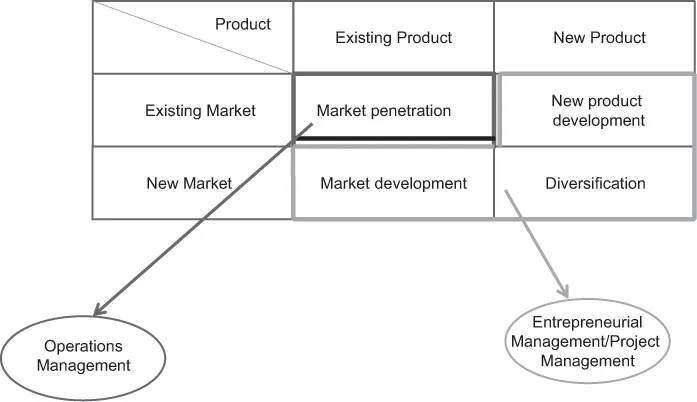
The product/market matrix of Ansoff (1987) is a sound framework for identifying market growth opportunities. As shown in Figure 1.1, the x-axis shows the dimensions of the product, and the y-axis represents the current and the new market.
There are four generic growth strategies arising from Ansoff’s grid. These are:
- Current product/current market: the strategy for this combination is ‘market penetration’. Growth will take place through the increase of market share for the current product/market mix.
- Current product/new market: in this situation the strategy for growth is ‘market development’. The pursuit will be for exploring new markets for current products.
- New product/current market: the strategy of ‘product development’ is followed to replace or to complement the existing products.
- New product/new market: the strategy of ‘product diversification’ is pursued when both the product and market are new in the business.
If we analyse the four quadrants of Ansoff’s product/market matrix it is evident that only the quadrant of ‘current product/new market’ relates to operations management: the other three quadrants relate to entrepreneurial management and project management. Even in operations management change management is inevitable. Therefore in any form of business strategy the application of project management disciplines is essential. A review of literature addressing the current thinking in innovation and new product development (NPD) initiatives (Cooper, 2001, 2009; Mankin 2006; Feng and Gonslaves, 2010) strongly supports the ‘stage gate’ process. This basically comprises the stages of a project life cycle and thus recommends the adoption of project management principles for NPD initiatives.
Figure 1.1 Product/market matrix (based on Ansoff, 1987)
Over the past several decades, more and more work has been accomplished in business through the use of projects and project management (Mantel, Meredith, Shafer and Sutton, 2001). However, despite the strong growth in project management literature and bodies of knowledge, projects continue to fail in terms of scope (i.e specification) and outcome (quality) in spite of the commonly used measures of cost and time (Thomas and Mengel, 2008). With increasing globalisation, competitive pressures, uncertainties (Atkinson, Crawford and Ward, 2006) and the resultant scope (specifications) creep, the emphasis in improving project planning and stakeholders and people management has grown considerably (Perminova, Gustafsson and Wikstrom, 2008).
People issues, including their expertise, are key factors in the successful delivery of a project’s end products, and are often considered the most difficult of the many variables related to planning and implementation activities. This view is supported, at least in principle, by project management bodies of knowledge, such as the PMBOK Guide (2008) and the PRINCE2 system (OGC, 2009). In the context of this book, ‘people issues’ is defined as the ‘organisation quality’, scope (product breakdown structure) and specifications are ‘product quality’ and planning processes are ‘process quality’. These three dimensions of project quality and their significance will be developed further in succeeding chapters of this book, but it is important to discuss the fundamentals of project management to ascertain the vital role of project quality in the successful delivery of projects.
This chapter investigates the fundamentals of project management, beginning with project management definitions and processes, followed by project supply chains and project life cycle and then project management characteristics relevant to project quality
Project Management Definitions and Controls
The size, scope, duration and complexity of projects vary widely from a small one-person project of a few days duration to a highly complex multidisciplinary engineering construction or new product-development project spanning multiple years and requiring hundreds of people (Ives, 2005).
The Association of Project Management (APM) in the UK produced the APM Body of Knowledge (BOK) in 2006, which provides the following definition of project management:
The planning, organisation, monitoring and control of all aspects of a project and the motivation of all involved to achieve the project objectives safely and within agreed time, cost, and performance criteria. The project manager is the single point of responsibility for achieving this.
The Project Management Body of Knowledge in the USA (PMBOK Guide 2008) described:
A project is a temporary endeavor undertaken to create a unique product, service or result.
Project management is the application of knowledge, skills, tools and techniques to project activities to meet project requirements. This is accomplished through the application processes.
The uniqueness of a project is also stated in PRINCE2 (2009) as:
A project is a temporary organization that is created for the purpose of delivering one or more business products according to an agreed business case.
Project management is the planning delegating monitoring and control of all aspects of the project, and the motivation of those involved, to achieve the project objectives within the expected performance targets.
The expected performance targets are primarily focused on the iron triangle of costs, times and quality (Turner, 2002; Heisler, 1990; Atkinson, 1999). Another version of iron triangle (Seaver, 2009) shows scope, schedule and budget at three corners of the triangle. It is important to note that the latest versions of PMBOK (2004) and PRINCE2 (2009) have basically done away with the project triangle. The reason for this is that a project has many more constraints to be observed other than the scope, schedule and budget or costs, times and quality. There are six variables of project control suggested in PRINCE2 (2009):
- Costs: The project has to be affordable and delivered within the budget
- Timescales: Arguably the next most important area of concern of a project manager is the delivery on time.
- Quality: The project’s deliverables must be fit for purpose.
- Scope: Exactly what will the project deliver? Often scope and quality are misconstrued as synonymous. Scope defines what is included and what is not included in the deliverable.
- Risk: The uncertain characteristic of a project entails risks, but how much risk are we prepared to accept?
- Benefits: Perhaps most often overlooked question, ‘why are we doing this?’. Benefits are determined by the outcome of the project perceived by the customer, not just the return on investment.
The role of quality in the control objectives of a project, in PRINCE2 terms, appears to be in the specification and functionality of the deliverable and overlaps with scope and benefits.
Project Management Processes
In PMBOK (2004) project management processes (identified as 44 processes) are grouped together in five process groups:
- Initiating process group; for defining a project.
- Planning process group; for establishing the scope and plan of the project.
- Executing process group; for executing the plan ...
Table of contents
- Cover Page
- Title Page
- Copyright Page
- Table of Contents
- Acknowledgements
- Dedication
- List of Figures
- List of Tables
- About the Author
- Introduction Why Managing Quality is Essential in Project Management
- 1 Fundamentals of Project Management
- 2 The Definition and Dimensions of Project Quality
- 3 The Application of the Guidelines of Project Quality in Bodies of Knowledge
- 4 Project Success Criteria and Success Factors
- 5 Project Excellence and Maturity Models
- 6 Operational Excellence Concepts in Major Projects
- 7 How Project Quality and Project Excellence are Practised: An Empirical Study
- 8 Heathrow Terminal 5: Case Study
- 9 Channel Tunnel Rail Link High Speed 1 Project (HS1): Case Study
- 10 Implementation: How to Make Project Quality and Project Excellence Happen
- Appendix 1 Online Questionnaire
- Appendix 2 Guidelines for apex (Assessing Project Excellence)
- Appendix 3 An Example of a Quality Management Plan
- Glossary
- References
- Index
- Advances in Project Management
Trusted by 375,005 students
Access to over 1.5 million titles for a fair monthly price.
Study more efficiently using our study tools.
Frequently asked questions
Yes, you can cancel anytime from the Subscription tab in your account settings on the Perlego website. Your subscription will stay active until the end of your current billing period. Learn how to cancel your subscription
No, books cannot be downloaded as external files, such as PDFs, for use outside of Perlego. However, you can download books within the Perlego app for offline reading on mobile or tablet. Learn how to download books offline
Perlego offers two plans: Essential and Complete
- Essential is ideal for learners and professionals who enjoy exploring a wide range of subjects. Access the Essential Library with 800,000+ trusted titles and best-sellers across business, personal growth, and the humanities. Includes unlimited reading time and Standard Read Aloud voice.
- Complete: Perfect for advanced learners and researchers needing full, unrestricted access. Unlock 1.5M+ books across hundreds of subjects, including academic and specialized titles. The Complete Plan also includes advanced features like Premium Read Aloud and Research Assistant.
We are an online textbook subscription service, where you can get access to an entire online library for less than the price of a single book per month. With over 1.5 million books across 990+ topics, we’ve got you covered! Learn about our mission
Look out for the read-aloud symbol on your next book to see if you can listen to it. The read-aloud tool reads text aloud for you, highlighting the text as it is being read. You can pause it, speed it up and slow it down. Learn more about Read Aloud
Yes! You can use the Perlego app on both iOS and Android devices to read anytime, anywhere — even offline. Perfect for commutes or when you’re on the go.
Please note we cannot support devices running on iOS 13 and Android 7 or earlier. Learn more about using the app
Please note we cannot support devices running on iOS 13 and Android 7 or earlier. Learn more about using the app
Yes, you can access Managing Quality in Projects by Ron Basu in PDF and/or ePUB format, as well as other popular books in Business & Operations. We have over 1.5 million books available in our catalogue for you to explore.