- 328 pages
- English
- ePUB (mobile friendly)
- Available on iOS & Android
eBook - ePub
An Introduction to Landscape
About this book
Inspiring deep emotion, landscape carries many meanings. This book follows the development of several threads of the concept of landscape as they have evolved across disciplines and across countries, leading to the European Landscape Convention and the designation of cultural landscapes as World Heritage Sites. The book introduces the key notions of landscape, such as landscape as meaning, as picture, as scale, as scenery and as place. It also considers the various factors which influence the way in which landscape is perceived now and in the past, with all of the senses. Finally, it looks of the various ways of protecting, managing and enhancing the landscape, taking into account a future of climate change. Beautifully illustrated and including 'capsules' in each section which provide fascinating insights into subjects from reading pictures, to mapping and GIS, through a discussion of the range of types of landscape to issues such as eco-museums, this book provides an excellent introductory overview for any students with an interest in the landscape around us.
Information
1
Introduction
Those who need to read this textbook on landscape will not fit easily into even a few categories. Many may be students, but their main subject might be one of many; others may be involved in one of the many battles concerning landscape alterations that are under way in courts and inquiries in most countries. Others may hope to discover more about places they love, or even some advice on designing and planting their garden. Some of these will be disappointed, especially the last, as the author’s aim is that you should learn more about yourself, and hence about your attitude to landscape. I cannot even promise that you will learn what ‘landscape’ is, although you will be given some of the arguments and elements that might allow you to answer that question for yourself. At the very beginning we cannot assume very much more than ‘landscape is out of doors’ so if I want to look at a landscape I must go to the window, and there it is. However, immediately we can discover that some places are more landscape than others. The view from my back window looks out across fields to Dartmoor in the distance (Figure 1.1), and this is much more ‘landscape’ than the view from my front window to the road and the garage next door (Figure 1.2). As for the ‘outdoors’, even that might be questioned as I am surrounded by paintings and photographs of places, and these are certainly called landscapes.
No wonder that landscape is still not quite a respectable academic subject if we still remain so unsure as to what it might be. No doubt if it had become the intellectual property of a single discipline it would by now have been defined so carefully as to miss all the richness of the present confusion, and it would have been so imbued with abstractions as to be safely removed from the daily conversation of non-specialists. Perhaps that process is already well under way; sadly, some may consider this book to be contributory to that process. True, there are departments of Landscape Architecture or Landscape Design, and there are modules concerning landscape in several other disciplines, including geography, ecology, archaeology and art history. Sometimes they seem to be talking about quite different things, and these differences, and the difficulties of definition, are the principal discussion of Part 1 of this book. But in most of these disciplines landscape is still rather peripheral, and people studying landscape more often find their allegiances with others in other departments. There is, I suggest, a very simple reason for this. Landscape is not very rational. It is intensely personal and reflects our own history, our own nationality and culture, our personal likes and dislikes. It is always about ‘my place’, or at least somebody’s place. The official definition by the European Landscape Convention (also known as the Florence Convention after the city where it was signed), to which we shall return again and again in this book, is ‘an area of land as perceived by people’, and inevitably that means ‘an area of land as perceived by me’. So the whole of this first part of the book has elements of autobiography, and the first person is used quite frequently. This is entirely consistent with the plan of constantly underlining that rational judgements of landscape quality are always overlaid, usually buried, by personal preference. So it is no part of this book’s remit to change your mind as to what constitutes a good landscape or a bad one, though I spend some time asking you why you like what you like.
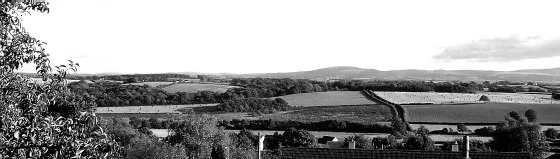
1.1 Mid-Devon landscape. View from the back of the author’s house. Proper landscape?
Landscape is immensely popular; meetings to discuss the landscape impact of some local planning proposal attract large numbers, and they are vocal and defensive. The landscape is indeed the Nimby’s playground. (Nimby is one of those useful acronyms; it means ‘Not In My Back Yard’ – a position many of us find ourselves in when confronted by new developments.) Very few people welcome change, even to what appear to most outsiders’ eyes to be very drear places indeed. This popularity of landscape is not limited to Britain – the existence of a European Convention is proof enough – but Britain has played a particular role in the history of landscape. There are strong arguments for supposing, as we shall see, that an important strand of the ‘landscape concept’, the idea of landscape as distinct from ‘land’, was largely an aristocratic invention in Britain, most specifically England, and that it was then learned and acquired by others who also changed the idea itself (Olwig, 2002). To a veneer of intellectual conceit were added emotional and visceral meanings that have brought the current obsession with landscape almost to the point where it hardly differs from the much more mundane idea of ‘place’.
This concept of ‘place’ is very clearly understood by most local people; almost all local events can be filed under ‘who’ or ‘where’ or ‘when’ or all of those three. It is the journalist’s basic creed – you never get this wrong … though they do. Place is the ‘where’ category. There may be a local history society, but the members are usually equally happy dealing with biological material as historical (natural history), or archaeological, or agricultural, or genealogical – provided it is still about ‘our place’. Academics divide the world of knowledge into much more sophisticated categories of disciplines, but after years of argument and debate they have agreed on a definition of ‘landscape’ that looks remarkably like the local idea of ‘place’ – an area perceived by people, and therefore containing not only their works but also their memories.
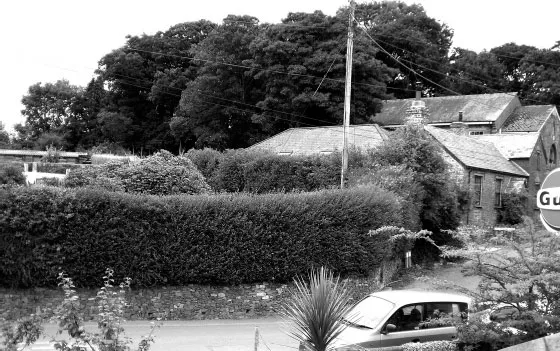
1.2 Street scene. View from the front of the author’s house. Is this landscape?
The emotional nature of landscape needs to be kept clearly in view throughout the first part of this book, which tries to follow some of the threads of ideas about landscape that have been the subject of academic concern. The definition by the European Landscape Convention (signed in Florence in 2000) is taken as being the final destination of all these threads, although of course that is unlikely to be true: first because it is only European countries that have agreed upon it, though there are now rumours of a World Convention; and second because no academic debate is ever agreed upon so completely. Many disciplines and discussions on landscape occur without any reference to this definition at all. However, by the end of Part 1 you should have a good idea of the different undercurrents that swirl about the concept of landscape and how the idea has conceived.
Part 2 can, therefore, concentrate on the present and examine the phenomenon of landscape itself. In some ways this is even more difficult. If landscape is a ‘place perceived by people’ then there are two obvious ways to describe it – either describe the places or describe the people doing the perceiving. The first of these is by far the most common, and most books on landscape will take either a chronological structure (how did the place come to look like this?) or a typological one (moorlands, woodlands, farmland, industry perhaps). Here I prefer to concentrate on the people and their perceptions, on the meanings that landscape evokes in a wide variety of people. The early chapters, therefore, first consider whether there are any perceptions, or landscape meanings, common to all people, while subsequent chapters examine the factors that might significantly alter these meanings to individuals or groups, from nationalism to local defensiveness, from the pastoral to the ‘other-worldly’. There are a series of capsules connected with this section which apply this understanding to types of landscape to help you apply the broader ideas, but the ‘landscape history’ offered here will be ‘perceptual history’. How Dartmoor, for example, was made and came to be as it is has been the subject of much work (Mercer, 2009), but how it has been perceived is scarcely discussed. This book is the other way round; the emphasis is clearly on the factors influencing the perception, but you will find little detail about the history of hedgerows or field patterns, or about the ecological history of ancient woodlands or of changes in farming practice. There is no doubt much work still to be done in those fields, but excellent introductions are already available (Hoskins, 1955; Rackham, 1986).
By the end of Part 2 you should know something of how the landscape idea came to be, what it is and what landscape means to a whole variety of people. One lesson will be fundamental, that all landscapes are of deep significance to someone, so that altering any place will always concern someone. Nevertheless landscapes are never static, and Part 3 therefore must look to the future landscapes of a fast-changing world. It does this by referring back to the Convention, which states that some landscapes will need protection, some management and some enhancement. In fact, of course, most landscapes will require all three, and how one can protect without managing is a useful question. But it makes a valuable structure, and the protective measures are essentially either those of designation of the special, which has been widely used at every level of government and international agency, or the Convention’s idea of ensuring that all landscapes are treated as special, though different. That leaves the issues of managing landscapes by other methods, and of enhancing them – the latter being the role of landscape architects in particular. In all of this it is vital to remember that only very few landscapes can be managed for landscape values alone (whatever they might be). Even British National Parks have important other roles, such as encouraging access. Landscapes are not museum artefacts – they have to be lived in and have to produce the food, drink and the oxygen for the world’s fast-increasing population. This leads to the final chapter of trends and issues concerning the sustainable landscape in the face of climate change, food demands and other major developments. Is there a way in which we can possibly love our future landscapes (with all the mental, spiritual and physical health benefits this brings) without completely compromising the ability of the world’s fast-increasing population, of humans but also of other species of both animal and plant, to survive?
Next time you are out in the street you will probably find a once-white van with ‘Landscape’ or ‘Landscaping’ on the side. It will mean ‘gardening’ or possibly ‘tree-planting’. That use of the word is not discussed in this book, although it does remind us that landscapes are manufactured by people. While we are writing and reading about the concept of landscape there will be people out there planting the trees and laying out the grounds which just might be a significant part of the solution to the problem of loving the future. Some of them will also be deeply concerned that this future will be sustainable and are well aware that their trade has important responsibilities to make it so.1
Before setting forth, there are three elements of the book that require a little explanation. Because landscape is such a confusion of ideas, there are elements which just will not fit into the structure laid down, and these are treated as separate little essays or ‘capsules’, scattered not quite randomly throughout. I owe the idea to Norman Davies in his History of Europe. There are two types: there are capsules concerning methods and sources; and, especially in Part 2, there are others, sometimes quite long, that apply the perceptions and meanings discussed in the main text to specific landscape types such as heathland or villages.
There are also exercises throughout, and you may be surprised at the nature of some of these. While a few may resemble examination questions, and will involve some further reading, the majority are simply intended to stimulate thought and relate the matter in the book to people’s own experience, and especially to landscapes with which they are familiar. This reinforces the conviction that landscape is a deeply emotional subject and cannot be understood as an abstraction or a lump of knowledge that remains within the covers of a book. It has to relate to real places, to real times and, above all, to real people. Similarly the pictures and the case studies mentioned will closely reflect landscapes well known to me; you will need to translate these into examples known to you. The fact that I live in south-west England will be very obvious from the start, and the illustrations will probably reflect my travels, largely within Europe. Consequently the book does not attempt to give answers that are relevant to all the landscapes around the globe; it does, however, attempt to ask questions that are appropriate everywhere and to which readers might attempt a local solution. If you find yourself saying ‘It isn’t like that around here!’ then the book has achieved its aim, and you may have just found the subject for an essay.
Some readers might be shocked by the paucity of references cited here. This is quite deliberate, but it is also intended that the summation of all the references should constitute a reading list including the most significant works with which every student of landscape should be reasonably familiar. It does not include works of local importance; nor do I feel the need to justify every sentence throughout the book with a reference in order to prove that nothing written is new, as is the modern way with works of scholarship. Many of the articles will stem from the journal Landscape Research, which I once edited and which remains the broadest of the numerous academic journals that are relevant to the subject. Sadly there is no simple Dewey catalogue number to help the beginner, though perhaps 711 might be a start. But you must be prepared to find relevant material on every floor of the library, from theology and philosophy to travel and pure science. It is assumed that when readers have read all the works in the reference list, and all the works in their reference lists, they will be sufficiently well read in the field, and might be allowed time off to go and experience a landscape of their choice.
References
Davies, N. (1996) Europe: A History, Oxford: Oxford University Press.
Hoskins, W.G. (1955) The Making of the English Landscape, Harmondsworth: Penguin.
Olwig, K. (2002) Landscape, Nature and the Body Politic: From Britain’s Renaissance to America’s New World, Madison: Wisconsin University Press.
Mercer, I. (2009) Dartmoor, Collins New Naturalist, London: HarperCollins.
Rackham, O. (1986) The History of the Countryside: The Full Fascinating Story of Britain’s Landscape, London: J.M. Dent.
Exercise
Go and look out of the windows – all the windows available to you. Which is the best landscape? Do any windows not look out on landscapes at all? Which of these landscapes should be protected if you had your way? Which should be enhanced? Open each window and use your ears and your nose, as landscape may not merely be about vision.
Start making a list of all the usages of landscape you find in your usual media input, whether representations of real landscapes on television or in the printed media; or fantasy ones in computer games or in literature. Start classifying these usages.
Note
1 Landscape Juice Network, http://www.landscapejuicenetwork.com, is a useful website to enter into this practical world of landscaping, especially the wonderful variety of blogs there. There remains a real gap in communication between the academic and the practitioner in this field.
PART 1
WHAT IS LANDSCAPE?
2
Landscape as Culture
The biggest problem with landscape is that it means so many different things to so many different people that it is no surprise that many avoid using the word. This includes both the European Union (EU) and the UK government, both of which tend to use the term ‘environment’, which is far from being the same thing, in any documents with legal purport. So the whole of Part 1 attempts to unravel the main threads in the concept of landscape as they shift over time and move towards a definition given in the 2000 European Landscape Convention (ELC). Not that this definition itself is likely to be uncontested, but it forms a destination of some value. Of all the complexities o...
Table of contents
- Cover
- Half Title
- Title Page
- Copyright Page
- Table of Contents
- Preface
- List of Figures
- 1 Introduction
- PART 1 WHAT IS LANDSCAPE?
- PART 2 HOW IS LANDSCAPE PERCEIVED?
- PART 3 WHAT IS THE FUTURE?
- Index
Trusted by 375,005 students
Access to over 1.5 million titles for a fair monthly price.
Study more efficiently using our study tools.
Frequently asked questions
Yes, you can cancel anytime from the Subscription tab in your account settings on the Perlego website. Your subscription will stay active until the end of your current billing period. Learn how to cancel your subscription
No, books cannot be downloaded as external files, such as PDFs, for use outside of Perlego. However, you can download books within the Perlego app for offline reading on mobile or tablet. Learn how to download books offline
Perlego offers two plans: Essential and Complete
- Essential is ideal for learners and professionals who enjoy exploring a wide range of subjects. Access the Essential Library with 800,000+ trusted titles and best-sellers across business, personal growth, and the humanities. Includes unlimited reading time and Standard Read Aloud voice.
- Complete: Perfect for advanced learners and researchers needing full, unrestricted access. Unlock 1.5M+ books across hundreds of subjects, including academic and specialized titles. The Complete Plan also includes advanced features like Premium Read Aloud and Research Assistant.
We are an online textbook subscription service, where you can get access to an entire online library for less than the price of a single book per month. With over 1.5 million books across 990+ topics, we’ve got you covered! Learn about our mission
Look out for the read-aloud symbol on your next book to see if you can listen to it. The read-aloud tool reads text aloud for you, highlighting the text as it is being read. You can pause it, speed it up and slow it down. Learn more about Read Aloud
Yes! You can use the Perlego app on both iOS and Android devices to read anytime, anywhere — even offline. Perfect for commutes or when you’re on the go.
Please note we cannot support devices running on iOS 13 and Android 7 or earlier. Learn more about using the app
Please note we cannot support devices running on iOS 13 and Android 7 or earlier. Learn more about using the app
Yes, you can access An Introduction to Landscape by Peter J. Howard in PDF and/or ePUB format, as well as other popular books in Architecture & Historic Preservation in Architecture. We have over 1.5 million books available in our catalogue for you to explore.