Junior hospital psychiatrists, general practitioners and medical students will find this book a valuable study aid, as will psychiatric nurses, psychiatric social workers, psychiatric occupational therapists and clinical psychologists.
- 160 pages
- English
- ePUB (mobile friendly)
- Available on iOS & Android
eBook - ePub
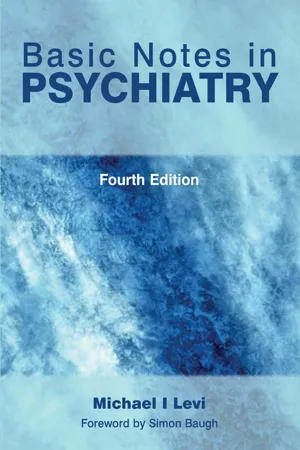
Basic Notes in Psychiatry
About this book
Information
CHAPTER 1
The history, mental
state examination
and formulation
As in any branch of medicine, psychiatry begins with taking a good history and examining the patient. The history is very similar in format to that taken in general medicine, while the mental state examination is something very particular to psychiatry. Having done both of these, it is then necessary to provide a formulation – i.e. a summary of the case presented in an integrated or synthesised fashion. This chapter deals with, in turn, the history, the mental state examination and the formulation.
The history
Age/Marital Status/Occupation
Source of referral
1 PC/HPC (presenting complaint/history of the presenting complaint): Principal symptoms or complaints and their duration; associated disturbance in appetite, weight, sleep and sexual drive; effects on patient’s ability to cope socially or with work.
2 PPH (past psychiatric history):
Previous hospital admissions with psychiatric illness. Treatment given.
How well did patient remain in between admissions?
3 PMH/PSH (past medical history/past surgical history):
Previous hospital admissions with physical illness or for operations.
4 FH (family history):
(a) Mother and father – current age or, if dead, age at death and cause of death; occupations.
(b) Sisters and brothers – names, ages, marital status, occupation.
(c) FPH (family psychiatric history) – history of any psychiatric illness in the family.
(d) FMH (family medical history) – history of any physical illness in the family.
(e) Current relationships – with parents, siblings and other relatives.
5 PH (personal history) – born and bred:
(a) Birth – any prematurity or low birth weight; any difficulties during delivery.
(b) Pre-school development – any delay in achieving milestones; any separation from parents; relationships with parents, siblings, other children and adults at this age.
(c) School – age of starting and finishing school; type of school attended; academic qualifications; relationships with pupils and teachers.
(d) Occupations – chronological list of jobs; if multiple changes, enquire about the reasons; relationships with workmates and superiors.
(e) Psychosexual history – age of onset of puberty; first steady relationship; first sexual intercourse; any evidence of physical, sexual or emotional abuse; if married, age at marriage and age of spouse at marriage; any psychiatric or physical illness in spouse; relationship with spouse; if children, give chronological list of their names, age and sex; any psychiatric or physical illness in children; relationship with children.
6 Smoke – current and past smoking habits.
7 Drink – current and past drinking habits.
8 Drugs – drugs, medicines or tablets patient is currently taking; any abuse of illicit drugs (e.g. cannabis, amphetamines, opiates).
9 Allergies – any known allergies.
10 Social circumstances – current type of residence (e.g. flat, house); composition of household.
11 Forensic history – any trouble with the law or police; any conviction...
Table of contents
- Cover Page
- Half Title
- Previous books by the same author
- Title Page
- Copyright Page
- Contents
- Foreword
- Preface
- Introduction
- 1 The history, mental state examination and formulation
- 2 The symptoms and signs of mental illness
- 3 Personality disorders
- 4 Anxiety disorders
- 5 Dissociative (conversion) disorders
- 6 Hypochondriacal disorders
- 7 Delusional disorders
- 8 Affective disorders
- 9 Schizophrenia
- 10 Organic disorders
- 11 Eating disorders
- 12 Alcohol and drug dependence
- 13 Psychiatric emergencies
- Index
Trusted by 375,005 students
Access to over 1.5 million titles for a fair monthly price.
Study more efficiently using our study tools.
Frequently asked questions
Yes, you can cancel anytime from the Subscription tab in your account settings on the Perlego website. Your subscription will stay active until the end of your current billing period. Learn how to cancel your subscription
No, books cannot be downloaded as external files, such as PDFs, for use outside of Perlego. However, you can download books within the Perlego app for offline reading on mobile or tablet. Learn how to download books offline
Perlego offers two plans: Essential and Complete
- Essential is ideal for learners and professionals who enjoy exploring a wide range of subjects. Access the Essential Library with 800,000+ trusted titles and best-sellers across business, personal growth, and the humanities. Includes unlimited reading time and Standard Read Aloud voice.
- Complete: Perfect for advanced learners and researchers needing full, unrestricted access. Unlock 1.5M+ books across hundreds of subjects, including academic and specialized titles. The Complete Plan also includes advanced features like Premium Read Aloud and Research Assistant.
We are an online textbook subscription service, where you can get access to an entire online library for less than the price of a single book per month. With over 1.5 million books across 990+ topics, we’ve got you covered! Learn about our mission
Look out for the read-aloud symbol on your next book to see if you can listen to it. The read-aloud tool reads text aloud for you, highlighting the text as it is being read. You can pause it, speed it up and slow it down. Learn more about Read Aloud
Yes! You can use the Perlego app on both iOS and Android devices to read anytime, anywhere — even offline. Perfect for commutes or when you’re on the go.
Please note we cannot support devices running on iOS 13 and Android 7 or earlier. Learn more about using the app
Please note we cannot support devices running on iOS 13 and Android 7 or earlier. Learn more about using the app
Yes, you can access Basic Notes in Psychiatry by Michael Levi in PDF and/or ePUB format, as well as other popular books in Medicine & Medical Theory, Practice & Reference. We have over 1.5 million books available in our catalogue for you to explore.