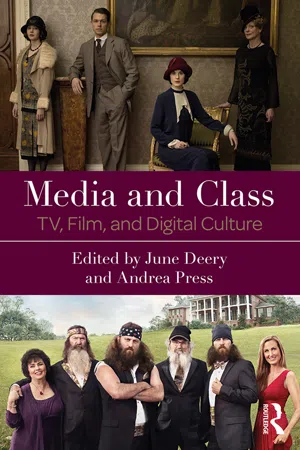
Although the idea of class is again becoming politically and culturally charged, the relationship between media and class remains understudied. This diverse collection draws together prominent and emerging media scholars to offer readers a much-needed orientation within the wider categories of media, class, and politics in Britain, America, and beyond. Case studies address media representations and media participation in a variety of platforms, with attention to contemporary culture: from celetoids to selfies, Downton Abbey to Duck Dynasty, and royals to reality TV. These scholarly but accessible accounts draw on both theory and empirical research to demonstrate how different media navigate and negotiate, caricature and essentialize, or contain and regulate class.
- 226 pages
- English
- ePUB (mobile friendly)
- Available on iOS & Android
eBook - ePub
About this book
Information
1
INTRODUCTION: STUDYING MEDIA AND CLASS
The topic of class, having helped launch the fields of Media and Cultural Studies, has in recent decades been largely neglected, with scholars turning instead to individualization and identity politics,1 and politicians to neoliberal visions of meritocratic marketization.2 In Sociology, the topic also faded to an extent, even as—and perhaps because—the class configuration of contemporary societies has become more complex. An initial spur to studying popular media was understanding the class dynamics of production and representation, yet while this topic was fundamental to early research at the Birmingham Centre for Contemporary Cultural Studies (Richard Hoggart, Stuart Hall, Raymond Williams),3 attention to gender and race began to overtake this original mission. In Britain, but more especially when British Cultural Studies crossed over the Atlantic, examinations of class largely subsided as a component of media analysis.4
Today, in both academic and non-academic circles, there is a renewed interest in class—due, at least in part, to recent and somewhat shocking political events. In decades past, a few scholars and many more politicians floated the idea that advanced democracies were approaching a post-class era: in Britain it was a sentiment voiced by both the Right (Thatcher) and the New Left (Blair). Whereas today, scholars, politicians, and ordinary people alike are more convinced that if we want to understand contemporary society we cannot dismiss class as a meaningful category. Furthermore, there is an understanding that the media has a vital role to play in forming and understanding class identities, and that we need to know more about its impact. As both cultural expression and industrial product, the media represent and shape class; and in particular, the new media environment has enabled the rise of isolated opinion nodes which have fostered the rise of class-specific discourse. How and to what degree the media reflect or construct class are matters of debate, but certainly those who finance, produce, compose, distribute, those who receive, interpret, use, and modify, all occupy classed positions whether consciously or not.
Popular Consciousness
Today, the nexus of class, media, and, ultimately, politics is much more a part of public consciousness in America and Britain than even a few years ago when this collection was first conceived. The frequency with which popular and political discourse now acknowledges class differences is, in fact, a significant trend. This used to not be the case. In fact, in American culture class was for a long time something of a taboo and its mention deemed rude or even unpatriotic. However, the patricians’ rejection of class discussion as objectionable “class warfare” has receded since the Bush era and now there is unapologetic probing of class division. Increasingly people are naming it, characterizing it, and discussing it as a problem.
Some people have even taken to the streets—all over the world. Protest against a neoliberal wealth disparity was brewing in the Seattle WTO protests in 1999. A similar outrage over economic injustice figured in the overthrow of plutocratic regimes in the Arab Spring of 2010, in the English working-class riots in August 2011, and in the Occupy movement in the autumn of 2011 (with largely bourgeois supporters). Anxieties about economic divisions also figure in the rise of a recent right-wing populism in Europe, often with lower-class support (Judis, 2016; also Frank, 2004). But for Britain and America the great explosion came in 2016 with Brexit (June referendum) and Trump (November election). Both cultures shared the shock of these two events, and in both nations these populist eruptions not only foregrounded class but also demonstrated the apparent failure of the media, particularly news organizations, to understand festering class conflicts and dissent. At the same time, candidate Trump was a creature of the media who, as he exploited and condemned its coverage with equal enthusiasm, highlighted a disturbing link between media profitability (ratings) and a weakening of democracy.
The Brexit referendum and Trump’s victory were immediately attributed to protest votes on the part of the White working class whose jobs are threatened by de-industrialization, immigration, and globalization. It seemed, therefore, that the elite had neglected the pains and injustices of class division at their peril—except that in actuality the oligarchic Trump administration successfully co-opted this working-class revolt and in Britain, too, the Conservative government remained in place. Nevertheless, intellectuals and others have since been scrambling to understand the disaffected working class and books that foreground class and economic distribution are now in high demand, from Thomas Piketty’s erudite Capital in the Twenty-First Century (2014) to ethnographic or personal accounts like Strangers in Their Own Land (Hochschild, 2016) and Hillbilly Elegy (Vance, 2016), both best-sellers that examine poor White cultures in the American South. Similarly, in Britain, there has been considerable interest in negative stereotyping of working-class Whites, for example, Chavs: The Demonization of the Working Class (Jones, 2011).
It is once again recognized that class matters because, quite simply, it still marks and consolidates power, which means that it also affects the fundamentals of life and death. For each of us, our class position affects how we will live and how long we will live, how we will be cared for and educated, how we will interact with the law, and what experiences and pleasures are open to us. To a large degree, class still determines geographic and social location: where we live, where we go to college, where we go on vacation. It affects how we speak and who listens.
Certainly, there is some class flexibility and movement in both Britain and America, but not as much as people think, or used to think.5 Socioeconomic mobility is statistically less evident today in both countries and this can be attributed to many factors: the loss of skilled manufacturing jobs (due to automation and outsourcing), the rising cost of higher education, stagnant middle-class incomes, tax codes, global trade, and other legislation that favors the very wealthy.6 Now multigenerational socioeconomic inequality is increasingly a subject of inquiry. Both the extent of the chasm, as captured in widespread debate about the ascent of the “1%,” and how difficult it is to cross, are topics of continuing public debate. From President Obama to Pope Francis, international leaders have urged nations to address this issue as a matter of some urgency. In the United States, more people now dispute that upward social mobility—a moral imperative that many Americans believe is enshrined in the constitution—is a fair representation of how things work (if it ever was). If building a classless society was a raison d'être for the new nation, it is now feared that the vision has soured. And there is some finger pointing at the media, since its output has for some time helped perpetuate a hegemonic narrative that masked unequal opportunities and persuaded people to vote against their own economic interests. This, of course, is encapsulated in “the American Dream,” the almost trademarked ideology of frictionless social advancement that popular media have frequently endorsed, whether by selling the immediate thrill of a meteoric rise or by relying disproportionately on portraits of the highly successful for audiences to admire, envy, or vicariously live through and identify with, emotionally and politically.
Scholarship on Class
The Concept
Few ideas are more contested in the social sciences than the concept of class. However, most scholars would agree that class refers to one’s position within a social structure of unequal access to available resources (material, social, political). The concept is therefore relativistic and involves categorization within systems of stratification. There is also agreement that while in any human society some form of differentiation may be inevitable, the particulars are not universal but are orchestrated through sociopolitical means. Therefore, relative wealth or poverty may be expected, but the range is constructed and variable. Beyond this, there are disputes about what criteria ought to be used to determine class ranks, and how cohesive these groups are. Within academic literature, there are theories about class formation in general, about how to categorize class, and accounts of class relations within a particular culture or historical moment. Some accounts are descriptive and others are explanatory. But whatever the approach taken, there is some agreement that the major theorists are Karl Marx, Max Weber, and Pierre Bourdieu, with E.O. Wright essentially continuing the tradition of Marx and John Goldthorpe of Weber, though of course there is considerable overlap. See, for instance, Weber (1978), Bourdieu (1984), Wright (1997) and Goldthorpe (1987). Marx (1818–1883) was a scholar and a political advocate whose work encompassed both explanations and future projections of class relations. In the context of early industrial society, he regarded class differences as hinging on the relationship to the means of production, and his approach stressed the exploitation of the working class (labor) by the upper class (owners), although Marx’s brilliant early writings contained the seeds of a more cultural theory of social class. Above all, Marx established that understanding class relations was fundamental to understanding how society functions. Later, in a more bureaucratic and service economy, Max Weber (1864–1920) emphasized that class assessment also involves cultural status or social prestige indicated by lifestyle and associational groupings. Weber took a less purely economistic approach than Marx, but he didn’t deny that economic rank and social status are often correlated. While he also critiqued capitalist systems, he was not so critical of modern economic arrangements and their rational bureaucratic implementation as was Marx in his observations of industrialization.
Following Weber, and as Sociology continued to grow as a discipline, there was a prime period of stratification research from the 1940s to the 1970s. After that there was a relative falloff in attention to class, although, particularly in Britain, socioeconomic categorization continued to be used as an administrative instrument by governments and bureaucracies. By the 1990s, some scholars proposed that in high-consumerist, service economies class is no longer a useful explanatory tool for understanding social behavior (Pahl, 1989; Pakulski & Waters, 1996; Kingston, 2000). The rise in importance of theories of individualization such as those of Giddens (1991), Beck (1992), Bauman (2001), and Beck and Beck-Gernsheim (2002), and the transformation of Marxist Sociology with the fall of the Soviet Union, meant that social class analyses became less prominent in Western social science.
Yet a major shift was already occurring when the writings of Pierre Bourdieu became more widely distributed among scholars in Britain and America in the last decade of the twentieth century. The French theorist placed more emphasis on what he termed cultural and social capital, and looked closely at taste and everyday behavior to demonstrate how culture is a mechanism through which class relations are constituted and perpetuated (Bourdieu, 1984). Bourdieu’s dual focus on material and cultural assets is now increasingly popular among scholars and has inspired a new cultural approach to class in Sociology, particularly among those writing in the tradition of the Birmingham School for whom Marxist class analyses were always primary even as advanced economies have changed and social class categories have become more complex. Among sociological and interdisciplinary studies that focus on class are Giddens (1973, 1991), Dahrendorf (1976), Sennett and Cobb (1977), Willis (1981), Katznelson (1982), Burawoy and Skocpol (Eds.) (1983), Scott (1996), Skeggs (1997), Reay (1998), Lamont (2000), Savage (2000, 2015), Sayer (2005), Devine, Savage, Scott, and Crompton (2005), Crompton (2008), Biressi and Nunn (2013), Milkman (2016), and Standing (2016). Areas of interest include social stratification and inequality, mobility, cultural identity (lifestyle, education, race, gender), capitalism, and neoliberalism. Also well regarded are historical accounts like Cannadine (1999) and Rose (2010). Sociologists who are interested in media, in addition to authors in this collection, include Bennett et al. (2009), Couldry (2011), Skeggs and Wood (2012), and Couldry and Hepp (2016).
More specifically, a variety of scholars, including media sociologists, have of late tried to revive the concept of class in Media Studies. This constitutes a relatively small portion of media research but has produced several titles. In addition to contributors to this collection, who represent some of the most important research in this area, there are, for example, works by Morley (1980), Hill (1986), Stead (1989), Ross (1998), Walkerdine (1998), Rowbotham and Beynon (2001), Horne (2001), Grindstaff (2002), Beach (2002), Bodnar (2003), Gillett (2003), Heider (2004), Vineberg (2005), Foster (2005), Dave (2006), Gandal (2007), Nystrom (2009), Kendall (2011), Wood and Skeggs (Eds.) (2011), Tyler (2013), Henderson (2013), Ross (Ed.) (2014), Cloarec, Haigron, and Letort (Eds.) (2016), and Sharot (2016). As feminist Media Studies, and feminist scholarship more generally, have taken intersectionality seriously, studies targeting the importance of race, gender, sexuality, and often social class have become central to feminist Media Studies (McRobbie, 1991, 2004; Steedman, 1987; Press, 1991; Skeggs, 1997; Press & Cole, 1999; Walkerdine & Lucey, 2001).
Categorization
The basic questions that arise when categorizing class include, what are the criteria, boundaries, fluidity, mobility, and number of class categories? Each of these refers to dynamic and changing patterns, and no one claims they have understood and predicted them for all time. Fluidity here refers to broader changes in class formations and criteria over time, not to individual mobility between ranks.7 In addition to establishing classifications, scholars typically have to consider how does class operate, what effects does it produce, and how is it perceived by outside observers or by individuals as their own personal experience. There are a variety of methods in use today and some disagreement about their relative effectiveness, for example, smaller focus groups for qualitative research versus large statistical surveys, and self-reporting versus ethnographic observation. Some scholarship focuses on taxonomies or data collection and others on larg...
Table of contents
- Cover
- Half Title
- Title Page
- Copyright Page
- Contents
- Acknowledgments
- 1. Introduction: Studying Media and Class
- Part I: Class Representation as Entertainment
- Part II: Documenting Class
- Part III: Media Leisure/Labor
- Part IV: Digital Cultures
- Contributors
- Index
Trusted by 375,005 students
Access to over 1.5 million titles for a fair monthly price.
Study more efficiently using our study tools.
Frequently asked questions
Yes, you can cancel anytime from the Subscription tab in your account settings on the Perlego website. Your subscription will stay active until the end of your current billing period. Learn how to cancel your subscription
No, books cannot be downloaded as external files, such as PDFs, for use outside of Perlego. However, you can download books within the Perlego app for offline reading on mobile or tablet. Learn how to download books offline
We are an online textbook subscription service, where you can get access to an entire online library for less than the price of a single book per month. With over 1.5 million books across 990+ topics, we’ve got you covered! Learn about our mission
Look out for the read-aloud symbol on your next book to see if you can listen to it. The read-aloud tool reads text aloud for you, highlighting the text as it is being read. You can pause it, speed it up and slow it down. Learn more about Read Aloud
Yes! You can use the Perlego app on both iOS and Android devices to read anytime, anywhere — even offline. Perfect for commutes or when you’re on the go.
Please note we cannot support devices running on iOS 13 and Android 7 or earlier. Learn more about using the app
Please note we cannot support devices running on iOS 13 and Android 7 or earlier. Learn more about using the app
Yes, you can access Media and Class by June Deery,Andrea Press in PDF and/or ePUB format, as well as other popular books in Social Sciences & Media Studies. We have over 1.5 million books available in our catalogue for you to explore.