eBook - ePub
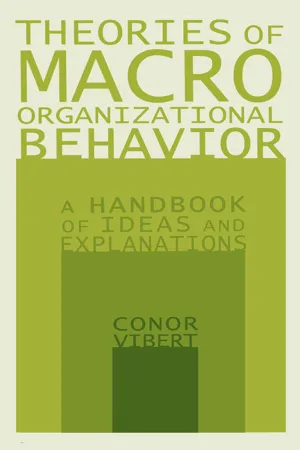
Theories of Macro-Organizational Behavior: A Handbook of Ideas and Explanations
A Handbook of Ideas and Explanations
- 240 pages
- English
- ePUB (mobile friendly)
- Available on iOS & Android
eBook - ePub
Theories of Macro-Organizational Behavior: A Handbook of Ideas and Explanations
A Handbook of Ideas and Explanations
About this book
This book provides a comprehensive summary of the major theories meant to explain the way business and other organizations work, why they look and act as they do, and what makes some succeed and others fail. Among the many different approaches to the subject, no one school of thought accurately reflects current thinking on these issues. The author presents a much-needed overview of thirty of the major theories that underpin Organization Theory and Economic Organization. Each theory is summarized in a stand-alone fashion, allowing each chapter to be used either in complement or as a separate perspective. Integration of the various topics and perspectives is accomplished within section introductions and in the overall introduction and conclusion to the text. The goal of this book is to inform students of the main issues confronting organizations, the main theoretical ideas within the different paradigms, why it is important to theorize about organizations, how these theories are constructed, and how learning is improved by scanning multiple perspectives. It can be used as a stand-alone uourse text or supplementary text for advanced undergraduate or graduate courses in Organization Theory.
1
Introduction
Why do large organizations behave as they do? The question is simple and thought provoking. It is also one that is rarely answered or indeed pursued in a comprehensive manner outside of academia. One need simply ponder the activities of firms such as Microsoft, Nike, Calvin Klein, or the International Olympic Committee to appreciate the significance of this query. An investor in the North American stock markets of the late 1990s and early millennium might also understand the importance of not having seriously considered this concern. Indeed, as never before, the fallout from the dot.com era of investing and the questions of legitimacy surrounding investment community–sponsored corporate research suggests a need to revisit our understanding of why corporations act as they do. It also demands that we reconsider how practitioners, investors, academics, and students obtain and process information to make informed decisions. In short, we need to consider alternative means of undertaking business-related analysis.
This book is a response to that concern. Our readers are academics, business analysts, corporate trainers, students, researchers, and the curious. After completion, readers will note an increase in their abilities to understand complex organized behavior occurring in the private and public sectors. It offers a series of different theoretical lenses useful for explaining one event from multiple perspectives or many events from one perspective. Theories of Macro-Organizational Behavior: A Handbook of Ideas and Explanations presents a series of well-established theories of organization and economic theories of the firm. For each of these perspectives, a brief overview of the main ideas is provided, along with an example and a concluding critique. Together, these components allow readers to improve their understanding of why corporations and other large entities act as they do, while introducing them to leading-edge academic thought.
About Organization Theory
Why are corporations such as Wal-Mart, Dell, and IBM so often perceived as top performers? Organization and business strategy theorists address questions of this nature. As scholars, these individuals seek to understand why organizations look and act as they do and why they are effective. Not surprisingly, among academics no school of thought accurately reflects current thinking on these issues (Meyerson and Martin 1988). As a consequence, there now exists a large collection of scholarly insight that suggests many different approaches for explaining and predicting large-scale organized behavior.
Numerous themes connect the different perspectives that make up this body of research and literature known as organization theory. Noteworthy among these themes is the idea that efforts to improve the corporate bottom line do not always drive the behavior of large organizations. Despite popular misconception, profit is not the sole motivator of corporate and organized activity. Indeed, evidence suggests strong roles for reasons other than improvements to the bottom line.
Overview of the Book
The core of this endeavor is a presentation of the theories that fit under the heading of "organization theory." These theories represent a broad overview of this important field of research and include perspectives originating with European, North American, Australian, and Asian thought. Theories covered range from those with strongly critical slants on the one hand to the more mainstream, less critical perspectives on the other hand. The theories covered originate within fields as diverse as economics, management, psychology, sociology, ecology, anthropology, and political science. Profit-driven economic theories of the firm are covered side by side with effectiveness-driven theories of organization. Following the motto "There is no one best way to organize," each chapter suggests to readers a different approach to understanding how organizations should or do behave. For each theoretical perspective, readers are offered a stand-alone modularized write-up.
This book is divided into a number of different parts. To begin, a brief primer is presented to familiarize readers with the topic of organization theory. We then offer a set of perspectives, each categorized under four distinct headings: "Functional Economic Theories of the Firm," "Functional Organization Theories," "Interpretive and Social Constructionist Perspectives," and "Radical Humanist and Structuralist Perspectives." Since most of the past and present of organization theory is located within the functionalist theories tradition, this part of the book is much longer then the other parts. Meanwhile, the third and fourth parts contain more recent theoretical developments. It is also important to note that this book does not intend to replace the more traditional organization theory text. Instead, this book seeks to provide readers with a broad overview of the field, to be used, if chosen, in partnership with lectures, case materials, and other readings that strive to explain large-scale organized behavior. In this book, we address:
- The main issues confronting organizations
- Why it is important to theorize about organizations
- How these theories are constructed
- The main theoretical ideas within the different paradigms
- How learning is enhanced by looking across perspectives.
Part I: Functional Economic Theories of the Firm
Economists have long held an interest in the behavior of for-profit organizations. Much of their insight has been anchored in a long series of research efforts falling under the heading of "theories of the firm." Theories of the firm refer to conceptualizations and models of business organization conduct. Despite the common use of the expression "theory of the firm," no one conceptualization exists to unite those seeking to understand why companies act and organize as they do (Grant 1996). However, a few ideas are accepted by most academics and theorists. Among the most important of these is the idea that observers can explain and predict the structure and behavior of business enterprises.
Furthermore, agreement probably exists that a theory of the firm should represent an "abstraction of a real world business enterprise designed to address a particular set of its characteristics and behaviors" (Machlup 1980). Economic theories of the firm are implicitly managerial in their orientation, while theorists in this tradition "seek to examine regularities and relationships that lead to generalizations" (Gioia and Pitre 1990). Economic theories of the firm are functional and are concerned primarily with predicting the behavior of firms in external markets (Grant 1996). As such, performance ultimately refers to the bottom line in an environment where the firm is considered a singular decision taker.
In this part, as with the others in this book, we deal with how the theories contribute to macro-organization theorizing. Economic theories of the firm discussed include neoclassical, Chicago School, Bain-Mason paradigm, transaction costs, network perspective, agency perspective, stakeholder perspective, resource-based theory, behavioral perspective, game theory, property rights perspective, knowledge perspective, evolutionary theory, and natural environment perspective, which is authored by Gregory R. Berry. These discussions are found in chapters 3 through 16, respectively.
Part II: Functional Organization Theories
A second category hosts those perspectives that are also functional in nature. Implicitly, theories in this group adopt an orientation that takes for granted the role of managers, while theorists in this tradition "seek to examine regularities and relationships that lead to generalizations" (Gioia and Pitre 1990, 590). Five issues differentiate organization theories from economic theories of the firm. First, the objects of analysis are organizations, not just business enterprises. Second, performance or organizational effectiveness is not limited to the corporate bottom line or externally imposed market measures. It may take on many forms, including survival and legitimacy. Third, organizations are not necessarily considered singular decision takers. Fourth, firms or entities under examination are recognized as organizations encompassing multiple individuals. Finally, theorists of this tradition address the structures of internal organization and the relationships between constituent units and departments (Pfeffer 1982).
Under this heading, in chapters 17 through 23, we address organization perspectives that include those of bureaucracy, contingency, strategic choice, resource dependence, population ecology, institutions, and chaos.
Part III: Interpretive and Social Constructionist Perspectives
A third category of theories fits within the paradigm or school of thought known as interpretivism. In contrast to the oversocialized, passive, determined role-taker presented in functionalist theories, interpretive theories provide for an undersocialized, active role-maker. "This perspective is based on the view that people socially and symbolically construct and sustain their own organizational realities" (Gioia and Pitre 1990). Of importance to theorists of this tradition are the descriptions, insights, and explanations of events that reveal the system of interpretations and organizing processes that are associated with modern organizations.
In this part, chapters 24, 25, and 26, respectively, will consider three important interpretive approaches for organization theorizing: symbolic interactionism, dramaturgy, and the use of metaphors. Chapters 27 and 28 address two newer approaches, the sensemaking and organizational rules perspectives. These are authored by Jean Helms Mills and Albert J. Mills, respectively. Chapter 29 offers a discussion on the culture perspective. As with the others in this book, these theories contribute to macro-organization theorizing.
Part IV: Radical Humanist and Structuralist Perspectives
Radical poststructuralism and humanism are rarely associated with managerial theorizing due to their confrontational and oppositional natures. Yet, a close inspection of the ideas found within these schools of thought suggests that organization scholars do indeed make use of these perspectives to understand many phenomena. Unlike the more conservative thrusts of the functionalist and interpretive approaches, theories in the radical structuralist and radical humanist traditions serve to challenge and critique existing taken-for-granted beliefs, assumptions, and institutions. Radical theories add an important perspective to our thinking about organizations, particularly those who are complacent among us.
Radical humanism is a well-established style of theorizing quite common to the discipline of sociology. When applied to modern organizations, theorists in this tradition seek to "free organization members from sources of domination, alienation, exploitation and repression by critiquing existing social structure with the intent of change" (Gioia and Pitre 1990, 588). Theories found under this heading seek radical change by examining the legitimacy of the social consensus on meaning, uncovering communicative distortions, and educating individuals about the ways in which these distortions occur (1990). From a radical humanist approach, we examine organizations from the perspectives of configuration, postmodernism, and critical theory. These write-ups are found in chapters 30, 31, and 32, respectively.
Radical structuralists share an ideology for change-seeking to remove from society, industries, and organizations the sources of domination forced on lower members of the social hierarchy by dominant elites. The normal operation and makeup of modern corporations and organizations are viewed as dysfunctional and capable of transformation only through conflict and revolution. Not surprisingly, theories found under this heading seek to understand, explain, criticize, and illuminate the dysfunctional areas of writing within this paradigm (Gioia and Pitre 1990). Two important areas of writing falling within the structural side of this paradigm, which are discussed in chapters 33 and 34, respectively, are the Marxist and poststructuralist feminism perspectives, with Deborah Hurst authoring the latter chapter.
How Exposure to the Concepts of Organization Theory Can Benefit Practitioners
Does academic thought matter? Why should professional analysts, business researchers, management writers, and consultants pay attention to the ideas found in this book? Aside from the simple response of "they can improve analysis," a number of reasons can be offered:
- The ideas of this book are the result of observation, data collection, and data analysis. They exist and are referenced because evidence exists to support them. This evidence and the core ideas that they support have passed critical review and are accepted among scholars.
- For practitioners, knowledge of these ideas can lead to a career-related competitive advantage over one's peers by differentiating and enhancing his or her own analysis.
- These theories can help analysts and consultants improve de-cision making by enhancing the credibility and acceptance of their own arguments by incorporating these ideas into discussions, interactions, and presentations to decision makers and colleagues.
- Relativism suggests that knowledge of any particular event or activity is not objective and universally accepted, nor does it have definite foundations. Picture one company or its actions analyzed through dozens of different lenses. The concepts outlined in this book are these lenses.
- Use of these concepts can also help overcome a researcher's bias toward the use of online information sources. Windle (2003) suggests that many professionals may rely too heavily on online information sources for intelligence needs. Exposure to new management concepts offers researchers and professional analysts a portfolio of mental frameworks with which to position different information strands.
- Fleisher and Bensoussan (2003, 114) suggest many corporate researchers and consultants suffer from tool rut or the overuse of the same analytical tools that in part stems from instruction from accountants and finance professors. The set of theoretical frameworks presented in this book offer analysts ideas to overcome these shortcomings.
- Finally, the breadth of explanations found in this book can also help nascent professionals establish their credibility. Fleisher (2003, 86) suggests that specialized knowledge of other related fields is one prerequisite for a profession. For burgeoning fields of practice, organizational theory can be thought of as a related field (Vibert 2003).
Author Note: The section of this chapter entitled "How Exposure to the Concepts of Organization Theory Can Benefit Practitioners" is adapted with permission from Conor Vibert, Competitive Intelligence: A Framework for Web-based Analysis & Decision-Making (Mason, OH: Thomson South-Western, 2003).
2
A Primer on Organization Theory
Deborah Hurst and Conor Vibert
Picture yourself getting ready to take a Ph.D. comprehensive exam on organizational analysis. The process is probably familiar to anyone who has written an exam to enter a profession such as law, accounting, or medicine. You have been studying fo...
Table of contents
- Cover
- Half Title
- Title
- Copyright
- Contents
- Acknowledgments
- 1. Introduction
- 2. A Primer on Organization Theory
- Part I. Functional Economic Theories of the Firm
- Part II. Functional Organization Theories
- Part III. Interpretive and Social Constructionist Perspectives
- Part IV. Radical Humanist and Structuralist Perspectives
- References
- Recommended Readings
- About the Author and Contributors
- Index
Trusted by 375,005 students
Access to over 1.5 million titles for a fair monthly price.
Study more efficiently using our study tools.
Frequently asked questions
Yes, you can cancel anytime from the Subscription tab in your account settings on the Perlego website. Your subscription will stay active until the end of your current billing period. Learn how to cancel your subscription
No, books cannot be downloaded as external files, such as PDFs, for use outside of Perlego. However, you can download books within the Perlego app for offline reading on mobile or tablet. Learn how to download books offline
Perlego offers two plans: Essential and Complete
- Essential is ideal for learners and professionals who enjoy exploring a wide range of subjects. Access the Essential Library with 800,000+ trusted titles and best-sellers across business, personal growth, and the humanities. Includes unlimited reading time and Standard Read Aloud voice.
- Complete: Perfect for advanced learners and researchers needing full, unrestricted access. Unlock 1.5M+ books across hundreds of subjects, including academic and specialized titles. The Complete Plan also includes advanced features like Premium Read Aloud and Research Assistant.
We are an online textbook subscription service, where you can get access to an entire online library for less than the price of a single book per month. With over 1.5 million books across 990+ topics, we’ve got you covered! Learn about our mission
Look out for the read-aloud symbol on your next book to see if you can listen to it. The read-aloud tool reads text aloud for you, highlighting the text as it is being read. You can pause it, speed it up and slow it down. Learn more about Read Aloud
Yes! You can use the Perlego app on both iOS and Android devices to read anytime, anywhere — even offline. Perfect for commutes or when you’re on the go.
Please note we cannot support devices running on iOS 13 and Android 7 or earlier. Learn more about using the app
Please note we cannot support devices running on iOS 13 and Android 7 or earlier. Learn more about using the app
Yes, you can access Theories of Macro-Organizational Behavior: A Handbook of Ideas and Explanations by Conor Vibert in PDF and/or ePUB format, as well as other popular books in Business & Business General. We have over 1.5 million books available in our catalogue for you to explore.