eBook - ePub
Supporting Self Care in Primary Care
The Epidemiologically Based Needs Assessment Reviews, Breast Cancer - Second Series
- 264 pages
- English
- ePUB (mobile friendly)
- Available on iOS & Android
eBook - ePub
Supporting Self Care in Primary Care
The Epidemiologically Based Needs Assessment Reviews, Breast Cancer - Second Series
About this book
"Self care is about people's attitudes and lifestyle, as well as what they can do to take care of themselves when they have a health problem. Supporting self care is about increasing people's confidence and self esteem, enabling them to take decisions about the sensible care of their health and avoiding triggering health problems. Although many people are already practising self care to some extent, there is a great deal more that they can do." - Ruth Chambers, Gill Wakley and Alison Blenkinsopp, in the Preface. Designed around the Department of Health's Working in Partnership Programme, this book is full of easy-to-implement advice for everyday use, promoting a positive approach to self care and demonstrating how smoothly it can be introduced and undertaken. "Supporting Self Care in Primary Care" encourages interactive professional learning and development, both individually and within a team, and highlights the importance and benefits of self care in the workplace. It is a self-contained text with tools and illustrative examples to aid comprehension, and includes a complementary web resource containing further tools and a training package. All healthcare professionals involved in commissioning or providing primary care to patients will find this practical guide invaluable, as will healthcare managers and health promotion specialists.
Information
Part 1
Making self care happen
1
Supporting self care
Ruth Chambers
This chapter sets out the context, and what supporting self care means. It considers where we are now, how we have got here and where we want to go with self care.
To make self care work, both the public and professionals need knowledge and information (of facts and of where to find information), skills and motivation. The English public appears to be very interested in wanting to do self care, but a recent survey has shown that many lack the motivation, information and knowledge to adopt a healthy lifestyle and practise self care.1 Box 1.1 captures the importance of the role of health professionals in primary care in encouraging and supporting patients’ self care. The same survey concluded that:
If professionals are to play an active role in self care, more work needs to be done with them to develop their role in supporting self care. Education and training are key, as change may require a culture shift from professionals being the principal providers of care and patients as passive recipients, towards more emphasis on preventative care, healthy lifestyle and patient involvement in their own care of minor, acute and long term conditions – with professionals providing a supportive, advisory, educational and skills training role.1
Support groups were found to have a role in providing advice, education and support – and self care support networks are part of the vision for the future.
Box 1.1: Key findings about the public’s attitudes to self care
- More than half of those who have seen a care professional in the last six months say they have not often been encouraged to do self care, and one-third say they have never been encouraged by the professionals.
- Over three-quarters of the public agree that with guidance and support from an NHS professional they would be far more confident about taking care of their own health and wellbeing.
- Two-thirds of the public say they would be more confident in doing self care if they had support from people with similar health concerns or conditions.
- Awareness of patient organisations and voluntary agencies was low (68% of respondents were not aware of one).
- Few people say they have used NHS Direct in the last six months; however, they want to use the services more in the future.
- Family, friends and colleagues were the preferred source for self care information and support, after general practitioners (GPs) and nurses.1
The future for the NHS and support for self care
Emphasising self care by patients is a key strand in NHS delivery plans at all levels – strategically in the community services White Paper and locally in primary care trust (PCT) and practice development plans for all independent contractor practices.2 Supporting self care for patients is part of the vision for development in the NHS through commissioning where responsibility is taken by a partnership operating between PCTs, general practice and local government, as a cost effective development that fits with patients’ choice.3
The NHS must become ‘as much a service to support health as to treat illness’, where patients are empowered to take a more active self care role in maintaining or improving their health.4 Table 1.1 describes some of the key messages in successive national policies about establishing self care in an integral way across the NHS and other government agencies.
There is a great deal of self care by members of the public occurring already, and lots of interest by the public in learning and reading what they can do for themselves (see Box 1.2).
Box 1.2: Key statistics describing activity around self care in England
- Over-the-counter medicine sales total £2 billion per year.
- Two-thirds of internet users have researched health issues online.
- Sales of consumer health magazines have grown at around 20% per year in the last decade.
- Around 1 million people are providing over 50 hours per week of unpaid care.5
What self care means – to the practice team
In future, local people should be:
knowledgeable about the health and health care choices available to them… They should understand the links between lifestyle and health, and how to get support for changing their lifestyles when they need it.4
If people go to a pharmacy and discuss their symptoms, then the pharmacist and counter staff should be able to recommend that they self care, if appropriate, rather than consulting their GP. If they ring in or consult at the practice for a trivial reason, or return for a second opinion, then every member of the general practice team should give consistent health messages and advice as appropriate, all the time encouraging and supporting self care. Patients or people in the community can practise self care in their daily lives, provided they are able to trust and believe in the principles of self care and have the support or resources to be able to do so.
Figure 1.1 describes a real primary care team discussing how they define self care in their own words. It has been estimated that self-treatable disorders account for nearly 40% of GP time5 – so there should be lots of opportunity for those working in primary care to encourage and support self care.5
Table 1.1 Examples of recent policy documents and reports following progress on self care (derived from www.pagb.co.uk and Department of Health (DH) sources)
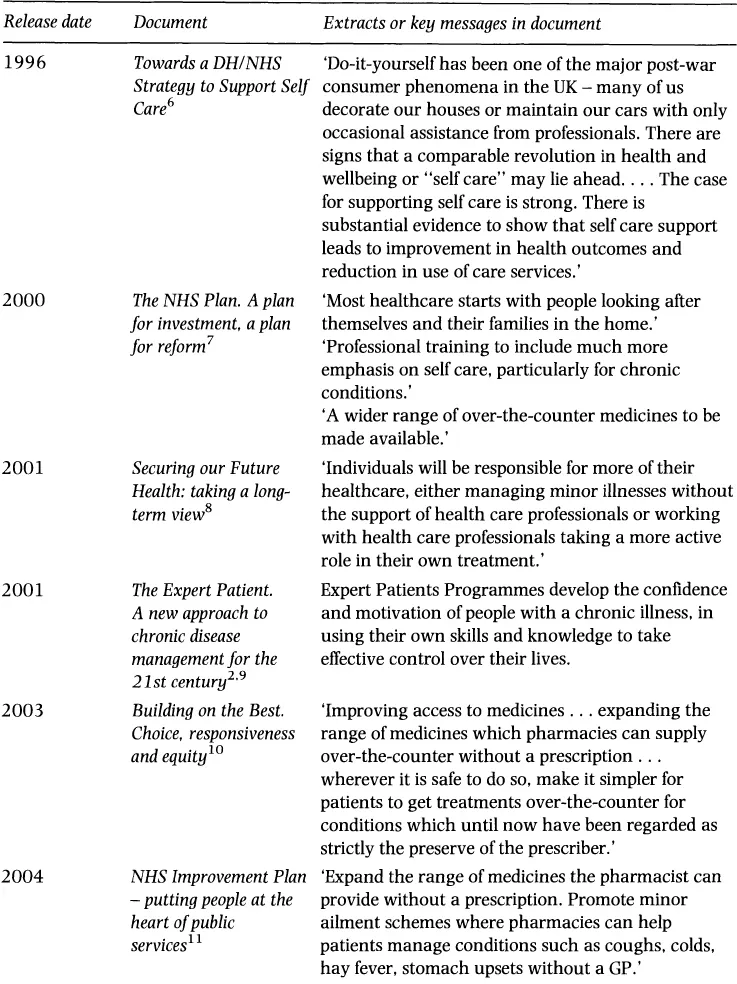
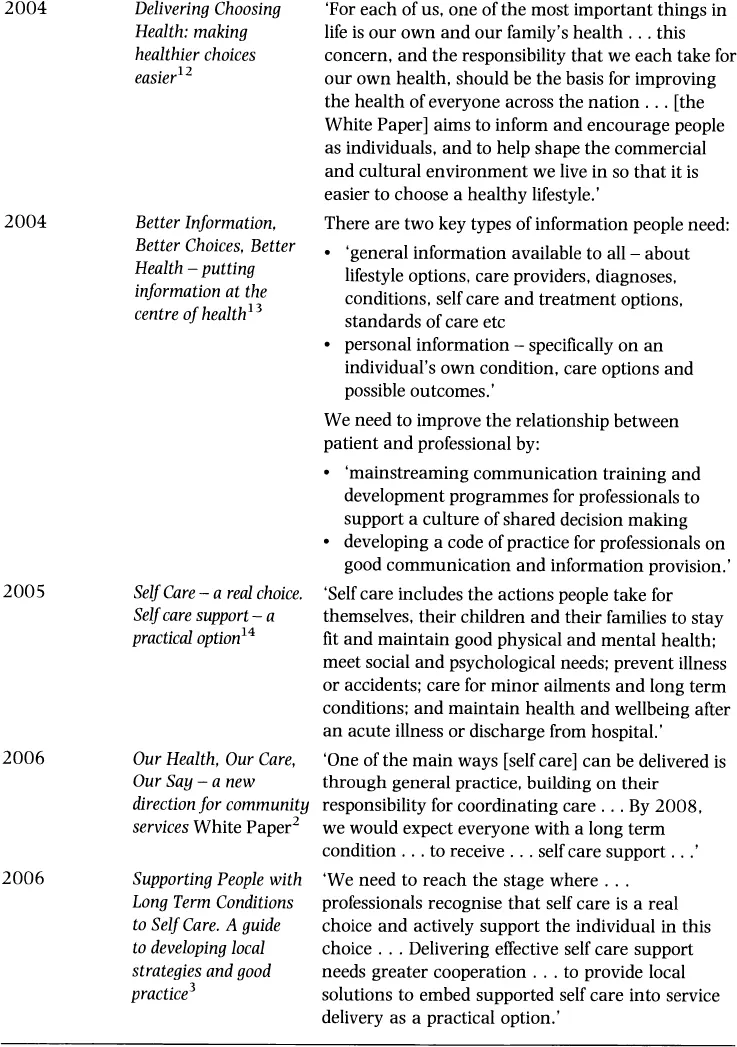

Figure 1.1: What self care means – to the practice team.
There is considerable antipathy about supporting self care in some practice teams or among some health professionals. Disaffected GPs might say: ‘Good idea, but I once picked up a serious illness in a patient who came for something minor so you can’t be too careful’. Or ‘It’s quicker to give a script than explain about alternatives and self care’. So professionals need to be encouraged to realise the benefits of self care – such as by spelling out that time spent advising on and treating minor conditions could be better focused on the more major health problems included in the Quality and Outcomes Framework.5,15
Establishing an integrated strategy for supporting self care in practice
Initiatives to encourage self care in the practice are more likely to be successful if they are fully integrated into the delivery of general medical services by the primary health care team. A self care support strategy should be integral to all other strategies and development plans in a PCT or practice – and appropriate for the local population. It should avoid merely transferring dependence from one professional (e.g. a GP) to another in a different setting (e.g. a pharmacist).
Self care approaches should be interesting and meaningful to patients and the public, to encourage changes in their behaviour. Erewash PCT, for example, focused on three key areas: minor ailments, chronic disease (e.g. asthma) and the presentation of coronary heart disease. They set up the Pharmacy First initiative whereby patients can use the pharmacy instead of their GP practice. They held seasonal campaigns – linking in pharmacies, and focusing on hay fever, coughs and colds, etc. The initiative broke down barriers between GPs and pharmacists, to build trust and consistency and create a team approach to supporting self care.15 The PCT ran self care skills training for people with asthma, associated with their Expert Patients programme. They also...
Table of contents
- Cover
- Title Page
- Copyright Page
- Table of Contents
- Foreword
- Preface
- About the authors
- Acknowledgements
- About the Working in Partnership Programme (WiPP)
- Abbreviations
- Part 1 Making self care happen
- Part 2 Illustrative patient pathways to self care
- Part 3 Tools to help you plan and support self care
- Appendix 1 Useful resources
- Appendix 2 Record sheet to plan and describe your progress in supporting self care
- Index
Trusted by 375,005 students
Access to over 1.5 million titles for a fair monthly price.
Study more efficiently using our study tools.
Frequently asked questions
Yes, you can cancel anytime from the Subscription tab in your account settings on the Perlego website. Your subscription will stay active until the end of your current billing period. Learn how to cancel your subscription
No, books cannot be downloaded as external files, such as PDFs, for use outside of Perlego. However, you can download books within the Perlego app for offline reading on mobile or tablet. Learn how to download books offline
Perlego offers two plans: Essential and Complete
- Essential is ideal for learners and professionals who enjoy exploring a wide range of subjects. Access the Essential Library with 800,000+ trusted titles and best-sellers across business, personal growth, and the humanities. Includes unlimited reading time and Standard Read Aloud voice.
- Complete: Perfect for advanced learners and researchers needing full, unrestricted access. Unlock 1.5M+ books across hundreds of subjects, including academic and specialized titles. The Complete Plan also includes advanced features like Premium Read Aloud and Research Assistant.
We are an online textbook subscription service, where you can get access to an entire online library for less than the price of a single book per month. With over 1.5 million books across 990+ topics, we’ve got you covered! Learn about our mission
Look out for the read-aloud symbol on your next book to see if you can listen to it. The read-aloud tool reads text aloud for you, highlighting the text as it is being read. You can pause it, speed it up and slow it down. Learn more about Read Aloud
Yes! You can use the Perlego app on both iOS and Android devices to read anytime, anywhere — even offline. Perfect for commutes or when you’re on the go.
Please note we cannot support devices running on iOS 13 and Android 7 or earlier. Learn more about using the app
Please note we cannot support devices running on iOS 13 and Android 7 or earlier. Learn more about using the app
Yes, you can access Supporting Self Care in Primary Care by Ruth Chambers,Gill Wakley,Alison Blenkinsopp in PDF and/or ePUB format, as well as other popular books in Medicine & Family Medicine & General Practice. We have over 1.5 million books available in our catalogue for you to explore.