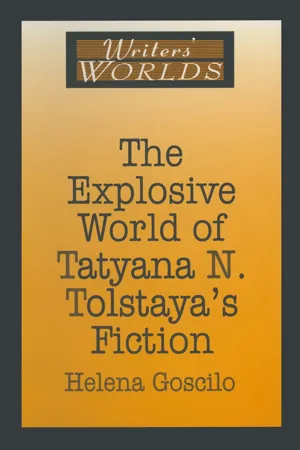
This study of the work of Tatyana N. Tolstaya initiates the reader into the paradoxes of her fictional universe: a poetic realm ruled by language, to which the mysteries of life, imagination, memory and death are subject.
Paradise, Purgatory, and Post-Mortems: The Lapsarian Myth as Universal Rite of Passage
Tatyana Tolstaya made her literary debut in 1983 on the pages of Avrora with the story, dedicated to her sister Shura (Aleksandra), that subsequently lent its title to her collection: “‘On the Golden Porch’” (“‘Na zolotom kryl’tse sideli…’”)1. Since this miniature masterpiece of six pages and its companion piece, “Rendezvous with a Bird” (“Svidanie s ptitsei”),2 her second publication, condense practically all the hallmarks of her writing, they afford a convenient introduction to Tolstaya’s artistic world—a world structured by the regnant triad of cognition, time, and memory.
As elsewhere in Tolstaya’s work, plot in “‘On the Golden Porch’” performs a minimal function. The story summarizes selectively a woman’s reminiscences of several externally insignificant incidents from her childhood in the countryside, most of which involve a neighboring bookkeeper called Uncle Pasha. Such a deceptively mundane and highly compressed recapitulation, however, cannot even hint at the dazzling richness of the story, which, like a voluminous body packed into an undersized corset, strains at the contours of the confining form, its abundance threatening to burst the seams. The thematic wealth, the resonances, and the gourmandizing style (which elicited the uneasy opprobrium of critics accustomed to a diet of attenuated texts)3 must have overwhelmed readers weaned on the blandness of Soviet prose.
Tolstaya casts the nets of her creativity wide and high. At the heart of the story reside no less than the eternal questions of life’s meaning and the elusive multifariousness of the individual life, which the narrator as a young girl reformulates more concretely and reductively as the enigma of personality. Hence the children’s counting rhyme that serves as the story’s epigraph:
On the golden porch sat:
Tsar, tsarevich, king, prince,
Cobbler, tailor.
Who are you?
Tell me fast, don’t hold us up. (41)
Na zolotom kryl’tse sideli:
Tsar’, tsarevich, korol’, korolevich,
Sapozhnik, portnoi,
Kto ty takoi?
Govori ppskorei, ne zaderzhivai dobrykh liudei. (40)
The unusual genre of the epigraph, together with the plot surface of the text proper, prompted an interviewer to read the story naively as a commentary on the evanescence of childhood, in response to which Tolstaya asserted:
The story … is about the attempt to grasp life. What is life? Who exactly is the neighbor Uncle Pasha: a tsar, tsarevich, cobbler, tailor? He’s the first, the second, and the third. He’s a henpecked husband, and a happy lover, and an impotent [helpless] old man. And we see him with the enraptured eyes of a child one moment, and the sober gaze of an adult the next, and each time he’s different. And there’s no answer to the children’s counting rhyme: who are you?
Rasskaz … o popytke postich’ zhizn’. Zhizn’—chto eto takoe? Sosed diadia Pasha—kto on takoi: tsar’, tsarevich, sapozhnik, portnoi? I to, i drugoe, i tret’e. On—i zabityi muzh, i schastlivyi liubovnik, i bessil’nyi starik. I my vidim ego to voskhishchennymi detskimi glazami, to trezvym vzgliadom vzroslogo, i kazhdyi raz on raznyi. I net otveta na detskuiu schitalochku: kto ty takoi?4
To have a children’s chantlike ditty point to the ontological dimension of her narrative is characteristic of Tolstaya’s subversive penchant for yoking that which convention deems incompatible. It evinces her attraction to grotesque, oxymoronic matings of all types, whether they be confined to a single narrative sphere (such as character, style, tone, or language) or simultaneously cut across two or more categories and strata.5
For the actual exploration of the mystery of life in “‘On the Golden Porch,’” however, Tolstaya draws prodigiously on two familiar domains rich in ontological tradition and imagery that also inform her second published narrative: the Edenic myth and folklore. The matrix metaphor that presides over “‘On the Golden Porch’”6 unambiguously identifies childhood with the natural, uncorrupted world of prelapsarian innocence/ignorance. Tolstaya establishes the equation in the story’s introductory sentences, which have an evocatively Biblical ring:
In the beginning was the garden. Childhood was a garden. Without end or limit, without borders and fences, in noises and rustling, golden in the sun, pale green in the shade, a thousand layers thick. (41)
V nachale byl sad. Detstvo bylo sadom. Bez kontsa i kraia, bez grani i zaborov, v shume i sheleste, zolotoi na solntse, svetlozelenyi v teni, tysiacheiarusnyi. (40)
Innumerable autobiographies conceive of childhood as a paradise destined to be lost, yet partly retained or recuperated as a source of inspiration for the remainder of one’s life. For Kathleen Raine, the author of a fine-tuned re-creation of early years entitled Farewell Happy Fields (1973), the significance of childhood lies less in its personal experience than in its shared cultural inheritance as “[p]art of the Fable we know; Paradise and the Fall. And as surely as we each enact the Fall, so have we memories of Paradise. My own have been a refuge, a source of wisdom and poetry, inexhaustible to this day.”7 As Richard Coe justly observes, “Few childhoods, even among the most sordid and the most degrading, are entirely without some experience of paradise” (67). In the majority of cases, that paradise assumes the form of a verdant refuge awaiting exploration.
Tolstaya’s lush garden of timeless eternity (Mircea Eliade’s Mud tem-pus) and sun-washed splendor lacks enclosure. It thus enables the protagonist and her companion to bite the metaphorical fruit through a voluntary traversal of symbolically saturated time and space so as to acquire firsthand knowledge of the body:
They say that early in the morning they saw a completely naked man at the lake. Honest. Don’t tell Mother. Do you know who it was? …—It can’t be.—Honest, it was. He thought he was alone. But we were in the bushes.—What did you see?—Everything. (41)
Govoriat, rano utrom na ozere videli sovershenno gologo cheloveka. Chestnoe slovo. Ne govori mame. Znaesh’, kto eto byl? …—Ne mozhet byt\—Tochno, ia tebe govoriu. On dumal, chto nikogo net. A my sideli v kustakh.—A chto vy videli?—Vse. (40)
This first, as yet unassimilated, loss of innocence conduces to others, arranged in an incremental sequence that Tolstaya orchestrates so as to emphasize the link between knowledge and retributive mortality prescribed by the lapsarian myth. Accordingly, the naked body of a man at the lake becomes the live equivalent of the anatomical illustration in the girl’s biology textbook, which Tolstaya describes in terms of skin removed from red meat (“Sodrav po etomu sluchaiu kozhu, naglovatyi, miasnoi i krasnyi” [40]). From this textbook image, which attempts to actualize theoretical knowledge, Tolstaya rapidly modulates to the red meat fed a neighbor’s cat (“Takim zhe krasnym miasom stamkha Anna H’inichna kormit tigrovuiu koshku Memeku” [40]), then culminates the image in the cat’s decimation of sparrows (“V dushnykh zarosliakh krasnoi persidskoi sireni koshka portit vorob’ev. Odnogo takogo vorob’ia my nashli. Kto-to sodral [had torn off] skal’p s ego igrushechnoi golovki” [emphasis added (41)]). This chain of suffering flesh, pain, and death, which posits a continuity between the human and the animal spheres, initiates the child-protagonist into the world of mortality with all its attendant complexities. These are skillfully condensed by Tolstaya in the figure of Uncle Pasha, his women, and his dwelling, as emblems of elemental mystery, mutability, and death.
Tellingly, to reach Uncle Pasha’s house, which is singled out contrastively from the rented dachas as “sobstvennyi dom,” one has to descend “vniz-vniz-vniz” (down-down-down). As in Zamiatin’s We (My),8 the downward movement extends the story’s cluster of Fall imagery, abetted by the description of Veronika Vikent’evna, who rules the house as “tsaritsa,” “huge white beauty” (“belaia, ogromnaia krasavitsa”), and “luxurious, golden, applelike beauty” (“pyshnaia, zolotaia, iablochnaia krasota” [emphasis added]). With her crimson hands bathed in the blood of the berries she weighs (“the beautiful merchant’s wife’s fingers in berry blood” [43]/ “pal’tsy prekrasnoi kupchikhi v iagodnoi krovi” [41]) and the calf she slaughters in a barn, Veronika effects the narrator’s horrified realization that death is life’s deferred corollary and ineluctable end, an epiphany from which the girl instinctively recoils, but which she can only postpone: “Argh! Let’s get out of here, run, it’s horrible—an icy horror—shed, damp, death” (43) (“Proch’ otsiuda, begom, koshmar, uzhas—kholodnyi smrad—sarai, syrost’, smert’” [42]). The alliterative sibilants, of course, onomato-poetically conjure up the hiss of the Edenic snake, thus strengthening the matrix metaphor through auditory means.
Tolstaya amplifies Veronika’s mythic proportions, transmitted initially through imagery of sovereignty, life, and death, by mythic and folkloric associations: the Cerberus-like yellow guard dog she acquires; the magical egg9 she sells conditionally to the protagonist’s mother, according to the formula of fairy-tale contracts; the enormous bed on glass legs that she shares with Uncle Pasha; and her nocturnal insomnia-inspired appearances in the garden, where her hearing takes on supernatural acuity and her posture with a pitchfork evokes not only implicit demonic associations but also an explicit comparison with Neptune. That comparison reinforces the lines from Pushkin’s folkloric “Tale of the Fisherman and the Fish” (“Skazka o rybake i rybke”), of which Tolstaya interpolates four lines to analogize Veronika with the poor fisherman’s domineering, greedy wife, who aspires to rule the sea:
They pour foreign wines for her,
She eats iced gingerbread,
Terrifying guards surround her,
Axes over their shoulders … (43)
Nalivaiut ei zamorskie vina,
Zaedaet ona prianikom pechatnym
Vokrug ee stoit groznaia strazha,
Na plechakh toporiki derzhat… (42)
Since Veronika-tsaritsa is both “merchant” (“kupchikha”) and “the greediest woman in the world” (“samaia zhadnaia zhenshchina na svete”), within her character zone, to borrow Bakhtinian terminology, the idyllic gold of sunshine (emanating from the sun, traditionally cognate with a higher Unity, Oneness, the divine eye)10 metamorphoses into the crasser gold of material wealth.
At this conjunction of mythic and folkloric planes, Veronika constitutes the first mysterious, ominous symbol of death (both spiritual and physical), and hers is the first literal (wholly unexplained) human death in the story. True to the polarized doublings of folklore formula, Veronika is the dark sister (the “Black Swan”), subsequently replaced by her physically identical but spiritually obverse younger sister Margarita (the “White Swan”). Associated antithetically with light (by virtue of its golden center, the daisy [margaritka] evokes the image of the sun), laughter, and youth, Margarita becomes Uncle Pasha’s next love and liberates him from the imprisonment of Veronika’s sterile materialistic influence: he places Cerberus in a trunk with mothballs, hospitably opens his house to children, takes in lodgers, and rediscovers the romance of youth as he casts a spell over his visitors by his rendition of Beethoven’s “Moonlight” Sonata. In a quintessentially Tolstayan reversal, Uncle Pasha becomes the sleeping prince awakened on his glass-legged bed by Margarita’s kiss.
The same forces that signal Uncle Pasha’s youthful rebirth (Margarita, the magically released dog, spatial openness) accompany his death by freezing many years later. In a passage that fuses striking paronomasia with poignant overtones of Bulgakov’s Master and Margarita, Tolstaya writes: “Uncle Pasha froze to death on the porch White snow daisies grew between his stiff fingers. The yellow dog gently closed his eyes and left through the snowflakes up the starry ladder to the black heights, carrying away the trembling living flame” (50) (“Diadia Pasha zamerz na kryl’tse Belye moroznye margaritki [emphasis added] vyrosli mezhdu ego oderevenevshikh pal’tsev. Zheltyi pes tikho prikryl emu glaza i ushel skvoz’ snezhnuiu krupu po zvezdnoi lestnitse v chernuiu vys’, unosia s soboi drozhashchii zhivoi ogonechek” [48]).11 Uncle Pasha’s death is prefigured in his collection of clocks, stored in the wondrous room overflowing with mementos of the past, alongside the immemorial omens auguring all humankind’s ultimate fate: the clock housing the two figures of “the Lady and the Chevalier, masters of Time” (49) (“Dama i Kavaler, khoziaeva Vremeni” [101]). Just as their chimes announce the departure of the narrator during a visit, so they toll Uncle Pasha’s departure from life.12
The multiple deaths in “‘On the Golden Porch’”—of Veronika, Uncle Pasha, birds, and animals whose bodies/meat provide food for other species—instantiate the axiom that no one escapes mutability and the inexorable flow of time that rules the universe. We all die our biological deaths and turn to dust; and in keeping with the magical transformations that reticulate throughout the story, Tolstaya literalizes the metaphor by having Uncle Pasha, narratively speaking, disintegrate into dust virtually overnight.13 Yet, Tolstaya contends, people become immortalized in two ways. The first is through their participation in the universal process of life, hence the ostensibly cryptic paradox articulated early in the narrative: “Life is eternal. Only birds die” (42) (“Zhizn’ vechna. Umiraiut tol’ko ptitsy” [41]). Hence also the magical dog (in the logic-defying spirit of fairy tales, he lives several decades) who carries away with him the quivering, vital flame of life (“drozhashchii zhivoi ogonechek”).14 Since he transports it “po zvezdnoi lestnitse v chernuiu vys’,” presumably its destination is the heights beyond the Milky Way to which, maintains the poem conjured by Uncle Pasha’s inspired performance of the “Moonlight” Sonata, the united bodies of lovers ascend:
O Milky Way, light brother
Of Canaan’s milky rivers,
Should we swim through the starry fall
To the fogs, where entwined
The bodies of lovers fly? (48)
O Mlechnyi put’, presvetlyi brat
Molochnykh rechek Khanaana,
Uplyt’ li nam skvoz’ zvevdopad
K tumannostiam, kuda sliiano
Tela vozliublennykh letiat! (46)
This extract from David Samoilov’s remarkably free translation of Guillaume Apollinaire’s “La Chanson du mal-aimé” (included in his 1913 collection Alcoöls) reads as follows in the original five free-flowing, continuous lines:
Voie lactée o soeur lumineuse
Des blancs ruiss...
Table of contents
Cover
Half Title
Title Page
Copyright Page
Dedication
Table of Contents
Tatyana Tolstaya (photograph)
Annotated Bibliography of Tolstaya’s Works
Introduction
1. Paradise, Purgatory, and Post-Mortems: The Lapsarian Myth as Universal Rite of Passage
2. Language and the Soul’s Dark Night in Childhood
3. Tolstayan Love as Surface Text
4. The Eternal Feminine’s Liebestod Transposed to Baser Clef
5. Monsters Monomaniacal, Marital, and Medical: Tolstaya’s Regenerative Use of Gender Stereotypes
6. Perspective in Tolstaya’s Wonderland of Art
7. Fantasy and Fatality: Narrative as Creative and Killing Strategy
8. Tolstayan Times: Traversals and Transfers
9. Tolstayan Tropes: Perils, Pleasures, and Epiphanies
Postscript
Notes
Works Cited
Index
Trusted by 375,005 students
Access to over 1.5 million titles for a fair monthly price.
Study more efficiently using our study tools.
Frequently asked questions
Yes, you can cancel anytime from the Subscription tab in your account settings on the Perlego website. Your subscription will stay active until the end of your current billing period. Learn how to cancel your subscription
No, books cannot be downloaded as external files, such as PDFs, for use outside of Perlego. However, you can download books within the Perlego app for offline reading on mobile or tablet. Learn how to download books offline
Perlego offers two plans: Essential and Complete
Essential is ideal for learners and professionals who enjoy exploring a wide range of subjects. Access the Essential Library with 800,000+ trusted titles and best-sellers across business, personal growth, and the humanities. Includes unlimited reading time and Standard Read Aloud voice.
Complete: Perfect for advanced learners and researchers needing full, unrestricted access. Unlock 1.5M+ books across hundreds of subjects, including academic and specialized titles. The Complete Plan also includes advanced features like Premium Read Aloud and Research Assistant.
Both plans are available with monthly, semester, or annual billing cycles.
We are an online textbook subscription service, where you can get access to an entire online library for less than the price of a single book per month. With over 1.5 million books across 990+ topics, we’ve got you covered! Learn about our mission
Look out for the read-aloud symbol on your next book to see if you can listen to it. The read-aloud tool reads text aloud for you, highlighting the text as it is being read. You can pause it, speed it up and slow it down. Learn more about Read Aloud
Yes! You can use the Perlego app on both iOS and Android devices to read anytime, anywhere — even offline. Perfect for commutes or when you’re on the go. Please note we cannot support devices running on iOS 13 and Android 7 or earlier. Learn more about using the app
Yes, you can access The Explosive World of Tatyana N. Tolstaya's Fiction by Helena Goscilo in PDF and/or ePUB format, as well as other popular books in Literature & Feminist Literary Criticism. We have over 1.5 million books available in our catalogue for you to explore.