![]()
1
Introduction to Anticancer Drug Development
1.1Cancer
Cancer is a genomic disease with complex mechanisms which is hard to be understood, where the cells in a particular tissue change uncharacteristically, become less specialized, and do not respond to the signals generated inside the tissue that controls cellular differentiation, proliferation, survival, and finally cell death [1,2]. Cancer cells are capable to evading immune systems and spreading to distant areas or invading surrounding tissues [3]. There are more than 100 different types of cancer that are reported to date, and each one has its own methods of diagnosis and treatment [4].
The incidence of cancer is found to increase globally, attributed mainly to aging and genetic factors. There is also a contribution due to DNA damage caused by a cancer-associated lifestyle, which includes smoking, tobacco consumption, physical inactivity, certain dietary habits, exposure to radiation, and so on [5]. Cancer is the principal cause of death reported in economically developed countries and the second reason for death in developing countries [6].
1.2Chemotherapy
Treatment of cancer is decided primarily depending on the type of cancer, site of its origin, or whether it is metastasized to other parts of the body or the stage of cancer the patient is suffering from [7]. Cancer is mainly managed through any one of the following treatment modalities like surgery, immunotherapy, chemotherapy, radiation therapy, hormone therapy, targeted therapy, or their combinations [8]. Chemotherapy, the most common treatment strategy, uses drugs to either stop or slow down the growth of cancer cells or kill them [9].
Though there are many side effects from chemotherapy, it is the most preferred treatment strategy because usually cancer in patients is diagnosed once it starts spreading to the entire body during which other cancer therapies will not help in controlling cancer dissemination [10]. As chemotherapy affects cell division, and a larger percentage of the targeted cells are undergoing cell division at any point in time, cells having higher growth rates are more affected by chemotherapy, whereas malignant tumors with lower growth rates tend to be less sensitive to chemotherapeutic agents. Heterogenic tumors, depending on the tumor populations, may respond to chemotherapy drugs displaying varying sensitivities [11].
1.3Need for Effective Anticancer DrugS
Existing marketed anticancer chemotherapeutic agents suffer from a broad range of issues associated with their efficacy and safety profile [12]. Cytotoxic chemotherapeutics primarily affect the cells that are rapidly proliferating, mostly sparing the cancer cells that are in the resting phase. Moreover, most of these cytotoxic anticancer agents only influence a cell’s ability to multiply, with little effect on other features of tumor development such as progressive loss of cellular differentiation, tissue invasion, or finally metastases, which are considered the hallmark of malignant tumors. The predominant reason for the clinical death of most cancer patients is attributed to invasion and metastasis that involve multistep biochemical processes like cell detachment from the primary tumor site, invasion, migration to other body areas via intravasation and circulation, and implantation as secondary tumors followed by angiogenesis and proliferation [13,14]. Drugs that inhibit the spread of cancer to secondary sites by affecting any of the above features of metastatic dissemination will be broadly useful [15,16]. Also, the cytotoxic agents are associated with a high incidence of important adverse effects, which include alopecia, bone marrow suppression, mucositis, nausea, and vomiting. Because of all these factors, there is a high therapeutic urge to find newer anticancer agents that can focus individually or collectively on different characteristic features of malignant cells from different possible ways, to improve the outcome of cancer chemotherapy and thereby combat cancer.
1.4Stages of Anticancer Drug Development
The increase in the techniques employed in the discovery of new anticancer therapies and investigations can be ascribed to the improved conception of cancer biology mechanisms. The various anticancer therapies and chemotherapeutic agents interact with their respective target by blocking the vital pathways involved in cancer cell proliferation or metastasis or activate cell death pathways. Every new anticancer drug developed, whether a single drug, hybrid drug, or a drug combination, is subjected to safety and efficacy assessment before being approved by the regulatory bodies [17].
As per the National Cancer Institute’s (NCI) drug development program, the steps involved in developing an anticancer chemotherapeutic are as follows:
Preliminary in vitro screening: New drug candidates are first prescreened in a panel of three human tumor cell lines (breast MX-1, lung LX-1, and colon CX-1) at a single concentration for 48 h. If the drug inhibits the growth of any one or more cell lines, then its inhibition efficacy is further tested against a comprehensive panel of 60 human tumor cell lines [18].
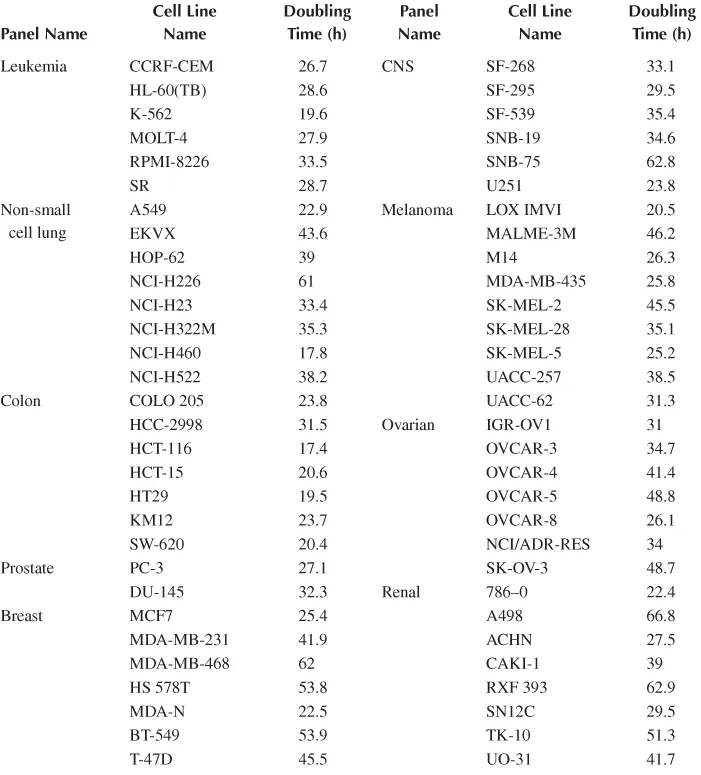
In vitro screening in human tumors: This in vitro drug discovery selection method is proposed to replace transplantable animal tumors employed in anticancer drug screening process by 60 human tumor cell line panels that include lung, kidney, prostate, colon, breast, ovarian, and melanoma cancers as presented in Table 1.1. These cell lines sufficiently meet the minimum quality assurance standards like adaptable to a single suitable growth medium, demonstrate reproducible results for growth inhibition and thereby drug sensitivity under certain laboratory conditions. These cancer cells keep dividing and growing over time, but primary cells of more than 20 passages are not employed in the drug screening process [19]. The cells are exposed to five different doses of drug candidates for 48 h. If they exhibit any of the unique features like (1) preferentially kills any one or more of the tumor cell lines, or (2) acts via a distinctive mechanism, or (3) inhibits tumor growth or malignant cell proliferation at a very small concentration, then the screening will continue to the next stage. In approximately 2500 compounds tested, only 2% may be recommended to proceed to the next stage of testing in mice.
Table 1.1
NCI-60 Cell Lines for Anticancer Drug Screening
In vivo screening using the hollow-fiber technique: Small hollow plastic, polyvinylidene fluoride tubes of 1 mm diameter and 2 cm length containing human tumor cells are inserted into the body cavity or underneath the skin of the mouse. The average duration of this test is about 4 days, wherein the candidate drug is administered to the mice in two dosages and is tested against 12 tumor cells in different hollow fibers [20–22]. Among 150–200 compounds tested by this method in a year, those molecules that retard cell growth are carried forward to the next level of screening.
In vivo testing using xenografts: Candidate drugs that display positive evidence of activity in the...