- 232 pages
- English
- ePUB (mobile friendly)
- Available on iOS & Android
eBook - ePub
Rapid Revision in Clinical Pharmacology
About this book
This book addresses the five core components of an investment appraisal; strategic, economic, commercial, financial and project management. It provides managers and policy makers in healthcare, government and private sector organisations with a tried and tested decision making tool and supporting guidance to improve capital investment decisions. It is a practical guide that includes numerous examples from the health service as well as lessons learnt from other public sector areas where best practice has been demonstrated. Comprehensively illustrated with case studies, checklists and templates to aid decision making, it offers practical, evidence-based guidance, clear summaries and pointers to accessing further information.
Information
1 Introduction
This book is intended for the student in a hurry. It was written by someone who has experienced the terror associated with realising that an examination is just around the corner. The book addresses the needs of the student who:
- ■ at the beginning of an academic year needs a clear picture of the overall shape and size of the topic
- ■ asks about its relevance to the ultimate aim of the field of study
- ■ may need direction on how the information can be concisely and accessibly arranged in preparation for examination.
You will find practical suggestions for the preparation of easily accessible notes which, from personal experience, the writer has found to be useful. These suggestions are offered in the knowledge that some readers prefer a more cursive style of information storage and retrieval, but it is hoped that some may find the method presented here useful.
Approaching the task at hand
Below are some of the printable exhortations used by this writer to help him get down to revision (and to writing this book).
- ■ No one made me get into this.
- ■ I’m hoping this will help others.
- ■ It’s better late than never.
- ■ At least I’ve got this book.
- ■ Just think of that pass list.
- ■ I’m as good as the others.
- ■ This won’t beat me.
- ■ Either life’s got its foot on my neck, or I’ve got my foot on life’s neck.
- ■ No one’s going to do this for me.
Making notes for and during revision
- ■ Ideally, notes should be made as soon as possible after a lecture when the information is still fresh in the mind. However, sometimes this is not possible. The disadvantage of not having good notes can be turned to an advantage by using note preparation as a form of revision.
- ■ Revision notes should be as brief and concise as possible − lecture notes are usually not brief and concise.
- ■ Heavy textbooks do not automatically transfer their contents to the buyer’s brain on purchase, and some students do not have time to assimilate such books.
- ■ Revision notes, especially in an emergency, should be portable and their information instantly accessible.
A suggested method of compiling notes for revision purposes
Equipment needed: filing cards 8 in × 5 in (20 × 13 cm) and pens, pencils and erasers. These are available from stationery shops and some supermarkets. All the information about a drug − its mechanisms, uses etc − will be written on the card. The card system can also be used for making tables, diagrams and graphs. The overriding principle is to simplify, summarise and reduce the volume of notes.
You may ask why the book does not contain finished cards. The process of producing revision cards is a powerful form of learning, so readers are encouraged to do this for themselves. A vital part of this learning method is to find the information relevant to a given heading.
Below is an example of a revision card for the drug digoxin.
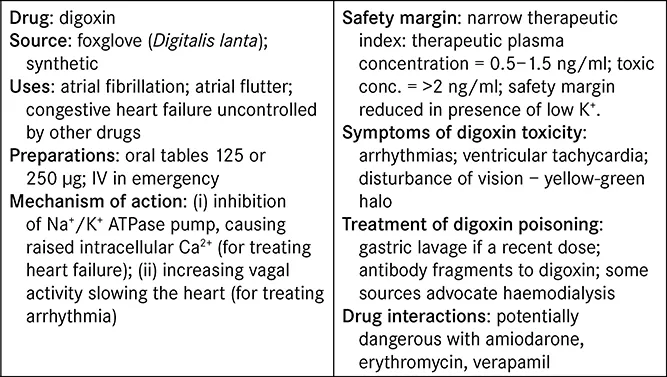
FIGURE 1.1
There is a quiz at the end of each chapter. It follows the subject of the chapter closely and is intended as a supplement and a reminder of the chapter’s contents. The questions are for the most part True/False choices and there are some gentle ‘traps’. The quizzes are designed to reinforce the information presented in the chapter.
Finally, it is worth mentioning that pharmacology is not really about drugs − it is about people. When I first started teaching the subject to medical and dental students, the most frequent complaint was that the subject was not relevant. Students asked, ‘Why do I have to know anything about receptors to help patients?’ It took me a long time to develop the right answer, which is that pharmacology is not about drugs, it is about helping patients − helping them to feel no pain, to feel encouraged, to relieve symptoms and, if possible, to get them well again. And apart from surgery, drugs are virtually all we have when confronted by disease − apart from complementary medicine and TLC.
Author’s note
Readers may notice that not much attention is paid here to hormones as drugs. This is more fully covered in the companion volume, Rapid Revision in Endocrinology by Ben Greenstein (Oxford: Racliffe Publishing; 2007).
Further reading
Greenstein B., Greenstein A. Concise Clinical Pharmacology. London: Pharmaceutical Press; 2007.
2 Pharmacology overview
- Learning objectives
- A definition of pharmacology
- Main divisions of pharmacology
- Pharmacodynamics
- Pharmacokinetics
- Sources of drugs
- Relevance of pharmacology to health care
- Pharmacokinetics
- Pharmacoeconomics
- The QALY – Quality Adjusted Life Year
- Pharmacovigilance
- Summary of systems targeted by drugs
Learning objectives
- ■ Know the meanings of the different branches of pharmacology.
- ■ Be able to give a definition of pharmacology.
- ■ Have an idea of the different sources of drugs.
- ■ Be acquainted with the terminology given here for pharmacoeconomics.
- ■ Know what pharmacovigilance is, and briefly what it involves.
A definition of pharmacology
Pharmacology is the science of drug action on and interaction with living systems and other organisms such as viruses.
Main divisions of pharmacology
- ■ Pharmacodynamics.
- ■ Pharmacokinetics.*
- ■ Pharmacoeconomics.■ Pharmacovigilance.
- ■ Pharmacodynamics is the study of how the drug affects the organism.
- ■ Pharmacokinetics is the study of how the organism affects the drug.
- ■ Pharmacoeconomics is the study of the cost/benefit ratio in comparison with other drugs or strategies aimed at a particular treatment.
- ■ Pharmacovigilance is the study of the detection, assessment, understanding, assessment and prevention of adverse effects of medicines.
Pharmacodynamics (see Chapter 4)
- ...
Table of contents
- Cover Page
- Title Page
- Copyright Page
- Copyright Page
- About the author
- 1 Introduction
- 2 Pharmacology overview
- 3 Pharmacokinetics
- 4 Pharmacodynamics
- 5 Clinical trials
- 6 Receptors
- 7 The autonomic system I: introduction
- 8 The Autonomic System II: Parasympathetic Division (PNS)
- 9 The Autonomic System III: Sympathetic Division (SNS)
- 10 The Neuromuscular Junction (NMJ)
- 11 Myasthenia
- 12 5-hydroxytryptamine (5-HT; serotonin)
- 13 Eiconasoids
- 14 Peptides and proteins as drugs (‘biological’ drugs)
- 15 Systems targeted by drugs
- 16 Diuretics
- 17 Drugs and the heart I: heart failure
- 18 Drugs and the heart II: myocardial infarction heart attack)
- 19 Drugs and the heart III: antidysrhythmic drugs
- 20 Drugs and the heart IV: angina pectoris
- 21 Drugs and the heart V: antiplatelet drugs
- 22 Anticoagulants I: heparin, hirudins and heparinoids
- 23 Anticoagulants II: oral anticoagulants
- 24 Fibrinolytic and Antifibrinolytic Drugs
- 25 Hypertension I: introduction
- 26 Hypertension II: treatment
- 27 Inflammation I: introduction
- 28 Inflammation II: nonsteroidal anti-inflammatory drugs (NSAIDs), mainly aspirin
- 29 Inflammation III: steroidal anti-inflammatory drugs
- 30 Inflammation IV: disease-modifying anti-rheumatic drugs (DMARDs)
- 31 Inflammation V: gout, scleroderma and Raynaud’s phenomenon
- 32 Paracetamol (USA: acetaminophen)
- 33 Opioid analgesics
- 34 Local anaesthetics
- 35 General anaesthetics
- 36 Parkinson’s disease
- 37 Epilepsy
- 38 Alzheimer’s disease
- 39 Antidepressant drugs
- 40 Anxiolytic drugs
- 41 Anti-infective drugs (antibiotics)
- 42 Chemotherapy for malignancy (cancer)
- Quiz answers
- Index
Trusted by 375,005 students
Access to over 1.5 million titles for a fair monthly price.
Study more efficiently using our study tools.
Frequently asked questions
Yes, you can cancel anytime from the Subscription tab in your account settings on the Perlego website. Your subscription will stay active until the end of your current billing period. Learn how to cancel your subscription
No, books cannot be downloaded as external files, such as PDFs, for use outside of Perlego. However, you can download books within the Perlego app for offline reading on mobile or tablet. Learn how to download books offline
Perlego offers two plans: Essential and Complete
- Essential is ideal for learners and professionals who enjoy exploring a wide range of subjects. Access the Essential Library with 800,000+ trusted titles and best-sellers across business, personal growth, and the humanities. Includes unlimited reading time and Standard Read Aloud voice.
- Complete: Perfect for advanced learners and researchers needing full, unrestricted access. Unlock 1.5M+ books across hundreds of subjects, including academic and specialized titles. The Complete Plan also includes advanced features like Premium Read Aloud and Research Assistant.
We are an online textbook subscription service, where you can get access to an entire online library for less than the price of a single book per month. With over 1.5 million books across 990+ topics, we’ve got you covered! Learn about our mission
Look out for the read-aloud symbol on your next book to see if you can listen to it. The read-aloud tool reads text aloud for you, highlighting the text as it is being read. You can pause it, speed it up and slow it down. Learn more about Read Aloud
Yes! You can use the Perlego app on both iOS and Android devices to read anytime, anywhere — even offline. Perfect for commutes or when you’re on the go.
Please note we cannot support devices running on iOS 13 and Android 7 or earlier. Learn more about using the app
Please note we cannot support devices running on iOS 13 and Android 7 or earlier. Learn more about using the app
Yes, you can access Rapid Revision in Clinical Pharmacology by Ben Greenstein in PDF and/or ePUB format, as well as other popular books in Medicine & Medical Theory, Practice & Reference. We have over 1.5 million books available in our catalogue for you to explore.