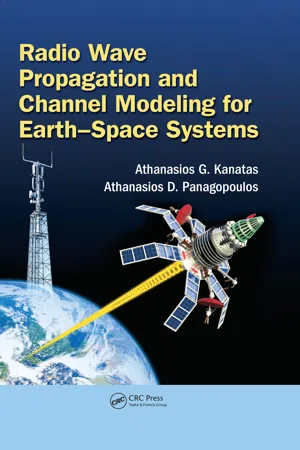
The accurate design of earth–space systems requires a comprehensive understanding of the various propagation media and phenomena that differ depending on frequencies and types of applications. The choice of the relevant channel models is crucial in the design process and constitutes a key step in performance evaluation and testing of earth–space systems. The subject of this book is built around the two characteristic cases of satellite systems: fixed satellites and mobile satellite systems.
Radio Wave Propagation and Channel Modeling for Earth–Space Systems discusses the state of the art in channel modeling and characterization of next-generation fixed multiple-antennas and mobile satellite systems, as well as propagation phenomena and fade mitigation techniques. The frequencies of interest range from 100 MHz to 100 GHz (from VHF to W band), whereas the use of optical free-space communications is envisaged.
Examining recent research advances in space-time tropospheric propagation fields and optical satellite communication channel models, the book covers land mobile multiple antennas satellite- issues and relative propagation campaigns and stratospheric channel models for various applications and frequencies. It also presents research and well-accepted satellite community results for land mobile satellite and tropospheric attenuation time-series single link and field synthesizers.
The book examines aeronautical communications channel characteristics and modeling, relative radio wave propagation campaigns, and stratospheric channel model for various applications and frequencies. Propagation effects on satellite navigation systems and the corresponding models are also covered.
eBook - ePub
Radio Wave Propagation and Channel Modeling for Earth-Space Systems
- 353 pages
- English
- ePUB (mobile friendly)
- Available on iOS & Android
eBook - ePub
Radio Wave Propagation and Channel Modeling for Earth-Space Systems
About this book
Information
1
Next-Generation MIMO Satellite Systems From Channel Modeling to System Performance Evaluation
Konstantinos P. Liolis and Pantelis-Daniel Arapoglou
CONTENTS
1.1 Introduction
1.2 MIMO Satellite System Configurations
1.2.1 Scenario A: Single-Satellite/Dual-Polarization Diversity Configuration
1.2.2 Scenario B: Dual-Satellite Diversity/Single-Polarization Configuration
1.3 Overview of Relevant State-of-the-Art Work in MIMO LMS Channel Modeling
1.4 Unifying Stochastic MIMO LMS Channel Model
1.4.1 Modeling of SISO LMS Subchannel Effects
1.4.2 Modeling of Cross-Channel Discrimination Effects
1.4.2.1 Scenario A
1.4.2.2 Scenario B
1.4.3 Modeling of Spatial Correlation of Large-Scale Fading Components
1.4.3.1 Scenario A
1.4.3.2 Scenario B
1.4.4 Modeling of Spatial Correlation of Small-Scale Fading Components
1.4.4.1 Scenario A
1.4.4.2 Scenario B
1.4.5 Modeling of Temporal Correlation
1.4.5.1 Interstate Temporal Variations
1.4.5.2 Intrastate Temporal Variations
1.5 Unifying MIMO LMS Channel Simulator Step-by-Step Methodology
1.6 MIMO Satellite System Performance Evaluation
1.6.1 Scenario A
1.6.2 Scenario B
1.7 Overview of MIMO Satellite Technology HW Demonstration
1.8 Additional MIMO Satellite Avenues of R&D
1.8.1 SU MIMO for Mobile Satellite Interactive Services
1.8.2 MU MIMO (Precoding) in Multibeam-Fixed Broadband-Interactive Systems
1.9 Summary and Conclusions
References
1.1 Introduction
Satellite communications (SatCom) are currently undergoing a strong expansion to follow the dramatic increase in demand for higher capacity, improved quality of service (QoS), and ubiquitous connectivity. Characteristic examples of emerging paradigms in SatCom are the hybrid satellite/ terrestrial transmission systems based on the ETSI (European Telecommunications Standardization Institute), DVB-SH (Digital Video Broadcasting—Satellite to Handheld) (DVB-SH, 2008), and DVB-NGH (Digital Video Broadcasting—Next-Generation Handheld) (DVB-NGH, 2013) standards that provide rich multimedia broadcast content to mobile users. Although benefiting from their large geographic coverage, satellite networks have some limitations compared to terrestrial networks, which make them suitable mainly for serving sparsely populated areas. Under these limitations, new advanced technologies at the physical layer and system level are urgently required to boost the performance of SatCom and follow the capacity growth trends of terrestrial wireless communications.
In this course, the utilization of multiple-input multiple-output (MIMO) technology is a very promising candidate. In the last few years, single-user (SU) and multiuser (MU) MIMO transmission systems have received significant attention from both the research community and the wireless industry due to their impressive potential capacity gains with respect to the conventional single-input single-output (SISO) transmission systems (Mietzner et al., 2009). The appealing gains obtained by SU MIMO techniques in terrestrial cellular and WiFi networks generate further interest in investigating the applicability of the same principle in satellite networks (Arapoglou et al., 2011a). However, the fundamental differences between the terrestrial and the satellite channels make such applicability a nontrivial and nonstraightforward task but instead, a rather challenging research subject. These differences are mainly related to the requirement for having line-of-sight (LOS) reception of satellite signals (due to the limited power arriving on the ground) and to the absence of scatterers in the vicinity of the satellite, which eliminate multipath-fading profiles over the space segment and lead to an inherent rank deficiency of the MIMO channel matrix. Further details on such key differences, which justify the increasing interest of the research community in MIMO SatCom, are highlighted in Horvath et al. (2007), Liolis et al. (2007), and Arapoglou et al. (2011a); and Petropoulou et al. (2014).
DVB-SH is a satellite-driven standard first published in 2007 (DVB-SH, 2008) that does not foresee any type of MIMO application. Nevertheless, this air interface has been adopted in the majority of research and development (R&D) works as the baseline system configuration, which is then extended to introduce MIMO applications. On the other hand, DVB-NGH was published in 2013 (DVB-NGH, 2013) and includes a sheer terrestrial base profile, a sheer terrestrial MIMO profile, a hybrid satellite/terrestrial profile, and a hybrid satellite/terrestrial MIMO profile, the last three being optional (Jokela et al., 2012).
Both DVB-SH and DVB-NGH standards in general refer to satellite digital multimedia broadcasting (SDMB) systems. SDMB systems are used for the provision of digital mobile broadcasting at L (1/2 GHz) or S (2/4 GHz) frequency bands by means of geostationary or highly elliptical orbit satellites and a complementary ground component (CGC) to cover urban areas (see Figure 1.1). The typical applications envisaged are audio/video broadcasting and software updates for mobile platforms, an example being the commercially successful U.S. Sirius XM Radio system (DiPierro et al., 2010). The broadcasting mission of SDMB systems can be complemented by some interactive return link capability for messaging services (Scalise et al., 2013), leading to interactive mobile satellite systems (Gallinaro et al., 2014).
Regarding the type of coverage, for European scenarios, a few linguistic beams reusing the system bandwidth in, for example, a three-color frequency reuse scheme is a suitable approach (Gallinaro et al., 2014) to customize the digital content to the specific language adopted in each region cover...
Table of contents
- Cover
- Half Title
- Title Page
- Copyright
- Preface
- Editors
- Contributors
- Chapter 1 Next-Generation MIMO Satellite Systems From Channel Modeling to System Performance Evaluation
- Chapter 2 Propagation Phenomena and Modeling for Fixed Satellite Systems Evaluation of Fade Mitigation Techniques
- Chapter 3 Mobile Satellite Channel Characterization
- Chapter 4 Land Mobile Satellite Channel Models
- Chapter 5 Propagation Effects on Satellite Navigation Systems
- Chapter 6 Mobile Satellite Channel Characterization
- Chapter 7 Review of Space–Time Tropospheric Propagation Models
- Chapter 8 Impact of Clouds from Ka Band to Optical Frequencies
- Chapter 9 Aeronautical Communications Channel Characteristics and Modeling From Legacy toward Future Satellite Systems
- Chapter 10 Stratospheric Channel Models
- Index
Trusted by 375,005 students
Access to over 1.5 million titles for a fair monthly price.
Study more efficiently using our study tools.
Frequently asked questions
Yes, you can cancel anytime from the Subscription tab in your account settings on the Perlego website. Your subscription will stay active until the end of your current billing period. Learn how to cancel your subscription
No, books cannot be downloaded as external files, such as PDFs, for use outside of Perlego. However, you can download books within the Perlego app for offline reading on mobile or tablet. Learn how to download books offline
Perlego offers two plans: Essential and Complete
- Essential is ideal for learners and professionals who enjoy exploring a wide range of subjects. Access the Essential Library with 800,000+ trusted titles and best-sellers across business, personal growth, and the humanities. Includes unlimited reading time and Standard Read Aloud voice.
- Complete: Perfect for advanced learners and researchers needing full, unrestricted access. Unlock 1.5M+ books across hundreds of subjects, including academic and specialized titles. The Complete Plan also includes advanced features like Premium Read Aloud and Research Assistant.
We are an online textbook subscription service, where you can get access to an entire online library for less than the price of a single book per month. With over 1.5 million books across 990+ topics, we’ve got you covered! Learn about our mission
Look out for the read-aloud symbol on your next book to see if you can listen to it. The read-aloud tool reads text aloud for you, highlighting the text as it is being read. You can pause it, speed it up and slow it down. Learn more about Read Aloud
Yes! You can use the Perlego app on both iOS and Android devices to read anytime, anywhere — even offline. Perfect for commutes or when you’re on the go.
Please note we cannot support devices running on iOS 13 and Android 7 or earlier. Learn more about using the app
Please note we cannot support devices running on iOS 13 and Android 7 or earlier. Learn more about using the app
Yes, you can access Radio Wave Propagation and Channel Modeling for Earth-Space Systems by Athanasios G. Kanatas, Athanasios D. Panagopoulos, Athanasios G. Kanatas,Athanasios D. Panagopoulos in PDF and/or ePUB format, as well as other popular books in Technology & Engineering & Information Technology. We have over 1.5 million books available in our catalogue for you to explore.