eBook - ePub
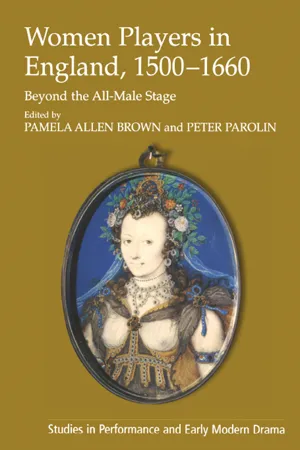
Women Players in England, 1500–1660
Beyond the All-Male Stage
- 348 pages
- English
- ePUB (mobile friendly)
- Available on iOS & Android
eBook - ePub
About this book
Offering evidence of women's extensive contributions to the theatrical landscape, this volume sharply challenges the assumption that the stage was 'all male' in early modern England. The editors and contributors argue that the pervasiveness of female performance affected cultural production, even on the professional London stages that used men and boys for women's parts. English spectators saw women players in professional and amateur contexts, in elite and popular settings, at home and abroad. Women acted in scripted and improvised roles, performed in local festive drama, and took part in dancing, singing, and masquing. English travelers saw professional actresses on the continent and Italian and French actresses visited England. Essays in this volume explore: the impact of women players outside London; the relationship between women's performance on the continent and in England; working women's participation in a performative culture of commerce; the importance of the visual record; the use of theatrical techniques by queens and aristocrats for political ends; and the role of female performance on the imitation of femininity. In short, Women Players in England 1500-1660 shows that women were dynamic cultural players in the early modern world.
Information
Chapter 1
Introduction
Scholars of early modern English drama are coming to recognize that while women were never members of professional troupes, they had long appeared as players in a variety of arenas, and at every level of society. It is no longer enough to say, along with E. K. Chambers, that women who performed were the exceptions that proved the rule. As Stephen Orgel points out, “it is no longer clear just what the rule is” (Chambers 1: 137; Orgel, 8). Queens, aristocrats, and gentlewomen danced, sang, and recited in masques, plays, and court and manor entertainments; non-elite women in village, town and city took roles in parish drama and festive pageantry; Italian prima donnas and French actresses came to England to perform for both courtiers and commoners; and poorer women worked as itinerant entertainers, ballad singers and mountebanks. Despite the opprobrium heaped on the theatrical woman, a few elite women took the female player as a model in staging their own identities. In the alternative playing areas of the street, alehouse, market square, parish green, manorhouse and court, women could be found performing; connecting these places were female spectators, patrons, and traveling entertainers.1 The cultural knowledge about female playing that a spectator, actor, or playwright carried to the “all-male” stage was therefore enormous.
This pattern of mimetic activity in many places, by many sorts of women, constitutes what Ann Thompson calls “the relatively hidden tradition of female performance” (103) – a tradition usually ignored or downplayed in discussions that focus exclusively on courtly performances and the transition to Restoration drama. Bringing more of this half-hidden tradition into the light and arguing for its profound importance to dramatic and cultural history is the work of this volume.2 Several conditions make this project timely: ongoing work on the politics of queenly performance, especially masquing, and its relationship to public theater plays; the rapid expansion of scholarship on selfstaging and theatricality in writings by women; and a lively new debate about the mimetic visibility of non-elite and working women, which has been given an enormous boost by the Records of Early English Drama project.3 At the same time, scholars are calling for a re-examination of the English stage in light of the growing perception that theatrical forms were far more transnational and border-blind than previously presumed. The skilled foreign diva was an influential “go-between” in this process, circulating generic and dramatic innovations that changed the course of theater, despite the charge of whorishness that spectacular women inevitably aroused.4
“Notorious whores,” unnatural bearded ladies, “lean-cheek’d Moors,” “French women, or monsters rayther,” “immodest and lascivious” entertainers, actresses “hissed, hooted and pippin-pelted from the stage,” “unchaste, shamelesse and unnaturall” Italian acrobats, “squirting baudie comedians,” “common Curtizens,” “a Pantaloun, a Whore and a Zanie” – all are contemporary reactions to women players.5 Reading such phrases in the scanty literature on the topic, one might assume that everyone found female performers repellent. Nonetheless, such stridency spiked with xenophobia utterly failed to master the fascination of the woman who deliberately takes the stage. This volume, which grew out of a 2000 Shakespeare Association of America seminar, “Women Players In and Around Shakespeare,” demonstrates that the women under attack – Queen Henrietta Maria and her ladies, Queen Anna and her ladies, roaring girl Moll Frith, French actresses, Italian acrobats, and Italian divas – were not the great and singular exceptions to the rule of the all-male stage. In fact, the evolving picture pieced together by our contributors shows the woman player was a lively presence whose impact on culture and drama was profound, and demands more attention than given the subject by studies focused on anomalies, absences, and “firsts.”
Because what constitutes theater and acting is highly debatable, and because theater does not always make its way into written records, attempts to fix a single moment for the advent of the actress invite skepticism. Accounts of “the first English actress,” for example, generally begin in 1660, with the entrance of the first female Desdemona, in Thomas Killigrew’s production of Othello.6 While the word “actress” is treated as transparent, her Englishness is held to be a crucial distinction – otherwise the visiting Frenchwomen who acted in comedies on London stages in 1629, or the Italian actresses who performed at Elizabeth’s court in 1578–9, would have a claim to first prize (Orgel, 7; Chambers 2: 262). Getting paid is also assumed to be essential, or Queen Henrietta Maria and her ladies would have been first in 1626, when they performed speaking roles in Racan’s Artenice (McManus, 209). It seems her playing must be rooted in written, not traditional, culture, else the women who entertained Elizabeth at Kenilworth in 1575 by taking roles in a mock bride-ale might also be deemed actresses.7 An actress must operate in a secular world; if religious drama were admitted, then the women who played “Anne Prophetissa” and the Virgins in the Digby “Killing of the Children” would have to count, too.8 And a real actress must speak, not sing, else the musical nuns of Barking Convent might be in the running. Directed by Abbess Katherine Sutton, the nuns personated the worthy souls trapped in hell. Waiting behind a screen on Easter morning, the women were “harrowed” out by a priest playing Christ. Bearing palms, the released souls processed to the sepulcher, singing triumphantly. This remarkable performance took place in the fourteenth century (Davidson, 102).9
Evidently these “musts” do not hold for the early modern period. The very concept of “the English actress” derives from the Restoration theater and its descendants, not the early modern stage, which was far more intimately connected to traditional and religious forms of pageantry and festivity and to non-elite audiences. Restoration theater exploited the sexual allure of the new actress while defining her social identity, but the all-male theater that preceded it was also alive to the pressure of the performing women who surrounded and influenced its productions of “women” (Tomlinson 1992). Early modern theater was never the exclusive property of the male professionals, who were called “players” far more often than “actors,” underlining the reality that their art encompassed many mimetic forms, such as singing songs and ballads, dancing jigs, cross-dressing, miming, jesting, and masking. Nonprofessional players, both men and women, also used all these mimetic forms to draw and entertain their audiences. For these reasons, we have set our sights on the “woman player,” finding that concept more historically rooted and appropriate to our subject than “actress.”10
Our approach strives to be extensive – categorically, temporally, and geographically. We include geographical locations beyond London, physical spaces beyond the public amphitheaters and the private playhouses, and social categories beyond those of the professional players and elite masquers. Our definition of performance is fittingly broad and inclusive: a performance is any act of embodied display or representation intended for an audience. Our essays examine singing, dancing, and role-playing in aristocratic houses and on the street; staging rituals and festive drama in parish and market contexts; taking part in jesting and holiday games; engaging in acrobatic feats; putting on entertainments for visiting elites; devising shows to sell wares; and staging identity in theatrical ways to achieve desired ends. We have set a time frame of 1500–1660 to stress the connection between late medieval and traditional modes of playing and the new arenas of the public stage, and to make the point that Jacobean and Caroline masquing and acting by queens and female aristocrats grew out of practices at the sixteenth-century courts of England and Europe. Because women performers were part of a theatrical world that did not end at the outskirts of London or even at the Channel, we have expanded the ambit of native drama to other regions, focusing attention on female performance in Lincolnshire, Lancashire, Yorkshire, and Gloucestershire; and we have enlarged our scope to include professional and royal players in Italy and France, to assess the ways in which their performances intersected with, and affected, the English scene. Methodologically, then, we seek to read different cultures and categories of female performance in relation to each other. However, we have limited our scope – we deal primarily with women players in England, Italy, and France rather than Spain, Scotland, and Ireland, to name three noteworthy omissions.11 Comprehensive as we have tried to be, this volume begins rather than exhausts the work of synthesizing different fields of female performance.
While the critical emphasis thus far has been on royal and aristocratic woman performers and courtly politics, our volume pays special attention to non-elite woman and their workaday performances in less formal settings: ballad singers (the subject of Bruce Smith’s essay), participants in parish drama (James Stokes), mountebanks (Bella Mirabella), and even clothes-brokers with a penchant for performing (Natasha Korda). Seeing common women as potential players provides a rich source of extradramatic reference, offering insights for both historians of early modern women and scholars of drama and literature. For example, because women took part in popular dramatics ranging from shaming rituals to Maygames to festive drama to jigs and jesting, their participation surely had an as-yet unexamined impact on “the politics of mirth” (in Leah Marcus’s phrase) that made such pastimes so controversial.
Being alert to female performance means revisiting familiar works which feature “women on top of the world of play,” ranging from Tudor farces like Johan the Husband to Jacobean comedies like Fletcher’s The Womans Prize; or in which “boy actresses” produce and act in playlets and tricks, such as Heywood’s Wise Woman of Hogsdon and Jonson’s The Alchemist. As different as they are, these plays share connections to the myriad forms of jigging, disguising, and masking in which real women took part, and which so deeply marked the vocabulary of theater.12 In Shakespeare plays, for example, the transvestite heroines Rosalind, Viola, and Portia have their counterparts in the “open-air theater” of festive play, long before the Hic Mulier era of cross-dressing. Women in a “holiday humour,” from revelers at Horn Fair to Scottish queens, were known to steal the breeches.13 In Two Noble Kinsmen, a chambermaid and a hostess play the Queen of May and Maid Marian in the morris – just as some female audience members, or their grandmothers, may have done.14 When Mistresses Page and Ford trick and mock the horned Falstaff at the end of Merry Wives, Shakespeare draws on a vast panorama of street satire and shaming ritual in which women took part. And in Twelfth Night Maria engineers the practice used to shame Malvolio, in a plot that strongly resembles popular satires in which women helped caricature Puritans who attacked their plays and games.15
Attending to the cultural visibility of female players will also further the debate over whether spectators “took boys for women.” Arguments that the boy’s body vanished to consciousness, or co-existed with an acceptance of the female mask as female, weaken in the face of evidence that even the unprivileged playgoer had often seen women playing women. Having such a mental image might well increase a spectator’s curiosity about the actor’s body beneath his skirts; and, rather than banishing ambiguity, his or her knowledge of female performers would multiply and intensify it. The erotic frisson of the transvestite theatre likely derives in part from its very artificiality, from its artful and anomalous erasure of women from the world of traditional performance that they participated in elsewhere – a world that London audiences would have known well.
On the other hand, it is vital to recognize that not all staged echoes of female performance derive from familiar English contexts. In the 1590s, boy players in professional companies began to present radically new kinds of roles that never had been performed by Englishwomen. Many of these roles are startlingly similar to those created by the rising stars of the commedia dell’arte, such as Isabella Andreini, Vittoria Piisimi, Diana Ponti, and Angelica Martinelli, who emerged onto the international theater scene in the 1570s and 1580s, skillfully playing tragic parts and light innamorata roles in scripted and improvised pastorals, tragedies, comedies, and farces. Praised by Montaigne, Fynes Moryson, and Thomas Coryat and seen by diplomats abroad and courtiers at home, the professional actress was a startling innovation whose fame spread rapidly among the players of London, eliciting both hostility and imitation (Brown, 1999). Although scholars seeking to pinpoint the relationship between the Italian and English drama have rarely looked beyond the Capitanos and Pantalouns of the commedia troupes, a few have addressed the far-ranging influence of the foreign actress (Barasch, Clubb, Nicholson). Some have noted the fascinating congruency between the vogue for female mad scenes in late Elizabethan plays such as Tamburlaine, The Spanish Tragedy, and Hamlet, and the acclaimed mad scenes of actresses such as Isabella Andreini, renowned for the highly literary frenzy she displayed in several plays, most famously La Pazzia d’Isabella, or “The Madness of Isabella” (see Clubb, 263–4).
To recognize women as performers raises important questions of agency and subjectivity. Discussing the controversy that erupted over Henrietta Maria’s acting, Sophie Tomlinson attributes it to “the threat of the actress in performance,” disruptive because it has “the potential for presenting femininity as a vivid and mobile force: the spectacle of the woman-actor summoning up the spectre of the female subject” (1992, 192).16 Certainly women players could at least be imagined to have access to forms of cultural agency, and in the context of the male-dominated professional theater such a development caused consternation. Even a Caroline dramatist such as James Shirley, who courted the queen’s favor and who seemed sympathetic to elite female performance, encoded critiques of women’s acting in his plays (Walker; Tomlinson, 1999). In some instances, however, performance seems unlikely to have translated into agency for women or to have endowed them with the benefits of subjectivity. Early moderns also gaped at “hairy women” displayed as freaks, black women exhibited in Tudor and Stuart pageants, and women paraded to cuckstool or whipping post (Thompson, 104; Andrea, 256–7). These women cannot be seen as players in the agential sense because they were entirely subjected to the violence of representation, experiencing its coercive power without designing or controlling their own display. Although most performances offer moments in which the performer can take control, reinterpret the scenario, and mock or otherwise resist authority, we seek to track the power dynamics that women had to negotiate when they performed, even women who did wield a measure of representational autonomy.
Outside the professional theatre, the implications of women’s performance are only just beginning to emerge, with some scholars probing women’s impact on popular culture and providing frames for studying female performance. Both Laura Gowing, who has recently explored early modern women’s self-defense against slander charges, and Pamela Brown, who has analyzed women’s engagement in the public culture of jest, suggest that representing themselves publicly gave women considerable power to affect their own lives and the lives of others. Women’s performance introduced contingency and unpredictability even into spaces that we think of as patriarchal. Women’s wit, humor, mockery, and narrative skill could all destabilize masculinist structures of authority and put a woman in charge of any given moment by helping her win the sympathy of her audience. In the elite context of the court masque, even women’s silence could speak volumes. Clare McManus has dispelled the notion that the court ladies who appeared in masques lacked expressive power by virtue of the fact that, unlike professional actors, they did not speak. Focusing on dance, McManus shows the complex expressiveness of the body in motion: the injunction that women remain silent could thus free the eloquent potential of their physical bodies – the tools of control become in this process women’s tools of expression. McManus argues that merely by accepting or denying the invitations to dance they received during the masque, women exercised substantial control over what the audience would see (9, 18).
M...
Table of contents
- Cover
- Half Title
- Title Page
- Copyright Page
- Table of Contents
- List of Illustrations
- List of Musical Transcriptions
- Contributors
- General Editor’s Preface
- 1 Introduction
- Part I Beyond London
- Part II Beyond Elites
- Part III Beyond the Channel
- Part IV Beyond the Stage
- Part V Beyond the “All-Male”
- Afterword
- Index
Trusted by 375,005 students
Access to over 1.5 million titles for a fair monthly price.
Study more efficiently using our study tools.
Frequently asked questions
Yes, you can cancel anytime from the Subscription tab in your account settings on the Perlego website. Your subscription will stay active until the end of your current billing period. Learn how to cancel your subscription
No, books cannot be downloaded as external files, such as PDFs, for use outside of Perlego. However, you can download books within the Perlego app for offline reading on mobile or tablet. Learn how to download books offline
Perlego offers two plans: Essential and Complete
- Essential is ideal for learners and professionals who enjoy exploring a wide range of subjects. Access the Essential Library with 800,000+ trusted titles and best-sellers across business, personal growth, and the humanities. Includes unlimited reading time and Standard Read Aloud voice.
- Complete: Perfect for advanced learners and researchers needing full, unrestricted access. Unlock 1.5M+ books across hundreds of subjects, including academic and specialized titles. The Complete Plan also includes advanced features like Premium Read Aloud and Research Assistant.
We are an online textbook subscription service, where you can get access to an entire online library for less than the price of a single book per month. With over 1.5 million books across 990+ topics, we’ve got you covered! Learn about our mission
Look out for the read-aloud symbol on your next book to see if you can listen to it. The read-aloud tool reads text aloud for you, highlighting the text as it is being read. You can pause it, speed it up and slow it down. Learn more about Read Aloud
Yes! You can use the Perlego app on both iOS and Android devices to read anytime, anywhere — even offline. Perfect for commutes or when you’re on the go.
Please note we cannot support devices running on iOS 13 and Android 7 or earlier. Learn more about using the app
Please note we cannot support devices running on iOS 13 and Android 7 or earlier. Learn more about using the app
Yes, you can access Women Players in England, 1500–1660 by Peter Parolin, Pamela Allen Brown in PDF and/or ePUB format, as well as other popular books in Literature & Literary Criticism. We have over 1.5 million books available in our catalogue for you to explore.