![]()
CHAPTER 1
Overview of the Terrorism Threat from Nixon to Trump
The U.S. government’s efforts to counter international and domestic terrorism have evolved considerably over the past decades, but the pace accelerated during the Obama administration. The acceleration was influenced both by changes in the character and scope of the threat and the impact of modern technology. Many of the challenges, issues, and programs that emerged in the past are carrying over into the Trump administration, although perhaps in a different form.
During the Obama administration, some of the key developments included the more sophisticated use of the Internet by terrorist groups to spread their propaganda and recruit activists and “lone wolves,” the emergence of cyberterrorism threats and hacking, and the increasing deployment of armed drones by the United States and other governments and now even terrorist groups. On the “defensive side,” the increased deployment of surveillance cameras in urban areas and airports has been useful in identifying terrorist suspects and prosecuting them in courts. Information sharing within the U.S. government, with local and state governments, and with foreign partners also became intensive.
The issues that faced the Obama administration and will face the Trump administration—as well as the basic policies and programs—have roots in previous generations, some of them dating back to the 1970s and President Richard Nixon’s administration. Many programs conceived and developed during previous administrations continued, evolved, and were expanded during subsequent administrations. These programs include antiterrorism training for U.S. and foreign law enforcement officials, the interagency Counter Terrorism Financing (CTF) and Countering Violent Extremism (CVE) programs, and the ever-pressing need for improved international cooperation and intelligence sharing. They are likely to continue in one form or another as tools in the ongoing efforts against one or another manifestation of terrorism.
Underlying all counterterrorist strategy, however, remains the fundamental question as to whether terrorism is an existential threat to the United States, with the perspective of the “War against Terrorism” initiated by the George W. Bush administration after 9/11, or a serious problem enmeshed in the wider foreign policy concerns of the United States as perceived by President Barack Obama.
In either case, the world and the United States are now in the sixth decade of the modern era of terrorism and, as the Trump administration came into office, the 15th year of the current era of terrorism that began with 9/11. These have been frustrating as well as tragic years, as the terrorist challenge has metastasized within the broader problems of a dramatically changing and increasingly violent international environment. The terrorist threat and challenge can be seen as primarily Middle Eastern and South Asian problems—with those regions being “ground zero” for terrorist origin and the main terrorist battleground. However, the United States is a prominent target, along with people in the Middle East and our Western European allies, such as Britain, France and Belgium, and some African countries. At the same time, the United States is the most prominent and historic leader of the effort to develop counterterrorist alliances.
One sober summary balance sheet of the situation was recently presented by long-time terrorism expert Brian Jenkins of the Rand Corporation:
Measuring progress in irregular warfare without frontlines is always difficult. The various dimensions and multiple fronts of the US’ ongoing campaigning against terrorists make it an exceptional challenge. And much has changed since that campaign began 15 years ago. There not been another 9/11-scale event. Although they attract followers, neither Al-Qàida nor its progeny have become a mass movement. The constellation of groups claiming allegiance to them is far from an effective alliance and the Islamic State’s territorial control has been contained and pushed back. The leaders of AQ depend heavily on exhortation to get others to fight and the turnout is thin. On the other side of the ledger, the targeted groups have survived, their determination seems undiminished, and their ideology remains powerful. They are deeply imbedded in a number of fragile, divided, conflict-ridden states. Persistent foes, they are able to operate underground and capable of comebacks if pressure on them subsides. The conflict will go on. 1
A primary theme of the past 15 years, indeed of the past 50 years, has been the evolving character of the terrorist threat, from the so-called boutique terrorists of Western Europe to today’s “Islamic State.” Earlier terrorist groups usually had relatively specific targets and goals, such as trying to free their imprisoned colleagues or specific nationalistic/territorial demands. However, with al-Qaeda, the Tamil Tigers, and Hamas, we saw the emergence of more ambitious goals and related suicide and larger attacks designed to kill and wound as many people as possible. The terrorists’ goals keep moving and will continue to do so. There has been a significant and dramatic change in the numbers, character, and capability of the terrorists themselves, from the 50 or so core Red Brigade members in Germany during the 1980s to the estimated 40,000 Jihadists of ISIS. In addition, the global environment has changed in significant ways.
“The West failed to predict the emergence of Islamic terrorism in general and al-Qaeda in particular across the Middle East and North Africa. It was blindsided by the ISIS (also known as ISIL or Daesh) sweep across Syria and Iraq, which at least temporarily changed the map of the Middle East. Both movements have skillfully continued to evolve and proliferate—and surprise,” Jenkins observed.2
The technological developments since 9/11 have especially complicated the situation by further empowering both governments and nonstate terrorist groups. The Internet, drones, and cyber warfare, with the latter even producing its own form of terrorism—cyber terrorism—have changed the landscape for terrorism and countermeasures. For these and other reasons, the international character of terrorism and counterterrorism has become more marked. There are few countries now untouched by the threat.3
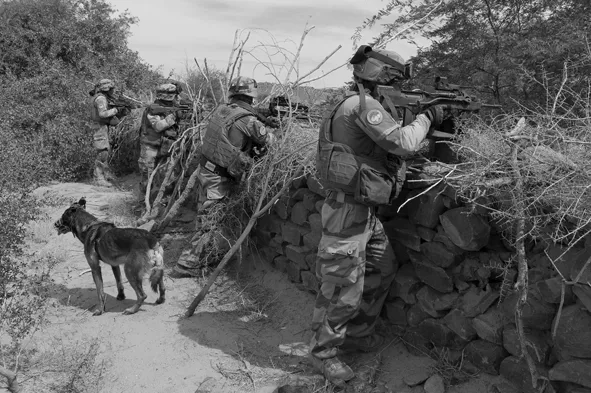
Politically and environmentally, the collapse of meaningful governance and governmental organizations in the Arab Middle East has created a zone of anarchy. In the ungoverned areas of Afghanistan, Syria, Iraq, and Yemen, a complex mix of religious, ethnic, national, ideological, and political combatants struggle for power “where ignorant armies clash by night.” In the process, they have drawn in their neighbors and other players as far distant as the United States. The same is true in parts of Africa, where the French have played a major role in helping their former colonies, but the United States has also provided training and other assistance (Figure 1.1). Major geographic regions are in turmoil and the violence has an impact abroad, even indirectly, with the movement of hundreds of thousands of refugees from Syria and Afghanistan to Europe and elsewhere.
FIGURE 1.1 French soldiers stand guard in Mali as part of Operation Barkhane; Barkhane is centered in the African Sahel. France has increased its involvement and support of countries’ counterterror measures in Africa in recent years. The United States has been working closely with France and other countries to counter various terrorist groups in Africa. French Ministry of Defense photo. (Courtesy of U.S. Department of Defense.)
A cottage industry has developed in trying to analyze terrorist movements in general and Islamic jihadist movements in particular. The experts pretty much agree that terrorist movements are produced by a confluence of factors. A key point in the emergence of the Islamic jihadist movement was the rallying of Muslims to fight the Russian occupation of Afghanistan in the 1980s. Subsequently, some individuals were motivated to join jihadist movements by a variety of reasons: ideology, the desire for meaning in their lives and belonging to a greater cause, anger at the West, even just a desire for adventure and “action.” Other conditions enable jihadism to flourish. They include the volatile mix of shifting demographics, notably a surge of youth, higher literacy, and greater social aspirations intersecting with economic woes, growing unemployment, and deepening political malaise or disillusionment. The mix of personal motives and enabling conditions has become even more combustible since the Arab uprisings of 2011. These drivers of extremism are rampant in the Middle East. They differ in local contexts. Six conditions are particularly pivotal today.
- The fragility of states
- Ideological upheaval
- Conflict zones
- Foreign intervention, for example, by the United States, Russia, Iran, and Saudi Arabia
- Socioeconomic factors
- Technology
All of these developments are impacting the international environment. Terrorism kills and wounds people, contributes to refugee problems, threatens both national governments and the traditional international order. Countering terrorism effectively puts a premium on global, regional, and bilateral cooperation and alliances.
These developments and the consequent analysis have also made it increasing clear that the global community cannot simply kill its way out of the problem by attacking terrorist leaders and followers. This is despite the key role played by military force in attacking and weakening terrorist groups such as ISIS that control territory and are able to extract taxes and other payments from locals and sell oil or other resources. Until the ideology underpinning jihadism is defeated, or at least effectively countered, it will continue to be used to recruit new—sometimes very young—men and women. This realization is increasingly influencing strategic calculations, including the effort to reduce the territory controlled by such groups and undercut the image they try to project of being the wave of the future.
A basic question affecting strategic approaches is the perception of Islamic extremist violence or terrorism. This question can be posed in a fairly simple form: is Islamic jihadist terrorism a “serious” threat or an “existential” threat? The answer that governments and officials give to this question significantly influences the response. Just as the threat has been evolving, so has the response of governments, notably that of the U.S. government. Although counterterrorism had been evolving in various ways, from the 1980s’ focus on European and Japanese terrorist movements toward the increasing importance of Islamic-based movements from the Middle East, U.S. Government policy remained essentially the same during that period, albeit increasing in scale and scope, and especially undergoing a significant expansion of military and intelligence community capabilities.
THE BUSH ADMINISTRATION
The attack on 9/11, however, dramatically changed the scene. President George W. Bush, and the country, now saw a different and more serious threat. To use a word that became common later, the Islamic jihadist terrorist threat was now seen as “existential,” that is, a fundamental threat to the continued existence of the United States and its traditions.
With that viewpoint, President Bush announced a Global War on Terrorism (GWOT), putting the country on a war footing in attitude and behavior if not technically in legal terms, that is, a Declaration of War by Congress. The Authorization for Use of Military Force against Terrorists became law on September 14, 2001, authorizing the use of U.S. Armed Forces against those responsible for the attacks on September 11, 2001 (see Chapter 2).
The GWOT signaled two shifts in USG policy: a war footing against an existential threat, and a concentration on Middle East/Islamic terrorism. The War on Terror (WOT) or the GWOT was a metaphor of war referring to the international military campaign that started in Afghanistan and Iraq after the 9/11 attack. The Bush administration and the Western media used the term to describe a global military, political, legal, and conceptual struggle against both designated terrorist organizations and regimes accused of supporting them. It was originally used with a particular focus on countries associated with Islamic terrorist organizations, including al-Qaeda and like-minded organizations. President Bush and Vice President Cheney, at the same time, tried to make clear that this was not a war against Islam itself.
The GWOT produced a number of titled military campaigns. Operation Enduring Freedom, Operation Iraqi Freedom, and Operation Active Endeavor were the major operations.
Operation Enduring Freedom was the official name for the war in Afghanistan, together with three smaller military actions, under the umbrella of the GWOT. These global operations are intended to seek out and destroy any al...