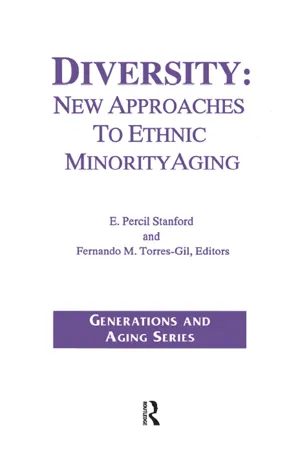
eBook - ePub
Diversity
New Approaches to Ethnic Minority Aging
- 168 pages
- English
- ePUB (mobile friendly)
- Available on iOS & Android
eBook - ePub
Diversity
New Approaches to Ethnic Minority Aging
About this book
Containing ideas and perspectives, this monograph examines the evolutionary and future considerations for diversity in aging.
Information
Chapter 1
Diversity and Beyond: A Commentary
INTRODUCTION
As populations continue to age and individuals live longer, chances of sharing cultural values and normative expectations are apt to increase. With this prospect in mind, it is no longer reasonable to expect that populations will exist in isolated environments. A higher percentage of all persons throughout the world are more likely to find themselves interacting on a global basis. Circumstances may be such that many will permanently change their formal residence. Such change may be interstate, intercontinental, or international. These changes often give people cause to confront personal and cultural biases in unexpected ways, and these biases are not necessarily negative in nature. It is merely that ethnic and cultural underpinnings are a manifestation of one’s unique experiences.
During the 1960s, it was popular to voice one’s opinions, from a philosophical or practical perspective, regarding ethnicity, race, culture, discrimination, and prejudice. Many had very definite philosophical positions that guided their actions and relations regarding ethnicity and race. Since then, society has continued to evolve with a highly mixed ethnic and racial population. The development of this type of population has made it necessary for all age groups and social classes to reexamine the significance of being able to effectively participate in and contribute to a highly diverse society.
The rapidly burgeoning aging population, which consists of a higher percentage of ethnically and culturally different older people than ever before, is cause for concern but not alarm. With the prospect of approximately 65 million persons—22 percent of the U.S. population—being 65 and older by the year 2030, there is an urgent need to plan for the acceptance, recognition, and utilization of the skills and talents of diverse groups.
That aging population will become increasingly diverse by race, gender, income, ethnicity, immigration, and language. What we now see in the younger population, with its tremendous growth of minority groups, we will see in time in the older population. That diversity raises issues of how we can best respond to different social, cultural, and economic needs; understand and incorporate the effects of race, language, ethnicity, immigration, and historical experiences on the aging process; and in turn make public benefits and programs responsive to that diversity.
Diversity in the older population will require us to distinguish between that which is generic and common to all older persons irrespective of race, language, and ethnicity, on the one hand, and those particular factors that necessitate culturally and linguistically specific responses, on the other. Diversity will challenge us to address potential divisiveness and separation of older groups based on race and ethnicity while we also seek to respond to the common needs of all persons.
The aging network is not alone in facing those challenges. The entire nation is forced to confront them as the U.S. population becomes more diverse, with greater numbers of non-Europeans (African Americans, Hispanics, Asian/Pacific Islanders, Native Americans) and newly arrived immigrant groups from Eastern Europe, the Soviet Union, and the Middle East constituting a larger proportion of the society.
Those challenges will require us to redefine the concept of diversity—from one emphasizing differences and the separation of a population into its isolated parts to one that looks at the strengthening of each group while seeking commonalities that lend themselves to public responses.
There are compelling reasons to go beyond the common definition of diversity. The concept can be used not only to explain variance, differences, and dissimilarities but also to highlight strengths within groups. If we dare focus on the distinctiveness of individuals and groups, numerous positive lessons can be learned.
This new focus is timely because we have been moving away from the old view of our society as a melting pot—in which individuals and cultures were seen as inevitably moving closer together—to a point where there is a push for more tolerance for differences among divergent populations. This shift is accompanied by a degree of uncertainty and lack of understanding regarding when diversity is a strength and when it becomes a liability. We should move toward a notion of diversity that allows for the coexistence of different cultures and ethnic identities while extracting the best from all involved. As this understanding develops, diversity will need to incorporate the notion of acculturation—where the goal is to enable individuals to function successfully in society by eliminating such barriers as racism and nativism (favoring native-born citizens against immigrants) and promoting economic and social opportunities. The concept of acculturation is in contrast to assimilation, whereby one gives up the strengths of group identity.
There are very few, if any, critical areas in society that will escape the effects of diversity and efforts to come to terms with assimilation and acculturation as related to aging. As generations evolve, it will become more evident that diversity will continue to be a leading force in determining the essence of lifestyles of older people as anchors in society.
These ideas and perspectives represent a preliminary examination of some of the evolutionary and future considerations for diversity in aging. This commentary is intended to provide only a point of departure for thinking further about diversity and its significance in the realm of aging. Diversity should be viewed as an enabling concept and not an end unto itself.
Chapter 2
Trends and Forces: Influence of Immigration, Migration, and Acculturation on the Fabric of Aging in America
Predicting trends and forces that will hold into the next century is, in some respects, akin to forecasting from a crystal ball. In gerontology, predictions are difficult because many of the factors that will affect the fabric of aging in America in the coming years are as yet unknown. What all indicators do suggest is a growing diversity in the aging population. As a society we must be prepared to address this likely characteristic of our future.
Increased immigration into the United States is currently having a major impact on the diversity of the American population, just as immigration has shaped the composition of American society throughout our history. Some of the significant changes in immigration flows that have occurred during the past 25 years are attributable to modifications in immigration policy.
RECENT IMMIGRATION POLICY
The first major change was the abandonment in 1965 of the “quota system” that discriminated against individuals from Southern and Eastern Europe. This system was replaced by one that gave “preference” to close relatives of American citizens, with the result being increased immigration from countries such as Greece, Italy, and Portugal. For the first time since the early 1900s there was also a substantial immigration from Asia.
The Refugee Act of 1980 brought the United States into line with other countries in its definition of a refugee. The application of the criterion “a well-founded fear of persecution” has, however, been political. Cubans, Southeast Asians, and Russian Jews, for example, have not had difficulty obtaining refugee status, while few Central and South Americans have been able to satisfy the Immigration and Naturalization Service about their claims to refugee status. Besides the Cuban “Marielitos” of the 1980s, the largest group of refugees have been the 800,000 Vietnamese who have resettled in the United States, along with a considerable number of Laotians and Cambodians.
None of the immigration reforms successfully dealt with the problems of illegal immigration. After long and bitter debate, the Immigration Reform and Control Act (IRCA) was passed in 1986. Among its most important provisions was a one-year amnesty period during which individuals who had been in the United States since before January 1, 1982, could apply for legalization. In addition, agricultural workers who could prove that they had worked for 90 days between May 1985 and May 1986 were eligible for legalization. Approximately 1.6 million individuals applied for regular legalization and 1.3 million for legalization as Special Agricultural Workers (Baker, 1990). Regular legalization applicants had to prove competency in English within 18 months after the initial legalization approval and apply for permanent residency status one year after this period. The IRCA also required new employees to prove U.S. citizenship or legalized alien status and imposed penalties on employers who hire undocumented workers.
AGING, IMMIGRATION, AND THE FUTURE AGED
Immigration has dramatically increased the representation of some groups in the American population. The percentage of Hispanics in the United States grew from 6.4 in 1980 to 9 in 1990. During the same period the percentage of Asians/Pacific Islanders almost doubled, from 1.5 to 2.9. Overall, more than a third of the population growth in the United States during the 1980s can be attributed to immigration (Vobedja, 1991). As yet, the impact of the increased American diversity on the field of aging either has not been felt or has been overlooked. High fertility rates have kept the median age among groups such as Hispanics relatively low. Among Southeast Asians and other refugee groups, the proportion of older individuals also tends to be low because of the hardships of migration. Many older persons stay in their homeland if some of their family members remain behind.
Based on fertility rates and immigration patterns among ethnic minority aged, it is possible to project a scenario that will face service providers during the next 30 years. There will be three groups of ethnic minority aged. One group will include native-born blacks, Hispanics, Asians/Pacific Islanders as well as increasing numbers of American Indians. A second group will consist of ethnic minority elderly who immigrated when they were children or young adults. This group includes blacks, Hispanics, and Asians/Pacific Islanders. The third group will be immigrants who have come to this country as older persons.
LIFE-SPAN PERSPECTIVE: IMPACT OF COHORT AND ACCULTURATION
The life-span perspective enhances our ability to view trends and forces that will impinge upon cohorts into the next century (Barresi, 1987). “Cohort” describes a group of people who share a common factor, such as age. Each age cohort has experienced a set of historical events and trends, including socialization and educational and cultural influences, during the group’s lifetime. These life experiences systematically affect the cohort’s attitudes, values, beliefs, and behaviors.
Future age cohorts of minority elders will have more diverse characteristics than has been common because the life experiences of members will have been more varied. Age cohorts of minority elders will be less likely to have common immigration histories, socialization patterns, cultural values or behaviors, and educational or socioeconomic backgrounds. Future immigration will include a mixed group of immigrants, particularly if the immigration quotas provide a preference for “skilled” workers as well as for reunification of families. Perhaps the best use of “cohort” for immigrant and ethnic minority elders will be to describe homogeneous groups of immigrants who come to American shores at specific historical times in the future.
Key developmental tasks during the second half of life have not changed dramatically in the United States and will probably remain essentially the same in the near future. For instance, during middle age the major focus is upon reaching a career pinnacle when biological, cognitive, and other skills based upon years of experience coalesce or reach their height. This may mean different things for men and women in our society or for people who come from cultures with differing expectations for people at each stage of the life cycle (Yee, 1989).
Goals for middle age and old age may not be attainable for the older immigrant. When these goals are not reached by late middle age, the responsibility for accomplishing these goals for the family is transferred to the younger generation (Yee, in press). A positive result is the push among Asian immigrant families toward high educational achievement for children. A negative effect is academic burnout when this educational push puts too much stress and responsibility on the younger generation to achieve for the sake of the family.
An immigrant elderly person who came to the United States during his young adult years will probably be quite different from another elder who immigrated recently. The expectations, adaptational requirements, and skills available to cope with old age in America will be quite different for these groups of immigrant elders. The process of acculturation during the intervening years, from immigration to old age, will determine the characteristics of a minority elder. For instance, the Asian and Pacific Islander population will include elderly people who arrived yesterday and also those whose ancestors came to America to work the plantations in Hawaii during the late 1800s.
Acculturation to all American norms may not necessarily be ideal; in fact, in some situations, it may be harmful. For instance, there is some indication that adoption of such habits as high-fat and low-fiber diets may create health problems for immigrants acculturating to American ways (Lipson and Kato-Palmer, 1988; Tong, 1991; Yano et al., 1985). By adopting these harmful habits, Asian and Hispanic Americans and American Indians may become more susceptible to diabetes and heart disease (Morioka-Douglas, 1990; Yee, 1990a). Moreover, psychological and cultural factors such as culturally based stress responses, nutritional patterns, or types of physical activity may account for some of the differences in rates of many preventable diseases (Hahn et al., 1990; Yee, 1990b).
The individual’s adherence to traditional cultural norms and acculturation to a new society’s cultural norms form an important research agenda. The topics for research include not only those typically viewed as cultural, such as language and family patterns, but also consideration of the relative effects of socioeconomic status versus cultural components of poverty.
MEETING THE NEEDS
It is doubtful that the 1990s and beyond will be a period of expansion for many aging services. The most reasonable approach to meeting the needs of immigrant aged is the maintenance of existing service delivery models with an eye toward revisions that will enhance their effectiveness with this unique—and diverse—population.
Programs that provide orientation to American lifestyle and cultural differences must be segregated for age and gender. English language classes should be given for children, young adults, and middle-aged and elderly students. Mixed-age orientation classes have often turned immigrant and refugee elders away from learning English and learning about their new country. Their younger counterparts in the same classes seem more adept at acquiring these skills. Elders may drop out of these classes because their role-reversed positions in the classroom often seem to them quite shameful and demeaning.
Professionals who work in aging services must be trained to work with diverse ethnic minorities, social classes, and educational levels. The key is sensitivity to diversity and open mindedness about philosophies of life that may be different from one’s own value orientations. This training produces professionals who are more tolerant of people from different backgrounds, more accep...
Table of contents
- Cover
- Title Page
- Copyright Page
- Table of Contents
- Chapter
- Best Practice
- Contributors
Trusted by 375,005 students
Access to over 1.5 million titles for a fair monthly price.
Study more efficiently using our study tools.
Frequently asked questions
Yes, you can cancel anytime from the Subscription tab in your account settings on the Perlego website. Your subscription will stay active until the end of your current billing period. Learn how to cancel your subscription
No, books cannot be downloaded as external files, such as PDFs, for use outside of Perlego. However, you can download books within the Perlego app for offline reading on mobile or tablet. Learn how to download books offline
Perlego offers two plans: Essential and Complete
- Essential is ideal for learners and professionals who enjoy exploring a wide range of subjects. Access the Essential Library with 800,000+ trusted titles and best-sellers across business, personal growth, and the humanities. Includes unlimited reading time and Standard Read Aloud voice.
- Complete: Perfect for advanced learners and researchers needing full, unrestricted access. Unlock 1.5M+ books across hundreds of subjects, including academic and specialized titles. The Complete Plan also includes advanced features like Premium Read Aloud and Research Assistant.
We are an online textbook subscription service, where you can get access to an entire online library for less than the price of a single book per month. With over 1.5 million books across 990+ topics, we’ve got you covered! Learn about our mission
Look out for the read-aloud symbol on your next book to see if you can listen to it. The read-aloud tool reads text aloud for you, highlighting the text as it is being read. You can pause it, speed it up and slow it down. Learn more about Read Aloud
Yes! You can use the Perlego app on both iOS and Android devices to read anytime, anywhere — even offline. Perfect for commutes or when you’re on the go.
Please note we cannot support devices running on iOS 13 and Android 7 or earlier. Learn more about using the app
Please note we cannot support devices running on iOS 13 and Android 7 or earlier. Learn more about using the app
Yes, you can access Diversity by E Percil Stanford, Fernando M Tores-Gil, E Stanford,Fernando Tores-Gil,E Percil Stanford,Fernando M Tores-Gil in PDF and/or ePUB format, as well as other popular books in Social Sciences & Social Policy. We have over 1.5 million books available in our catalogue for you to explore.