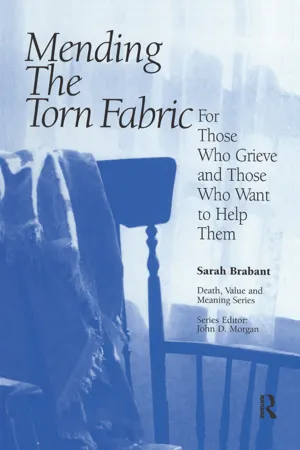
The analogy of the torn fabric was first used by the author in response to a bereaved mother's cry: "I know what grief feels like; I don't know what it looks like." In "Mending the Torn Fabric: For Those Who Grieve and Those Who Want to Help Them", the author expands the metaphor to include earlier and future or potential losses as well as losses associated with the death that may be unrecognized or minimized. This book includes chapters that examine complications that may be present or may arise, suggestions for mending even the most torn fabric, and a chapter dedicated to friends who want to help. Stories bereaved persons have shared with the author through the years are interspersed throughout the book to provide examples of loss and mending.
eBook - ePub
Mending the Torn Fabric
For Those Who Grieve and Those Who Want to Help Them
- 162 pages
- English
- ePUB (mobile friendly)
- Available on iOS & Android
eBook - ePub
About this book
Information
Chapter 1
THE TORN FABRIC
The meeting of Compassionate Friends, a support group for bereaved parents, was over. The guest speaker and most of the parents had left. I was helping with the clean-up when one of the remaining parents walked over to me. “I’m so tired of people coming here and telling me how I feel,” she said angrily. “I know I’m in pain, but I can’t get a handle on it. I know what grief feels like; I don’t know what it looks like.” I listened as she poured out her frustration. After a few minutes, she thanked me for listening, and went on her way. As I gathered up my things and went out to get in my car, I kept thinking about what she had said. “I know what grief feels like; I don’t know what it looks like.”
This woman’s child had died and she was in enormous pain. She knew the source of her pain. She knew what her pain felt like. She wanted to know what her pain looked like. Perhaps if she could somehow see the pain, she could “get a handle” on it. As I mulled her words over and over in my mind, I pictured a torn fabric, badly in need of mending. I saw a person bending over this torn fabric trying to sew the edges of the tear together. No matter how this person tried to mend the tear, the rip tore open again and again and I thought, that is what the terrible pain of grief looks like. It is a tear that keeps tearing no matter how hard you try to mend it. What does a person do when that happens? Do you just live with this enormous tear in your fabric or do you keep searching until you find the right needles and threads to mend it? Can such a badly torn fabric ever be mended?
As a support person for a Compassionate Friends chapter for over ten years, I have attended too many meetings and listened to too many bereaved parents not to know the answer. You keep working on your mending and, sooner or later, you find the right needles and threads. It takes time, sometimes a long time, and it takes work, sometimes a great deal of work, but even the most torn fabric can be mended. It will never be the same as it once was, but there will come a time when the fabric’s owner can once again focus on the fabric itself rather than just on mending it.
This does not just happen as a matter of course. Mending is work and it takes time and patience. Even before we can begin to look for the right needles and threads, we have to acknowledge that there is a break, a tear,1 in our fabric. Then we have to become familiar with the tear. We have to comprehend the size of it, its outline, and where it is in our fabric. Is it only a small tear, a medium size tear, or one almost as big as the fabric itself? Is it a round hole or a jagged rip? Is it in a corner of our fabric or in the center? And we have to know what kind of fabric we are working with. Not all tears are the same; not all fabrics are the same. We may need to use different needles and threads at different times in the mending process. We may need to learn new stitches. That is what this book is all about. It is about tears and needles and threads and stitches. This book is about mending a torn fabric.
Think of your life, your very being, as a piece of fabric. When you were born you were given this piece of fabric. No one else has ever been given this particular piece of fabric before. It is your fabric and it is unique. The material may be similar to that of others; it may be very different. Some people, for example, get a piece of Irish linen. This kind of material is sturdy and is not easily torn. Most stains are easily removed with laundry detergent; even the worst stain can usually be removed with bleach. If the fabric is torn, just about any needle can be used for mending as long as the needle is strong enough and sharp enough to pierce the fabric. Others, however, may be given a piece of Swiss batiste. This delicate material is beautiful, shimmering with light as you finger it. But you have to be very careful with this kind of cloth. Most stain removers will damage the material and only very small, sharp needles can be used. A large needle will leave a hole; a dull one will rip into the fabric, leaving pulled threads and sometimes even a ragged tear.
There are so many different kinds of materials in the world. There are the heavy cottons, the ginghams, the various kinds of woolens, the silks; there is khaki, denim, and burlap. Even when materials are the same, there are differences in weaves and dyes. Brothers and sisters who share the same biological parents have different fabrics, because it makes a difference whether a piece of fabric is cut at the beginning of the bolt, or the middle, or the end. Were you the oldest child in your family, the youngest child, the only child? Even if you are an identical twin, you or your twin is the oldest; the other is the youngest. Your fabric is unique. It always has been. It always will be.
Time affects all fabrics. Some people use their fabrics every day until the cloth is worn in places from so much use. Others choose to do nothing with their material, storing it away in a closet for some future use. Even so, the cloth does not stay the same. It may yellow with age and even become weakened in places so that when it is used, it tears more readily. Some persons choose to decorate their fabric, painting designs upon it or embroidering it. Sometimes the design is so beautiful that it becomes a cherished keepsake for others, perhaps many others. Sometimes a design does not turn out too well. The owner may decide to live with it, paint over it, or rip it out and begin a new design.
As we move through life, we are often careless with our fabric. We lay it down somewhere or leave it unattended and it becomes soiled (e.g., we become bored or we lose muscle tone). Perhaps another person spills something on our fabric (e.g., gossip damages our reputation). These stains often can be removed if we find the right cleanser; sometimes the stain cannot be removed no matter what we do. We may even tear our fabric trying to get the stain out. At other times we may notice a little tear in our fabric and wonder how it happened. We may decide to ignore it since it is so little, or we may mend it with a quick stitch or two. Sometimes, however, our fabric becomes so torn that we cannot ignore the tear or hastily repair it. A particular tear may be so huge that it is difficult to even see the fabric. We wonder if such a tear can ever be mended. Maybe the tear is so large that the fabric is useless forevermore.
Through the years I have listened to the stories of many grieving people. They have shared with me some tears in their fabrics that were so big and so jagged that the fabric appeared irreparable. And I have watched as these courageous men, women, and children began the task of mending their torn fabrics. It often takes a long time and sometimes the stitches they take seem to do more damage than good. I have watched them try one stitch and then another. I have seen newly-stitched tears rip open again. I have watched as the person began to mend the tear once more and, this time, found a thread that could hold the ragged edges together. I have come to believe that no fabric is beyond mending. With enough time and enough work, even the most terrible tear can be mended to the point that the material can once again be vibrant.
There are many different kinds of tears and they vary in size. There are also many different kinds of needles and threads. Before talking about different kinds of tears, needles, and threads, however, there are four words that are important for us to define. These words are bereavement, grief, grief work, and mourning. These words do not mean the same thing, and unfortunately two of these words, grief work and mourning, are often confused with each other. It would be nice if there were some universal consensus about the definition of these words, but it is not essential. What is important is to recognize that there are four very different dimensions in the grieving process, and that you and I use the same word to describe each of these dimensions.
The first word is bereavement. A bereavement is a loss. It can be any loss. Bereavement simply means that something you once had is no longer yours. Have you ever lost your keys? This is a bereavement. Most of the time this is not a very important bereavement or loss because you probably had a duplicate key at home or you asked a locksmith to make a new key for you. But it was a loss and demanded your attention if only for a little time. These kinds of losses are inconvenient losses. They are a nuisance, but they are easily taken care of. Other losses are not so easy to take care of. We may lose our job or find out that a person we thought was a friend was talking about us behind our back. We may eventually find a new job or make new friends, but until we do there is a great emptiness in our life. And even when we have been in our new job for a time or become comfortable around our new friends, we may feel pain when we remember the way things were.
Sometimes a bereavement or loss is so enormous that life seems to come to a standstill. From that moment on, one’s life is divided into before the loss and after the loss. For a parent, a child’s death is this kind of bereavement. Never, never, never can that child be replaced. There may be other children to come, but that unique child is no longer physically present and that child’s presence cannot be duplicated. A bereavement or loss, then, is a tear in our fabric. It can be a little tear, hardly noticeable. It can be a medium size tear that demands attention, but only for a time. It can be a tear so devastating that the bereaved person wonders if his or her fabric can ever be mended.
Grief is the human response to loss. It is the pain a person feels when someone or something that was important in his or her life is no longer present. Grief can be momentary or it can last a long time. It can be so temporary that we quickly forget it. It can be so overwhelming that it is difficult to breathe and we wonder if we will physically survive our loss, much less emotionally survive it. What is important to remember is that there can be a bereavement or loss and little or no pain. If there is pain, however, there is always a loss. If the pain is great, the loss is large. This is an important axiom to keep in mind and we will return to it in later chapters. For now, just remember that there can be a loss with no pain, but if there is pain, there is always a tear in your fabric.
Grief work is the work that must be done to move through the pain that we experience because of a loss. The word ”through” is important. You cannot just go around the pain or under the pain or over the pain; the only way to go is through the pain. Until you do this, the pain will surround you and if it is intense enough, the pain will control your life. When you go through the pain, the pain becomes a part of you. Thus, there is nowhere to go with pain but through it. You may never be free of the pain, but you can learn to live with it. It will cease to control your life. Grief work, then, is the necessary mending that has to be done in order to move through the pain. Work is a good term, for it reminds us that there is something we have to do in order to move through the pain. The pain will not just go away. A torn fabric will not just mend by itself.
Finally there is the word mourning. Some people use this word when they are talking about grief work. We will use it to mean certain kinds of grief work (i.e., grief work that is approved by the members of any particular society). In other words, mourning is how our cultural background (nationality, ethnicity, religion) teaches us how we should respond, and how we think others will expect us to respond to our losses. We can recognize mourning when we use or hear phrases such as “I think (or others think) that I should feel a certain way” or “I think (or others think) I ought to do certain things.” With respect to grief work, there is often a particular way of behaving that is considered appropriate by ourselves or others and to behave differently is to risk disapproval. Our cultural background, however, provides more than just ways of responding to loss. It also tells us how important our loss is, whether we have a right to hurt, and if so, how much and for how long.
Mourning, then, is how a culture defines the tear in our fabric. Is the tear a big one or only a small one? Mourning is how our culture tells us we should feel about our tears and how, or even if, we can express our pain. Mourning is how our culture defines mending for us. What is and what is not acceptable?
Mourning definitions and rules may be very helpful; they may also keep us from moving through the grieving process. Only you know how big the tear is in your fabric because only you know how much you hurt. Only you can do the mending. It is very important, however, to recognize mourning. What others think about bereavement, grief, and grief work or what we have learned to think about bereavement, grief, and grief work can prevent us from getting our mending done. It can even prevent us from beginning our mending.
We will talk about some of the barriers that can block us from our mending and how to get around these blocks in more detail. Before continuing on to the next chapter, however, it might help to repeat the following affirmations several times.
My fabric is unique.
If I am hurting, there is a tear in my fabric.
Since only I know how much I hurt, only I know how big the tear is.
My fabric can be mended.
Note
1 The word “tear” has two distinctly different meanings: 1) a hole or flaw made by tearing; and 2) a drop of clear saline secreted from the eye. To avoid confusion, “tear” or “tears” will always refer to a torn place or a rip in a piece of fabric and never to the liquid that flows from a person’s eyes when he or she is crying.
Chapter 2
PLACES TO MEND
About twenty-five years ago a young physician who worked with dying patients was asked to write a book about dying and death. Today this would not seem so strange, but back in the 1960s dying and death were taboo topics for many people. Dying persons in hospitals were often moved to rooms at the far end of the hall, and when they died their body was bundled up and hurriedly sent to a morgue as though the person had done something so terrible in dying that it must be kept secret. This courageous physician dared to call this kind of treatment of dying persons shameful. She argued that dying persons should be respected because they have a right to this respect and also because they have much to teach the living. She accepted the challenge to write a book and today people all over the world recognize the name, Elisabeth Kübler-Ross, and many have read her book, On Death and Dying [1]. Indeed, many still refer to this book as the book on death and dying.
Elisabeth Kübler-Ross never intended for her book to become the book on death and dying. In the preface, she wrote:
I am simply telling the stories of my patients who shared their agonies, their expectations, and their frustrations with us. It is hoped that it will encourage others not to shy away from the “hopelessly” sick but to get closer to them, as they can help them much during their final hours [1, preface].
Unfortunately, we live in a “cookbook society.” We want step-by-step directions on how to do things, and since few people at that time had any idea of what a dying person was going through, her book became the guideline for what to expect. Not too much was known about grieving either, so the book became the guideline for the grieving process as well. Even today, many people continue to describe the grief process as five stages: denial, bargaining, anger, depression, and acceptance. According to them, it is quite simple. You have a loss and then you move through each of the stages and when you have completed the first four stages, you reach acceptance. That is all there is to it. You are now through with your grief.
Well, it is not that simple. And Elisabeth Kübler-Ross never said it was that simple. I often wonder if either the people who claim the grief process is that simple or those who criticize her book as being too simplistic have ever really read it. It is a wonderful book and she did just exactly what she said she was going to do. She listened to her patients and she shared their stories with those who read her book. She was allowing others to hear those stories, not trying to establish a format of predictable behavior. Her use of the word “stage,” however, may have inadvertently encouraged people who were looking for some direction to think of the dying and/or grieving process as a predictable sequence of steps.
Words are more than meaning; they point us in one direction or another. Stop and think for a moment what the word “stage” means. I think of steps that go higher and higher and you have to climb the first one before you can reach the next one. Grade levels in school are an example of stages. You have to complete first grade in order to go to second grade. If you do not complete first grade, it means you have failed and that is a terrible thing to do. But what about being promoted to second and then being sent back to first? That is even worse than failing. It means you have slipped and that is something only weak people do. If you do not slip, however, but keep climbing higher and higher, you reach the final stage—graduation—and that is wonderful...
Table of contents
- Cover
- Title Page
- Copyright Page
- Table of Contents
- Acknowledgments
- Chapter 1 The Torn Fabric
- Chapter 2 Places To Mend
- Chapter 3 Places To Avoid
- Chapter 4 How Many Tears?
- Chapter 5 Earlier Tears
- Chapter 6 Future Tears
- Chapter 7 Needles And Threads
- Chapter 8 Complicated Mending
- Chapter 9 The Mended Fabric
- Chapter 10 Guidelines For Those Who Want to Help
- Chapter 11 Notes for the Professional: Theoretical Underpinnings and Use of Analogy
- Bibliography
- Resources for Bereaved Persons
- Suggested Readings/Videos
- Index
Trusted by 375,005 students
Access to over 1.5 million titles for a fair monthly price.
Study more efficiently using our study tools.
Frequently asked questions
Yes, you can cancel anytime from the Subscription tab in your account settings on the Perlego website. Your subscription will stay active until the end of your current billing period. Learn how to cancel your subscription
No, books cannot be downloaded as external files, such as PDFs, for use outside of Perlego. However, you can download books within the Perlego app for offline reading on mobile or tablet. Learn how to download books offline
Perlego offers two plans: Essential and Complete
- Essential is ideal for learners and professionals who enjoy exploring a wide range of subjects. Access the Essential Library with 800,000+ trusted titles and best-sellers across business, personal growth, and the humanities. Includes unlimited reading time and Standard Read Aloud voice.
- Complete: Perfect for advanced learners and researchers needing full, unrestricted access. Unlock 1.5M+ books across hundreds of subjects, including academic and specialized titles. The Complete Plan also includes advanced features like Premium Read Aloud and Research Assistant.
We are an online textbook subscription service, where you can get access to an entire online library for less than the price of a single book per month. With over 1.5 million books across 990+ topics, we’ve got you covered! Learn about our mission
Look out for the read-aloud symbol on your next book to see if you can listen to it. The read-aloud tool reads text aloud for you, highlighting the text as it is being read. You can pause it, speed it up and slow it down. Learn more about Read Aloud
Yes! You can use the Perlego app on both iOS and Android devices to read anytime, anywhere — even offline. Perfect for commutes or when you’re on the go.
Please note we cannot support devices running on iOS 13 and Android 7 or earlier. Learn more about using the app
Please note we cannot support devices running on iOS 13 and Android 7 or earlier. Learn more about using the app
Yes, you can access Mending the Torn Fabric by Sarah Brabant in PDF and/or ePUB format, as well as other popular books in Medicine & Mental Health in Psychology. We have over 1.5 million books available in our catalogue for you to explore.