eBook - ePub
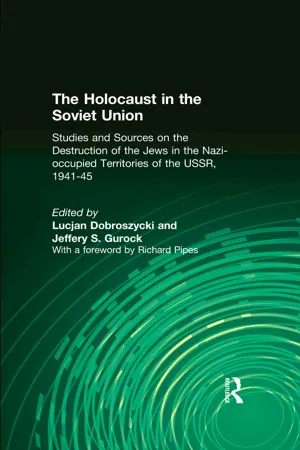
The Holocaust in the Soviet Union
Studies and Sources on the Destruction of the Jews in the Nazi-occupied Territories of the USSR, 1941-45
- 272 pages
- English
- ePUB (mobile friendly)
- Available on iOS & Android
eBook - ePub
The Holocaust in the Soviet Union
Studies and Sources on the Destruction of the Jews in the Nazi-occupied Territories of the USSR, 1941-45
About this book
In this volume, scholars from the United States, Israel and Eastern Europe examine the history of the Holocaust on Soviet territory and its treatment in Soviet politics and literature from 1945 to 1991. Of special interest to researchers will be chapters on some of the major research sources for historical study, including census materials, memorial books, archives and recently released documents.
Information
The Holocaust in the Soviet Union
Soviet Reactions to the Holocaust, 1945–1991
ZVI GITELMAN
The Holocaust in the Soviet Union
About one-third of all the Jews killed in the Holocaust had been living under Soviet rule in 1940. Most estimates, necessarily based on fragmentary information, are that about one and a half million Soviet Jewish citizens who lived in the pre-1939 borders of the USSR were murdered by the Nazis and that 200,000 more died in combat.1 The rest of the victims were Jews who came under Soviet rule in 1939–40, in the wake of the Hitler-Stalin pact.
The Soviet treatment of the Holocaust, and most notably of the Holocaust within its borders, has been very different from that in the West. William Korey, in the September 1991 issue of Hadassah magazine, writes of "the Kremlin's suppression of all reference to the Holocaust until now" (p. 10). This is somewhat exaggerated. While not denying the Holocaust, most Soviet writers have either ignored it or submerged it in more general accounts of the period. A preliminary survey of Soviet writings reveals that they vary significantly in the prominence and interpretations given to the Holocaust. Most Soviet works either pass over it in silence or blur it by universalizing it. Western assertions to the contrary, there seems to be no consistent Soviet "party line" on the Holocaust. Some works do acknowledge and describe the Holocaust, while others discuss only some aspects of it. One can only speculate regarding Soviet motivations, but we can point with greater certainty to some consequences, intended and unintended, of the general Soviet tendency to ignore or downplay the Holocaust. In any case, as the Soviet Union and its dominating party broke up, the treatment of the Holocaust began to change radically.
Soviet treatment of the Holocaust has had profound, if subtle, effects on both Jews and non-Jews in the USSR. On the one hand, it denied Jews any particular sympathy on the part of non-Jews. Unlike in the West, Soviet non-Jews, for the most part, did not feel a need to "make up" to the Jews, as it were, for any of the wrongs done to them. On the other hand, Soviet treatment aroused Jewish consciousness. But it also engendered first puzzlement, and then bitterness, when Jews, especially younger ones, realized that a vital part of their recent history was being denied them. Their worth and importance had been denigrated, their particular history and culture dismissed, and their claims of discrimination rejected. Soviet treatment—or lack of it—of the Holocaust was a significant factor in the reemergence of Jewish national consciousness in the former Soviet Union. It will be not only interesting from an academic point of view, but also important socially and politically, to see how and to what extent the current reexamination of Soviet history, which began as part of glasnost', will reopen the pages of the Holocaust and will permit this chapter to be written in full. Early indications are that this is beginning to occur.
After briefly identifying the main outlines of how the Holocaust was perpetrated in the USSR, we shall discuss how it has been treated in Soviet writings, offer some suggestions as to why it was been accorded such a treatment, and examine the consequences of that treatment.
The War Against Soviet Jewry
Around a quarter of a million of the Jews from the territories annexed by the Soviet Union in 1939–40 either fled to the interior beyond the Nazi grasp or were inadvertently saved by the Soviets from Nazi annihilation when the former deported them to Siberia and Central Asia.2
The Soviet occupation of the western territories brought with it a tragic, fateful divergence in the perceptions and interests of Jews and non-Jews. In all of those territories anti-Semitic regimes in the 1930s had made life increasingly uncomfortable—in many cases intolerable—for Jews. America and Palestine were closed to immigration, and Jews in Poland, Romania, Latvia, and Lithuania had little hope of improving their lot. The entry of the Red Army, with its Jewish officers and men, its promises of national equality and social justice, gave hope to some of the younger and more radically inclined Jews. Despite misgivings about the Bolsheviks' militant atheism, their persecution of Zionism, and nationalization of property, many Jews welcomed the Red Army as a liberator. A resident of eastern Poland recalled that when the Red Army came, "There was a holiday atmosphere. Things changed overnight.... The Germans would not come in and that was the most important thing."3 Others saw the Soviets as the lesser of two evils. Another survivor from the same area comments, "when the Russians came in we were a little afraid, but not as afraid as we were of the Germans in the western part of Poland."4
By contrast, the Poles, Baltic peoples, and Romanians saw the Red Army as an invader, not a liberator, one that was depriving them of their hard-won and all too brief political independence. Jews who welcomed the Red Army were seen as traitors, and all Jews were assumed to be Bolshevik sympathizers and betrayers of the lands of their birth. Little wonder, then, that in 1941 when the Germans drove the Red Army out, many non-Jews greeted the Germans as liberators from Soviet oppression and took the opportunity to wreak harsh vengeance on the traitorous Jews. In the first few days of the German occupation of Lithuania, for example, Lithuanian groups murdered 5,000 Jews.
Three million German troops invaded the USSR from the west, quickly encircling the main centers of Jewish population. The Nazis had long been explicit about their consuming hatred for both Bolsheviks and Jews, whom they equated with each other. Adolf Hitler wrote in 1930, "The Nordic race has a right to rule the world.... Any cooperation with Russia is out of the question, for there on a Slavic-Tatar body is set a Jewish head."5 German General von Reichenau issued an order stating, "The most essential aim of war against the Jewish-Bolshevistic system is a complete destruction of their... power.... Therefore, the soldier must have full understanding for the necessity of severe but just revenge on subhuman Jewry." General von Manstein wrote, "More strongly than in Europe, [Jewry] holds all the key positions in the political leadership and administration.... The Jewish-Bolshevist system must be exterminated once and for all. The soldier must appreciate the necessity for harsh punishment of Jewry, the spiritual bearer of the Bolshevist terror."6
Though the Nazis could not have been more explicit about their intentions, following the Nazi-Soviet pact of August 1939 the Soviet media had draped a blanket of silence over Nazi atrocities. Together with older people's memories of the Germans of World War I as "decent people," this may have left many Soviet Jews unprepared for the mass murder campaign conducted by four Einsatzgruppen, or mobile killing squads, who liquidated much of Soviet Jewry by machine gunning them in or near their home towns. Others were placed in ghettos, most of which were liquidated, along with their inhabitants, by 1941–42. Within five months, the Einsatzgruppen—whose officers were largely intellectuals and professionals, as Raul Hilberg observes—had killed about half a million Jews. Needless to say, these killings were often preceded by extensive torture.7 By war's end, perhaps two or three million Jewish civilians had been killed, singled out from the rest of the population for "special handling."
Soviet Historiography of the Holocaust
Some Western observers charge that it was Soviet policy to suppress any public discussion of the Holocaust. William Korey writes of "the Soviet attempt to obliterate the Holocaust in the memories of Jews as well as non-Jews."8 Writing in 1970, Mordechai Altshuler asserts that "The wall of silence regarding the Holocaust still stands in the Soviet Union, though here and there small cracks were observed.... The paucity of publications on the Holocaust of Soviet Jewry ... and the attacks on Yevtushenko's 'Babi Yar' ... testify to a purposeful policy of the regime to suppress the Holocaust in the Soviet Union."9 This policy is sometimes explained as a consequence of Soviet anti-Semitism and hostility toward Jewish history and culture. Korey's explanation is more sophisticated: "Expunging the Holocaust from the record of the past was hardly a simple matter, but unless it were done the profound anguish of the memory was certain to stir a throbbing national consciousness. Martyrdom, after all, is a powerful stimulus to a group's sense of its own identity."10 In his study of Lithuanian Jewry's resistance to the Nazis, Dov Levin points out that Soviet writing on World War II generally downplays the role of the Jews in the war, and does so regarding Lithuanian Jewry as well. He reasons that this is in order not to diminish the already marginal role of the Lithuanians in the resistance against the Nazis.11
A closer examination of Soviet writings on World War II reveals that if there existed a policy of repressing the Holocaust, it was applied unevenly at best. Nevertheless, it remains true that the overall thrust of the Soviet literature was to assign the Holocaust far less significance than it has been given in the West. One cannot entirely dismiss the possibility that this is the consequence of having large, articulate, nationally conscious Jewish populations in the West where they are mostly free to explore Jewish history and draw whatever conclusions they wish, whereas conditions in the Soviet Union until now permitted neither such exploration nor such expression. Moreover, no country in the West lost as many of its non-Jewish citizens in the war against Nazism as did the USSR, so that the fate of the Jews in France, Holland, Germany, or Belgium stands in sharper contrast to that of their conationals or coreligionists than it does in the East. On the other hand, in Yugoslavia and Poland, where civilian populations were decimated in no less a proportion than they were in the USSR, greater public attention has been paid to the specifically Jewish tragedy of the war period. Thus, the Soviet Union did treat the issue differently from most other countries, whether socialist or not, though this treatment was not uniform.
In striking contrast to the way it has been treated in the West, in the Soviet Union the Holocaust was not presented as a unique, separate phenomenon. It was not denied that six million Jews were killed, among them many Soviet citizens, nor that Jews were singled out for annihilation. But the Holocaust was seen as an integral part of a larger phenomenon—the murder of civilians, whether Russians, Ukrainians, Belorussians, Gypsies, or other nationalities. It was said to be a natural consequence of racist fascism. The Holocaust, in other words, was but one of several reflexes of fascism, which is, in turn, the ultimate expression of capitalism. Thus, the roots of the Holocaust lie in capitalism, expressed in its most degenerate form. Armed with the theory of "scientific socialism," the Soviets were able to explain in a facile way how so many were murdered. For them there was no mystery about the Holocaust. In the West, by contrast, there is a vast literature which seeks to understand how it happened. There are cultural explanations, psychological and sociological ones, political and bureaucratic ones. There is an extensive theological literature which seeks to confront God with the Holocaust. My impression is that not a single book published in the USSR sought to explain the Holocaust as sui generis. In fact, the term "Holocaust" is completely unknown in the Soviet literature. When discussing the destruction of the Jews, the terms "annihilation" (unichtozhenie) or "catastrophe," and more recently, "Holocaust" (transliterated from English) have been used. The Black Book of Soviet Jewry, containing documentation gathered from all over the country by the writers Ilya Ehrenburg, Vassily Grossman, and others, had 1,200 typescript pages by 1944, and was printed in 1946. But every single copy was sent to storage warehouses where they were destroyed in 1948, along with the type from which they were set. Only one copy, which had been sent abroad, survived, and now additional materials from Ehrenburg's archives have been brought to Israel. Thus, the major work on the Soviet Holocaust was never published in the USSR, though there are Hebrew, English, and even Russian (published in Jerusalem) editions. The Holocaust was treated as regrettable, but merely as one small part of the larger phenomenon which, according to the Soviets, resulted in the death of over 20 million of their citizens. If the Nazis gave the Jews "special treatment," the Soviets did not.
This premise translated into a policy of bypassing the Holocaust for most general audiences, and addressing it in a highly ideological way for certain specialized ones. William Korey's survey has shown that Soviet elementary school history textbooks contain no reference to Jews at all, and a 30-page chapter on World War II in one of them has not a single reference to either Jews or anti-Semitism. The same is true of secondary school texts and syllabi, except for a single reference to "terrible Jewish pogroms."12 The controversy over the construction of a monument at Babi Yar, the site in Kiev where over 35,000 of the city's Jews were shot in the course of two days, is well known. For years, no monument was placed there, and the site was prepared for housing, a park, and other uses. In 1959 the writer Viktor Nekrasov protested plans to turn the site into a park and soccer stadium, and momentum began to build for the construction of a memorial monument. When this was finally done, the inscription referred only to "Soviet citizens," and not to Jews specifically. Similarly, when Yevgeny Yevtushenko published his poem "Babi Yar," whose first line reads "Over Babi Yar there are no monuments," he was roundly criticized by conservative writers who charged him with slandering the "Russian crew-cut lads" who had fought the Nazis. The writer Dmitri Starikov asserted that "the anti-Semitism of the Fascists is only part of their misanthropic policy of genocide... the destruction of the 'lower races' including the Slavs."13 When Dmitri Shostakovich included "Babi Yar" in his thirteenth symphony, Yevtushenko was forced to make two additions to the text. One line reads: "Here, together with Russians and Ukrainians, lie Jews," and the other is, "I am proud of the Russia which stood in the path of the bandits." Again, the point is not that others suffered along with Jews, which no one would dispute, but that there was nothing unique about the quality and quantity of Jewish suffering, a far more dubious assertion.
The same issue arose in regard to Anatoly Kuznetsov's novel, Babi Yar. Public controversy arose over whether Jewish travails should have been singled ou...
Table of contents
- Cover
- Half Title
- Title
- Copyright
- Contents
- Foreword
- Acknowledgments
- Preface
- Part 1. THE HOLOCAUST IN THE SOVIET UNION
- Part 2. SOVIET POLICIES DURING THE HOLOCAUST
- Part 3. REGIONAL STUDIES
- Part 4: SOURCES FOR STUDY OF THE HOLOCAUST IN THE SOVIET UNION
- About the Contributors
- Index
Trusted by 375,005 students
Access to over 1.5 million titles for a fair monthly price.
Study more efficiently using our study tools.
Frequently asked questions
Yes, you can cancel anytime from the Subscription tab in your account settings on the Perlego website. Your subscription will stay active until the end of your current billing period. Learn how to cancel your subscription
No, books cannot be downloaded as external files, such as PDFs, for use outside of Perlego. However, you can download books within the Perlego app for offline reading on mobile or tablet. Learn how to download books offline
Perlego offers two plans: Essential and Complete
- Essential is ideal for learners and professionals who enjoy exploring a wide range of subjects. Access the Essential Library with 800,000+ trusted titles and best-sellers across business, personal growth, and the humanities. Includes unlimited reading time and Standard Read Aloud voice.
- Complete: Perfect for advanced learners and researchers needing full, unrestricted access. Unlock 1.5M+ books across hundreds of subjects, including academic and specialized titles. The Complete Plan also includes advanced features like Premium Read Aloud and Research Assistant.
We are an online textbook subscription service, where you can get access to an entire online library for less than the price of a single book per month. With over 1.5 million books across 990+ topics, we’ve got you covered! Learn about our mission
Look out for the read-aloud symbol on your next book to see if you can listen to it. The read-aloud tool reads text aloud for you, highlighting the text as it is being read. You can pause it, speed it up and slow it down. Learn more about Read Aloud
Yes! You can use the Perlego app on both iOS and Android devices to read anytime, anywhere — even offline. Perfect for commutes or when you’re on the go.
Please note we cannot support devices running on iOS 13 and Android 7 or earlier. Learn more about using the app
Please note we cannot support devices running on iOS 13 and Android 7 or earlier. Learn more about using the app
Yes, you can access The Holocaust in the Soviet Union by Lucjan Dobroszycki,Jeffery S. Gurock in PDF and/or ePUB format, as well as other popular books in Storia & Storia dell'Olocausto. We have over 1.5 million books available in our catalogue for you to explore.