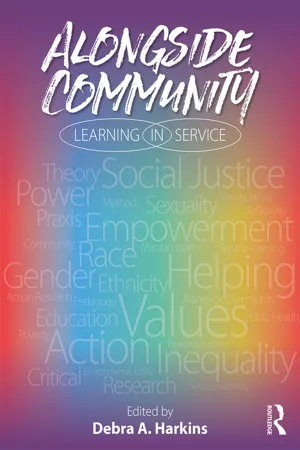
Alongside Community is a step-by-step guide that prepares social science students to be democratic citizens by examining the theory, method, and sociopolitical dynamics that impact helping those different from oneself. The first part of this book explores the more theoretical issues of helping others, including issues of social identity, values, and power. The second part of this guidebook examines action-based methods; interventions available for community-based engagement; and the sociopolitical issues that inevitably arise for those who strive to create social change including issues of race, ethnicity, social class, gender, sexual orientation, mental health, educational and environmental justice along with suggestions on how to address these issues. The third part of Alongside Community critically explores how to measure the impact of community service on major stakeholders including student, faculty, college and community agency and ends with reflections and suggestions on how to be a lifelong civically engaged citizen.
- 196 pages
- English
- ePUB (mobile friendly)
- Available on iOS & Android
eBook - ePub
About this book
Information
Part I
Learning to Serve
Chapter 1
Understanding Complexities of Helping and Serving
Aims of Chapter
- 1. Understand the role of altruism, empathy, and prosocial behavior in the practice of helping.
- 2. Explore the complexity and theories of helping.
- 3. Describe how service learning is a win-win helping approach.
Reflection: Do you have Any Spare Change?
Students often work with the local homeless community in our city. Our college is in the northeast region of the United States, with a significant number of homeless people in and around our urban campus. For many students, this is the first time they have seen so many homeless people. An often-discussed issue we have is what to do when a homeless person asks you for some spare change. Do you give money? Do you get them a coffee or a sandwich? Do you ignore them?
Some people give money and feel good with themselves for a little while. Others are fearful that this homeless person might spend the money in nefarious ways (e.g., drugs, alcohol) but feel like they need to do something, so they buy the homeless person a coffee or a sandwich and feel good with themselves for a little while. Others ignore and wish they would just get a job and get off the street.
What do you do? What do your actions toward this homeless person say about you? What assumptions do you hold about this person? What assumptions do you have about how and why we help another in our society? There is no right or wrong answer to any of these questions; rather, your answers reveal much about yourself, your values, and your assumptions about social class, poverty, and homelessness.
Helping seems like an obvious act, right? However, there are many types of helping such as helping because it makes one feel good, helping to make someone else feel good, helping based on charity, helping out of empathy, or helping out of sense of equity. What we do not often consider is how the act of helping can make the one being helped feel less than and make the helper feel—or look—more than (Schein, 2009). Helping is an unequal act!
So, how do we help without perpetuating the very injustices we are seeking to remove? First, we need to become aware of why we want to help. What is our own definition of helping? Are we helping because we are supposed to help the downtrodden? The sick? The infirm? Do we feel bad for the other? Do we help based on sympathy, empathy, and/or justice? Do we expect those who are helped to say “thank you” for receiving a dollar from us? What if they don’t smile when we give them that dollar? What if they don’t say “thank you” graciously enough? What if they don’t say anything at all? Understanding our own reaction to how we help and what we expect from helping may clarify our own role in oppression and or liberation. Ironically, helping requires us to look deeply at ourselves and ask why we help. Or why we don’t.
Psychology of Altruism, Empathy, and Prosocial Behavior
Do you like to help? Do you wish you were motivated to help? Psychological research may help you want to help more when you see the benefits for yourself and others. A review of the impact of altruism and prosocial behavior on cognitive, moral, and social development (Begue, 2016; Goetz, Keitner, & Simon-Thomas, 2010) reveals significant benefits of helping others for the helper, including the following:
- Improved sense of well-being, self-esteem, and self-worth
- Increased energy, mood, and strength
- Decreased aches and pains.
Do these findings motivate you to help? Unfortunately, many worry about helping for “selfish” reasons. Is it okay to help, when you are helping, because it helps you? Can you help selflessly? Well, take heart. Research confirms that most people help based on both selfish and unselfish reasons, and this combination of selfish and unselfish helping seems to create the best helpers, at least for the helper. Interestingly, there are two important reasons that explain these counterintuitive findings:
- Pure altruism can quickly lead to burnout for the helper (clearly not good for anyone).
- Receiving help can be a mixed blessing for the helpee, since the helpee can sometimes feel helpless or inferior for not being able to help themselves.
Since the helper wants to help, sometimes helping too much is not helpful at all. Helping is complicated!
In fact, theorists suggest and researchers (Clary, Snyder, & Stukas, 1996) find that relieving one’s own distress and pain through helping others increases one’s empathy and prosocial behavior in the future. Prosocial behavior (e.g., acting out of care and concern for others) serves many functions including the following:
- Allowing you to act on your values
- Increasing your self-worth
- Improving your learning and understanding of other people
- Enhancing your career development
- Improving your fit with important social groups
- Decreasing your guilt.
Role of Pity, Sympathy, and Empathy in Helping
Do you know the difference between pity, sympathy, and empathy? All these emotions are different empathetic responses to distress. As we describe these types of responses next, consider the type of empathetic reaction you have when you see a homeless person on the street.
In Neel Burton’s (2015) recent book, Heaven and Hell: The Psychology of the Emotions, he describes the developmental process of empathetic reactions. For example, Burton defines pity as the lowest level of empathy, involving simple feelings of discomfort that arise from witnessing or hearing about the distress of another. Note that this level of empathy does not elicit any outward action. The next level of empathy—sympathy—involves feelings of care and concern for another and wishing that the other person felt better. Notice, there may still be no action taking place at this level of empathy, but deep evolutionary emotions are being triggered by the desire for community protection of another. There is a sense of concern for the other. The highest level of empathy—compassion—is described as “suffering with” the other and involves a strong desire to alleviate another’s suffering, which often feels like your own suffering. Strong evolutionary emotions of protecting and supporting those who are considered part of one’s own community trigger powerful feelings of compassion that often lead to action. Compassionate empathy often elicits helping responses focused on liberating others from suffering, including resisting oppression and improving well-being. Note that as empathy deepens, feelings of community concern and support emerge. That is, as empathy moves from pity to compassion, we often broaden our concern to include community (see Figure 1.1).

Figure 1.1 Empathy
Reflection: Journey from Clinical Developmental to Community-Focused Psychologist
As a clinical developmental psychologist, I was trained, like most psychologists, in individually focused therapy. I learned cognitive, behavioral, and psychoanalytic approaches to help others deal with emotional issues. I provided clinical services to many children and adults, often in a standard therapy room, and some of my clients said they felt better coming to therapy and reported doing better at the end of the therapy work. However, my clinical journey took a sharp turn from many psychologists when I left the therapy room in the counseling center and began working in urban school settings.
My post-doctoral internship included providing clinical services to young children in several poorly funded urban elementary schools. As a clinical developmental psychologist, my responsibility was to provide therapy to young children who had been identified as in need of services by teachers or staff. Each week, I would meet with children one on one, in a small room within the school, for several months at a time, playing and building a rapport so they felt comfortable enough to talk with me or share their experiences through play.
On several occasions, a child would come to their weekly session with bruises and eventually she or he would tell me or show me through their play that they had been hit by someone, often an adult in their home. My training had clearly taught me what I should do in such situations; I had an ethical and legal obligation to report incidences of child abuse. My responsibility was to inform administrators that a report needed to be filed to child protective services, which I did. However, I was just as quickly told that if they, administrators, filed a report on all children ...
Table of contents
- Cover
- Title
- Copyright
- CONTENTS
- Foreword
- Acknowledgments
- About the Authors
- Introduction
- Part I Learning to Serve
- Part II Building Helping Skills and Sociopolitical Awareness
- Part III Assessing Civic Engagement
- Glossary
- Appendix: Suggestions and Thoughts From Former Students
- Index
Trusted by 375,005 students
Access to over 1.5 million titles for a fair monthly price.
Study more efficiently using our study tools.
Frequently asked questions
Yes, you can cancel anytime from the Subscription tab in your account settings on the Perlego website. Your subscription will stay active until the end of your current billing period. Learn how to cancel your subscription
No, books cannot be downloaded as external files, such as PDFs, for use outside of Perlego. However, you can download books within the Perlego app for offline reading on mobile or tablet. Learn how to download books offline
Perlego offers two plans: Essential and Complete
- Essential is ideal for learners and professionals who enjoy exploring a wide range of subjects. Access the Essential Library with 800,000+ trusted titles and best-sellers across business, personal growth, and the humanities. Includes unlimited reading time and Standard Read Aloud voice.
- Complete: Perfect for advanced learners and researchers needing full, unrestricted access. Unlock 1.5M+ books across hundreds of subjects, including academic and specialized titles. The Complete Plan also includes advanced features like Premium Read Aloud and Research Assistant.
We are an online textbook subscription service, where you can get access to an entire online library for less than the price of a single book per month. With over 1.5 million books across 990+ topics, we’ve got you covered! Learn about our mission
Look out for the read-aloud symbol on your next book to see if you can listen to it. The read-aloud tool reads text aloud for you, highlighting the text as it is being read. You can pause it, speed it up and slow it down. Learn more about Read Aloud
Yes! You can use the Perlego app on both iOS and Android devices to read anytime, anywhere — even offline. Perfect for commutes or when you’re on the go.
Please note we cannot support devices running on iOS 13 and Android 7 or earlier. Learn more about using the app
Please note we cannot support devices running on iOS 13 and Android 7 or earlier. Learn more about using the app
Yes, you can access Alongside Community by Debra Harkins,Debra A. Harkins in PDF and/or ePUB format, as well as other popular books in Social Sciences & Civics & Citizenship. We have over 1.5 million books available in our catalogue for you to explore.