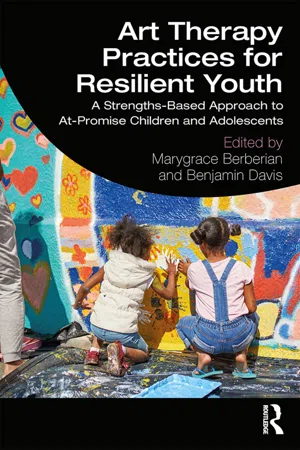
Art Therapy Practices for Resilient Youth highlights the paradigm shift to treating children and adolescents as "at-promise" rather than "at-risk." By utilizing a strength-based model that moves in opposition to pathology, this volume presents a client-allied modality wherein youth are given the opportunity to express emotions that can be difficult to convey using words. Working internationally with diverse groups of young people grappling with various forms of trauma, 30 contributing therapists share their processes, informed by current understandings of neurobiology, attachment theory, and developmental psychology. In addition to guiding principles and real-world examples, also included are practical directives, strategies, and applications. Together, this compilation highlights the promise of healing through the creative arts in the face of oppression.
eBook - ePub
Art Therapy Practices for Resilient Youth
A Strengths-Based Approach to At-Promise Children and Adolescents
- 532 pages
- English
- ePUB (mobile friendly)
- Available on iOS & Android
eBook - ePub
Art Therapy Practices for Resilient Youth
A Strengths-Based Approach to At-Promise Children and Adolescents
About this book
Information
1
Introduction
For centuries, violence and deprivation have hindered the lives of developing young people in communities most affected by poverty and inaccess. Systems continue to reinforce outdated power structures, and clinical paradigms have shifted without comprehensive practice guidelines. Despite well-intended clinicians and institutions, children and adolescents have often resorted to their internal, strength-based survival instincts to heal and grow. Activated as a response to trauma and unmet need, the young person’s extraordinary ability to persevere has captivated clinical audiences over the past few decades. Resilience, a dynamic interplay of developmental stages involving both threatening and protective factors, is nested in a historical, ecological, and cultural context known to influence individual and communal development over time (Jain & Cohen, 2013). Clinical psychologist Norm Garmezy conceived the scientific study of resilience, which “transformed the science and practice of multiple disciplines, from the molecular level to the global ecosystem, infusing a strength-based and recovery-oriented approach into psychology, education, social work, and psychiatry” (Masten, Nuechterlein, & Wright, 2011, p. 141). Garmezy (1983) noted, “children are not strangers to stress. Over a significant span of human history, they have been more often the victims of slings and arrows of an uncaring society than recipients of its beneficent protection” (p. 49). Nearly four decades after Garmezy’s work began, we sadly continue to see our youngest members of society often suffering the most.
Across the literature, demographics track patterns and trends among groups. Age, wealth, gender, location, and ability provide general guidelines to classify circumstance, risk, and repair. The specific condition, be it homelessness, war, or medical fragility, bring expected developmental concerns. Yet scholars also acknowledge massive heterogeneity in the responses to psychosocial and physical environmental hazards. Protective factors that buffer and modify the impact of risks over time and support positive adaptation can diminish vulnerabilities to environmental stressors, aid in the recovery of adversity, and ultimately yield more positive outcomes (Rutter, 2012). A socioecological perspective has examined the continuum of risk and protective factors to domains inclusive of culture, society, community, gender, race, ethnicity, and historical period (Bronfenbrenner, 1977; Garbarino, & Haslam, 2005; Garmezy, 1987). In this vein, a young person is examined in a bidirectional relationship within the continuum of environmental micro to macro systems contributing to adaptation and well-being. The bidirectional relationship of the young person within a communal system of support underscores the proverb “it takes a village to raise a child” (Henderson, DeCuir-Gunby, & Gill, 2016, p. 480). The “experience within” the domain, rather than the domain itself, is what ultimately influences the young person (Siperstein & Favazza, 2008). Social, cognitive, economic, and cultural contexts will affect the potential and risk inherent in the transactional, experiential relations between the young person and their world. The “experience within” the domain therefore becomes highly personalized, and effective clinical intervention becomes more complex.
Many clinicians find themselves searching to determine causality from a single variable responsible for developmental outcomes (Horowitz, 2000). But without an intersectionally informed approach, the nuance of a young person’s “experience within” a domain is quickly lost, and an opportunity to bolster resilience becomes less attainable. This reductive stance also risks the clinician becoming complicit in seeing deficits and thereby wrongfully placing blame within the individual, family, and community, rather than the institutional structures that create and maintain inequality (Arnold & Swadener, 1993; Lubeck & Garrett, 1990; Swadener & Lubeck, 1995).
Case material in this book showcases profound resiliency evident despite micro and macro experiences of adversity. Authors use the framework of “at-promise” rather than “at-risk” to dispel the assumptions of pathology for young people managing systems that are inherently detrimental and oppressive. This compilation recognizes that pathologizing young people “at-risk” for negative outcomes based on their race, primary language, family structure, gender, or class, results from a deficit model that parallels the persistent social stratification in the U.S. (Swadener & Lubeck, 1995). The “at-risk” label, disproportionately classified through sociodemographic data for many marginalized groups, appears more detrimental and stigmatizing than the internal and external factors in causal relationship to negative outcomes themselves (Franklin, 2013). The classification of being “at-risk” is not one of neutrality and comes with the potential to damage, disempower, and further marginalize (Swadener, 1995). Franklin (2013) adds:
History clearly shows that when these labels were used for poor or minority children, they served as immutable referents that spoke only to inadequacies in the child and his or her family. The psychological character, physiological makeup, and cultural patterns of students were often called into question and labeled deficient, as if competence, achievement, and motivation manifested and developed solely in the home.
(p. 3)
Examining adversity broadly, this compilation reviews the impact of communal, familial, and interpersonal stressors as variables in the expansive constellations of young people’s psychology and sense of self. The ideology of an “at-promise” framework offers complimentary concepts for further discussion in the field of art therapy. The concept of “at-promise” has been most largely embraced by educational reform for students who are economically disadvantaged (Henderson et al., 2016; Rios, 2011), stigmatized by institutional racism (Franklin, 2013; Whiting, 2006), physically challenged (Leifield & Murray, 1995), twice-gifted (gifted students with learning disabilities) (Nielsen, 2002), and underachieving (Boykin, 2000). Similar goals intrinsic to the field of art therapy illuminate a vision to “see beyond ‘what is’ into a more democratically just and humane world of ‘what might’ be” (Lake & Kress, 2017). Paolo Freire upheld principles for democratic education that would emancipate people from oppression and transform society through a sense of personal agency (Rennick, 2015). For revolutionaries John Dewey and Maxine Greene, the nurturance of imagination propagated new thinking, actively reconstructing current understanding and sustaining receptivity to novel problem solving (Mayer, 2017). Embedded in the theory and practice of art therapy is the opportunity to promote creative play and problem solving while engendering new aspects of personal agency. Throughout history we have witnessed young people, despite the circumstance, access these vital developmental building blocks through art-making.
During World War II, Anna Freud and Dorothy Burlingham (1943) observed young children in wartime nurseries separated from their parents. In these accounts, a range of responses were noted:
Children may therefore go apparently unharmed through experiences that would produce grave results in people of another age. On the other hand, they may break down completely under strain which to the ordinary adult person seems negligible. The peculiarities of the psychological make-up of the child may account on the one hand for the astonishing robustness of children, on the other hand for most of the problems of behavior and symptoms to which all the war nurseries complain.
(p. 64–65)
While Freud and Burlingham were tending to children’s reactivity to war in England, Friedl Dicker-Brandeis artistically engaged children imprisoned in the Terezín ghetto in former Czechoslovakia. Despite her tragic death in Auschwitz, Dicker-Brandeis’ safely guarded collection of approximately 5,000 drawings created by children of the Holocaust survived and provide an example of legacy for vitality summoned in the face of annihilation (Makarova, Makarov, & Kuperman, 2004). In a letter in 1940, Dicker-Brandeis wrote, “Today only one thing seems important—to rouse the desire towards creative work, to make it a habit, and to teach how to overcome difficulties that are insignificant in comparison with the goal to which you are striving,” (Dicker-Brandeis, as cited in Makarova, 2001, p. 151). Dicker-Brandeis, a teacher and mentor for art therapy pioneer Edith Kramer, demonstrated the undebatable therapeutic potential for art-making in the face of engulfing anguish. In reference to Dicker-Brandeis’ contributions, John-Steiner (2010) described:
They understood that for the minutes or hours during which they drew with a pencil on scraps of paper or performed or listened to music, they were alive in the deepest sense of what it is to be human. To create is to go beyond restrictions of habit, pain, terror and the known. It requires a continuity of concern, an absorption in shaping experience in a novel and moving manner.
(p. ix)
Kramer referenced and credited Dicker-Brandeis for her influences on her foundational theories of art as therapy (Makarova, 2001). Kramer (2010), commenting on the work of Dicker-Brandeis, wrote that she “allowed children to depict the sanity and beauty of their past lives while permitting comfort amid present nightmares. In this sense she formed a kind of therapeutic community that sustained the many children who endured unimaginable fear, loss and the threat of annihilation” (p. 2).
In the presence of adversity, coping (and healing) through creative play and artistic exploration has paralleled the established, pathology-driven, “medical model” of mainstream child psychiatry and laid the foundation for a more holistic understanding of the child in a resilience-oriented approach (Ludwig-Körner, 2017). Observation of the child engaged in their natural setting, while the clinician restrains preemptive judgment, will enable a more precise assessment of strengths. Freud and Burlingham’s (1943) observations also highlight the increased resilience of children when caregivers maintained expected routines and positive interactions. These protective factors include active coping skills, self-efficacy, social support, and the maintenance of stable relationships with adults that encourage adaptive practices (Garbarino & Kostelny, 1993, p. 29).
Almost 80 years later, clinicians and community leaders continue to identify, systematize, and strengthen a framework of protective factors in pursuit of childhood resilience. To encapsulate the state of young people today, one is tasked with understanding complex experiences of identity and self. Bracketed by community norms, economic conditions, geographic location, family structure, and psychological idiosyncrasies, each young person’s voice carries with it a unique fingerprint of personal history; a snapshot of time and place; self-definition; and their particular, often non-linear, experiential perceptions. Understanding the global context and the experience of youth today would take many lifetimes of inquiry. Here, we provide only a brief snapshot of demographic information to ground readers with the trends and patterns exemplified in literature to date.
Young people today make up the largest youth population in history, and half of the global population is now under 30 years old (Sharma, 2017). By 2020, the under-18 population is expected to grow to 73.9 million (Vespa, Armstrong, & Medina, 2018). As a group, they face unprecedented technological, social, environmental, and economic challenges. The experience of being a young person varies drastically based on age, sex, religion, ethnicity, location, level of ability or disability, racial minority status, gender identity, and sexual orientation, among many other factors. As clinicians, therapeutic interventions designed at engaging young people have needed to adapt to technological advances, communication styles, and evolving relational dynamics as children and adolescents prepare themselves to manage an increasingly volatile world.
The International Youth Foundation, a cumulative source for global trends in youth welfare, defines well-being as a “multidimensional concept that includes a person’s physical and mental health, educational status, economic position, physical safety, access to freedoms and ability to participate in civic life. It is, in a sense, the abundance or scarcity of opportunities available to an individual” (Sharma, 2017, p. xiv). Under the domain of health, in 2017 The International Youth Foundation ranked the U.S. twelfth globally behind Saudi Arabia, Spain, the United Kingdom, China, Morocco, Germany, Colombia, Ghana, Vietnam, Sweden, and Jordan (Sharma, 2017). Several factors contribute to the low health ranking, including a high rate of adolescent fertility (21 per 1,000 births for women ages 15 to 19 versus an average of 9 per 1,000 births in European countries) and high rates of youth self-harm fatalities (23 deaths per 100,000 youth). Currently the U.S. ranks twenty-third globally in youth interpersonal violence, accounting for 20 deaths per 100,000 youth (Sharma, 2017).
Despite advances in the field, The National Institute of Mental Health reports an estimated 49.5% of adolescents live with a mental disorder; of those, an estimated 22.2% are severely impaired based on DSM-IV criteria (Merikangas et al., 2010). ADHD, behavior problems, anxiety, and depression are the most commonly diagnosed mental disorders in children, whereby 9.4% of children aged 2–17 years (approximately 6.1 million) have received an ADHD diagnosis (Danielson et al., 2018), and, of children aged 3–17, 7.4% (approximately 4.5 million) have a diagnosed behavior problem, 7.1% (approximately 4.4 million) have diagnosed anxiety, and 3.2% (approximately 1.9 million) have diagnosed depression (Ghandour et al., 2019). Depression and anxiety diagnostic rates have increased over time among youth (Bitsko et al., 2018). A multitude of factors impact access to care, treatment options, and outcomes. The Centers for Disease Control and Prevention (2019) acknowledged that age and poverty-level were strong predictors in the treatment of mood and behavioral problems.
In the U.S. 20% of all children ages 0–17 lived in poverty in 2015, down from 21% in 2014 (Federal Interagency Forum on Child & Family Studies, 2017). In 2015, approximately 13.1 million children (18% of all children in the U.S.) lived in households that were classified as food insecure (Federal Interagency Forum on Child & Family Studies, 2017). While socioeconomic class correlates with health, wellness, and educational markers of success, strongly held racism and other discriminatory ideologies have had devastating consequences, particularly on youth of color and LGBTQ (Lesbian, Gay, Bisexual, Transgender and/or Queer) individuals. For example, despite an overall decline in youth incarceration rates, as of 2015, African-American youth were five times as likely as white youth to be detained or committed to youth facilities (The Sentencing Project, 2017). Black students, who comprise 16% of students in U.S. public schools, make up over a quarter of students referred to law enforcement from schoo...
Table of contents
- Cover
- Half Title
- Title
- Copyright
- Dedication
- Contents
- List of Contributors
- Acknowledgments
- Foreword
- 1 Introduction
- 2 Creative Problem Solving in Art Therapy: An Overview of Benefits to Promote Resilience
- 3 Art as Communication for Young People
- Part I Disruptions in Early Individual Development
- Part II Disruptions in Family Systems
- Part III Consequences of Global and Systemic Stress and Inequalities
- Index
Trusted by 375,005 students
Access to over 1.5 million titles for a fair monthly price.
Study more efficiently using our study tools.
Frequently asked questions
Yes, you can cancel anytime from the Subscription tab in your account settings on the Perlego website. Your subscription will stay active until the end of your current billing period. Learn how to cancel your subscription
No, books cannot be downloaded as external files, such as PDFs, for use outside of Perlego. However, you can download books within the Perlego app for offline reading on mobile or tablet. Learn how to download books offline
Perlego offers two plans: Essential and Complete
- Essential is ideal for learners and professionals who enjoy exploring a wide range of subjects. Access the Essential Library with 800,000+ trusted titles and best-sellers across business, personal growth, and the humanities. Includes unlimited reading time and Standard Read Aloud voice.
- Complete: Perfect for advanced learners and researchers needing full, unrestricted access. Unlock 1.5M+ books across hundreds of subjects, including academic and specialized titles. The Complete Plan also includes advanced features like Premium Read Aloud and Research Assistant.
We are an online textbook subscription service, where you can get access to an entire online library for less than the price of a single book per month. With over 1.5 million books across 990+ topics, we’ve got you covered! Learn about our mission
Look out for the read-aloud symbol on your next book to see if you can listen to it. The read-aloud tool reads text aloud for you, highlighting the text as it is being read. You can pause it, speed it up and slow it down. Learn more about Read Aloud
Yes! You can use the Perlego app on both iOS and Android devices to read anytime, anywhere — even offline. Perfect for commutes or when you’re on the go.
Please note we cannot support devices running on iOS 13 and Android 7 or earlier. Learn more about using the app
Please note we cannot support devices running on iOS 13 and Android 7 or earlier. Learn more about using the app
Yes, you can access Art Therapy Practices for Resilient Youth by Marygrace Berberian, Benjamin Davis, Marygrace Berberian,Benjamin Davis in PDF and/or ePUB format, as well as other popular books in Psychology & Art General. We have over 1.5 million books available in our catalogue for you to explore.