eBook - ePub
Mechatronics and the Design of Intelligent Machines and Systems
- 348 pages
- English
- ePUB (mobile friendly)
- Available on iOS & Android
eBook - ePub
Mechatronics and the Design of Intelligent Machines and Systems
About this book
Mechatronics as a discipline has an ever growing impact on engineering and engineering education as a defining approach to the design, development, and operation of an increasingly wide range of engineering systems. The increasing scope and complexity of mechatronic systems means that their design and development now involve not only the technical aspects of its core disciplines, but also aspects of organization, training, and management.
Mechatronics and the Design of Intelligent Machines and Systems reflects the significant areas of development in mechatronics and focuses on the higher-level approaches needed to support the design and implementation of mechatronic systems. Throughout the book, the authors emphasize the importance of systems integration. Each chapter deals with a particular aspect of the design and development process, from the specification of the system to software design and from the human-machine interface to the requirements for safe operation and effective manufacture.
Notable among this text's many features is the use of a running case study-the autonomous and robotic excavator LUCIE-to illustrate points made in various chapters. This, combined with the authors' clear prose, systematic organization, and generous use of examples and illustrations provides students with a firm understanding of mechatronics as a discipline, some of the problems encountered in its various areas, and the developing techniques used to solve those problems.
Information
1
Of machines and mechatronics
1.1 INTRODUCTION
In 215 BC the Roman general Marcellus led an army to Sicily for the purpose of capturing the city of Syracuse taking with him a range of military technology that included siege towers and a catapult so big that it required eight ships lashed together to carry it. On arriving outside Syracuse, Marcellus discovered that its defences had been augmented by a range of machines devised by the Greek scientist and engineer Archimedes and that assaults were met by a barrage of missiles from giant catapults and by boulders dropped from cranes that swung out over the city walls. Most terrifying were the giant ‘claws’ that grasped and shook the Roman ships as they tried to enter the harbour. In the words of Pliny:
‘The ships, drawn by engines within and whirled about, were dashed against steep rocks that stood jutting out under the walls, with great destruction of the soldiers that were aboard them. A ship was frequently lifted up to a great height in the air – a dreadful thing to behold – and was rolled to and fro, and kept swinging, until the mariners were all thrown out, when at length it was dashed against the rocks, or was dropped.’
As to the role of Archimedes, Livy commented:
‘An operation launched with such strength might well have proved successful, had it not been for the presence in Syracuse at that time of one individual – Archimedes, unrivalled in his knowledge of astronomy, was even more remarkable as the inventor and constructor of types of artillery and military devices of various kinds, by the aid of which he was able with one finger, as it were, to frustrate the most laborious operations of the enemy’.
Archimedes was born in Syracuse around 287 BC. The son of the astronomer Phidias, he studied at the ‘Museum’ or university in Alexandria that had been founded by King Ptolemy II based on the teachings of Strato the philosopher, the head of the Lyceum in Athens from 287 BC to 269 BC. Following his studies, Archimedes later returned to Syracuse where he acted as adviser to its ruler, Hieron II.
In addition to the war engines referred to above and the discovery of the principle of floatation that carries his name, Archimedes was responsible for a series of developments in mechanics and was reputed to have single handedly launched the Royal ship Syracusa when fully loaded using a system of pulleys and levers of his own devising. When Syracuse finally fell, Archimedes was killed by Roman legionaries and was buried with full honours by Marcellus who had inscribed on his tomb a design depicting the ratio between the volumes of a sphere and a cylinder as Archimedes himself had requested be done.
Though the lever, pulley, wedge and windlass were known and in use prior to the end of the 4th century BC and the screw was an invention of the 3rd century BC, traditionally by Archimedes himself, Archimedes was the first of the great scientist/engineers whose works have passed down through history and was one of the first to appreciate and understand the working relationships between men and machines and the ways in which machines could be used to support all areas of human function and activity.
Of others of this early period in the development of the relationship between machines and men, four in particular are worthy of note. The first of these is Ctesibius of Alexandria. A contemporary of Archimedes, Ctesibius lived and worked in Alexandria in the middle of the 3rd century BC and though his writings have been lost he is credited with the invention of a range of mechanisms including a fire engine (Fig. 1.1), a pneumatic ‘gun’, a water organ and a clock. Slightly later than Ctesibius comes Philo of Byzantium whose work ‘On Artillery Construction’ dates from around 200 BC and details features such as the use of twisted skeins of material as an energy store as well as experimentation that was undertaken to determine the most effective combination of parameters for artillery. Ctesibius and Philo were followed in the later part of the 1st century BC by Marcus Vitruvius Pollio who in his writings details a range of mechanical systems including developments in artillery, water and wind power and a description of an odometer for measuring distance.
After Archimedes, perhaps the greatest of these early engineers of whom a record has survived is Heron (or Hero) of Alexandria who in the 1st century AD produced descriptions of a series of inventions and mechanisms such as a constant head water clock (Fig. 1.2), a system for automatically opening temple doors (Fig. 1.3), a coin operated dispenser for holy water, a miniature theatre complete with simple automata as the players and many others. Perhaps Heron’s best known invention is the aeolopile, a simple steam turbine. Shown in Fig. 1.4 this consists of a large, sealed cauldron of water connected by pipes to a sphere with two opposed nozzles. As the water in the cauldron was heated, steam was transferred to the sphere where it exited via the nozzles, causing the sphere to rotate.
By the end of the 1st century AD in Europe the study of mechanics was well developed and applied, particularly by the Romans, to systems including treadmill operated cranes such as that shown in Fig. 1.5 and the large scale use of water power for milling By the 5th century, the overshot wheel had appeared while tidal mills were in operation along the Atlantic coast of France and floating mills were reported in operation on the Tiber in the 6th century. Similar developments with water power were also taking place in China though, unlike the Romans, the Chinese used their watermills to drive bellows and trip hammers as well as to mill corn.
Over the next 1500 years however technological progress was to to be relatively slow despite works such as the ‘Book of Ingenious Devices’ written by the three Ban Musa brothers of Baghdad in the 9th century. This work describes a range of devices including an oil lamp with a self adjusting wick and automata such as the pond surrounded by moving statues of warriors reportedly built for the Caliph at the start of the 10th century. This interest in automata in the Arab world was continued by others including al-Jazari who in 1206 described clocks that marked the passage of time by using figures to strike drums, blow trumpets or drop stones onto cymbals. Developments in China also included automata and Su Sung’s 30 foot high ‘Cosmic Engine’ built in Hunan in 1090 was powered by a water-wheel and marked the time by figures which moved in and out of doors.
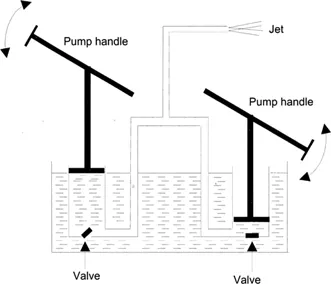
Figure 1.1 Ctesibius’s fire engine.
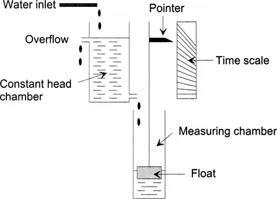
Figure 1.2 Heron’s constant head water clock with variable scale for changes in the length of day (from sunrise to sunset).
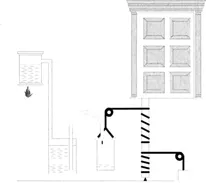
Figure 1.3 Heron’s mechanism for opening templ...
Table of contents
- Cover
- Half Title
- Title Page
- Copyright Page
- Table of Contents
- Preface
- 1 Of machines and mechatronics
- 2 Mechatronics and intelligent systems
- 3 A mechatronic design process
- 4 Requirements interpretation for mechatronic systems
- 5 Artificial intelligence
- 6 Neural networks and fuzzy systems
- 7 Software
- 8 User interfaces
- 9 System safety
- 10 Manufacturing technology
- 11 Future developments in mechatronics
- 12 Case studies in mechatronics
- Bibliography
- Index
Trusted by 375,005 students
Access to over 1.5 million titles for a fair monthly price.
Study more efficiently using our study tools.
Frequently asked questions
Yes, you can cancel anytime from the Subscription tab in your account settings on the Perlego website. Your subscription will stay active until the end of your current billing period. Learn how to cancel your subscription
No, books cannot be downloaded as external files, such as PDFs, for use outside of Perlego. However, you can download books within the Perlego app for offline reading on mobile or tablet. Learn how to download books offline
Perlego offers two plans: Essential and Complete
- Essential is ideal for learners and professionals who enjoy exploring a wide range of subjects. Access the Essential Library with 800,000+ trusted titles and best-sellers across business, personal growth, and the humanities. Includes unlimited reading time and Standard Read Aloud voice.
- Complete: Perfect for advanced learners and researchers needing full, unrestricted access. Unlock 1.5M+ books across hundreds of subjects, including academic and specialized titles. The Complete Plan also includes advanced features like Premium Read Aloud and Research Assistant.
We are an online textbook subscription service, where you can get access to an entire online library for less than the price of a single book per month. With over 1.5 million books across 990+ topics, we’ve got you covered! Learn about our mission
Look out for the read-aloud symbol on your next book to see if you can listen to it. The read-aloud tool reads text aloud for you, highlighting the text as it is being read. You can pause it, speed it up and slow it down. Learn more about Read Aloud
Yes! You can use the Perlego app on both iOS and Android devices to read anytime, anywhere — even offline. Perfect for commutes or when you’re on the go.
Please note we cannot support devices running on iOS 13 and Android 7 or earlier. Learn more about using the app
Please note we cannot support devices running on iOS 13 and Android 7 or earlier. Learn more about using the app
Yes, you can access Mechatronics and the Design of Intelligent Machines and Systems by David Allan Bradley,Derek Seward,David Dawson,Stuart Burge in PDF and/or ePUB format, as well as other popular books in Technology & Engineering & Civil Engineering. We have over 1.5 million books available in our catalogue for you to explore.