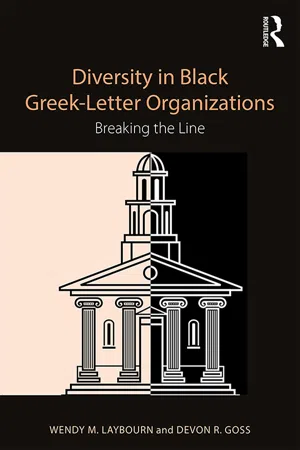
Starting in the early twentieth century and still thriving in the contemporary era, Black Greek-letter organizations (BGLOs) provide social support, networking opportunities, and service for the Black community. Although BGLOs have always been majority-Black organizations, there are small numbers of non-Black individuals who choose to pledge their membership. Diversity in Black Greek-Letter Organizations: Breaking the Line explores the experiences of these non-Black members who have immersed themselves in organizations rich with Black history and culture. Through in-depth interviews with thirty-four such members, Wendy Marie Laybourn and Devon R. Goss reveal how and why these individuals come to identify with organizations designed for the uplift of races other than their own. For non-Black BGLO members, the association with a Black organization provides them the opportunity to consider the meaning of racial inequality and their own racial identities. Although many non-Black BGLO members recount challenges to their membership, the participants in Diversity in Black Greek-Letter Organizations ultimately find a sense of belonging with their Black brothers and sisters, which Laybourn and Goss argue can provide an example of the challenges and promises of cross-racial interactions as a whole.
eBook - ePub
Diversity in Black Greek Letter Organizations
Breaking the Line
- 130 pages
- English
- ePUB (mobile friendly)
- Available on iOS & Android
eBook - ePub
Diversity in Black Greek Letter Organizations
Breaking the Line
About this book
1
Brotherhood and Sisterhood
What Are Black Greek-Letter Organizations?
On a Friday afternoon during her first semester of undergrad, Wendy took her usual seat by the window in her philosophy class. As she and her classmates discussed Frantz Fanon, the excited sounds of shouting, applause, and then the syncopated rhythms of a yard show drifted into the room. One of the Black Greek-letter organizations’ (BGLOs) Greek Weeks was coming to a close. As is customary on college campuses with BGLO chapters, throughout the semester, each chapter has a week dedicated to showcasing their organization. Chapters create elaborate themes for the weeks, with each day highlighting the programmatic thrusts of their respective organizations. For example, a week may be themed around old school hip-hop with each day titled after a well-known hip-hop song coupled with one of the BGLO’s community service activities, or around a popular movie with each day organized around a quote from the movie paired with a racial justice action. The close of the week culminates with the chapter having a yard show. At a yard show, chapter members perform choreographed step routines, strolls, and chants in front of an audience of the campus’s other BGLO chapter members, fellow BGLO members from nearby campuses who travel to see the show as well as the campus’s Black student community. The allure of the yard show is simple – showmanship, sportsmanship, and solidarity. There is pride in seeing fellow BGLO members from your particular organization ‘run the yard.’ There is the general camaraderie among BGLO members regardless of the specific organization being highlighted. Then, there is the feeling of campus belonging for Black students, both BGLO members and non-members alike, which is atypical for their everyday campus experience. Wendy, the unknowing freshman, had unwittingly scheduled a class during the most important on-campus social time of the week. Like many other students, she ended up skipping those Friday classes during a Greek Week. Better to miss a few classes than to miss a yard show.
This scene is not unlike the excitement that surrounds Black fraternities and sororities at college campuses across the country. From step shows, signing, roll calls, and community service initiatives, BGLOs are thick with tradition that not only provides members with a sense of belonging, but also acts as a spectacle for non-members on many campuses. Moreover, BGLOs and their activities are often the center of the Black community at majority-white institutions. Given the role of contemporary BGLOs, what is their history?
In this chapter, we examine the historical and contemporary status of Black Greek-letter organizations from their early years as vehicles for community uplift to their place in the current system of higher education. Understanding the role of BGLOs in the Black community helps to contextualize the experiences of the BGLO members that we document in later chapters, especially as it relates to their membership as non-Black individuals. After an exploration of how Black fraternal organizations birthed BGLOs and aided them in developing into the current organizations that exist today, we discuss the research on non-Black BGLO members.
Foundations of Black Fraternal Organizations
Black race-based organizations trace back to the social activism and community identity of religious institutions. Black autonomous churches began to take shape during times of slavery and early American settlement, during which slaves were socially divided due to different ethnicities, traditions, and languages from their origins (Lincoln and Mamiya 1990). The church aided in helping to break down these differences and acted as a unifying force. After the emancipation from slavery in 1863, these Black churches became formalized outside of the institution of slavery and began to provide a resource for the formation of Black schools and workspaces in a time of depravity of resources for Black people (Billingsley 1999).
Black churches became the expected and assumed centers for racial uplift, as complete freedom for Blacks implied not only social and political freedom, but also moral and religious freedom (Ross 2003). Therefore, parishioners relied on ministers and church members to take public stands against lynching, discrimination, and segregation. Despite this, prominent Black leaders questioned the ultimate success that the Black church could have in securing political and social rights for Blacks due to its religious focus (Warnock 2014). Additionally, cracks and fissures within the Black community began to form, made emblematic by the move to more insular and elite Black churches in some parts of the country (Moore 1999). As Eric Lincoln and Lawrence Mamiya (1990:9) state, “Some of the more astute and visionary church leaders saw the need to develop secular vehicles in order to cope with more complex and pluralistic urban environments.” It was out of this skepticism that other venues for racial uplift were founded, which led to race-based organizations in other facets of social life.
The legacies of slavery, racism, and segregation obstructed the possibility for civic cooperation between Blacks and whites. Central facets of social life, such as fraternal and civic organizations, excluded Blacks from membership. Additionally, Blacks were barred from full participation in trade unionism and electoral politics. This exclusion denied the opportunity to experience the ideals of shared citizenship, professional networking and potential business ventures, and develop connections across regional and state lines (Skocpol et al. 2006).
Black organizations, particularly civic organizations, began to spring up as a viable alternative to the predominantly white organizations that had been exclusive. These Black non-religious organizations became the second largest and most extensive sector of social organization next to churches. Fraternal groups allowed Black men the opportunities to gain valuable business and professional experiences, such as networking and leadership skills. They also provided a venue for Black women to engage in charity work for Black communities, allowing for the honing of their leadership skills and creating an opportunity to bond with other Black women (Moore 1999). In doing so, they became vital hubs of civil and political causes, such as advocating for Black politicians and for Black civil rights. Additionally, Black fraternal groups provided resources that the state did not, including life and funeral insurance to their members, as well as financial aid to economically needy families within their communities.
In addition to providing economically to their members, race-based organizations also provided racial uplift to their community. Racial uplift emphasizes the importance of community building to realize an inclusive vision of Black advancement through the work of institutions such as race-based organizations (Ross 2003). Racial uplift was, in more recent history, personified within the notion of the “Talented Tenth,” popularized by W.E.B. Du Bois (1903), who suggested that the top 10 percent of the Black race would serve to uplift the remaining 90 percent of the Black community onto equal footing with whites. Therefore, race-based organizations served as spaces that provided both material and cultural resources to communities that have been historically underserved and ignored within the mainstream.
While providing racial uplift was the core of Black organizations ranging from benevolent societies to churches, Black secret societies were unique in their structure and organization (Hughey 2013). Black secret societies, such as the Prince Hall Free and Accepted Masons, Grand United Order of Odd Fellows, and Improved Benevolent Protective Order of the Elks of the World, offered similar community uplift activities as benevolent societies but were differentiated by their male-only membership and secrecy (Butler 2012). These organizations were created to form and maintain long-lasting ties among their members, address racial exclusion from white fraternal organizations and society at large, and racial uplift. Characterized by restrictive membership and secret rituals, Black secret societies maintained a structure that allowed for the perpetuation of their organization and community impact (Butler 2012). Their organizational structure included local chapters, regional areas, and a national governing body. The influence of these Black secret societies can be seen in the structure and scope of Black Greek-letter organizations.
The Beginnings of BGLOs
One of the primary sites for race-based organizations and institutions was education, in which historically Black colleges developed in the late 1800s as alternatives to primarily white colleges that had denied admission to Black American students due to segregation policies (Whaley 2009). These historically Black colleges were often the only educational avenue for Blacks until the early twentieth century. However, in the early 1900s, a number of white schools had begun to admit small numbers of Black students. Accordingly, a number of elite Blacks chose to attend these colleges as opposed to Black centers of education as a “degree from a predominantly white school was ultimately preferable to any other” (Moore 1999:113). However, very few Blacks, even among the elite, were able to attend predominantly white schools in the North, leading to a small population of Blacks at these elite institutions. As these populations began to grow and students began to connect based on their similar experiences, Black students established Black student organizations (Moore 1999).
BGLOs were founded in the early twentieth century as a response to the racial exclusion policies that existed in white Greek-letter organizations’ constitutions and the general ostracism Black students faced on historically white college campuses. In order to combat academic pressures and racial isolation, Black students formed social and study groups that eventually were established as national fraternities. The first was Alpha Phi Alpha, which was founded at Cornell University in 1906. Although originating as a literacy society with the goal of the retention of Black male students, the group adopted the name Alpha Phi Alpha and set course to establish themselves as a fraternity (Wesley 1995). This change in scope signaled their desire to create a more permanent organization that would be recognized by Cornell University. The first national Black collegiate sorority quickly followed suit, with Alpha Kappa Alpha being established in 1908 at Howard University. Although Alpha Kappa Alpha’s founders did not experience the racial exclusion at Howard that Alpha Phi Alpha’s members did at Cornell, Alpha Kappa Alpha founders encountered conservative politics at Howard that discouraged radical activism and explicit expression of African cultural elements (Whaley 2010). Furthermore, Alpha Kappa Alpha founders’ experiences as Black women reflected a distinct raced and gendered position.
Over the next 14 years, six additional fraternities and sororities were founded: Kappa Alpha Psi (1911, Indiana University), Omega Psi Phi (1911, Howard University), Delta Sigma Theta (1913, Howard University), Phi Beta Sigma (1914, Howard University), Zeta Phi Beta (1920, Howard University), and Sigma Gamma Rho (1922, Butler University). Kappa Alpha Psi and Sigma Gamma Rho formed in response to the racial exclusion on and racism of their predominantly white campuses (Whaley 2009). The other four BGLOs founded at Howard University formed partly in response to the conservative political ideologies expressed by some administrators and professors, as well as to create alternative organizations that more aptly addressed their founders’ desires and visions (Whaley 2009). In 1930, the National Pan-Hellenic Council (NPHC) was established as a collaborative organization to oversee the mutual interests of the “Great Eight” BGLOs. In 1963, the last of what would become the “Divine Nine” BGLO organizations, Iota Phi Theta, was founded at Morgan State University (Slade 2010).
The creation of BGLOs was not met without challenges. For example, although Kappa Alpha Psi was incorporated in the state of Indiana, they were largely unrecognized by Indiana University administrators and as such were not granted a charter on campus (Crump 1993). Accordingly, the fraternity faced obstacles to securing meeting space on campus and obtaining a fraternity house. Thus, Kappa Alpha Psi did not enjoy the same rights and privileges of white fraternal organizations (Whaley 2009). Omega Psi Phi faced similar challenges from administrators at Howard University. Administrators were slow to approve the fraternity’s charter and initially stipulated changes to the fraternity’s constitution that would relegate the organization to a local-only scope (Whaley 2009). However, Omega Psi Phi members were intent on creating a national organization, and eventually Howard University approved the constitution.
From the beginning, these BGLOs aimed to forge a national network of fraternity or sorority chapters. Chapters expanded to other campuses quickly, with newly chartered chapters established within the first few years of each organization’s founding. Recognizing the need for chapters to be organized and uphold a cohesive platform, each organization instituted annual national conventions. The national conventions provided a space for members to discuss the organization’s structure, expansion, and programs, including those dedicated to social issues.
BGLOs and their members have held pivotal roles in social movements. For example, the sorority Delta Sigma Theta was the only Black organization to participate in the Women’s Suffrage March in Washington, DC, in 1913 (Giddings 2007). From World War I to World War II, BGLOs aided Black community members by filling in the economic gap caused by strained social services across the U.S. BGLOs implemented service, education, and development programs for community members during this time, as well as voiced critiques of welfare policies that they believed perpetuated racial discrimination. For example, Alpha Phi Alpha heavily criticized the New Deal in that the program was generally allocated to jobs that historically or legally barred Black participation (Weems 2013). BGLOs were also active during World War II, as sororities collaborated with charitable organizations during the war effort and delivered materials needed for the war, pushed for legislation that integrated Black women into the Navy, and supported investment in U.S. Defense Savings Bonds (Giddings 2007; Whaley 2010).
Additional political and humanitarian outreach on behalf of BGLOs took place during the Civil Rights era. The American Council on Human Rights (ACHR) was made up of six of the BGLOs and aimed to lobby Congress to pass legislation that improved rights for Blacks (Harris 2012). For example, the ACHR played a crucial role in the successful lawsuit against the Southern Railway policy of segregated seating. Additionally, many of the key figures in the Civil Rights movement were themselves members of Black Greek organizations, such as Martin Luther King, Jr. (Alpha Phi Alpha), Jesse Jackson (Omega Psi Phi), and Rosa Parks (Alpha Kappa Alpha).
Contemporary BGLOs
Many institutions of higher education have both BGLOs and historically white Greek organizations. Members of all Greek-letter organizations are likely to be leaders on campus, volunteers in the local community, and have successful academic performances. On most college campuses, Greek-letter organizations are segregated by race and overseen by different councils. Whereas the NPHC oversees BGLOs, predominantly white organizations are governed by the Inter-Fraternity Council (IFC) or the National Panhellenic Conference. People of color who join predominantly white Greek-letter organizations report being subjected to racially charged jokes or stereotypes from other members, as well as feeling isolated or disconnected from the organization as a whole (Hughey 2010). BGLOs are often considered an alternative, wherein members can receive the same networking and social opportunities, without the racial costs.
Although there are other BGLOs at campuses across the country, there are only nine that are officially recognized. These are commonly referred to as “The Divine Nine,” and currently consist of four sororities (Alpha Kappa Alpha, Delta Sigma Theta, Zeta Phi Beta, and Sigma Gamma Rho) and five fraternities (Alpha Phi Alpha, Kappa Alpha Psi, Omega Psi Phi, Phi Beta Sigma, and Iota Phi Theta). BGLOs comprise undergraduate and graduate chapters as well as a national body. While most members join through chapters at their undergraduate colleges, some members join through a graduate chapter. In order to join BGLOs, the organizations invite members through a selective recruitment process that includes pledging and sometimes hazing.
Pledging is a practice of initiation for new members of BGLOs, and is seen as a way for current members to evaluate their new recruits and to decide if they should be admitted to the organization. The pledge process for BGLOs has roots in European educational institutions, which then took hold in universities in the United States (Kimbrough 2003). Shortly after the founding of BGLOs, official pledge clubs associated with each organization were instituted (Parks and Brown 2005). Pledge activities varied from school to school and evolved throughout the years. Some activities included service projects, demonstrating scholarship, and competing in athletic events against other organizations’ pledges. Members of a pled...
Table of contents
- Cover
- Half Title
- Title Page
- Copyright Page
- Table of Contents
- List of tables
- Acknowledgements
- Introduction: “Why Would You Do That?”: Non-Black Members of Black Fraternities and Sororities
- 1. Brotherhood and Sisterhood: What Are Black Greek-Letter Organizations?
- 2. “I’m Not Trying To Be You”: Identity and Boundary Work
- 3. On the Yard: Race on the College Campus
- 4. Branded for Life: The Impact of Membership
- Conclusion: “I’m Not the First, and I Won’t Be the Last”: Crossing the Line, Connecting the Past and Present
- Methodological Appendix
- Glossary
- Index
Trusted by 375,005 students
Access to over 1.5 million titles for a fair monthly price.
Study more efficiently using our study tools.
Information
Publisher
RoutledgeEdition
1Year
2018Topic
Social SciencesPrint ISBN
9781138629639
9781138629622
Subtopic
African American StudieseBook ISBN
9781351809399
Index
Social SciencesFrequently asked questions
Yes, you can cancel anytime from the Subscription tab in your account settings on the Perlego website. Your subscription will stay active until the end of your current billing period. Learn how to cancel your subscription
No, books cannot be downloaded as external files, such as PDFs, for use outside of Perlego. However, you can download books within the Perlego app for offline reading on mobile or tablet. Learn how to download books offline
Perlego offers two plans: Essential and Complete
- Essential is ideal for learners and professionals who enjoy exploring a wide range of subjects. Access the Essential Library with 800,000+ trusted titles and best-sellers across business, personal growth, and the humanities. Includes unlimited reading time and Standard Read Aloud voice.
- Complete: Perfect for advanced learners and researchers needing full, unrestricted access. Unlock 1.5M+ books across hundreds of subjects, including academic and specialized titles. The Complete Plan also includes advanced features like Premium Read Aloud and Research Assistant.
We are an online textbook subscription service, where you can get access to an entire online library for less than the price of a single book per month. With over 1.5 million books across 990+ topics, we’ve got you covered! Learn about our mission
Look out for the read-aloud symbol on your next book to see if you can listen to it. The read-aloud tool reads text aloud for you, highlighting the text as it is being read. You can pause it, speed it up and slow it down. Learn more about Read Aloud
Yes! You can use the Perlego app on both iOS and Android devices to read anytime, anywhere — even offline. Perfect for commutes or when you’re on the go.
Please note we cannot support devices running on iOS 13 and Android 7 or earlier. Learn more about using the app
Please note we cannot support devices running on iOS 13 and Android 7 or earlier. Learn more about using the app
Yes, you can access Diversity in Black Greek Letter Organizations by Wendy Laybourn,Devon Goss,Wendy Marie Laybourn,Devon R. Goss in PDF and/or ePUB format, as well as other popular books in Social Sciences & African American Studies. We have over 1.5 million books available in our catalogue for you to explore.